

PestPro is advertised as a professional-grade ultrasonic device that can drive rats, mice, cockroaches, bed bugs, spiders, ants and more than a dozen other pests out of a home. Plug it in, wait a few days and the pests supposedly leave without traps, chemicals or an exterminator.
The offer sounds almost perfect. The website claims variable frequencies, independent laboratory testing, thousands of verified reviews, 70–90% reductions within days and a long-lasting device that protects an entire room.
The evidence does not support that confidence. The seller does not identify the independent laboratory or publish a product-specific test report. Peer-reviewed research found that commercial ultrasonic devices did not repel bed bugs, and the Federal Trade Commission has previously warned this product category about unsupported pest-control claims.
Our verdict: avoid PestPro. This looks like a generic ultrasonic plug-in wrapped in a premium sales page. The seller adds unsupported laboratory claims, an enormous unverifiable review count and questionable FCC language, but does not provide credible proof that the device eliminates the pests shown in its ads.
Overview
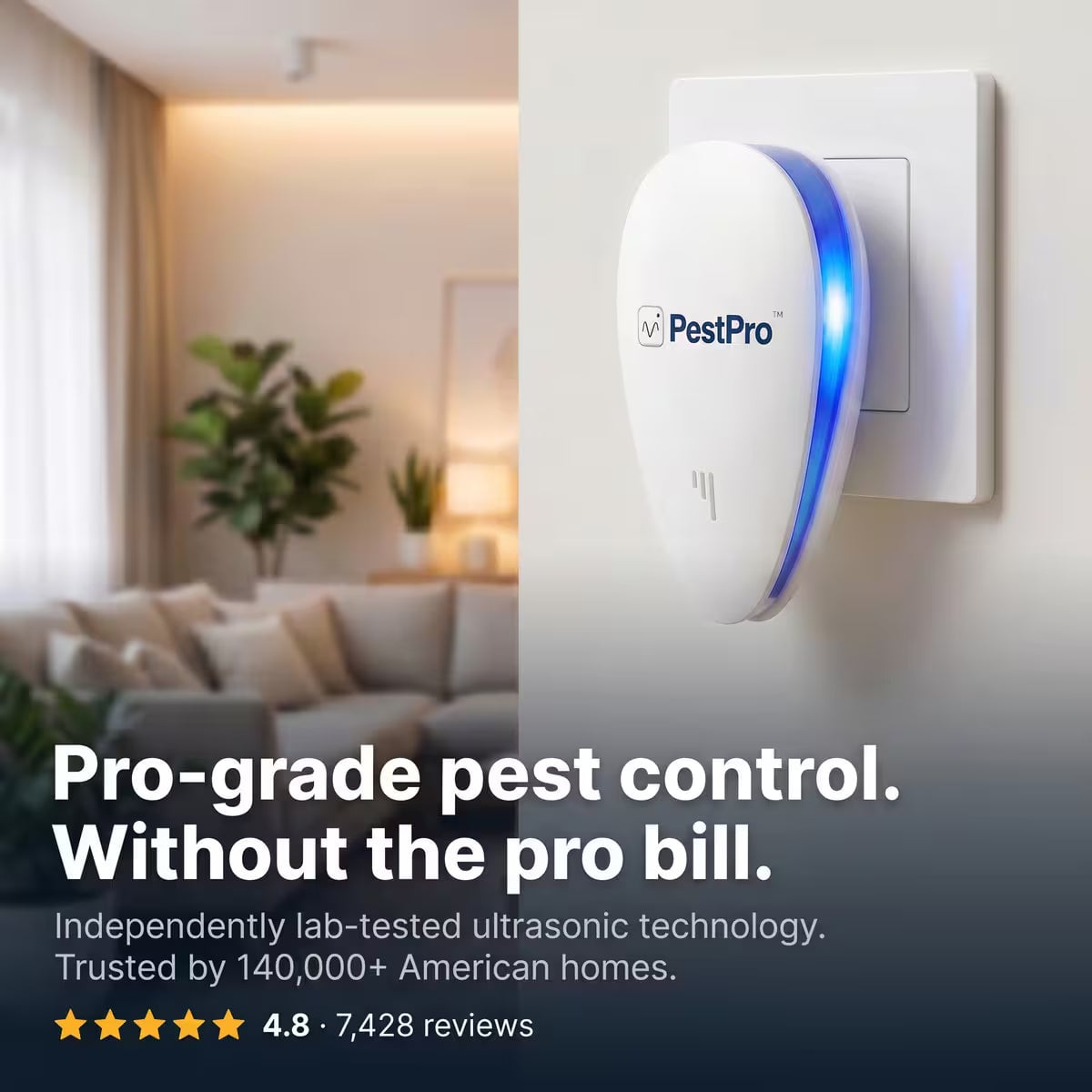
PestPro is a plug-in ultrasonic pest repeller sold through pestpro.store. The device is said to cycle between 22 and 65 kHz so rodents and insects cannot become accustomed to a single tone.
The current page prices one unit at $29.90 and pushes bundles of three, six or nine devices. It says one unit covers up to 300 square feet, while other sections tell buyers that ultrasound cannot pass through walls and that most homes need several units.
Devices with nearly identical promises are sold across low-cost marketplaces, so the hardware itself is not the innovation. The markup comes from the advertising: professional-looking graphics, urgent bundle pricing and claims that one plug-in can replace traps, chemicals and an exterminator. The evidence does not justify that promise.
What PestPro promises
- Repel 14 or more kinds of household pests.
- Cause pests to leave within three or four days.
- Reduce activity by 70–90% within a week.
- Work continuously for four or five years.
- Remain safe and inaudible around children, cats and dogs.
- Replace traps, sprays and expensive professional service.
- Provide a 90-day or longer money-back guarantee.
These are broad performance and safety claims. A device that truly controlled rodents, insects and bed bugs in real homes would need robust testing across each target species and environment.
PestPro does not make that evidence available. Instead, the page relies on confident diagrams, internal statistics, customer stories and the phrase “scientifically proven.”
How the PestPro Sales Funnel Works
Step 1: A serious infestation is reduced to a simple plug-in problem
The page describes roaches, rodents and even bed bugs as pests that can be driven out by changing the sound environment. It contrasts that effortless solution with poisons, traps, exterminator bills and sleepless nights.
This comparison is attractive because real pest control can be unpleasant and expensive. It also minimizes the fact that different pests have different biology, hiding places and treatment requirements.
Step 2: Technical numbers make the device feel proven
PestPro highlights a 22–65 kHz variable cycle, 300-square-foot coverage and a four-to-five-year lifespan. Numbers create precision, but precision is not validation.
The company needs to show who tested the device, how the output was measured, which pest populations were used, what the control conditions were and whether the results were independently replicated.
Step 3: The page claims pests cannot adapt
The seller says cheap repellers fail because they use a fixed frequency, while PestPro constantly changes frequency so pests cannot habituate.
The FTC has previously noted that rodents may show only a temporary reaction to ultrasound and can return after becoming accustomed to it. Changing frequency is a plausible marketing response, but PestPro has not published a product-specific field trial proving the claimed solution works.
Step 4: A timeline tells buyers to interpret failure as progress
The site says pests may hide deeper or become more visible during the first days, then begin an “exodus.” This is a convenient narrative because both more activity and less activity can be described as evidence the device is working.
A credible test defines the expected outcome in advance and compares it with an untreated area. A customer watching occasional sightings cannot reliably tell whether an ultrasonic device caused the change.
Step 5: Huge review numbers manufacture social proof
PestPro displays a 4.8 average from 7,428 verified buyers and claims that more than 5,000 devices were sold in the previous 24 hours. The page includes named stories from families, seniors and people who supposedly solved bed bug or rodent problems.
Those figures are controlled by the seller and are not accompanied by an independent review platform or auditable verification method. The site also says it is exclusively available there, limiting the buyer’s ability to compare a meaningful record elsewhere.
Step 6: Bundle pricing turns a trial into a larger commitment
Because ultrasound does not pass through walls, the company recommends one device per room. That limitation converts a $29.90 experiment into a three, six or nine-unit order.
Countdown language and “almost sold out” messaging push the buyer toward the bundle before they investigate whether the technology is likely to solve their specific pest problem.
What the Scientific Evidence Says
Bed bugs were not repelled in a controlled study
A peer-reviewed study published in the Journal of Economic Entomology tested four commercially available ultrasonic devices. Female bed bugs were equally likely to be found in areas with or without the ultrasonic sound. The researchers concluded that the devices were not a promising tool for repelling bed bugs.
The study did not test PestPro specifically. It does directly contradict the sales page’s confidence that an ultrasonic category product can broadly drive bed bugs out of a room without any other treatment.
Rodent responses can be temporary
Rodents can hear ultrasonic frequencies, but hearing a sound does not mean they will permanently abandon food, shelter or nesting sites. The FTC has warned manufacturers to possess competent and reliable scientific evidence for elimination and repelling claims.
PestPro’s page says its frequency sweep prevents adaptation. Without an identified laboratory report or independent field study, that remains the seller’s assertion.
Insects are not one biological target
Bed bugs, cockroaches, ants, fleas, mosquitoes and wasps behave differently and use different sensory systems. A single signal that reliably controls all of them would be an extraordinary tool.
Listing more species on a sales page does not expand the evidence. Each pest claim requires its own credible support.
The “Independent Lab” Claim Is Not Verifiable
PestPro says the device is independently lab-tested, but the sales page does not identify the laboratory, link to a report or provide a study title. Buyers cannot examine the method, sample size, controls or complete results.
The page also displays “FCC certified” and the identifier “2A-PP-2026.” That format is questionable. FCC rules use a grantee code as the first segment of an FCC ID; a code beginning with a letter is three characters, while one beginning with a number is five characters. “2A” does not match that format.
FCC authorization would also address radio-frequency compliance, not prove that the product eliminates pests. Even a valid FCC listing would not validate the headline efficacy claims.
Safety Claims Are Oversimplified
The site says cats and dogs cannot hear frequencies above 20 kHz, then describes a device reaching 65 kHz. Dogs and cats can hear frequencies above the typical human range, so a blanket claim that the signal is always inaudible to them is too broad.
The company does warn against using the device around hamsters, rabbits and birds. That warning itself shows that ultrasonic exposure is not irrelevant to household animals.
If a pet becomes agitated, avoids a room or behaves differently after a device is installed, remove it. Do not rely on a sales-page safety badge as a substitute for observation and professional advice.
Red Flags We Found
- “Scientifically proven” without a report: the laboratory and complete data are not disclosed.
- Claims covering more than 14 pests: one device is presented as a universal solution.
- Bed bug promise conflicts with research: tested commercial ultrasonic devices did not repel bed bugs.
- Unauditable reviews: 7,428 verified buyers and 5,000 daily sales are displayed by the seller itself.
- Questionable FCC identifier: the shown “2A-PP-2026” does not fit the standard grantee-code format.
- Contradictory guarantee language: the page refers to 90 days in one place and a 12-month guarantee in another.
- Permanent urgency: countdowns, today-only language and sold-out warnings pressure a fast order.
- Bundle dependency: the technology’s inability to pass through walls requires buyers to purchase multiple units.
Is PestPro a Scam or Legit?
PestPro is probably a real electronic device that emits high-frequency sound. The question is whether it performs as the site promises, not whether a plastic plug-in exists.
The seller has not provided credible evidence that this specific unit reliably clears rooms of rodents, cockroaches, bed bugs and numerous other pests. The marketing uses scientific language, invented-looking certification signals and large internal review figures to create confidence that the evidence does not earn.
Our recommendation is to avoid PestPro. Do not let an unproven plug-in delay effective control of an infestation, especially bed bugs or rodents, which can spread and become more expensive to handle.
What to Do If You Already Bought PestPro
1. Do not stop proven pest-control measures
Continue sanitation, food storage, sealing entry points, monitoring and any treatment recommended for the specific pest. Never use an ultrasonic device as the only response to a serious infestation.
2. Record the infestation objectively
Use dated photographs, traps, droppings counts or professional inspection rather than memory. This helps determine whether activity is actually changing and supports a refund claim.
3. Save the guarantee shown at purchase
Capture the 90-day promise, any 12-month wording, the “no questions” statement and your receipt. Ask support which version applies to your order and whether the device must be returned.
4. Request a refund before the shortest deadline
Do not wait for a longer guarantee if the checkout showed 90 days. Contact support in writing, identify the order and state that the product did not deliver the advertised result.
5. Return with tracking if required
Photograph the devices and package, keep the postal receipt and retain delivery confirmation. Ask whether original shipping or return postage is excluded from the refund.
6. Escalate if the written promise is ignored
If the seller refuses a valid claim or becomes unreachable, contact the card issuer or payment provider promptly. Submit the advertisement, receipt, support messages and proof of return.
7. Contact a qualified pest professional
Get species-specific advice if you see bed bugs, rodents, termites, wasps or persistent cockroaches. Early identification prevents wasted treatments and limits the infestation.
What Actually Helps With Common Pests
- Rodents: seal entry points, remove food access, use correctly placed traps and inspect nesting areas.
- Cockroaches: reduce moisture and food, use monitoring traps and targeted baits.
- Bed bugs: confirm identification, use encasements and monitoring, and follow a professional heat or pesticide plan.
- Ants: identify the species, remove attractants and use an appropriate bait rather than only spraying visible workers.
- Flying insects: repair screens, remove breeding water or nests and use species-specific controls.
The Bottom Line
PestPro sells the relief people want: no poison, no traps, no mess and no expensive technician. Unfortunately, an attractive idea is not a proven pest-control method.
The missing lab report, unsupported multi-pest promises, research contradicting the bed bug claim, questionable FCC identifier and unauditable review statistics make the offer untrustworthy. Skip PestPro and put the money toward identifying the pest and using a control method with evidence behind it.








