

Viral ads make the Electric Spray Air Cushion Massage Comb look almost magical. A few passes supposedly turn dry, tangled hair into glossy salon hair while mist, massage and a glowing red light “repair” damage at the same time.
The product that arrives is far less revolutionary. It is a generic misting brush sold by many unrelated stores at sharply different prices, and buyer reviews repeatedly say the real performance does not resemble the dramatic transformations shown in the advertisements.
Overview
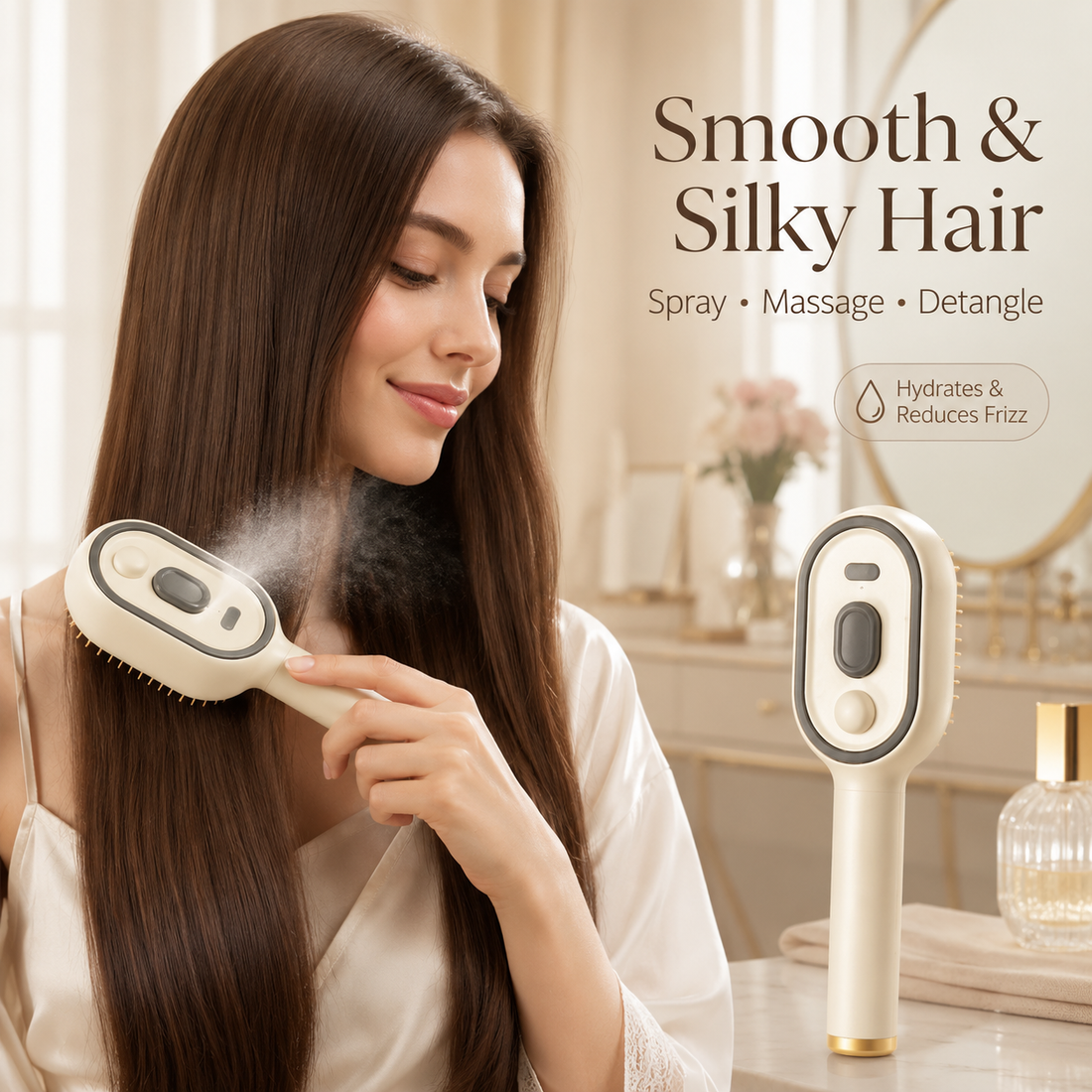
The Electric Spray Air Cushion Massage Comb is a real physical product: a rechargeable or battery-powered cushion brush with a small water reservoir, mist outlet and—in some versions—a red light. What is not real is the dramatic “hair repair” story used in many social-media ads. A misting brush cannot permanently repair split ends, reverse chemical damage or transform dry, tangled hair into salon-smooth hair in seconds.
The same generic device appears across unrelated Shopify stores, Shop listings and major marketplaces under different brand names. At the time of our review, comparable versions were listed around $15.70–$19.99 on Walmart Marketplace, while direct-response stores asked roughly $29.99–$58 and sometimes displayed supposed original prices of $69 or $119.99. That price spread is a strong clue that buyers are paying for viral advertising and a sales funnel, not proprietary technology.
Some stores show thousands of reviews, “today’s orders,” countdown timers, low-stock warnings and claims that the product was designed in Los Angeles. Yet nearly identical layouts and product descriptions appear on multiple domains. The product name itself is generic, and listings frequently reuse the same photos, benefit claims and review totals.
Actual buyer feedback is much less impressive. Recent Shop reviews describe products that do not perform like the advertisement, brushes arriving bent, instructions provided only in Chinese, cold mist that does nothing to smooth hair, and even units delivered without the advertised electric or spray function.
Our verdict: the brush is not imaginary, but the viral offer is misleading and poor value. It may detangle hair and spray a fine mist, just as a normal brush and spray bottle can. It should not be purchased as a hair-repair treatment, red-light therapy device or instant transformation tool.
What Is the Electric Spray Air Cushion Massage Comb?
Most versions combine three ordinary functions: flexible air-cushion bristles, a fine water mist and scalp massage from brushing. Some add a red LED and describe it as “red light care,” although the listings rarely provide wavelength, power output, exposure time or clinical testing for the exact device.
What the device can realistically do
- Detangle hair if the bristles suit your hair type.
- Distribute a light mist of water or leave-in product.
- Reduce static temporarily when hair is lightly dampened.
- Provide a mild scalp-massage sensation during brushing.
- Make styling easier for some users when combined with normal hair products.
What it cannot reasonably promise
- Permanently repair split ends or broken hair fibers.
- Reverse bleach, heat or chemical damage in seconds.
- Regrow hair simply because a red LED is present.
- Deliver professional red-light therapy without documented specifications.
- Guarantee glossy, straight, volumized hair for every texture.
Water can make hair look smoother for a short time, especially in a carefully filmed before-and-after. Lighting, styling products, editing and switching models or tools can create a much larger visual change than the brush itself.
How the Viral Sales Funnel Works
Step 1: An edited transformation video stops the scroll
The advertisement shows severely tangled or frizzy hair becoming smooth after one or two passes. Viewers are not shown the full routine, products applied beforehand, heat styling, cuts between shots or the actual condition of the hair.
Step 2: A generic brush is presented as an invention
The landing page uses phrases such as “2026 upgrade,” “patented technology,” “fine atomization,” “red light therapy” and “3-in-1 scalp spa.” Technical-sounding language creates value even when the seller provides no patent number, manufacturer identity or device specifications.
Step 3: Inflated reference pricing creates a fake bargain
A store may cross out $69 or $119.99 and sell the brush for $29.99–$49.99. If comparable generic units are available elsewhere for roughly $15–$20, the crossed-out price does not demonstrate a genuine discount. It is an anchor designed to make the current price feel urgent.
Step 4: Social proof overwhelms skepticism
Some pages display 4.8 or 4.9 ratings, thousands of reviews, customer avatars and live-order counters. When multiple unrelated stores use the same totals and copy, those widgets should not be treated as independent buyer evidence.
Step 5: The buyer discovers the return process after delivery
The item may arrive weeks later in generic packaging with limited instructions. A return can require contacting an overseas seller, paying postage, meeting a short deadline or proving the product is defective. Because return shipping may approach the product’s wholesale value, some buyers give up.
Red Flags We Found
- Many sellers, one product: identical photos and descriptions appear on unrelated domains.
- Huge price variation: similar brushes range from under $20 to nearly $60.
- Unverifiable review widgets: some pages claim thousands of reviews without showing a credible review history.
- Template urgency: “last day,” “low stock” and live-order counters continue to appear after the supposed deadline.
- Vague technology: red-light claims lack the specifications needed to evaluate dose or performance.
- Overpromising videos: the advertised transformation exceeds what mist and bristles can realistically produce.
- Seller confusion: product pages emphasize a marketing name but often provide little about the manufacturer or warranty provider.
Is the Red Light Feature Meaningful?
Red and near-infrared light are studied in specific medical and cosmetic contexts, but that does not validate every gadget with a red LED. A serious device claim should identify wavelength, irradiance, treatment area, session length, safety testing and evidence for the exact model.
Most viral comb listings simply say “red light care” or imply that the light nourishes follicles. A visible red glow proves only that an LED turns on. It does not prove that the brush delivers a clinically meaningful dose or treats hair loss.
Safety and Quality Concerns
A low-cost misting device combines water, a small reservoir, electronics and a rechargeable battery. Buyers should not assume every unbranded unit meets the same manufacturing or electrical standards. Stop using the comb if it becomes hot, smells unusual, leaks into the charging port or has a damaged battery casing.
- Do not charge the brush while it is wet or while the reservoir is leaking.
- Use only liquids permitted by the instructions; oils can clog the mist outlet.
- Do not shine a bright LED directly into the eyes.
- Clean the reservoir to reduce residue and microbial growth.
- Avoid using damaged bristles on an irritated or injured scalp.
- Do not rely on the device to diagnose or treat hair loss or scalp disease.
How to Shop More Safely
- Reverse-search the product image. If the same device appears under many names, compare the lowest reputable-marketplace price.
- Ignore crossed-out prices. Compare what sellers actually charge for identical hardware.
- Read off-site reviews. Prioritize reviews with buyer photos and specific details, not repeated five-star quotes on the landing page.
- Read the return address and deadline before paying. A “money-back guarantee” is weak if the buyer must ship overseas at their own cost.
- Use a credit card or protected payment service. Avoid debit transfers, cryptocurrency and payment apps without buyer protection.
- Buy based on realistic functions. If you want a misting brush, pay a misting-brush price—not a hair-restoration price.
What to Do If You Already Ordered
Document the offer now
Save screenshots of the advertisement, product page, price, promised features, delivery estimate and return policy. Sales pages can change after complaints begin, and the details may be important in a payment dispute.
Inspect the parcel before relying on it
Photograph the packaging and product. Confirm that the spray, charging system and controls match the description. If the item lacks advertised features, arrives damaged or is materially different, contact the seller in writing immediately.
Request a refund clearly
State the order number, delivery date, problem and requested resolution. Avoid accepting endless troubleshooting if the product was misrepresented. Keep every email and note whether the seller is delaying past the return or chargeback deadline.
Escalate through the payment provider
If the seller refuses, disappears or offers only a tiny partial refund, ask your card issuer or payment service about a dispute for goods not as described. Submit the saved advertisement, photos and correspondence. Dispute deadlines vary, so act promptly.
Watch for surprise charges
Review the receipt and card statement for add-ons such as shipping insurance, extended warranty or extra units. If any charge was not clearly authorized, report it to the payment provider and request that future merchant charges be blocked.
Bottom Line
The Electric Spray Air Cushion Massage Comb is a generic misting brush wrapped in aggressive viral marketing. A buyer may receive a functioning brush, but the evidence does not support the instant repair, dramatic transformation or vague red-light claims used to justify inflated prices.
If you still want one, compare identical marketplace listings and buy only from a seller with clear returns and strong payment protection. For most people, a normal detangling brush, spray bottle and proven hair-care routine will deliver the same practical benefit for less money and with fewer return headaches.








