

Calminity sells a small frequency generator with a surprisingly large list of promised benefits. Its product page says the device can restore the body’s natural balance, reduce chronic pain, improve sleep, melt away stress, support circulation, and provide drug-free relief with no side effects.
Those claims sound scientific because the sales page uses terms such as frequencies, sine waves, bio-healing, PEMF, and electromagnetic fields. The device may genuinely generate an electrical signal. That does not establish that listening to or applying its selected frequencies can treat the many health problems named in the marketing.
This is the crucial distinction: a real electronic product can still be sold with unproven medical implications. Calminity is not an anonymous checkout page. Its terms identify a Slovenian business operator, and the store publishes shipping and refund policies. But the existence of a company does not validate the health claims.
Do not buy Calminity as a treatment for chronic pain, disease, infection, circulation problems, or any condition that needs medical care.
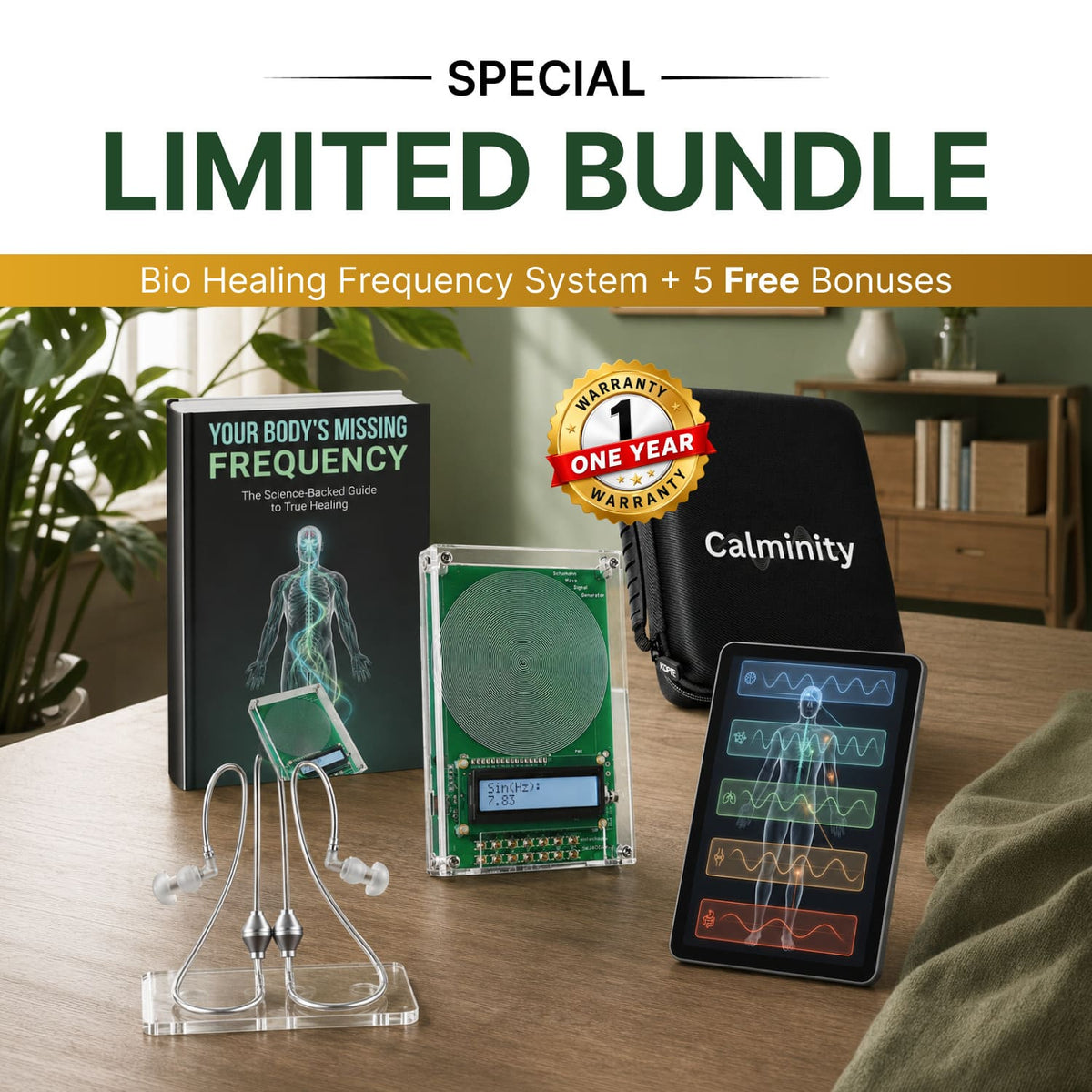
Overview
Calminity’s Bio-Healing Frequency Generator is marketed as a compact device that produces adjustable frequencies. Buyers receive the generator and accessories, along with digital bonuses such as frequency guides and wellness material.
The official page uses a “limited bundle,” a 50% discount, a $139 bonus value, a 60-day guarantee, and a claim of more than 50,267 customers. It also displays an extremely broad benefit list, from better sleep and stress relief to chronic pain reduction and improved blood circulation.
What the Device Can Plausibly Do
- Generate adjustable electrical or audio-frequency signals
- Provide a structured relaxation ritual
- Create sounds or sensations that some users may find calming
- Encourage quiet time, breathing, or meditation
What Has Not Been Proven by the Sales Page
- That specific frequencies treat chronic pain or circulation problems
- That the device can detoxify the body or eliminate parasites
- That it heals tissue, treats disease, or replaces medication
- That the product’s broad presets have been validated in controlled clinical trials
- That “no side effects” applies to every user and every condition
The store’s own footer includes a disclaimer stating that the products have not been reviewed by the FDA and are not meant to diagnose, treat, cure, or prevent medical conditions. That legal disclaimer sits in obvious tension with sales copy that says the device reduces chronic pain naturally and improves circulation.
Frequency Technology Is Not One Single Treatment
Legitimate medical devices can use electromagnetic energy, electrical stimulation, sound, or ultrasound for narrow and carefully defined purposes. Their effectiveness depends on the waveform, intensity, delivery method, diagnosis, treatment protocol, and evidence for that specific device.
That does not mean any consumer frequency generator inherits the evidence behind every regulated medical technology. The word “frequency” describes a measurement, not a universal healing mechanism.
A tuning app, a speaker, a nerve stimulator, a hospital imaging system, and a regulated bone-growth device all involve frequencies in different ways. Treating them as interchangeable is like saying every product that uses light must have the same medical effect.
How the Calminity Sales Funnel Works
Step 1: The Ad Starts With a Common, Persistent Problem
The marketing speaks to people dealing with pain, stress, poor sleep, brain fog, low energy, or frustration with conventional care. These are real problems, and many buyers have already tried several solutions.
A broad symptom list lets almost every viewer recognize something familiar. It also makes the device appear relevant without requiring a precise diagnosis.
Step 2: Technical Language Creates Scientific Authority
Terms such as “bio-healing,” “pure sine wave,” “PEMF,” and “healing frequencies” sound specific. But the sales page does not show that each advertised health outcome was demonstrated for this exact consumer device in rigorous human trials.
Technical vocabulary can describe what a circuit outputs while saying very little about what that output does inside the body.
Step 3: The Product Is Framed as Natural and Drug-Free
“Drug-free relief” appeals to people worried about medication costs, dependency, or side effects. It can also imply that the device is inherently safer because it is not a pill.
Natural and non-drug do not automatically mean effective or harmless. The greatest risk may be indirect: delaying diagnosis, stopping prescribed treatment, or spending money on a device that does not address the underlying condition.
Step 4: Large Social-Proof Numbers Reduce Skepticism
The page claims a 4.8 rating from more than 50,267 customers and displays numerous testimonials. These numbers are controlled by the seller and do not substitute for independently audited sales data or clinical evidence.
Testimonials can be sincere while still being unreliable evidence. Symptoms naturally fluctuate, expectations influence perception, and relaxation itself can temporarily change how someone experiences stress or pain.
Step 5: Discounts and Bonuses Encourage an Immediate Purchase
The page combines a limited bundle, 50% savings, multiple free bonuses, and a 60-day guarantee. This shifts attention from “Does the evidence support the claim?” to “Will I miss the deal?”
The guarantee also has conditions. Return shipping is paid by the customer, the address is supplied only after approval, and the item must meet condition requirements. Digital eBooks are excluded when purchased separately.
What Buyer Complaints Add to the Risk
Complaints discussed around Calminity describe a device that looks and feels more like a low-cost generic electronic gadget than a specialized medical breakthrough. Some buyers have alleged poor build quality, faulty units, unclear instructions, or results that did not resemble the broad promises in the advertising.
Those reports are individual experiences, not a controlled failure-rate study. However, they fit two facts disclosed by the store itself: stock may ship from China, and ordinary returns require the customer to obtain approval and pay tracked postage to an address that is not published in advance.
Refund Friction Can Make the Guarantee Less Valuable
A 60-day guarantee sounds reassuring until the cost and destination of the return are known. If the device must be sent internationally, tracked postage can consume a meaningful part of the refund. Buyers have also complained about slow or unhelpful support, making it important to start a return early and keep every message.
Scripted or AI-Looking Ads Are Not Medical Evidence
Some Calminity promotions appear heavily scripted or AI-produced. That does not prove the physical device is fake, but it adds distance between the buyer and verifiable evidence. A synthetic testimonial, polished animation, or confident voiceover cannot establish that the device treats pain, parasites, circulation problems, or disease.
Is Calminity a Scam or Legit?
Calminity appears to be a real store selling a real electronic frequency generator. Its terms name the operator as Andraz Stravs s.p. in Škofja Loka, Slovenia, and publish an address and VAT number. The shipping policy says stock may be dispatched from the U.S., Germany, or China.
However, the store’s legitimacy as a merchant does not make its medical-style promises reliable. The central problem is the gap between what the device is shown to do and what the marketing invites buyers to believe it can do.
The terms also contain unfinished Shopify boilerplate. They repeatedly call the business “My Store,” leave placeholder link text in important sections, and retain a merchant editing note. That does not prove fraud, but it weakens confidence in the care used to present legal and health information.
Our Verdict
Calminity is a real wellness gadget marketed with unproven healing claims and a high-risk value proposition. It may function as a basic frequency generator or relaxation aid. There is not enough credible evidence on the sales page to justify buying it for chronic pain, detoxification, parasite removal, circulation, disease treatment, or tissue healing.
If you enjoy sound-based relaxation and understand that the device is not medical treatment, you can evaluate it as a discretionary wellness purchase. If you are sick or in pain, spend the money on qualified medical advice first.
Calminity Red Flags
- One device is linked to many unrelated outcomes: Broad cure-like lists are a classic health-marketing warning sign.
- Scientific terms are not matched by product-specific trials: The page explains the idea more than it proves the results.
- The “no side effects” claim is too absolute: No device should make that promise for every person and condition.
- Seller-controlled testimonials dominate: Customer stories cannot establish medical efficacy.
- The legal text is poorly finished: “My Store,” broken policy links, and template notes remain visible.
- The return address is not published upfront: Buyers must obtain approval and pay tracked return shipping.
- Stock may ship from China: That is not automatically bad, but it contradicts any assumption of a locally manufactured medical device.
- Complaints mention generic hardware and quality problems: Buyers have described faulty units, unclear instructions, and performance below the advertising.
- AI-looking promotions weaken credibility: Scripted or synthetic marketing cannot substitute for product-specific clinical evidence.
What About Rife Frequencies and PEMF?
Frequency-wellness products are often connected to the ideas of Royal Raymond Rife, who claimed that particular frequencies could destroy disease-causing organisms. Those historic claims have not become an accepted general cure for cancer, infections, parasites, or chronic disease.
PEMF is also not a magic phrase. Some pulsed electromagnetic field applications have been studied or cleared for specific uses. That does not validate every frequency, every consumer generator, or every claim attached to a product using the label.
Before treating a health claim as credible, ask for the exact device name, trial design, number of participants, control group, measured outcome, adverse events, and whether an appropriate regulator reviewed that use. A link to a general article about frequencies is not enough.
Who Should Avoid Calminity?
Do not use the device without professional guidance if you have an implanted electronic device, are pregnant, have epilepsy or seizures, are being treated for a serious illness, or have unexplained symptoms that need diagnosis.
People taking prescription medication should not change or stop treatment because a frequency guide promises a natural alternative. Children and vulnerable adults should not be exposed to experimental wellness routines without appropriate supervision.
Seek urgent medical care for chest pain, breathing difficulty, signs of stroke, severe infection, sudden neurological symptoms, or rapidly worsening pain. A consumer gadget is not an emergency treatment.
What to Do If You Already Bought Calminity
1. Do Not Replace Medical Care
Continue prescribed treatment unless a licensed clinician advises otherwise. Tell your clinician what device you are using and which claims influenced the purchase.
2. Save the Advertisement
Capture the product page, promised benefits, guarantee, order total, and any claim that led you to buy. Marketing pages can change, and these records matter if you request a refund.
3. Check the Delivered Product
Photograph the packaging, label, manuals, electrical markings, and accessories before use. Compare them with the order description. Do not use damaged cables or an unknown power adapter.
4. Monitor for Symptoms
Stop using the device if it causes discomfort, dizziness, skin irritation, headaches, sleep disruption, or other unexpected effects. Get medical advice when symptoms are significant or persistent.
5. Start the Return Before Day 60
Email the seller with the order number, reason for return, and requested images or video. Obtain written approval and a return address before shipping. Use tracked postage because the policy requires a tracking number.
6. Expect to Pay Return Shipping
The published policy says ordinary return shipping is the customer’s responsibility and original shipping may not be refunded. Ask for the destination before deciding whether an international return is economical.
7. Escalate Misleading-Claim Complaints
If the seller refuses a valid return or the product was materially different from the advertisement, contact the card issuer and the relevant consumer-protection authority. Provide the receipt, saved claims, correspondence, tracking, and policy shown at purchase.
Frequently Asked Questions
Does Calminity Really Heal the Body With Frequencies?
The seller makes broad wellness claims, but the product page does not provide strong product-specific clinical evidence that the device heals disease, chronic pain, circulation problems, infections, or parasites.
Is Calminity FDA Approved?
The site’s own disclaimer says its products have not been reviewed by the FDA and are not intended to diagnose, treat, cure, or prevent medical conditions.
Is Calminity a Fake Company?
The terms publish a named Slovenian sole proprietor, address, and VAT number. That supports the existence of an operator, although it does not verify the advertised health outcomes.
Can Calminity Help With Relaxation or Sleep?
Some users may find a quiet frequency routine relaxing, just as they might enjoy ambient sound or meditation. A personal relaxation response is not proof that the device treats insomnia or an underlying sleep disorder.
Does the 60-Day Guarantee Remove the Risk?
No. The buyer must obtain approval, meet the condition requirements, pay ordinary return shipping, and send the package with tracking. The destination is not disclosed until the request is approved.
The Bottom Line
Calminity is not an imaginary product. It is an electronic wellness device sold by an identified business. The risk comes from the leap between generating frequencies and claiming broad healing effects.
Do not buy it as a treatment. If you still want it as a relaxation gadget, ignore the cure-like language, review the return cost, and make sure your decision does not delay real medical care.









It is now 9:37 PM and the delivery has not arrived. The last update was at 7:27 AM and I have spoken to the delivery service that they KNOW the route to our home, and the closest intersection, and MY PHONE NUMBER and I literally NEVER LEFT HOME today so that I could be here.
I posted a SIGN at the driveway end that was a third way for the driver to know to come up our very well-marked driveway and leave the package on the porch; that Amazon and Butcher-box, Wine.com, and Nordstrom and Kohl’s all have no problem doing.
I now believe that there is something very evil happening. There is no shipment and you are running some kind of cruel scam.
I bought the Calminity product because of a personal friend, Carol Hull in Colorado who is married to a doctor and spoke so well of your product. If I ever needed such a calming product it is now, over the last 6 weeks my son died and was resuscitated 2X and survived 3 brain surgeries and I was there with him 41 days.
He is surviving and I am home – spending my precious time following up on an order from months ago. Your company mis-delivered my purchase to a false address with a picture that is so suspect, on the night of my son’s brain aneurysm collapse into a coma and I flew to Portland to be with him.
Now after your company admitted that the address was NOT MY HOME (I sent you multiple photos) your replacement has still not been delivered (one attempt said my address is not valid) and I have been meticulous and FRANTIC to be here STAY HERE and receive that damned package. I want out of this hideousness.
I am so depressed at the inability to get the drivers to FIND MY HOUSE!!! Dear God every mapping system in the universe knows this small town and the streets – it is NOT HARD!!! We have been here 26 years!
I just want a refund and to go back to a peace that I had before I knew Calminity even existed. This seems so vicious if the truth is that you never really shipped me a package after taking my money.
image.png
I get UPS, USPS, FEDEX, AMAZON, COSTCO, HOME DEPOT and ALL OTHER DELIVERIES HERE AT MY HOME!!
I am begging you to either MAKE IT HAPPEN – take the damn package to the Ransom Brothers Postal ANNEX – THEY ALL KNOW ME THERE!!! For God’s sake stop promising me that you are helping when I am getting ABSOLUTELY NO RESPONSE from the carrier. I have spent HOURS on hold to make SURE they know where to come.
This is cruel. Run this response up to your happy owners and managers who keep sending us advertising on how great your resonance is. I am so DONE!
Outstanding, well presented review! Thank you Thomas for all these great points! We need more, non biased, thorough reviews out there like this.
As a consumer in today’s market and with all the scams, poor quality control, and lack of consumer protection out there, it’s much appreciated!
Thank you, Crystal – I have passed this along to Thomas, who will be glad it landed well. You have put your finger on exactly why we write these the way we do: with products like frequency generators the marketing leans on scientific-sounding language that sounds plausible right up until someone checks whether the underlying claim has ever actually been tested. If you come across another product you would like looked at, do mention it in the comments – a good many of these investigations start life as a reader suggestion.
Thank you, Crystal, that is genuinely encouraging to read. These reviews take a while to put together because we go through the ads, the company details, and the refund terms rather than repeating the sales page, so it means a lot when readers find that useful. If you come across another product showing the same warning signs, feel free to flag it and we will take a look.