

Caldrivo is not the kind of questionable store that necessarily takes an order and sends nothing. The more realistic danger is a package that does arrive, but contains a cheap, mass-produced item that looks noticeably worse than the product shown in the advertisement.
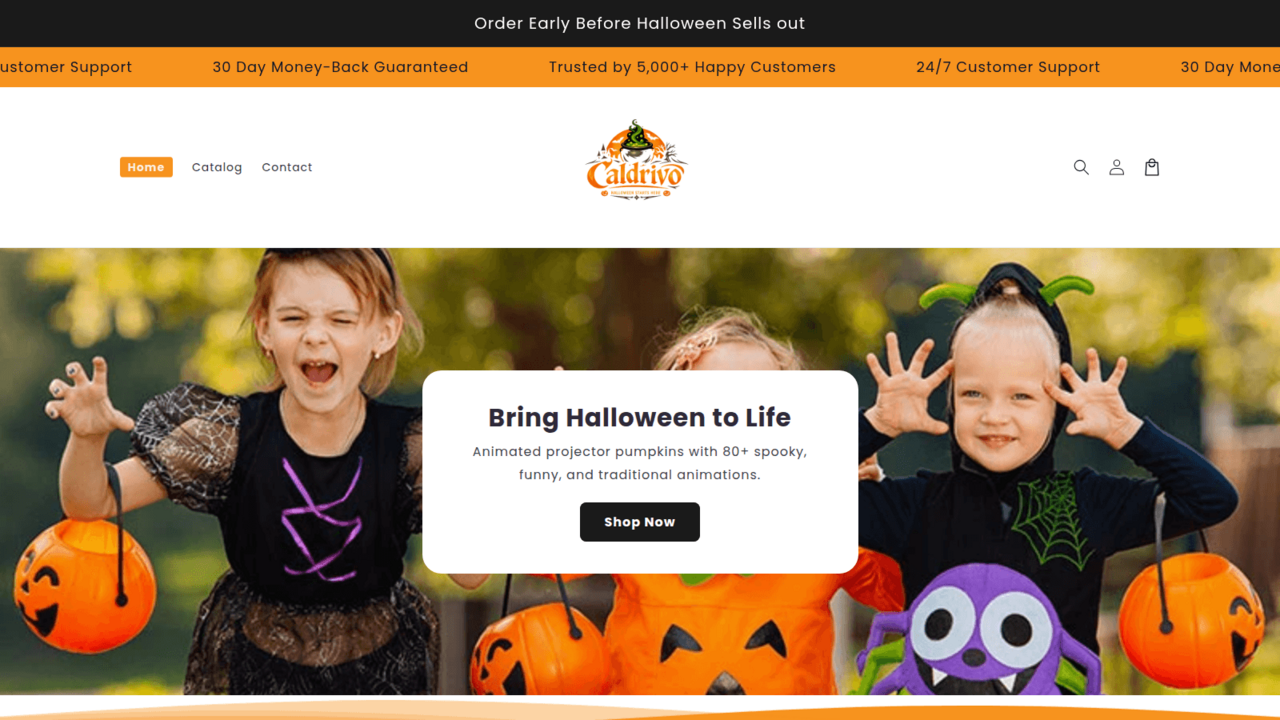
The store previously promoted America’s 250th Birthday banners with patriotic imagery and a “made in California” story. That campaign has disappeared. Caldrivo now presents itself as a Halloween shop selling candy bowls, artificial spider webs, and an animated pumpkin.
The theme changed, but the sales formula did not. Caldrivo still relies on dramatic product images, seasonal urgency, unsupported popularity claims, and a prominent 30-day guarantee. The difficult part begins when the delivered item is smaller, thinner, cheaper-looking, or otherwise different from the advertisement and the customer tries to return it.
Caldrivo should be treated as a high-risk dropshipping-style store. The likely loss is not an empty mailbox. It is paying a premium price for an inexpensive generic product, then discovering that the return destination, postage cost, approval process, and contradictory deadlines make a full refund impractical.
Overview
Caldrivo is a small Shopify storefront built around seasonal advertising campaigns. Its current homepage tells shoppers to “Order Early Before Halloween Sells Out” and repeatedly displays “Trusted by 5,000+ Happy Customers,” “24/7 Customer Support,” and “30 Day Money-Back Guaranteed.”
The active catalog contains a Halloween Candy Bowl for $19.99, Stretch Spider Webs for $14.99, a Talking Animated Halloween Pumpkin for $79.99, and a $4.99 Shipping Protection add-on. There is no visible manufacturer profile, legal company name, factory address, management team, or telephone number.
What Caldrivo Sold Before Halloween
Before the Halloween pivot, Caldrivo promoted patriotic porch banners for America’s 250th Birthday. The small banner was advertised for roughly $30 and the large version for approximately $50. The sales page claimed the products were proudly made in California with quality craftsmanship.
That product page has now been removed. Its old URL opens a 404 page, while parts of the shipping policy and footer still contain patriotic mission language. The current homepage, meanwhile, says the mission is to create Halloween memories.
Why the Rapid Change Matters
A legitimate retailer can sell products for different holidays. The concern is the speed and completeness of the identity change. Caldrivo does not look like an established decor company gradually expanding its catalog. It looks like the same advertising shell being reused for whichever seasonal product is easiest to promote next.
The unresolved patriotic text, Halloween mission, “Sold Out for the 2026 Season” message on the About page, and active Halloween scarcity message do not form a coherent business history. They look like pieces from different campaigns left inside the same template.
How the Caldrivo Shopping Scheme Works
Step 1: A Dramatic Advertisement Sells the Finished Fantasy
The customer does not first encounter Caldrivo as an unknown Shopify store. They see a polished social-media advertisement showing a product in its most impressive setting: a substantial patriotic banner on a beautiful porch or an animated Halloween decoration creating a memorable family display.
Lighting, staging, camera angles, editing, and carefully selected footage can make an inexpensive product look larger, thicker, brighter, or more sophisticated than it is.
Step 2: A Seasonal Story Creates an Emotional Reason to Buy
The patriotic campaign used national pride, veterans, family gatherings, and a once-in-a-generation anniversary. The Halloween campaign uses children, family memories, scarcity, and the fear of ordering too late for the holiday.
This emotional framing shifts attention away from ordinary shopping questions: Who owns the company? Where is the product manufactured? What are its exact dimensions and materials? Where must it be returned?
Step 3: Repeated Trust Claims Reduce Skepticism
Across the site, Caldrivo repeatedly claims more than 5,000 happy customers, 24/7 support, and a 30-day money-back guarantee. Repetition makes these statements feel established even though the site does not present independently audited sales data or a transparent company history.
A payment-method logo, Shopify checkout, or PayPal option only shows that a transaction can be processed. It does not prove that the advertisement accurately represents the delivered product.
Step 4: A Generic Product Is Sold at a Large Markup
Caldrivo’s risk profile is consistent with a dropshipping operation built around inexpensive products sourced from overseas suppliers, including China, then resold through a Western-looking seasonal storefront. The website does not identify the supplier or factory, so shoppers cannot verify the origin before ordering.
The item can be real and still be seriously overmarketed. A basic printed banner, plastic candy bowl, bag of synthetic webbing, or generic electronic pumpkin costs far less to source than the premium version suggested by an emotional video advertisement.
Step 5: Shipping a Package Helps Protect the Merchant
Sending a low-cost item gives the merchant a tracking number. When the buyer complains, the seller can point to delivery confirmation and argue that the order was fulfilled.
This is why receipt of a package does not make Caldrivo trustworthy. The important question is whether the product matches the material, measurements, color, performance, craftsmanship, and country-of-origin claims used to obtain the sale.
Step 6: The Delivered Product Falls Short of the Advertisement
The customer may open the parcel and find thin synthetic fabric instead of a substantial porch banner, flat printed details that looked dimensional online, weak stitching, washed-out colors, a much smaller decoration, or inexpensive plastic electronics that do not perform like the video.
Packaging or tracking may also reveal overseas fulfillment even when the advertisement created the impression of domestic craftsmanship. The product technically exists, but the buying decision was based on a different presentation.
Step 7: The Return Process Makes the Refund Uneconomical
Caldrivo does not publish the return address before purchase. Customers must contact support, obtain approval, and wait for instructions telling them where to send the item.
If the destination is overseas, tracked postage can cost a significant portion of the purchase price. The policy also requires the item to be unused and in its original packaging, giving the seller additional grounds to question a return after the customer has opened and tested it.
America’s 250th Birthday and Halloween: Two Versions of the Same Store
The Patriotic Banner Campaign
The banner campaign claimed domestic California production and careful craftsmanship. Those claims justified a higher price and encouraged customers to believe they were supporting a U.S.-made seasonal product rather than buying a generic imported decoration.
One complaint described two banners ordered through PayPal on May 2, 2026 for nearly $80. The buyer alleged that the order did not arrive and that Caldrivo sent repeated delay emails. Another complaint described an April 30 order, a refused refund, and a shipment claim without usable tracking.
Non-delivery complaints are relevant, but they are not the only or even the most likely problem. Other shoppers can receive a banner and still be harmed if the material, origin, size, or quality does not match the advertisement and no practical return is available.
The Current Halloween Campaign
The current store uses the same trust strip and urgency formula for Halloween products. The homepage says to order early before Halloween sells out, while the catalog presents a small set of generic seasonal items with no visible manufacturer information.
The $79.99 animated pumpkin is especially important because electronic novelty products are easy to exaggerate in short videos. Buyers should not assume the delivered size, projection quality, sound, animation, materials, or durability will match a polished promotional clip.
The shift from “made in California” patriotic banners to a Halloween projector theme shows that Caldrivo’s real specialty is not a particular craft. Its specialty is building urgent seasonal campaigns around products that can be advertised dramatically.
Is Caldrivo a Scam or Legit?
Caldrivo should not be trusted as a normal, transparent online retailer. It appears to be a deceptive dropshipping-style store that uses exaggerated seasonal advertising to sell inexpensive generic products at inflated prices.
The store may deliver a physical item. That does not make the transaction honest when the product differs materially from the advertisement or when the claimed guarantee cannot be used without expensive shipping and seller approval.
Our Verdict
Avoid Caldrivo. The rotating store identity, missing legal company information, unverified manufacturing claims, generic catalog, exaggerated trust messaging, vague tracking language, and contradictory return restrictions create an unacceptable level of risk.
Buy seasonal decorations from a retailer that identifies the manufacturer, publishes exact measurements and materials, provides realistic customer photographs, and discloses a domestic return address before checkout.
Caldrivo Red Flags
- The store rapidly changed identities: America’s 250th Birthday products disappeared and were replaced by Halloween merchandise.
- The old campaign remains inside policy pages: Patriotic mission text is still visible while the homepage promotes Halloween.
- No legal company is clearly identified: The site does not prominently publish an operating entity, street address, registration details, or telephone number.
- The catalog looks generic: Candy bowls, synthetic spider webs, an animated pumpkin, and shipping protection do not show a specialized manufacturer.
- The “5,000+ customers” claim is unsupported: No independent audit or established review history is provided beside it.
- Tracking is not promised clearly: The shipping policy says customers “may” receive a shipping update.
- The return address is hidden: It is supplied only after Caldrivo approves the request.
- The 30-day promise contains conflicting exclusions: The policy rejects requests after October 31 and separately lists orders after May 25 as non-returnable.
- “Handmade” is not substantiated: No craft facility, manufacturer, or production location is identified.
- Delivery can conceal the real problem: A tracking number does not prove that the item matches the advertisement.
Why the Caldrivo Return Policy Is a Trap
The top of the website repeatedly promises a 30-day money-back guarantee. The detailed policy is much less reassuring.
- The customer must request approval before sending anything back
- The return address is not disclosed in advance
- The item must be unused and in its original packaging
- Returns and refund requests are rejected after October 31
- The non-returnable list separately includes “orders after May 25th”
- The refund is issued only after Caldrivo receives and inspects the return
These conditions give the seller control over the address, approval, timing, product condition, and final inspection. A buyer who receives an item close to the holiday can run out of time before completing the process.
The return cost is equally important. A guarantee is not meaningful when sending a $20 or $50 item to an overseas warehouse costs nearly as much as the expected refund.
What to Do If You Already Ordered From Caldrivo
1. Save the Advertisement Immediately
Capture the product page, video, dimensions, materials, performance claims, country-of-origin statement, price, delivery estimate, and guarantee. Seasonal pages can disappear as soon as the campaign changes.
2. Record the Entire Unboxing
Film the sealed package, shipping label, return address, customs information, product packaging, and first use. Keep the parcel and every insert.
3. Compare the Item With Specific Claims
Measure it, photograph the material and stitching, test the advertised functions, and document differences in color, size, thickness, construction, or performance. Specific discrepancies are stronger than simply saying the product feels cheap.
4. Use “Item Not as Described”
If a product arrives but differs substantially from the advertisement, describe the problem accurately as “item not as described.” Do not file a non-delivery claim when tracking shows that a parcel arrived.
5. Request the Return Address in Writing
Ask Caldrivo for a full refund, return authorization, physical destination, postage responsibility, and deadline. Save the reply and any attempt to delay, redirect, or close the request.
6. Calculate the Real Return Cost
Obtain a tracked-postage quote before shipping. If the undisclosed destination makes the guarantee impractical, preserve the quote as evidence for the payment provider.
7. Escalate Before the Dispute Deadline
If Caldrivo blocks a valid refund or demands an unreasonable return, contact the card issuer or PayPal. Provide the advertisement, order record, unboxing video, measurements, messages, policy, shipping quote, and photographs showing why the item is materially different.
Frequently Asked Questions
Does Caldrivo Deliver Products?
It may. The main risk is receiving an inexpensive generic product that does not match the advertising, then facing an impractical return process. Delivery alone does not prove that the store is legitimate.
Is Caldrivo a Halloween Store?
It currently presents itself as one, but the same website previously focused on America’s 250th Birthday banners and patriotic decorations. The rapid pivot suggests a reusable seasonal sales operation rather than an established Halloween brand.
Are Caldrivo Products Made in the USA?
The removed banner page claimed California production, but Caldrivo did not identify a factory or manufacturer that allowed the claim to be verified. The current Halloween catalog does not provide the transparency needed to establish where its products are made.
Can I Return a Cheap or Misleading Caldrivo Product?
The website advertises 30 days, but the detailed policy requires prior approval, hides the destination until approval, imposes condition rules, and contains conflicting seasonal cutoff dates. Return postage may also make the process uneconomical.
Is Caldrivo Safe to Order From?
No. The combination of exaggerated advertising, generic merchandise, changing store identity, weak company transparency, and refund friction makes the purchase too risky.
The Bottom Line
Caldrivo’s central problem is not that every customer receives nothing. The more believable and common outcome is a real package containing a cheap product that does not match the premium advertisement.
The patriotic banner and Halloween campaigns are two versions of the same model: emotional seasonal marketing, generic merchandise, urgent promises, and a return process that becomes difficult after delivery. Avoid Caldrivo and buy from a retailer that discloses the manufacturer and return destination before taking payment.








