

Melt Drops promises to “activate” fat burning and melt stubborn weight with a few daily drops. It is a polished shortcut aimed at frustrated dieters.
Look closer and the pitch unravels. The website mixes conflicting ingredients with testimonials and scientific references apparently copied from a completely different supplement.
A bottle may arrive, but that does not make the transformation real. The live sales page gives shoppers strong reasons to distrust its weight-loss claims.
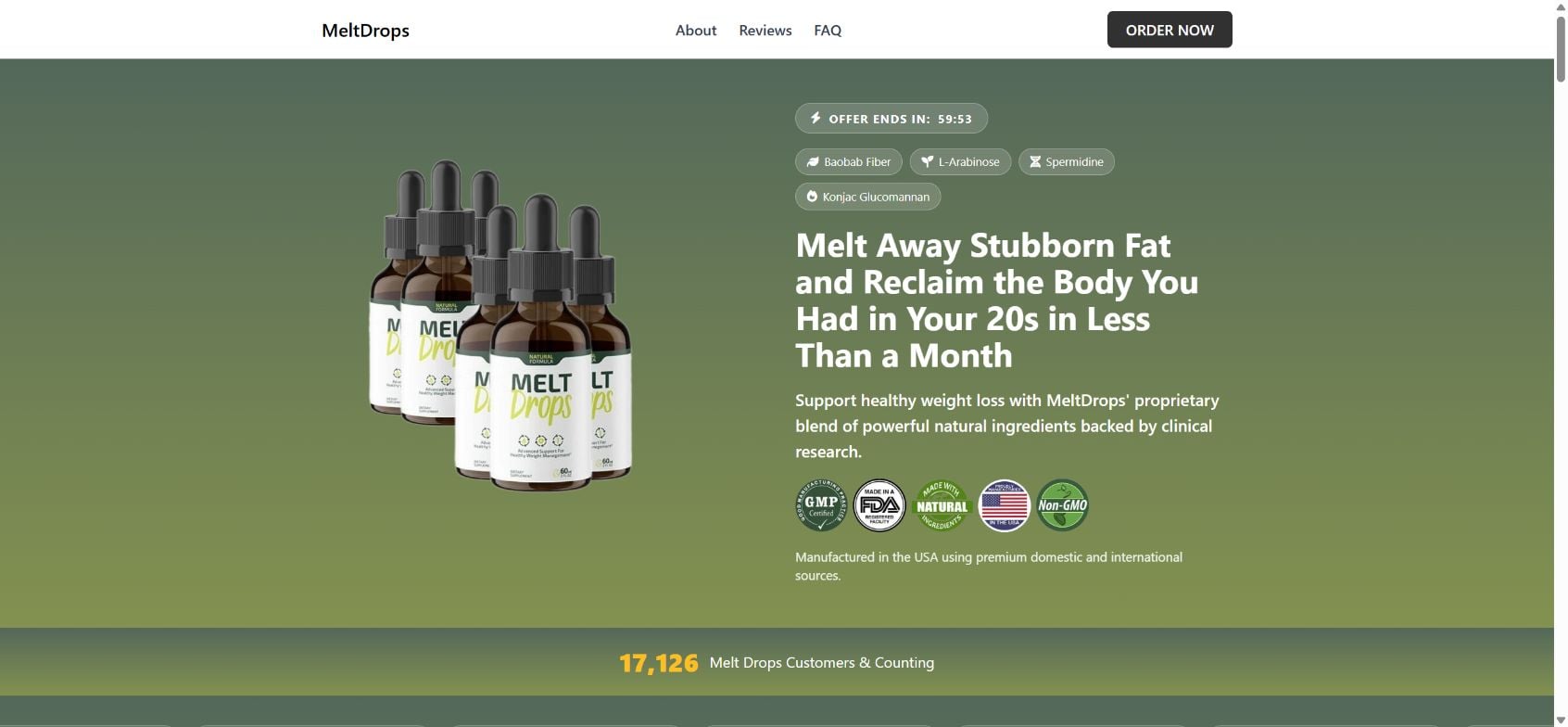
Melt Drops Overview
Melt Drops is sold through a long-form landing page that presents the product as natural support for rapid fat loss. The page claims buyers can “melt away” stubborn fat, regain the body they had in their 20s and see a meaningful change in less than a month.
The offer is framed as a simpler alternative to strict dieting, exhausting workouts and prescription injections. Scientific-sounding terms such as metabolism, thermogenesis, appetite control and cellular health are used throughout the pitch, but the website does not present a published clinical trial showing that the finished Melt Drops formula produces the promised results.
The current page lists baobab fiber, L-arabinose, spermidine and konjac glucomannan. However, promotional descriptions associated with the product have also referenced a very different group of ingredients, including green tea, cayenne, guarana, maca and ginseng. When a supplement’s formula changes across sales material, buyers cannot confidently know which claims apply to the bottle being ordered.
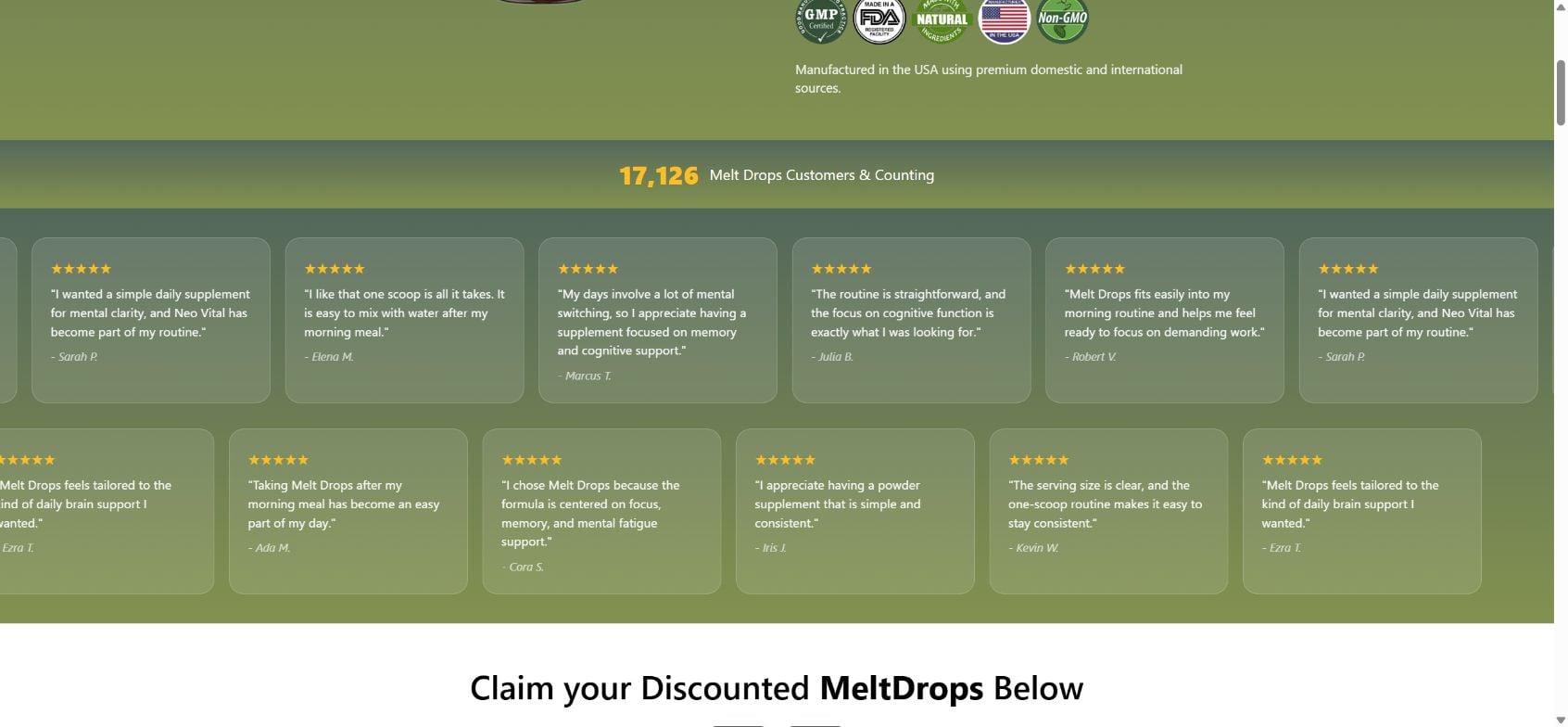
More importantly, the website contains obvious remnants from another supplement campaign. Testimonials praise a product called “Neo Vital,” describe improved memory and mental clarity, and refer to taking “one scoop.” Those statements make no sense on a page selling liquid weight-loss drops.
- Product type: Direct-to-consumer dietary supplement sold as liquid drops.
- Main promise: Faster weight loss, reduced appetite and improved metabolism.
- Evidence problem: No product-specific, peer-reviewed human trial is presented.
- Transparency problem: Conflicting ingredients and unrelated copy appear on the live sales page.
- Our assessment: The marketing is unreliable and the product should not be trusted as a proven weight-loss solution.
How the Melt Drops Sales Funnel Works
Step 1: The ad offers an effortless transformation
The funnel begins with the outcome people want most: visible fat loss without the usual work. Instead of asking shoppers to compare ingredients and doses, the copy encourages them to picture a younger, slimmer version of themselves.
This is a common direct-response tactic. The stronger the emotional promise, the less likely a hurried buyer is to stop and ask whether the finished product has actually been tested.
Step 2: Scientific language makes the promise sound established
The page connects individual ingredients to concepts such as appetite, glucose absorption, gut health and cellular renewal. Some ingredients may have legitimate research behind specific uses, but that is not the same as proving the exact Melt Drops formula causes rapid weight loss.
A study involving a particular dose, preparation or population cannot automatically be applied to a proprietary blend. Buyers would need a clear Supplement Facts label, exact serving amounts and a clinical trial of the finished product to judge the claim properly.
Step 3: Trust badges replace meaningful verification
Melt Drops uses phrases such as “clinically tested,” “100% safe,” GMP manufacturing and an FDA-registered facility. These phrases sound official, but they do not mean the FDA has approved Melt Drops for weight loss.
The FDA does not approve dietary supplements before they are sold in the same way it approves prescription drugs. A facility registration or manufacturing badge is not proof that a product works, and it should never be presented as though it were a government endorsement.
Step 4: Testimonials create borrowed credibility
The page displays glowing reviews, a near-perfect rating and a large customer count. Yet the same section contains references to Neo Vital, memory, cognitive support and powder scoops. Those template errors make the entire testimonial area unreliable.
Even when a testimonial is genuine, one customer’s story does not establish typical results. The site’s own disclaimer says testimonials are not necessarily representative and that names may have been changed.
Step 5: Packages and urgency push a larger order
The final stage presents multi-bottle packages, a countdown-style offer and a 60-day guarantee. The buyer is encouraged to commit to several bottles before knowing whether the first one is useful or tolerable.
A written guarantee only has value if the seller can be identified, responds to support requests and honors the stated terms without introducing unexpected conditions. Marketing language alone does not prove that refunds will be easy.
The Website’s Template Errors Are a Major Red Flag
A typo is not enough to condemn a product. This is different. The Melt Drops page includes entire testimonial narratives that belong to another category of supplement.
- Customers supposedly praise Neo Vital, not Melt Drops.
- Reviews discuss mental clarity, memory and cognitive support rather than weight loss.
- At least one testimonial describes taking one scoop, although Melt Drops is sold as a liquid.
- The reference list includes material about vitamins, cognition and neurological health that does not clearly support the headline weight-loss promise.
- Ingredient descriptions found in promotional material do not consistently match the formula currently shown on the live page.
These are not cosmetic mistakes. They suggest that a ready-made supplement template was repurposed without a careful scientific or editorial review. If the seller did not verify the claims on its own checkout funnel, shoppers should not assume the health statements were verified elsewhere.
Do the Ingredients Prove Melt Drops Works?
Some listed ingredients can be found in research related to fullness, digestion or metabolic markers. Konjac glucomannan, for example, is a soluble fiber that can absorb water. L-arabinose has been studied in connection with sucrose metabolism. That still does not establish the website’s promise of quickly melting stubborn fat.
Results depend on dose, formulation, diet, medical history and the quality of the study. The landing page does not give shoppers enough dependable product-specific evidence to bridge the gap between modest ingredient research and the dramatic before-and-after outcome being advertised.
Weight-loss supplements can also interact with medication or worsen existing conditions. Fiber-based ingredients may affect digestion or the absorption of other products, while stimulant-containing formulas may create different risks. Anyone considering a supplement should show the actual label—not the advertisement—to a qualified clinician or pharmacist.
Is Melt Drops FDA Approved?
No evidence on the page shows that Melt Drops is FDA approved as a weight-loss treatment. The sales copy’s reference to an FDA-registered facility is not equivalent to product approval.
The disclaimer at the bottom of the page acknowledges that the statements have not been evaluated by the FDA and that the product is not intended to diagnose, treat, cure or prevent disease. That standard disclaimer directly limits the impression created by the more authoritative-sounding badges higher on the page.
Melt Drops Scam or Legit? Our Verdict
Melt Drops should be treated as a high-risk, heavily marketed supplement—not as a proven weight-loss solution. The site’s conflicting formula descriptions, unrelated Neo Vital testimonials, questionable scientific references and misleading use of regulatory language destroy the credibility of the pitch.
A parcel may arrive, and the bottle may contain a real supplement. That is not the same as receiving the transformation shown in the advertisement. The core problem is a wide gap between what is sold emotionally and what is supported by product-specific evidence.
We would not rely on Melt Drops for weight loss, and we would not buy a multi-bottle package based on this landing page. Safer options begin with medical guidance, realistic nutrition changes and treatments whose benefits, risks and manufacturing standards can be independently verified.
What to Do If You Already Ordered Melt Drops
Check the confirmation before the return window closes
Save the order confirmation, checkout page, guarantee language and every email from the seller. Take screenshots showing the price, number of bottles, promised refund period and any statement that influenced your purchase.
Inspect the package without discarding anything
Photograph the shipping label, bottle, Supplement Facts panel, lot number and expiration date. Compare the formula on the physical label with the ingredients advertised when you ordered. Do not use a bottle with a broken seal, missing lot information or a label that does not identify the responsible distributor.
Request cancellation or a refund in writing
Contact the seller through the address in your receipt and state exactly what you want. Keep the message factual. Include the order number, purchase date and the specific guarantee you are invoking. Ask for written return instructions before paying to ship anything.
Watch for recurring charges
Review the checkout receipt and the next several card statements for subscriptions, add-on products or repeat billing you did not knowingly accept. If the seller charges you again without authorization, contact the card issuer promptly and ask about blocking future merchant charges.
Escalate when the seller does not cooperate
If the product was materially misrepresented or the advertised refund is refused, provide the evidence to your card issuer or payment service and ask about its dispute process. You can also report deceptive weight-loss advertising to the FTC and your state consumer-protection office.
Frequently Asked Questions
Can Melt Drops make you lose weight without diet or exercise?
The website does not provide reliable product-specific evidence that a few drops produce substantial weight loss without changes to diet, activity or medical treatment. Claims promising easy, rapid loss should be treated skeptically.
Are Melt Drops testimonials trustworthy?
The live page contains testimonials about a different product called Neo Vital and discusses memory, mental clarity and scoops. Because the section is visibly contaminated with unrelated copy, it should not be treated as dependable customer evidence.
Does FDA-registered mean FDA approved?
No. A facility may be registered with the FDA while the supplement itself has never been reviewed or approved for the advertised result. Registration is not an endorsement of effectiveness.
Is the 60-day guarantee enough protection?
Not by itself. A guarantee depends on the seller answering, providing workable return instructions and processing the refund. Preserve the exact terms and pay with a method that offers a dispute process.
The Bottom Line
Melt Drops is sold with a persuasive story, but the live website fails a basic credibility check. A weight-loss page that accidentally promotes Neo Vital, memory support and powder scoops cannot reasonably ask shoppers to trust its scientific claims.
Do not let a timer, a dramatic transformation photo or a regulatory-looking badge replace evidence. Until the seller provides consistent labeling, transparent ownership and credible trials of the finished formula, the safest decision is to avoid the offer.








