

Heusom Silent Groom Pro is not an imaginary product, but the sales page makes a basic rechargeable nail grinder sound like a breakthrough that will erase fear, prevent injury, and rebuild a cat’s trust.
A grinder may be useful for some pets. It may also vibrate, make a high-pitched sound, work slowly, or frighten the animal. The product, seller identity, marketing images, and return rules need to be separated before deciding whether this offer is worth the risk.
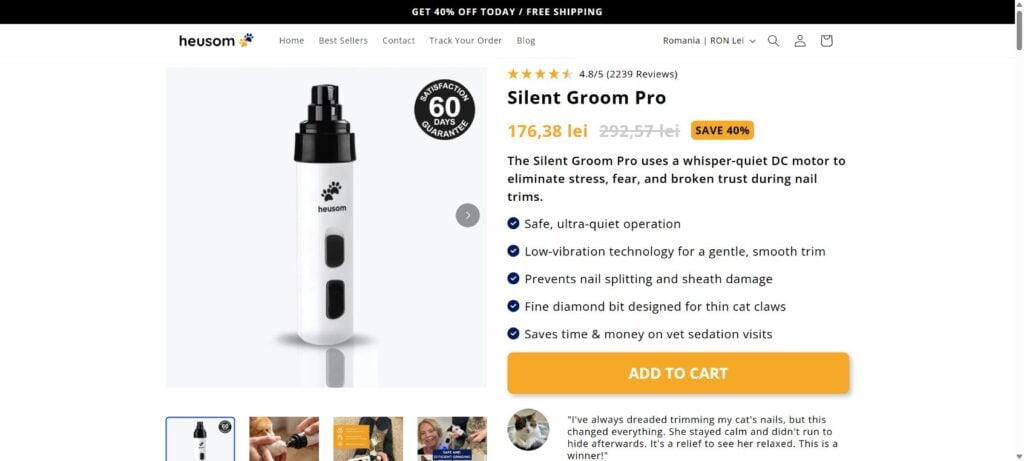
Overview
Silent Groom Pro is a compact USB-rechargeable nail grinder sold by Heusom. The cat-focused page claims a noise level below 40 dB, low vibration, a fine diamond bit, up to seven hours of battery life, safer trimming, fewer split nails, and reduced fear. It displays a 4.8/5 score from 2,239 reviews, emotional customer stories, survey percentages, a 40% discount, and a 60-day guarantee.
The physical idea is legitimate. Electric grinders use an abrasive rotating head to remove small amounts of nail gradually. Some owners prefer that control to making one cut with clippers. A grinder can also smooth a rough edge after clipping. None of that makes one model automatically silent, stress-free, safe for every cat, or superior to properly used sharp clippers.
Heusom is operated under the name Nivro LLC in its privacy policy and lists a mailing and return address at 700 Main Street in Bangor, Maine. The site provides support email addresses and phone numbers, although different pages display more than one phone number. The terms contain mandatory arbitration and class-action waiver language, and the refund policy requires authorization before a return.
The return promise needs more attention than the large “60-day guarantee” badge. Heusom says customers pay return shipping, prepaid labels are not provided, and a return should be sent only after approval. A used pet grooming device may also require evidence of its condition. That creates friction because the only way to know whether your cat tolerates the sound and vibration is to test it.
The marketing imagery also deserves skepticism. Several image filenames on the live product page literally contain “openart-image,” which strongly suggests that at least some promotional visuals were generated with an AI image tool. That does not prove the grinder is fake, but it means those scenes are advertising artwork, not independent evidence that real cats stayed calm or that the device produced the claimed result.
The clearest verdict is that Heusom sells a real nail grinder with unusually aggressive emotional marketing. Buyers should expect a generic-style grooming tool whose performance depends on motor quality, abrasive head, the individual pet, and careful technique. Do not expect a guaranteed cure for grooming anxiety.
How the Silent Groom Pro Offer Works
Step 1: The page turns ordinary clippers into the villain
The sales copy describes clipping as a high-risk event that can split claws, hit the quick, cause infection, and permanently damage the bond between owner and cat. Cutting the quick is painful and should be avoided, but this framing makes careful clipping sound inherently traumatic.
Step 2: The grinder is presented as the painless answer
Silent Groom Pro is then positioned as precise, nearly silent, low-vibration, and calming. The contrast is designed to make the purchase feel like a safety decision rather than a comparison between two grooming tools.
Step 3: Emotional testimonials remove doubt
Stories describe cats falling asleep, completing all four paws in one session, and rebuilding trust after a painful trim. These accounts may describe individual experiences, but they do not establish what the average buyer or cat should expect.
Step 4: A discount and guarantee create urgency
The crossed-out price, 40% savings, free shipping banner, large review total, and 60-day badge make the offer appear low-risk. The detailed return terms shift some of that risk back to the buyer through authorization, condition checks, and customer-paid postage.
Step 5: Real-world performance depends on the pet
A cat may tolerate the grinder, dislike the vibration, react to a frequency humans barely notice, or refuse paw handling entirely. The tool does not replace gradual desensitization, rewards, good lighting, knowledge of the quick, and the willingness to stop when the animal becomes stressed.
Red Flags and Limitations
The under-40 dB claim lacks test details
A decibel number depends on measuring distance, room noise, motor speed, load, and equipment. The page does not provide a laboratory report or explain the test method. Even a low measured volume does not address high-frequency sound or vibration that may bother a particular cat.
AI-looking scenes are not product tests
The “openart-image” filenames are a concrete reason not to treat every calm-cat scene as a real demonstration. Judge the device by unedited customer videos showing the motor running beside the animal, not by polished lifestyle art.
The product cannot eliminate the quick
A grinder still removes nail material and can reach the sensitive quick if used too aggressively. Heat can also build when the abrasive head stays in one place. Use brief contact, check progress often, and never force a frightened pet.
Return friction matters for a pet-specific product
Whether the item works for you depends on your cat’s response, yet the buyer may have to pay tracked return postage. Read the condition rules and obtain written approval before using or returning the grinder.
Is Heusom Silent Groom Pro a Scam or Legit?
Heusom Silent Groom Pro is a legitimate physical product sold by an identifiable operator. It is not proven to be uniquely quiet, universally calming, or dramatically safer than every other grinder. The page sells a basic grooming tool through fear-heavy claims, AI-looking imagery, and unusually perfect testimonials.
We would not call the grinder itself fake. We would call the presentation overhyped. Comparable grinders from established pet brands may offer clearer specifications, easier returns, and a longer track record. If you buy Heusom, do so because the specifications and refund terms suit you, not because the advertisement promises to restore your cat’s trust.
What to Do If You Already Bought It
1. Save the guarantee and policy
Keep screenshots of the under-40 dB claim, battery claim, 60-day guarantee, order total, delivery estimate, and return rules. Save the packaging and all accessories until you know you are keeping the device.
2. Test the device away from your cat first
Charge it, inspect the head, and run both speeds in your hand. Check for excessive wobble, heat, sharp edges, burning odor, or unstable power. A defective rotating tool should not go near an animal.
3. Introduce it gradually
Let the cat see and smell the switched-off tool. Run it at a distance while offering treats, then move closer over several short sessions. Touching the nail should be the final step, not the first. Stop if the cat freezes, struggles, pants, growls, or tries to escape.
4. Remove only a small amount
Use good lighting and brief touches. The quick contains nerves and blood vessels. If you cannot see it or are unsure, work only on the sharp tip and ask a veterinarian or groomer for a demonstration.
5. Start the return early if it is unsuitable
Email Heusom within the guarantee period, request authorization, and describe the problem with photos or video. Ask for the confirmed return address and refund amount. Use tracked shipping and keep the receipt. If the written guarantee is not honored, present the evidence to your payment provider.
Frequently Asked Questions
Is Silent Groom Pro really silent?
No motorized grinder is literally silent. Heusom claims under 40 dB, but the page does not publish the test conditions. Individual cats may still react to its sound or vibration.
Is a grinder safer than clippers?
It can allow gradual removal, but either tool can hurt the quick when used incorrectly. The safer choice is the tool the owner understands and the pet tolerates.
Are the Heusom product images AI-generated?
Several live image filenames contain “openart-image,” which strongly suggests AI-generated marketing assets. That does not apply automatically to every image, but it is enough to reject the page’s visuals as independent proof.
The Bottom Line
Silent Groom Pro is a real nail grinder, not a guaranteed behavior solution. The aggressive claims, AI-looking imagery, and return friction make the offer less convincing than the page suggests. Compare established alternatives, introduce any grinder slowly, and never let a sales promise override your cat’s reaction.








