

A dirt bike that inflates in minutes, floats on water, reaches 20 mph, and costs close to the price of an ordinary pool toy sounds like the perfect summer discovery. That remarkable promise is driving social media ads for the Floatdirt Bike.
The storefront looks polished and the videos are difficult to ignore. Before ordering, however, shoppers need to understand the large gap between the motorized machine being advertised and the inexpensive inflatable that may actually arrive.
Overview
The Floatdirt Bike scam is a misleading online shopping campaign built around AI-looking videos and images of motorized inflatable dirt bikes. The ads show riders apparently cruising across pools or lakes on motorcycle-shaped floats with working propulsion, steering, and the appearance of a real recreational watercraft.
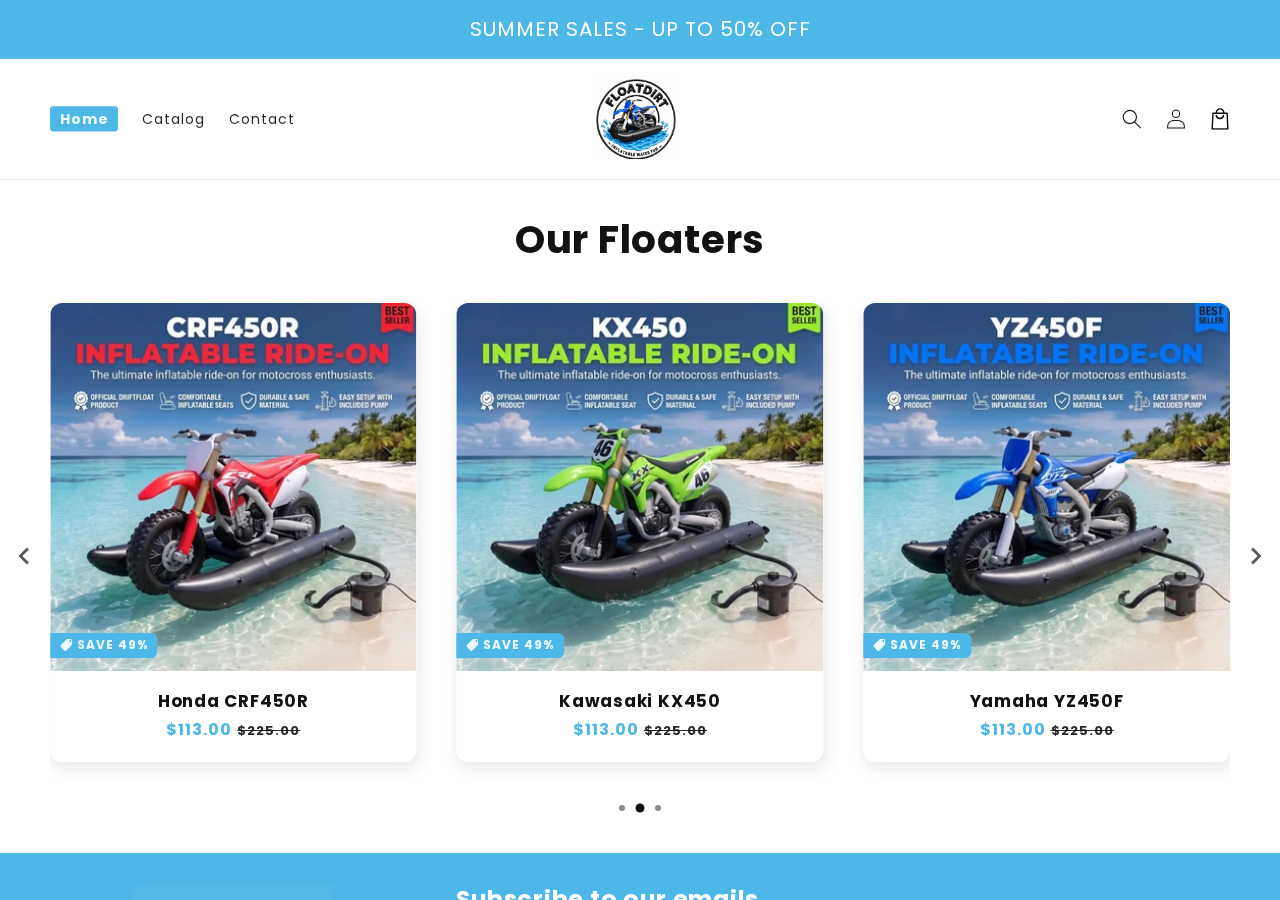
Floatdirt.store presents several versions inspired by well-known motocross models, including the Honda CRF450R, Kawasaki KX450, Yamaha YZ450F, Suzuki RM-450Z, and KTM 450 SX-F. Our screenshot captured the first three at $113 each, supposedly reduced from $225 during a summer sale.
The direct product page makes even bigger promises. It claims the inflatable uses dual jet motors, carries up to 400 lb, reaches speeds of 20 mph, and runs for 130 minutes on a single charge. It also says a pump is included and the product uses reinforced marine-grade PVC.
Those claims describe a substantial electric watercraft system, not a simple inflatable toy. Yet the store does not provide the engineering information a buyer would need to evaluate such a machine. There is no meaningful motor specification, battery voltage, battery capacity, charging system, waterproof rating, electrical certification, propulsor diagram, replacement-parts catalog, or independently verified test.
Complaints connected to this summer product pattern describe buyers receiving only a cheap passive inflatable, with no motors, battery, charger, or powered steering. Other customers may receive nothing, encounter tracking delays, or struggle to obtain a usable return address.
The safest conclusion is straightforward: do not order a Floatdirt Bike from Floatdirt.store. The offer combines implausible performance claims, unverified AI-style marketing, a recently registered website, questionable reviews, and a return policy that is not ready to support a real return.
What Floatdirt.store promises
The store describes its product as a premium “DIRTFLOAT” that can be used in a pool, lake, or calm water. According to the sales page, buyers simply connect the included pump, inflate the body, climb aboard, grab the wheel, and press the throttle.
Among the claims displayed at the time of our review were:
- Dual jet motors designed specifically for water floats.
- A top speed of up to 20 mph.
- Up to 130 minutes of operation on one charge.
- A weight capacity of up to 400 lb.
- Reinforced marine-grade PVC construction.
- Responsive throttle control suitable for first-time riders.
- An included pump and setup within minutes.
- A 30-day money-back guarantee with “no hassle” and “no hoops.”
A real product combining those features would require a battery pack, sealed controls, wiring, one or more motors, propulsion hardware, charging equipment, buoyancy engineering, and a structure capable of supporting the rider and electrical components. Each of those systems adds cost, weight, and safety requirements.
Floatdirt does not explain how its small advertised price covers that equipment. The lack of a technical manual is especially concerning because the page encourages use by both adults and families on lakes, where a power failure or puncture could become more than a simple product disappointment.
The domain was created only days ago
Registration records show that Floatdirt.store was created on July 29, 2026. That made the domain roughly one week old when we reviewed it on August 5, 2026.
A young domain does not prove fraud by itself. In this case, however, it conflicts with the image of a tested watercraft company that has already completed hundreds of orders, accumulated extensive customer feedback, designed five model variants, and established reliable fulfillment.
The product page claimed more than 100 orders in the previous 24 hours and displayed a 4.8 rating based on more than 300 “verified reviews.” The store does not identify the independent review platform, publication dates, or verification process behind those numbers.
The product photos do not prove the machine exists
The Floatdirt catalog uses highly polished images of motocross bikes mounted between black inflatable pontoons. The settings, product surfaces, lighting, proportions, and repeated promotional layout have the appearance of AI-generated or heavily composited advertising.
Even a flawless product image would not prove that a working item is available. What matters is independent, continuous evidence showing a real customer unpacking the exact retail box, identifying every component, charging the battery, installing the propulsion system, and operating it without cuts or hidden equipment.
The store does not provide verifiable engineering demonstrations from an established reviewer. Its testimonials are controlled by the seller and describe experiences that cannot be independently checked.
The motor claims lack basic specifications
“Dual jet motors” sounds impressive, but the phrase is not a specification. A careful buyer would need answers to several basic questions:
- What is the rated wattage of each motor?
- What voltage and chemistry does the battery use?
- What is the battery capacity in watt-hours?
- How long does a full charge take?
- Is the battery removable and replaceable?
- What waterproof and ingress-protection rating applies?
- How is the rider protected from the propulsion intake and moving parts?
- What safety certifications cover the charger, battery, and complete product?
- Who manufactures and services the system?
- Where can replacement batteries, controls, valves, and motors be purchased?
Floatdirt provides marketing language instead of these answers. That makes the 20 mph and 130-minute claims impossible for a shopper to evaluate responsibly.
The price does not fit the advertised hardware
The screenshot shows the floats at $113 after a claimed 49% discount. That price would already be high for a basic novelty inflatable, but it is extraordinarily low for an adult-capable electric watercraft with two motors, a rechargeable battery, controls, charger, pump, and marine-grade construction.
This price gap is part of the hook. Social media viewers compare $113 with the cost of a real jet ski, electric surfboard, or powered pool craft and feel they have discovered a factory-direct bargain. In reality, an unbelievable price can signal that the advertised machine is not what the seller intends to ship.
The FTC warns that social media ads offering expensive-looking products at unusually low prices may lead to sites that send a cheap substitute or nothing at all. Its online shopping scam guidance recommends researching the seller outside the platform and paying by credit card when possible.
The reviews and order counters are not reliable evidence
The Floatdirt product page surrounds the purchase button with more than 300 alleged reviews, recent-order messages, “going viral” language, low-stock warnings, and enthusiastic customer stories.
These elements are displayed by the merchant itself. There is no independent record showing that the reviewers bought the product, received a motorized version, or operated it for the periods described.
A store created at the end of July has had very little time to sell, manufacture, ship, and collect long-term customer feedback. Review counts and urgency messages should therefore be treated as advertising claims, not proof.
The return policy contains an unfinished placeholder
The product page promises a full refund within 30 days with “no questions asked.” The separate refund policy tells a very different story.
It says the product must be unused, in the same condition received, and inside its original packaging. A buyer would need to open, inflate, and inspect the item to discover that the advertised motors are missing, which can give the seller an excuse to argue that the product is no longer unused.
More importantly, the policy states that returns must be sent to [INSERT RETURN ADDRESS]. That is a template placeholder, not a usable warehouse address.
This defect makes the promise practically unreliable. A customer cannot calculate return shipping, verify the destination, or send the product back without first obtaining approval from an Outlook email address.
The checkout can cost more than the headline price
The purchase widget promotes multi-unit offers such as “buy 2 get 1 free” and “buy 3 get 2 free.” It also displays separate paid options for a 30-day warranty and shipping protection.
Shoppers should never assume the total equals the first price shown in the ad. Bundle selection, optional protection, shipping, taxes, currency conversion, and duplicate transactions can all produce a larger statement charge.
If you already ordered, compare the exact confirmation with the pending and posted amounts on your account. Treat any additional charge that you did not clearly authorize as a separate problem and report it promptly.
This is part of a wider summer scam pattern
Floatdirt is not an isolated idea. Each summer brings a new group of short-lived websites selling futuristic pool vehicles through viral videos. The brand names change, but the underlying offer remains remarkably similar.
MalwareTips has documented related campaigns involving the WaveSplash Motorized Float and the Rima Solo Jet Boat. Float Bump uses the same motorized-pool-toy theme through a separate newly created store.
When one domain accumulates complaints or loses its advertising accounts, another can appear with new colors, a new product name, and recycled AI media. Searching only the current brand is therefore not enough. Buyers must evaluate the product evidence, company identity, domain history, and return process.
Quick warning signs
- AI-looking videos show a product that is not demonstrated by independent owners.
- A complex motorized watercraft is sold for the price of an ordinary inflatable.
- The domain was registered only days before the advertising campaign.
- The website claims hundreds of reviews without an independent review source.
- Motor, battery, charger, waterproofing, and certification details are missing.
- Famous motorcycle model names appear without clear manufacturer authorization.
- Order counters, low-stock warnings, and sale banners pressure immediate action.
- Bundles and paid protection options can obscure the final amount.
- The 30-day guarantee conflicts with an unused-product return condition.
- The refund policy still contains an
[INSERT RETURN ADDRESS]placeholder.
How The Scam Works
The Floatdirt funnel turns a spectacular video into an impulse purchase before the shopper has time to investigate the hardware. Understanding the sequence makes the offer much easier to recognize on the next domain.
1. An AI-style video creates a product people want to believe in
The campaign begins with a short social media clip of a dirt bike apparently gliding across water. Fast movement, splashes, music, and close cuts make it difficult to inspect the product closely.
The concept combines two desirable products, a motocross bike and a personal watercraft, into one inexpensive summer toy. Curiosity does the first part of the selling.
2. Familiar motorcycle names make the catalog feel established
The store lists versions associated with Honda, Kawasaki, Yamaha, Suzuki, and KTM model names. Those names bring decades of engineering reputation into the shopper’s mind, even though the seller does not establish an official relationship with the manufacturers.
Different colors and models also make the storefront look like a complete product line instead of a newly assembled single-product shop.
3. A dramatic discount makes the risk feel affordable
The page presents $113 as a temporary summer-sale price rather than the normal value. A crossed-out $225 price and 49% saving create the feeling that hesitation will cost money.
The buyer is encouraged to compare the offer with a jet ski, not with the cheap passive inflatable that may be shipped.
4. Seller-controlled proof removes last-minute doubts
Hundreds of reviews, recent-order notices, low-stock messages, and emotional testimonials surround the purchase controls. Because all of them appear on the same store, none provides independent verification.
The page repeats the strongest claims in an FAQ so they look like answers to genuine customer concerns. No supporting manual, test report, or outside review accompanies them.
5. Bundles and protection options increase the order value
Once the shopper accepts the core promise, the store promotes three-unit and five-unit packages. Paid warranty and shipping protection options can increase the total again.
Someone who intended to test one item can therefore authorize a much larger transaction. A hurried mobile checkout makes quantities and add-ons easier to overlook.
6. The seller receives payment before the mismatch is visible
The decisive moment occurs at checkout, long before the buyer can inspect a motor, battery, or serial number. The seller already has the money and contact details while the customer has only images and promises.
Long fulfillment times can consume part of the card-dispute and return window. Tracking may show a lightweight parcel even though the advertised product should include heavy electrical equipment.
7. A cheap inflatable may satisfy the tracking record
Sending a low-value inflatable allows the merchant to show that a package was delivered. That can complicate a dispute if the buyer describes the problem only as non-delivery.
The accurate complaint is that the merchandise was materially different from the motorized product advertised. Save the advertising claims and document the unboxing so the missing motors, battery, charger, controls, and accessories are clear.
8. The refund path becomes the next obstacle
The buyer contacts the seller and may receive delays, repeated requests for photos, a small partial-refund offer, or instructions to return the item. The published policy requires prior approval and an unused condition.
Because the return-address field is unfinished, the customer cannot independently send the parcel to the location promised at purchase. An overseas destination, if eventually supplied, may cost nearly as much as the order.
9. The campaign can reappear under another name
When complaints become visible, advertising platforms remove the ads, or payment processing becomes difficult, the same creative idea can move to another domain. New brand names reset search results and make the offer look undiscovered again.
This is why a disappearing store is not the end of the scheme. It is often the beginning of the next version.
What To Do If You Have Fallen Victim
If you ordered a Floatdirt Bike, act while the transaction, advertisement, and website are still easy to document. Stay calm and describe the problem precisely.
- Save the complete advertisement immediately. Capture the social post, video, landing-page URL, product description, 20 mph claim, 130-minute runtime, dual-motor statement, price, bundle, guarantee, and checkout total. Pages can change after complaints begin.
- Preserve the order records. Keep the confirmation email, invoice, merchant descriptor, tracking number, shipping label, and every support message. Record the promised delivery date and the date each contact attempt was made.
- Check the card statement for the exact total. Compare the authorized order with pending and posted charges. Look for extra quantities, warranty fees, shipping protection, currency adjustments, duplicate transactions, and unfamiliar merchant names.
- Do not rely only on the seller’s return clock. Contact the card issuer promptly if the amount is wrong, the merchant is unresponsive, or the item was not delivered as agreed. Bank and card-network deadlines may be different from the store’s 30-day wording.
- Film the unopened parcel and unboxing. Show the shipping label, parcel size, seal, contents, and every included component in one continuous recording when possible. A lightweight box can help demonstrate that it could not contain the advertised propulsion and battery system.
- Describe a substitute product accurately. If you received a passive inflatable with no motors, state that the merchandise was materially different from the advertised motorized watercraft. List each missing component rather than saying only that the quality was disappointing.
- Request a refund in writing. Use the published email and contact form, state the order number and requested resolution, and ask for a prepaid return label and complete return address. Do not accept vague instructions that would make the parcel untraceable.
- Be cautious with partial-refund offers. A seller may offer a small percentage if you keep the item. Accepting it can complicate a later dispute. Ask the card issuer how a partial refund would affect your rights before agreeing.
- Dispute an incorrect or unauthorized charge promptly. The FTC explains that credit card billing errors can include the wrong amount, duplicate charges, unauthorized charges, and merchandise not delivered as agreed. Its billing and non-delivery guide recommends keeping all documents and contacting the issuer right away.
- Ask the bank whether the card should be replaced. If additional charges appear or the merchant descriptor changes, a replacement number may be appropriate. Continue monitoring the account after a dispute is opened.
- Report the store and advertisement. Report the social media ad, then submit the website, transaction details, and screenshots to the FTC at ReportFraud.ftc.gov. If Shopify requests a store-abuse report, provide the same evidence without sending unnecessary identity documents.
- Do not use an unverified product on open water. A substitute inflatable with unknown materials, valves, weight capacity, or safety testing should not be treated as a powered watercraft or lifesaving device. Keep it away from children while the dispute is documented.
The Bottom Line
Floatdirt.store advertises an extraordinary motorized dirt bike float but provides none of the technical transparency expected from a company selling electric watercraft. Its one-week-old domain, AI-looking visuals, unsupported reviews, implausible price, add-on-heavy checkout, and unfinished return address form a clear scam pattern.
Do not order the Floatdirt Bike. If a cheap inflatable without motors arrives, document it as merchandise that was not delivered as advertised, contact the seller in writing, and take the evidence to your card issuer quickly. When this storefront disappears, expect the same fictional summer machine to return under another name.








