

A small electric bumper boat that inflates in minutes and lets children and adults cruise around a backyard pool sounds like an easy way to transform summer. Social media advertisements for Float Bump make that promise look polished, affordable, and ready to ship.
The sales page tells a much less convincing story when its dates, reviews, specifications, prices, and refund process are examined together. Shoppers should do that comparison before trusting the blue pool float shown in the videos.
Overview
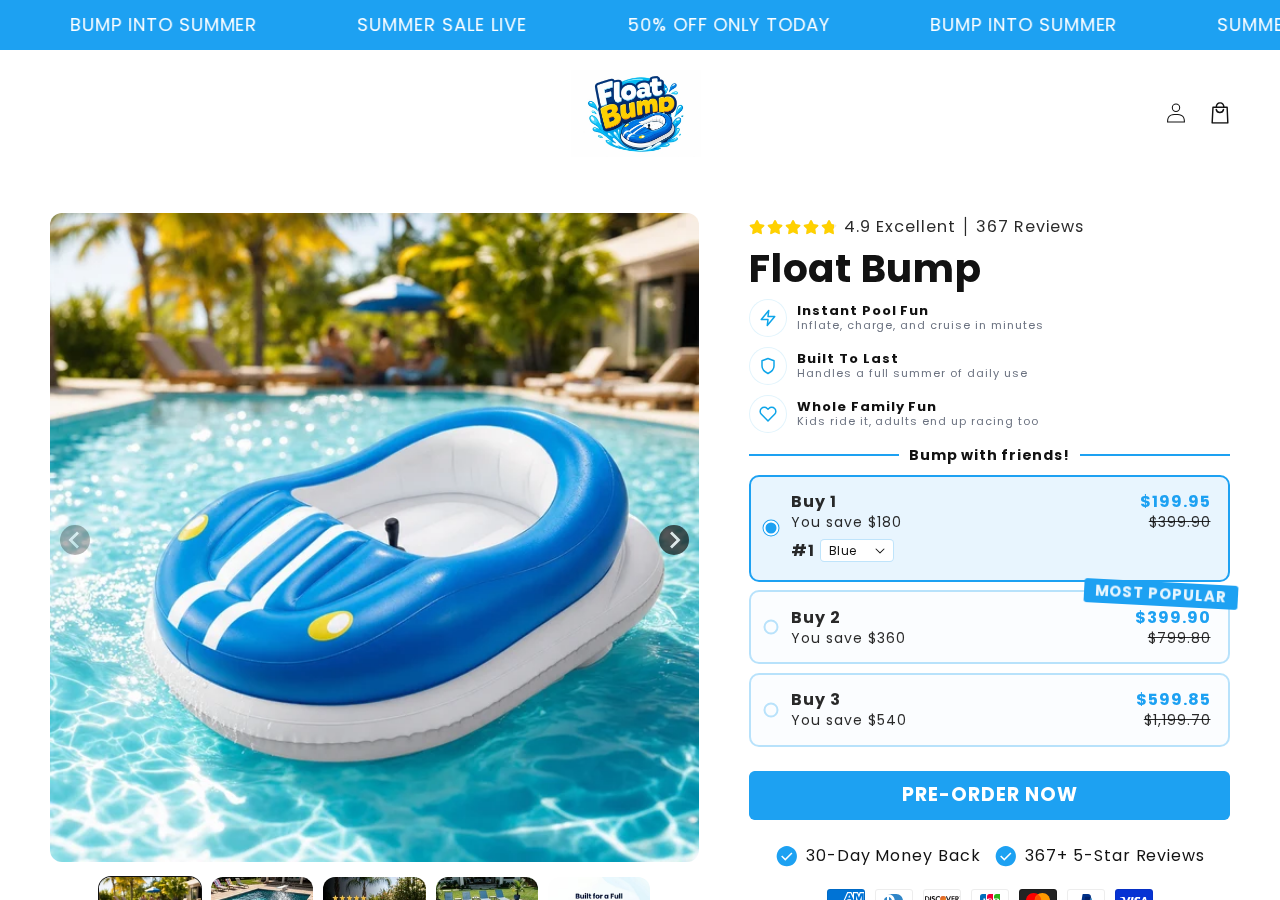
The Float Bump scam is a deceptive social media shopping campaign for what appears to be a rechargeable, self-propelled bumper boat. Videos and sales images show an inflatable blue or red craft with a seat, joystick, and motorized movement around a swimming pool.
Floatbump.com says customers can “inflate, charge, and cruise in minutes.” The page claims the rear motor moves the craft at a gentle speed, the joystick is simple enough for children, the inflatable supports adults, and the material can survive a full summer of daily bumping.
A single Float Bump was listed at $199.95 when we captured the page. The store also offered two for $399.90 and three for $599.85, while describing the larger quantities as substantial savings. Those totals are simply two and three times the single-unit price.
Reports associated with this viral summer-product pattern describe a very different outcome. Instead of receiving the working bumper boat shown in AI-generated or heavily manipulated social videos, buyers may receive a low-cost inflatable shell with no motor, battery, charger, or powered controls.
Other warning signs make the offer even harder to trust. Floatbump.com was registered only on July 27, 2026. Nine days later, it was already claiming 367 reviews, publishing testimonials about months of use, and simultaneously labeling the product a pre-order.
The store promises a 30-day money-back guarantee, but its standard refund-policy URL returns a 404 page. The product page provides a reassuring sentence about contacting the company, not a complete return process that identifies eligibility conditions, a destination, who pays shipping, or how refunds are approved.
Our recommendation is clear: do not order Float Bump from Floatbump.com. The campaign shows the same bait-and-switch indicators seen across a growing collection of motorized pool-float websites that appear during summer, run aggressive social ads, and can be replaced quickly when complaints spread.
What the Float Bump sales page promises
Float Bump is not marketed as an ordinary inflatable seat. The store repeatedly presents it as a powered pool vehicle that “actually drives itself” and provides “real bumper-car fun on the water.”
At the time of our review, the page claimed:
- A rechargeable rear motor.
- Simple joystick steering.
- Controlled speed for backyard pools.
- Enough capacity for both children and adults.
- Reinforced, puncture-resistant construction.
- Setup in four steps: inflate, charge, climb in, and cruise.
- Five-to-eight-business-day processing and another five to eight business days for delivery.
- A 30-day money-back guarantee.
- A 4.9 rating and 367 reviews.
The product page displays a large lifestyle image, testimonials, a comparison with ordinary floats, and a pre-order button. It does not provide the technical documentation needed to verify that the electrical propulsion system in the video is included in the box.
The website is new, but the reviews claim months of use
Authoritative domain-registration data records Floatbump.com as created on July 27, 2026. Its privacy policy was updated on August 5, the same day we reviewed the site.
Despite that very short history, the sales page claims 367 families have reviewed the product. One featured testimonial says a family is “three months in” with two boys and the product still holds air perfectly.
That timeline does not fit a store that had existed for only nine days. The company could theoretically claim earlier sales through another channel, but the page identifies no previous domain, established manufacturer, retailer, dated launch, or independent review platform that would explain the history.
A newly registered domain can sell a real product, but it cannot create three months of experience through that domain in nine days. The contradiction severely undermines the “verified” labels and the displayed review total.
“Pre-order now” conflicts with hundreds of customer reviews
The main purchase button says “PRE-ORDER NOW.” A pre-order normally means the product is not yet generally available for immediate fulfillment.
That message appears alongside claims that hundreds of families already own the craft, children use it daily, adults race it, and customers have tested its durability for months. Both presentations cannot be accepted without an explanation.
If the item is genuinely in pre-order, the seller should disclose the manufacturing status, expected release date, shipment schedule, cancellation rights, and whether the card is charged immediately. Float Bump instead surrounds the pre-order with the appearance of a mature, heavily reviewed product.
The store never identifies the electrical system
The page says “plug in the rear motor and let it charge,” but does not provide the most basic information about that motor or its power source.
Missing details include:
- Motor wattage and manufacturer.
- Battery voltage, chemistry, and capacity.
- Expected runtime per charge.
- Full charging time.
- Charger input and electrical certification.
- Waterproof and ingress-protection ratings.
- Maximum rider weight in pounds.
- Propulsion guard and entrapment protection.
- Replacement-battery and spare-parts availability.
- Instructions for storage, winterization, repair, and disposal.
A real manufacturer of a rechargeable pool craft would treat those details as essential. Float Bump replaces them with phrases such as “instant pool fun,” “built to last,” and “whole family fun.” Those are advertising slogans, not evidence.
The price is presented as a huge discount
The store lists one Float Bump at $199.95 against a crossed-out $399.90 reference price. A scrolling banner repeats “50% off only today” many times.
The offer claims a buyer saves $180 on one unit, $360 on two, and $540 on three. Yet each added unit costs the same $199.95. There is no additional bundle reduction when moving from one to two or three products.
The large savings exist only in comparison with the store’s own higher reference price. The page does not establish that the product was previously sold in meaningful quantities for $399.90.
FTC guidance warns that social ads featuring surprisingly cheap products can lead to sites that send a low-value substitute or nothing at all. The agency recommends checking the seller outside the social platform, reading the full return terms, and using a credit card for stronger dispute protections.
AI-generated videos can make a fictional motor look real
Generative video is particularly effective for a product like Float Bump. A short clip needs only to show a bright object moving through splashing water for a few seconds. Motion blur, reflections, quick camera cuts, and compression hide inconsistent edges and impossible mechanical details.
A viewer sees the joystick and assumes it connects to a motor. They see the craft move and assume the inflatable sold on the landing page created that motion. Neither assumption is established by a social video.
Before buying any motorized pool product, look for a continuous independent demonstration that shows the retail box, exact components, battery label, charger, motor attachment, startup procedure, steering response, measured runtime, and safe shutdown. Float Bump does not provide that level of proof.
A cheap inflatable can resemble the still images
The front of the advertised craft can be reproduced as a basic vinyl pool float with a molded-looking seat and decorative joystick. In a still photograph, that shell may look close enough to the promotion.
The value promised by the advertisement, however, comes from powered movement. If the delivered item has no motor, battery, charger, wiring, throttle, or functioning steering, it is not a slightly lower-quality Float Bump. It is materially different merchandise.
This distinction is important when contacting a card issuer. “I did not like the quality” is weaker and less accurate than “the seller advertised and charged me for a rechargeable motorized bumper boat but delivered an unpowered inflatable with the propulsion system missing.”
The 30-day refund promise has no working policy behind it
The product page displays “30-Day Money Back” near the purchase button and says buyers can contact the company if the item is not a fit. The store does not place a refund-policy link in its footer.
When we checked the standard Shopify refund-policy address, the site returned a 404 Not Found page. That means a shopper cannot review a complete published policy before ordering.
Important questions remain unanswered:
- Must the product be unopened or unused?
- Who pays return shipping?
- Where is the return warehouse?
- Are pre-orders refundable before shipping?
- Are sale items excluded?
- Is a return authorization required?
- How long does inspection and approval take?
- Are original shipping and protection fees refunded?
A guarantee is useful only when a buyer can follow it. A one-sentence promise without an accessible policy leaves the seller in control of every practical detail after payment.
The company identity is thin
The privacy policy lists an email address at the Float Bump domain and an address in Sheridan, Wyoming. It does not identify a legal company name, founder, product designer, electrical engineer, manufacturer, service center, telephone support line, or established water-sports business behind the product.
The store offers no repair network or parts catalog for an item that combines inflatable materials, a battery, electronics, and propulsion. If the motor fails or the charger is lost, buyers have no demonstrated support structure.
Quantity errors and larger charges require close attention
The page gives prominent options for one, two, or three units. On a small phone screen, it is easy to select a larger package or fail to notice which quantity remains active.
Buyers connected to this style of store also report concerns about charges exceeding the intended order. That may involve quantity, duplicate transactions, shipping, protection fees, taxes, or a different merchant descriptor.
Do not wait for delivery before checking the amount. Compare the confirmation page, email receipt, pending authorization, and final posted charge as soon as the order is placed.
Float Bump belongs to a repeating summer storefront cluster
The same concept appears under many names: an inflatable jet ski, ride-on car, dirt bike, bumper boat, lounge chair, or tiny jet boat that supposedly contains powerful electric propulsion at an implausibly low price.
MalwareTips has already examined the WaveSplash Motorized Float and the Rima Solo Jet Boat. The related Floatdirt Bike scam uses motorcycle-shaped floats and claims 20 mph performance from dual jet motors.
These sites can be launched from templates, filled with generated images and reviews, promoted heavily for a short season, and replaced when refund complaints become searchable. The product name is less important than the recurring structure.
Quick warning signs
- The social videos look AI-generated or mechanically inconsistent.
- The domain is only days old.
- A pre-order product supposedly has 367 customer reviews.
- A testimonial claims three months of use on a nine-day-old store.
- The merchant does not identify the motor, battery, charger, or runtime.
- The site targets children but provides little safety documentation.
- “50% off only today” repeats without evidence of regular-price sales.
- Two- and three-unit packages do not reduce the per-unit price.
- The money-back promise has no working refund-policy page.
- The company behind the product is not clearly identified.
How The Scam Works
Float Bump uses a compact, familiar sales journey. The shopper moves from an entertaining video to a high-value checkout before seeing any independently verified hardware.
1. A viral video turns an ordinary pool float into a vehicle
The ad shows riders steering, bumping, racing, or circling a pool. The craft appears to move under its own power, which separates it from the inexpensive inflatables available at ordinary retailers.
The motor is the entire reason to pay $199.95, yet it is also the part most easily invented or exaggerated through AI video.
2. The landing page repeats the movement claim
The shopper arrives at Floatbump.com and sees phrases such as “inflate, charge, and cruise” and “actually drives itself.” A four-step diagram describes plugging in the rear motor and controlling the craft with a joystick.
This continuity between ad and landing page reassures the buyer without adding verifiable specifications.
3. Family language lowers technical skepticism
The page focuses on children, parents, pool parties, and friendly races. A gentle backyard toy feels less like a serious electrical watercraft purchase, so shoppers may not ask about battery chemistry, waterproofing, certification, or entrapment hazards.
Emotional family testimonials replace the engineering documentation that should support the safety claims.
4. Reviews manufacture a mature customer history
A 4.9 score, 367 reviews, verified labels, and stories from parents make the new store look established. The dates and pre-order status reveal that this apparent history is not credible.
Visitors who do not check the domain age see only a community of satisfied families.
5. A temporary discount encourages immediate checkout
The repeated “50% off only today” banner makes research feel expensive. Waiting until tomorrow supposedly means losing $200 per unit.
Because the sale can remain in place or reset, the safest response is to close the page and investigate without the advertisement’s timer.
6. Multi-unit options raise the potential loss
The page encourages buyers to purchase several boats so family members can bump and race together. A three-unit order reaches $599.85 before any additional charge.
The marketing story itself makes one unit sound incomplete. This is a deliberate way to convert a questionable $199.95 purchase into a much larger transaction.
7. Payment is collected before fulfillment is proven
The button says pre-order, so the buyer may accept a delay. Processing and delivery are each described as taking five to eight business days, potentially creating a wait of 10 to 16 business days before further delays.
During that time, the seller controls the order information and the customer has no physical product to inspect.
8. A low-value parcel creates proof of delivery
A basic inflatable can be shipped cheaply and tracked to the buyer. The delivery scan may then be used to resist a claim that nothing arrived.
The customer must show that the delivered item lacks the motorized system central to the advertisement. Photos of the unpowered shell, package weight, and missing accessories are essential.
9. The missing refund policy creates friction
The buyer searches for the 30-day guarantee and finds no complete policy. Support may ask for photos, delay replies, offer a partial refund, or supply a costly return destination after the request is approved.
Every delay consumes time while the card issuer’s dispute deadline continues to run.
10. A replacement store carries the same video into the next campaign
The product can be renamed and sold through a new Shopify storefront with a fresh domain, new review count, and slightly different blue logo. The AI video can keep circulating even after the original website stops responding.
Consumers searching the old name find fewer warnings about the new one, allowing the cycle to repeat throughout the summer.
What To Do If You Have Fallen Victim
If you placed a Float Bump order, separate the problem into evidence, seller contact, payment protection, and product safety. Acting early provides more options.
- Capture the current product page. Save the $199.95 price, motor and joystick claims, pre-order button, 367-review count, 30-day guarantee, shipping statement, selected quantity, and checkout total. Keep the original social video if possible.
- Review the confirmation immediately. Verify whether the order is for one, two, or three units. Compare product charges, shipping, protection, taxes, and the total with what you intended to authorize.
- Check both pending and posted transactions. A pending amount can change when it posts. Watch for duplicate charges, a larger total, or a merchant name that does not match Float Bump.
- Contact the seller in writing. If you want to cancel a pre-order, do so immediately and keep proof. Request the complete refund terms, cancellation confirmation, and expected credit date.
- Do not let seller delays exhaust your dispute window. Contact the card issuer promptly if the seller refuses cancellation, charges the wrong amount, fails to ship as promised, or stops responding. Ask which documents and deadlines apply.
- Record the package before opening it. Photograph every side, label, declared weight, and seal. Film the unboxing in one continuous shot so the seller cannot claim that motors or accessories were removed later.
- List every missing advertised component. If you received only an inflatable, identify the absent motor, battery, charger, joystick connection, wiring, controls, instructions, and propulsion hardware. Save screenshots showing each feature was part of the sales promise.
- Use accurate dispute language. Explain that the item was not delivered as agreed and is materially different from the motorized product advertised. Also report an incorrect amount, duplicate billing, or unauthorized add-on separately when applicable.
- Keep seller conversations factual. State the order number, date, amount, promised product, actual contents, and requested remedy. Avoid sending extra identity documents or card images to an unverified support address.
- Ask before accepting a partial refund. A small offer to keep the inflatable may close the seller’s case or complicate the bank dispute. Confirm the effect with the issuer first.
- Use FTC dispute guidance. The FTC’s online shopping guide explains that credit card users can dispute duplicate charges, wrong amounts, undelivered merchandise, and goods not delivered as agreed. Contact the issuer quickly and preserve written evidence.
- Report the ad and store. Report the social media account and video, submit a fraud report at ReportFraud.ftc.gov, and provide the storefront evidence to the e-commerce platform or payment processor through official abuse channels.
- Do not put an unknown inflatable into use. A substitute product without verified construction, valves, capacity, labeling, or safety testing should not be treated as a motorized craft or flotation safety device. Keep children away from it while documenting the claim.
- Monitor for more summer-product scams. The email, phone number, address, and buying interest supplied at checkout can be used for retargeting. Expect ads and messages for similar jet boats, ride-on floats, and clearance offers.
The Bottom Line
Floatbump.com asks shoppers to believe that a nine-day-old pre-order store already has 367 reviews and customers with three months of product experience. It provides no meaningful motor or battery specifications, repeats a 50% discount, pushes orders up to $599.85, and offers a 30-day guarantee without a working refund-policy page.
Do not order Float Bump. If an unpowered inflatable arrives instead of the rechargeable bumper boat shown in the videos, preserve the advertisement and unboxing, report the product as materially different, and contact your card issuer without waiting for an impossible return process to resolve itself.








