

AquaCruiser is being promoted as an inflatable electric lounger that supposedly carries an adult across the water using built-in motors and hand controls.
The social media ads make it look real, powerful, and surprisingly affordable. However, the website behind the offer contains multiple warning signs, including apparent AI-generated product images, copied sales text, inconsistent branding, weak contact information, and refund language that may leave buyers with no practical way to return the item.
The most serious risk is a classic bait-and-switch: you order the motorized AquaCruiser shown in the videos, but receive a basic inflatable float without the advertised motor—or receive nothing at all.
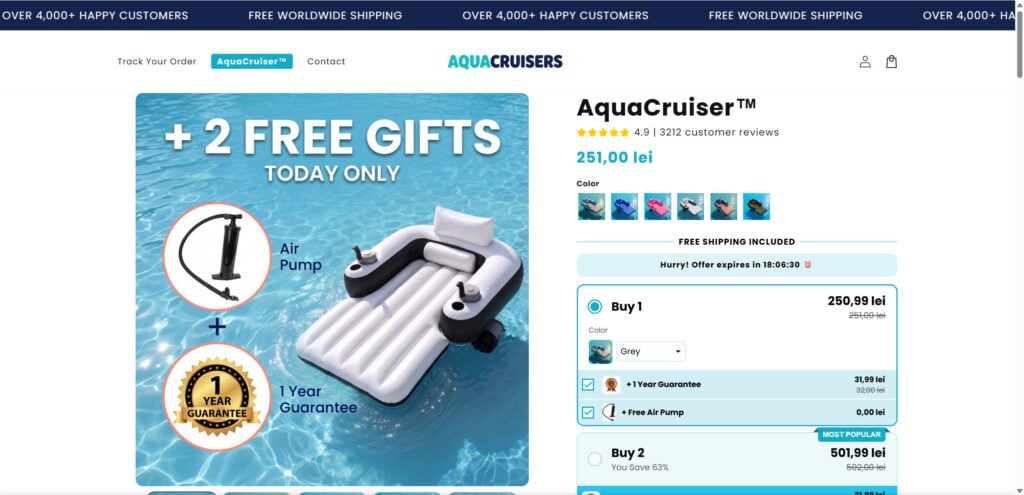
What Is AquaCruiser?
AquaCruiser is advertised as a motorized inflatable pool lounger with two hand controls, an electric propulsion system, and enough strength to carry an adult weighing up to 350 pounds.
The product page claims the float can travel at up to 6 mph and run for approximately 50 minutes on a full battery. It is shown at a heavily discounted price of £40, reduced from £108, despite being sold through a website that uses “USA” in its domain name. The page also displays a 4.9 rating based on 3,212 customer reviews.
According to the description, buyers simply inflate the AquaCruiser, charge its battery, climb aboard, and use the hand controls to move around pools, lakes, beaches, and calm rivers.
That is the product being sold in the advertisement.
The problem is that the website does not provide convincing evidence that customers will actually receive that motorized product.
The AquaCruiser Images Appear AI-Generated
The AquaCruiser sales page relies heavily on glossy product images showing an inflatable lounger floating perfectly in clear blue water. The shape, lighting, shadows, motor placement, and artificial-looking water effects suggest that at least some of these visuals may be AI-generated or heavily manipulated rather than photographs of a real production model.
This matters because AI-generated product advertising has made bait-and-switch scams much easier to operate.
A seller no longer needs to manufacture a working prototype, organize a photo shoot, or record a real demonstration. They can generate realistic images and videos of a product that does not exist in the form being advertised.
The result can look extremely convincing on TikTok, Facebook, Instagram, or YouTube Shorts. Viewers see someone apparently relaxing on a powered pool float, turning with the controls, and moving effortlessly across the water.
But an AI-generated demonstration proves nothing. It does not prove that the product exists, that it contains a motor, or that customers will receive what they see in the video.
The Same Sales Copy Appears on Multiple Unrelated Stores
Another major warning sign is that AquaCruiser’s advertising copy is not original.
The same wording about inflating the “Floatking,” charging the battery, and using hand controls appears on several other online stores selling similar viral water products. The same customer testimonials and performance claims also appear under different product and store names.
This makes the AquaCruiser website look less like the official store of a real manufacturer and more like one version of a recycled dropshipping template.
Even the AquaCruiser page cannot keep its product name consistent. It calls the item AquaCruiser in some places, FloatCruiser in others, and tells buyers to “inflate the Floatking” in the instructions.
A real manufacturer should know the name of its own product.
When several websites use the same text, the same testimonials, and the same technical claims while changing only the brand name, there is no reason to trust that any of them actually designed or manufactured the item.
How the AquaCruiser Scam Works
Step 1: AI Videos Create an Impossible-Looking Product
The scheme begins with a highly engaging social media advertisement.
The video shows an adult sitting comfortably on an inflatable lounger while electric motors move it through a pool or lake. The rider appears to steer using the two controls built into the armrests.
The product looks new, convenient, and fun. Because the video is short and fast-moving, viewers do not have time to inspect the details closely.
Some of these ads may use entirely AI-generated footage. Others may combine real inflatable products with computer-generated motion, edited motors, or clips taken from unrelated manufacturers.
The purpose is not to demonstrate the product accurately. It is to make viewers stop scrolling.
Step 2: An Unrealistic Discount Encourages an Impulse Purchase
After clicking the advertisement, shoppers are taken to a polished Shopify product page.
AquaCruiser is shown at £40, reduced from £108. The page repeatedly promotes free worldwide shipping, thousands of happy customers, and a large number of positive reviews. It also tells visitors that hundreds of people supposedly have the product in their carts.
These details create urgency.
The shopper is encouraged to believe that the product is popular, nearly sold out, and available for a limited time at a huge discount. Instead of researching the company, the buyer rushes through checkout before the offer disappears.
That is exactly what the seller needs.
Step 3: The Website Collects the Payment
The customer pays for what appears to be a motorized inflatable lounger.
However, the website does not provide a detailed motor specification, battery capacity, charger certification, motor manufacturer, replacement parts information, safety documentation, or a verifiable company address.
The checkout page may work normally because the store uses a standard ecommerce platform and recognized payment processors. That does not make the product claims legitimate.
A professional-looking payment page only confirms that the website can accept money.
Step 4: A Cheap Inflatable May Be Shipped From China
The most likely bait-and-switch outcome is that the customer receives a basic inflatable lounger without the electric motors shown in the advertisement.
The parcel may contain an ordinary inflatable chair, pool float, miniature version, or another low-cost product selected simply so the seller can prove that something was delivered.
The AquaCruiser website does not clearly disclose its shipping origin. However, closely related inflatable and motorized floats are widely available from Chinese wholesale suppliers, making a China-based dropshipping operation plausible. Chinese listings include everything from basic inflatables costing around $16 to actual motorized products that cost considerably more than the AquaCruiser retail offer.
That price difference matters.
A retailer cannot realistically sell a complete adult-sized inflatable, two motors, battery, charger, controls, free gifts, worldwide shipping, payment-processing fees, and customer support for £40 unless the product is dramatically different from what the advertisement shows.
The cheap parcel may technically match a vague part of the description because it is an inflatable water float. But it may not include the motors, battery, controls, or performance promised in the AI-generated videos.
Step 5: Delivery Makes the Payment Dispute Harder
Sending a cheap item serves an important purpose.
Once tracking shows that a parcel was delivered, the seller may argue that the order was fulfilled. The buyer then has to prove that the product was significantly different from what was advertised.
This is harder than disputing an order that never arrived.
The customer must photograph the package, document what was missing, save the original advertisement, and explain to the bank or payment provider that the delivered inflatable was not the motorized AquaCruiser shown on the website.
Meanwhile, the seller can point to the tracking number and claim successful delivery.
Step 6: The Buyer Discovers There Is No Practical Return Process
The product page advertises a “30-Day Guarantee,” but its clearest refund promise applies when an order arrives damaged. It says the seller will replace or refund an item that is delivered damaged, while failing to clearly explain what happens when the product is undamaged but completely different from what was advertised.
That distinction creates a serious problem.
A cheap inflatable without a motor may not technically be damaged. It may simply be the wrong or inferior product.
The seller can therefore refuse the refund by claiming that the item arrived in usable condition. Alternatively, the customer may be told to return the product to a warehouse in China at their own expense.
International tracked return shipping can cost as much as, or more than, the original order. The seller may also require the parcel to arrive within a limited period, remain unused, and include the original packaging.
In practical terms, that can make the advertised guarantee worthless.
Step 7: Customer Support Stops Responding
AquaCruisersUSA.com does not present a clear public business identity on its contact page. Customers are given a basic contact form, but no visible company address, customer-service phone number, direct support email, or identified legal business entity.
If the seller stops replying, the customer has nowhere else to go.
There is no physical storefront to contact, no known US office despite the “USA” domain name, and no clearly identified company against which to pursue a conventional return.
At that point, the buyer’s remaining option is usually a payment dispute.
The Website Itself Is Extremely Inconsistent
AquaCruisersUSA.com does not look like a stable, established water-products business.
At the time of review, the homepage was not even focused on AquaCruiser. Instead, it described handcrafted wooden manta-ray sculptures supposedly made by someone named Ray in a family workshop. The homepage also included unrelated testimonials about building decorative wooden products.
The product page, meanwhile, sells a motorized inflatable water lounger.
That is not a small spelling error or outdated banner. It suggests that the store has reused a website template from a completely different viral product campaign.
The website also shifts between AquaCruiser, FloatCruiser, and Floatking. It promotes more than 4,000 happy customers, while its homepage refers to only 150 reviews and its product page displays 3,212 reviews.
These contradictions make the displayed customer numbers difficult to trust.
Thousands of Reviews on a One-Month-Old Website
Independent domain analysis shows that AquaCruisersUSA.com was registered on June 29, 2026. At the time of the check, the domain was only around one month old. Gridinsoft gave it a trust score of 5 out of 100 and reported two security-provider warnings.
That short history clashes with the store’s claim of more than 4,000 happy customers and thousands of product reviews.
It is theoretically possible for a new store to process thousands of orders quickly. However, the website provides no independent review profile, established social-media history, corporate records, or other evidence supporting those figures.
The reviews displayed on the product page are controlled by the seller. They should not be treated as independently verified customer experiences.
The Price Does Not Make Sense
The AquaCruiser offer fails a basic reality check.
Real motorized inflatable floats require waterproof motors, propellers, rechargeable batteries, control systems, sealed wiring, a charger, reinforced PVC, safety testing, packaging, and international shipping.
Chinese wholesale marketplaces list real motorized pool floats at prices that can already exceed AquaCruiser’s £40 retail price before international shipping, advertising costs, taxes, payment fees, and profit are added.
A legitimate seller cannot normally offer all of that for less than the wholesale cost of the underlying product.
The low price makes more sense when viewed as bait. It is cheap enough to attract impulse buyers and low enough that some victims may decide it is not worth the time or expense of fighting for a refund.
You May Receive an Inflatable Without a Motor
This is the central risk.
The advertisement sells a powered watercraft. The parcel may contain only an inflatable.
It may look vaguely similar in shape and color, but have no functional propulsion system, no rechargeable battery, no working controls, and no ability to move under its own power.
Some buyers may receive an extremely small or cheaply constructed version. Others may receive a completely unrelated pool float. There is also a risk that no usable product arrives at all.
Do not assume that receiving a tracking number means you will receive the item shown in the advertisements.
No Dependable Returns
The website’s guarantee should not be mistaken for dependable buyer protection.
Its refund language focuses on items that arrive damaged, not products that are materially different from the advertising. The contact page does not provide the transparent company and return information a buyer would expect from an established retailer.
A customer who receives a cheap inflatable without a motor may therefore be told that the item is not defective and does not qualify for a refund.
Even when a return is offered, sending a large inflatable back to China with tracking can be expensive and complicated. This creates an effective “no returns” situation, regardless of what the guarantee banner claims.
Final Verdict: Do Not Order AquaCruiser
AquaCruiser looks like a high-risk viral ecommerce offer built around AI-generated or heavily manipulated marketing.
The site advertises a motorized adult pool lounger for an unrealistic price, uses sales copy copied across multiple stores, switches between several product names, displays questionable customer-review numbers, provides almost no verifiable company information, and operates from a domain that was registered only recently.
Its homepage even promotes an entirely unrelated wooden manta-ray product, suggesting that the store template has been hastily recycled from another campaign.
The likely risk is straightforward: you pay for the motorized AquaCruiser shown in social media videos and receive a cheap inflatable without a motor, shipped through an overseas dropshipping supplier. When you request a refund, you may be ignored, refused, or told to return the item to China at your own expense.
Do not order AquaCruiser from AquaCruisersUSA.com.
What To Do If You Already Ordered AquaCruiser
Start by saving every piece of evidence. Take screenshots of the social media advertisement, product images, motor claims, battery claims, price, checkout page, order confirmation, shipping promise, and guarantee.
Contact the seller in writing and ask them to confirm that your order includes the electric motors, battery, charger, and hand-control system shown on the product page. Do not accept a vague response saying that the correct “AquaCruiser product” has been sent.
When the package arrives, record yourself opening it. Make sure the shipping label, sealed parcel, and contents are visible in one continuous video. This can help prove that the motorized components were missing.
If the product does not match the advertisement, contact your credit-card issuer, bank, PayPal, or other payment provider and open a dispute for an item that was significantly not as described.
Do not let the seller delay the process with repeated promises, replacement offers, or requests to wait several more weeks. Payment disputes have deadlines, and waiting too long can reduce your chances of recovering the money.
FAQ
Is AquaCruiser legit?
AquaCruiser does not look like a trustworthy purchase. The site is extremely new, its content is inconsistent, its product copy appears across multiple unrelated stores, and the advertised price does not match the cost of a genuine motorized float.
Is AquaCruiser a scam?
The available warning signs strongly suggest a high-risk bait-and-switch operation. Buyers should not order from the website.
Does AquaCruiser really have a motor?
The website claims it includes an electric motor, battery, and hand controls. However, there is no convincing independent evidence showing that customers receive the complete motorized product presented in the ads.
What might AquaCruiser customers receive?
Customers risk receiving a basic inflatable float without a motor, battery, charger, or working controls. They may also receive a smaller or cheaper product than the one advertised—or nothing at all.
Are the AquaCruiser videos real?
The images and videos appear AI-generated or heavily manipulated. They should not be treated as evidence that a working consumer product exists or will be delivered.
Is AquaCruiser shipped from the United States?
The website does not clearly disclose its shipping origin or provide a verifiable US business address. The product appears consistent with items sourced through Chinese wholesale and dropshipping suppliers.
Can I return AquaCruiser?
A dependable return process is not clearly provided. The website’s strongest refund language focuses on damaged products, which may leave buyers unprotected when an undamaged but incorrect inflatable arrives.
Why is AquaCruiser so cheap?
The £40 price is far below what a genuine adult-sized motorized inflatable would normally cost after the motor, battery, charger, materials, shipping, and retailer expenses are included. The low price is one of the offer’s biggest warning signs.
What should I do if I received an inflatable without a motor?
Photograph and record the package, keep the shipping label, save the original advertisement, contact the seller in writing, and promptly open a payment dispute for an item that was significantly not as described.
Should I order AquaCruiser?
No. The offer is too risky, and there is a serious possibility that the delivered product will not include the motorized system shown in the advertising.

Join the discussion
0 commentsShare your experience or ask a question about this article.
Discussion
Start the conversation
Have a question or something useful to share? Add the first comment.