

An official-looking notice about expiring vehicle protection can trigger an immediate worry: what happens if the transmission fails next month?
That worry is exactly what urgent vehicle service contract mailers are designed to activate. Before calling the number on a Sky Protection notice, it is important to understand what the letter is, who sent it, and what may be sold during the call.
Overview
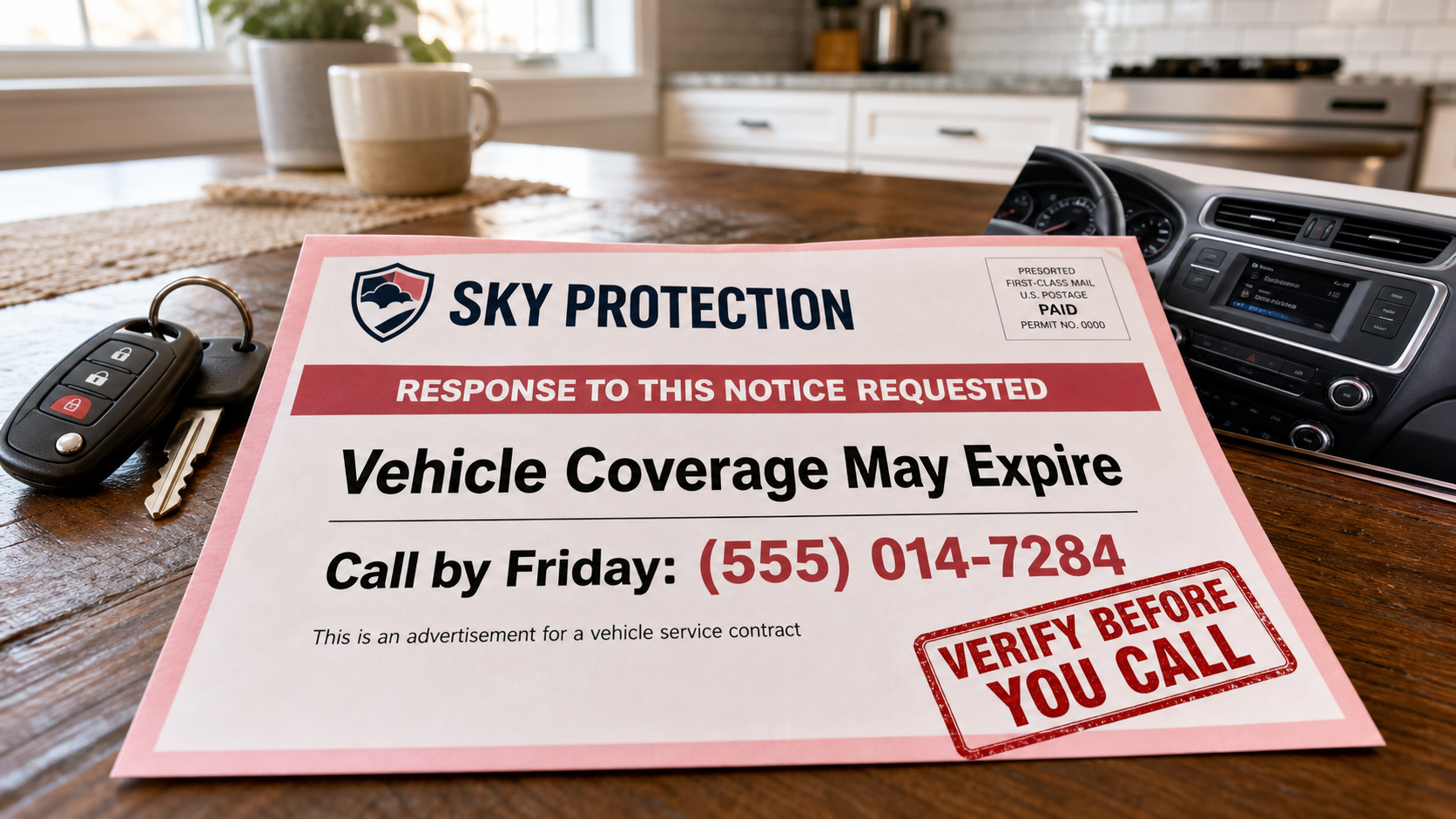
The phrase Sky Protection scam commonly refers to official-looking mailers that warn vehicle owners about expiring coverage and urge them to call a prominently displayed phone number.
The most important fact is that a mailer may be advertising a third-party vehicle service contract, not notifying you about the factory warranty that came with your car.
A service contract is an agreement that may pay for certain repairs under specified conditions. It is often marketed as an “extended warranty,” but it is not the same thing as a manufacturer’s original warranty.
The distinction is easy to miss when a notice uses a vehicle’s year or make, a deadline, a customer identification number, and phrases such as “response requested,” “final notice,” or “financial responsibility.”
Those details can make the recipient assume the letter came from the dealership, manufacturer, lender, or state motor vehicle agency. The prominent branding belongs to the marketer or service-contract operation named on the notice.
The Federal Trade Commission warns that warranty calls, texts, and mail may give the impression that the sender represents a dealer or manufacturer when the real purpose is to sell a service contract.
Not every vehicle service contract is fraudulent. Some consumers knowingly purchase contracts and later receive covered repairs. The concern is the sales method, the impression created by the mailer, the pressure to decide immediately, and whether the actual terms justify the cost.
A consumer should not buy because a postcard looks official or because a caller says a file will be closed. The decision should follow an independent check of existing coverage and a careful reading of the entire proposed contract.
What the Sky Protection notice may say
SKY PROTECTION
RESPONSE TO THIS NOTICE REQUESTED
Our records indicate that you may not have contacted us to activate vehicle protection.
Without coverage, you may be financially responsible for all repairs after your factory warranty expires.
Please call by the response date and have your customer ID available.
The wording changes. Some notices say coverage “may have expired,” while others say the recipient is eligible for a “vehicle protection plan.” A deadline may be only a few days away even though no genuine factory-warranty event occurs on that date.
Common variations of the mailer
- “Immediate response requested regarding your vehicle”
- “Factory warranty expiration notice”
- “Call to activate coverage before your file is closed”
- “You may be responsible for all repair costs”
- “Final attempt to notify you about vehicle protection”
- “Rates may increase after the deadline”
- “Registration fee required to maintain eligibility”
- “This notice is for your recently purchased vehicle”
- “Coverage has not been activated”
- “Please have your VIN and current mileage ready”
Small print may identify the notice as an advertisement or state that the sender is not affiliated with a manufacturer or dealer. Read that language before treating the headline as a factual warranty notice.
Why the mailer knows something about your car
People often trust the letter because it includes their name, address, vehicle make, model, or year. That information does not prove a relationship with the manufacturer.
Vehicle and consumer information can circulate through marketing lists, purchase-related records, public sources, lead brokers, service businesses, dealership relationships, online forms, and other commercial databases. The exact source can differ from one campaign to another.
A customer ID printed on the notice may be an internal marketing reference generated by the sender. It does not necessarily correspond to an account held by the automaker.
The questions to answer before calling
- Who is the legal company selling the contract?
- Is the sender affiliated with the manufacturer, dealer, or lender?
- Is my factory warranty actually expiring, and on what date or mileage?
- Who is the contract administrator and who pays claims?
- Which repair facilities may be used?
- What parts and failures are excluded?
- What deductible applies to each repair visit?
- Can the provider require maintenance records or prior authorization?
- Is there a waiting period before coverage begins?
- How is cancellation handled, and are fees deducted?
If the only way to see the contract is to pay first, that is a serious reason to stop. A salesperson’s summary is not a substitute for the written agreement that controls whether a future claim is covered.
Coverage is not the same as every repair being paid
A service contract usually covers named components or failures, subject to definitions and exclusions. It may not cover maintenance, pre-existing problems, diagnostic charges, wear items, consequential damage, unauthorized repairs, or failures linked to inadequate service records.
Some plans use a stated-component approach, while others describe exclusionary coverage. The attractive phrase “bumper-to-bumper” can still be followed by exceptions, limits, and claim procedures.
Repairs may require approval before work begins. A shop might need to provide diagnostics, photographs, maintenance documentation, or permission for an inspection. Starting work too soon could affect a claim.
Consumers should compare the total price, deductible, claim limits, waiting period, cancellation terms, and financial strength of the responsible provider with simply saving money for repairs.
What the response deadline really means
A date printed on a marketing notice is not automatically the expiration date of the manufacturer’s warranty. It may be the end of an advertising campaign, a sales-team follow-up period, or a date chosen to increase response.
Your actual factory coverage is normally determined by the vehicle’s in-service date, mileage, warranty booklet, and manufacturer records. A mailed deadline cannot rewrite those terms.
If a caller says that the price or eligibility disappears today, ask for the offer and contract in writing. End the call and verify the warranty. A plan that cannot be evaluated without an immediate card payment is not being sold in a consumer-friendly way.
Also check whether the notice describes cancellation as “activation.” That word can imply an existing benefit waiting to be turned on, when the caller is actually asking you to buy a new product.
How The Operation Works
1. A targeted mailer creates the appearance of an existing obligation
The recipient sees a notice that resembles routine account correspondence. A response date, bar code, customer number, and official language make it feel like unfinished paperwork from a recent vehicle purchase.
The letter may avoid directly stating that it came from the manufacturer, yet its layout encourages that assumption. This ambiguity is central to the response strategy.
2. Fear of a major repair creates urgency
The message reminds the owner that engines, transmissions, electronics, and air-conditioning systems can be expensive. It frames the choice as calling now or personally absorbing a catastrophic repair.
The response deadline discourages comparison shopping. A consumer who believes protection disappears tonight is less likely to contact the dealer or read sample terms.
3. The phone call becomes a sales qualification
The representative may ask for the vehicle identification number, make, model, mileage, purchase date, current warranty status, and driving habits. These details help determine eligibility and shape the pitch.
The caller may also request contact and payment information. A consumer should avoid giving card details until the company, administrator, and written contract have been independently verified.
4. The salesperson presents a high initial price
Some operations begin with an expensive plan, then apply a “manager discount,” “activation credit,” or lower monthly payment when the customer hesitates.
That movement can make the final offer feel like a special concession. The relevant figure is the total amount paid over the contract, not only the monthly installment.
5. Verbal assurances make the plan sound broader than the document
A salesperson may say that the plan covers “everything important” or that the customer can use “any certified mechanic.” The written terms may define those promises more narrowly.
Ask the representative to identify the exact contract section supporting each important claim. If the document is not available, do not rely on a verbal description.
6. Payment is requested before the consumer has time to compare
The operation may request an enrollment payment followed by monthly charges. The consumer might hear that the payment is refundable or only reserves eligibility.
Any refund right should be confirmed in writing, including the deadline, procedure, administrative fee, mileage adjustment, and method used to calculate a prorated refund.
7. Problems appear when the consumer cancels or files a claim
A buyer may later discover that an existing manufacturer warranty overlapped with the new contract, a repair falls under an exclusion, the shop did not obtain prior approval, or maintenance records are required.
Cancellation may require a signed form, odometer statement, or written request. Delays can lead to additional monthly charges if the consumer only asked a salesperson to “stop the plan” by phone.
How to evaluate a plan safely
- Call the dealership or manufacturer first. Use their verified contact information to confirm the actual factory-warranty status.
- Ask for the complete contract. Read definitions, exclusions, limits, claims procedures, and cancellation terms.
- Identify every company involved. The marketer, seller, administrator, obligor, payment processor, and repair network may be different entities.
- Check regulator and complaint records. Search official state business and insurance or service-contract databases where applicable.
- Calculate the total cost. Add the down payment and every installment, then consider deductibles and uncovered repairs.
- Compare alternatives. Obtain written quotes from the manufacturer, dealer, credit union, insurer, or established providers.
- Do not be rushed. A legitimate product should withstand questions and comparison.
What To Do If You Called or Bought Coverage
- Do not panic merely because you called. A conversation alone does not mean your account is compromised. Write down what information you shared and whether you authorized a payment.
- Verify your existing warranty independently. Contact the vehicle manufacturer or dealer using contact information you locate yourself. Ask for the in-service date, mileage limit, and remaining coverage.
- Request the complete service contract. Ask for the legal seller, administrator, obligor, claims number, cancellation procedure, and full schedule of payments.
- Review cancellation rights immediately. Many contracts provide a limited review period, but terms and state rules vary. Send any required cancellation through a trackable method and retain proof.
- Revoke future payment authorization in writing. Tell the company clearly if you are canceling recurring charges. Keep the confirmation number and copies of every email or letter.
- Watch your card or bank account. Confirm that the promised amount matches the posted transaction and check for monthly billing, duplicate charges, or a different merchant descriptor.
- Contact the card issuer if charges continue. Explain the transaction and cancellation timeline. Ask about blocking future recurring payments and disputing charges under the issuer’s rules.
- Protect sensitive data. If you shared a Social Security number or enough identity information for misuse, review credit reports and consider a security freeze. A VIN alone is not normally a secret, but it can support more convincing targeting.
- Document claim problems. Keep repair orders, diagnostic reports, maintenance records, denial letters, recorded dates, and the contract section cited by the administrator.
- Report misleading marketing. Complaints can be filed with the FTC at ReportFraud.ftc.gov and with relevant state consumer-protection or service-contract regulators.
If you want to keep the plan, that is still a decision to make only after reading the written agreement. Confirm that the price, coverage, deductible, repair process, and cancellation terms match what was promised.
The Bottom Line
A Sky Protection notice may look like a time-sensitive factory-warranty warning while functioning as an advertisement for a third-party vehicle service contract.
Do not call simply because the mailer says your file will close. Verify your real warranty with the manufacturer or dealer, identify the legal provider, and read the entire proposed contract before paying.
The safest decision is an informed one made without pressure. An official design, a vehicle detail, and a short deadline do not prove that the sender represents the company that built or sold your car.








