

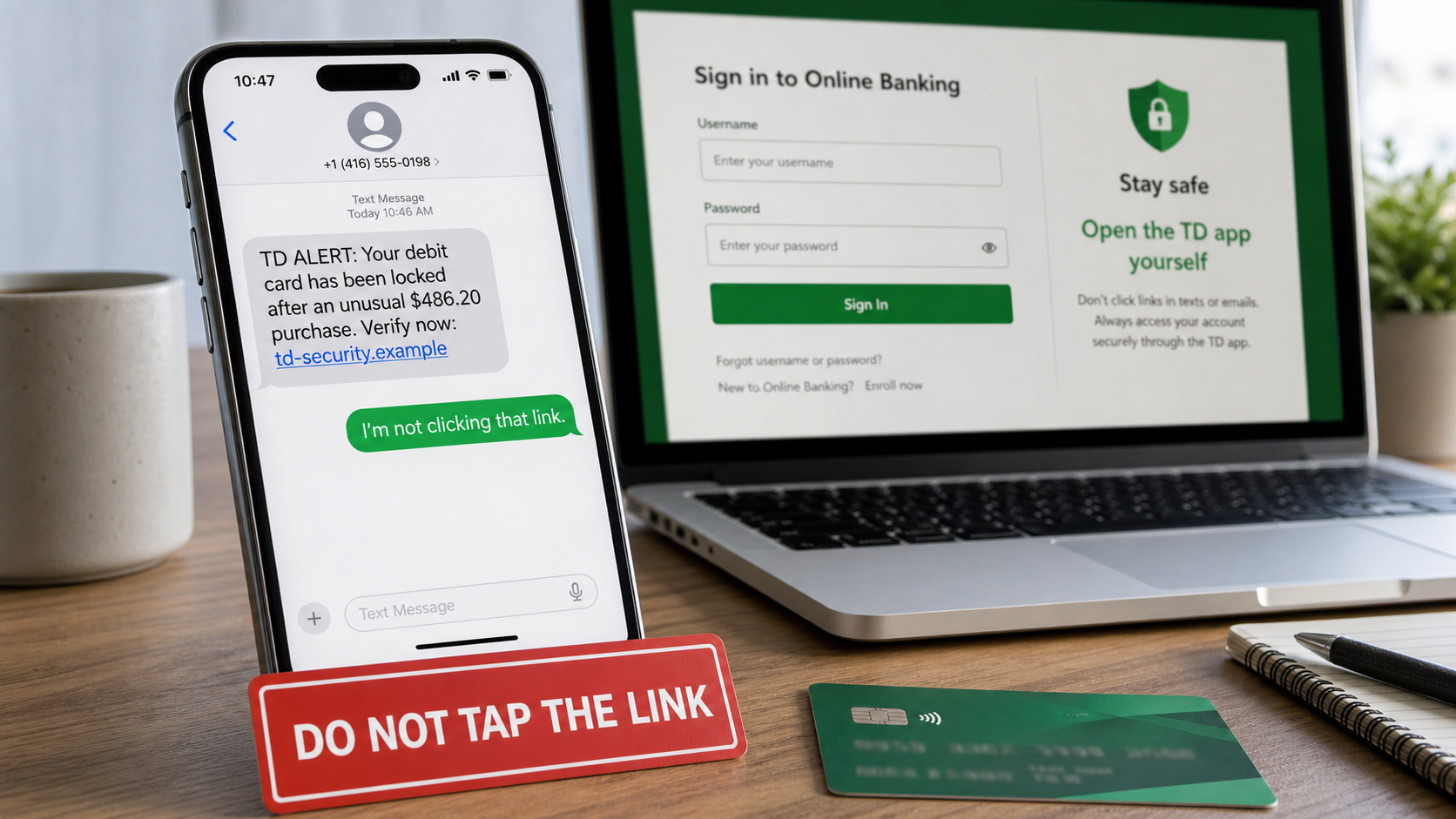
A text saying your TD debit card has been locked can turn an ordinary moment into an emergency. The message may include a purchase amount, a security warning, and a link that appears close enough to the bank’s real address.
The safest response is not to tap. A genuine concern can be checked by opening the TD app yourself, while the link in a fake alert is built to capture the very information needed to enter your account.
Overview
A TD Bank scam text is a smishing message that impersonates TD Bank or TD Canada Trust to steal online-banking credentials, payment-card details, security codes, or personal information.
“Smishing” means phishing delivered by SMS or another text-messaging service. The message uses fear, urgency, or a believable transaction alert to persuade the recipient to open a malicious link or call a fraudulent number.
Common stories include a locked card, suspended account, unusual purchase, failed login, new recipient, e-transfer, low balance, or required identity verification.
Some fake texts arrive in the same conversation as legitimate bank messages because sender names and numbers can be spoofed or messaging apps can group contacts in misleading ways. A familiar thread does not make a new link safe.
The fake website may closely copy TD’s colors, logo, wording, and mobile layout. It can ask for a username, password, card number, expiration date, CVV, Social Security or Social Insurance number, date of birth, and a one-time code.
Every field has a purpose. Credentials allow a sign-in attempt, card data supports fraudulent purchases, identity details help defeat security questions, and a one-time code can approve access or a transaction.
TD Bank’s official security guidance says legitimate companies do not use urgent unsolicited messages to pressure customers into providing sensitive information. TD tells customers not to use unknown links to access online banking and never to share passwords or PINs.
TD does send legitimate alerts. The correct test is not simply whether banks send texts. It is whether the particular message asks you to use an embedded link, reveal confidential information, or take an action you did not initiate.
What the scam text may say
TD ALERT: Your debit card has been locked after an unusual $486.20 purchase.
If this was not you, verify your identity now to restore access.
td-security.example
The amount and link change constantly. A small transaction can feel realistic, while a large one creates stronger panic. The message may omit an amount entirely and focus on an account restriction.
Common variations of the text message
- “Your TD card has been temporarily locked”
- “A purchase was declined at an online merchant”
- “An unusual transaction requires your response”
- “Your online banking access has been suspended”
- “A new payee or e-transfer recipient was added”
- “Your mobile number must be verified”
- “You have an unclaimed refund or reward”
- “A security update requires you to sign in”
- “Reply Y if you recognize this purchase” followed by a fake call
- “Call our fraud department immediately” with a fraudulent number
A phone number or short code alone is not a reliable verdict. Use current information published on the official TD website for your country and account type rather than a number repeated in a social post.
How a legitimate fraud alert differs
A real TD alert may contain limited transaction information and ask for a simple response, depending on the service and country. It should not demand a password, PIN, full account number, CVV, or complete Social Security or Social Insurance number.
TD Canada says its fraud alerts identify a transaction using details such as the last digits of the card, amount, transaction type, and merchant, and do not ask the customer to click a link or provide personal information.
TD Bank in the United States tells customers to check alerts through the official app or online banking. That is the safest habit even when a text appears plausible.
The address bar exposes the fake page
Scammers register domains containing words such as TD, bank, alert, secure, verify, online, or login. The familiar word may appear at the beginning of a long address while the registered domain belongs to someone else.
A padlock symbol only means that the connection to that website is encrypted. It does not mean TD owns the site. Criminal phishing pages routinely use HTTPS certificates.
Do not try to decide whether a suspicious link is “close enough.” Close the text, open the official banking app, or type the known TD address yourself.
Why the fake page asks for a one-time code
After capturing a username and password, the phishing site may display a loading screen while the operator attempts to sign in to the real bank.
If the bank sends a one-time code, the fake page immediately asks the victim to enter it. The criminal relays that code to the legitimate banking system.
The code is not confirming the fake page. It may be approving a real sign-in, new device, password reset, contact change, or transaction.
Other goals beyond online-banking credentials
Some pages collect card details for immediate online purchases. Others request identity information that can be combined with existing breach data.
A fraudulent phone number in the text may lead to a live operator who claims to be a TD fraud specialist. The operator can ask the victim to move money to a “safe account,” install remote-access software, or share codes.
No bank protects money by telling a customer to transfer it to an unknown account controlled by an inbound caller.
Why replying can make the campaign more convincing
A reply tells the sender that the number is active and that the bank story received attention. The next stage may be a live call from someone who refers to the exact transaction in the text.
Even a response such as NO or STOP should be avoided when the message is clearly fraudulent. Use the phone’s report-junk feature or forward the message to 7726 instead.
If the alert might be genuine, respond only through the mechanism described in TD’s current official documentation for your account and country. When uncertain, ignore the text interface and open the banking app yourself.
A criminal may also send repeated messages with different amounts to learn which one prompts a reaction. Silence deprives the campaign of that signal.
Do not forward the suspicious link to friends for an opinion because previews and accidental taps can expose more people. Share a screenshot with the dangerous address obscured when asking someone you trust for help.
If a family member is less comfortable with banking apps, help them create a simple routine: close the text, open the official app icon, and call the number on the card. Repeating the same routine removes the scammer’s urgency advantage.
How The Operation Works
1. Bulk messages reach customers and non-customers
Criminals send large volumes of texts to phone-number lists. They do not need to know who banks with TD because a recognizable bank has enough customers for some messages to reach the right audience.
A message received by someone who has no TD account is clearly fraudulent. A real customer may see the same text as personally relevant and react more quickly.
2. Urgency interrupts careful thinking
The text says that money is leaving, a card is locked, or online access will be closed. The victim is offered one obvious action: tap the link.
Short deadlines and capital letters are used to replace reflection with reaction. The criminal wants the customer to act before opening the real app.
3. A tracking link records engagement
The link may first pass through a redirect or shortened address. This allows the sender to measure clicks, route victims by country or device, and swap destinations after security companies begin blocking a page.
A click can confirm that the phone number is active even if no information is entered.
4. The phishing site copies TD’s login experience
The page displays a familiar sign-in form. It may automatically format card numbers, validate field lengths, and show professional error messages.
Visual quality is not evidence of legitimacy. A copied site can look nearly identical while sending every entry to a criminal server.
5. Credentials are tested in real time
The operator may attempt to sign in while the victim waits. If the password is wrong, the fake page can ask again. If it succeeds, the next screen requests the bank’s one-time code.
This live relay helps the criminal overcome multi-factor authentication by turning the victim into the person who supplies the second factor.
6. Account changes or transfers follow
Once inside, the criminal may review balances, add recipients, change contact information, request a card, transfer funds, use bill payment, or collect more identity details from statements.
The victim may receive genuine alerts during this stage. The scammer can claim those messages are expected parts of the “security process.”
7. The site ends with a reassuring message
After collecting data, the fake page may say the card is unlocked, the transaction was canceled, or verification will take several hours.
This delay reduces the chance that the customer immediately checks the real account and reports the takeover.
How to verify the situation safely
- Do not reply, tap, or call the contact in the message.
- Open the TD app from your normal icon.
- Check account alerts and transactions directly.
- Call the number printed on the back of your card if help is needed.
- Never provide a password, PIN, or one-time code to an inbound caller.
- Use card-lock controls while investigating an unfamiliar purchase.
- Forward suspicious email or text evidence to TD’s official phishing-reporting channel.
- Delete the message after preserving anything needed for a report.
What To Do If You Clicked or Shared Banking Details
- Stop interacting with the page. Do not enter another code or call a pop-up support number. Close the browser without accepting downloads or notification requests.
- Contact TD immediately through a verified channel. Use the official app, the number on the back of your card, or the contact details on TD’s website. Tell the fraud team exactly what was entered.
- Lock affected cards. Use official card controls if available and ask whether replacement cards or account restrictions are needed.
- Change the online-banking password. Use a trusted device and a unique password. If the same password protects email or another account, change those too.
- Review contact and security settings. Remove unknown phone numbers, email addresses, devices, payees, transfer recipients, and scheduled payments.
- Dispute unauthorized activity quickly. Note transaction dates and amounts, keep case numbers, and follow the bank’s written instructions.
- Secure the email account. Banking password resets and alerts often depend on email. Check for unknown sessions, forwarding rules, and deleted messages.
- Protect your identity if sensitive data was shared. Review credit reports and consider fraud alerts or security freezes when a Social Security or Social Insurance number was exposed.
- Scan the device if anything was installed. Remove unfamiliar apps or profiles, review permissions, update the operating system, and run a reputable security scan.
- Report the text. Forward it to 7726 where supported, report it through the phone’s junk controls, send evidence to TD’s official phishing address, and report financial fraud to the relevant national authority.
If you only clicked and the page did not receive data, the risk is lower. Still check for downloads, close the tab, clear any permission granted to the site, and monitor the account.
Is Your Device Infected? Run a Free Malware Scan
Slow performance, constant pop-ups, or strange behavior? These are classic signs of a malware infection. The fastest way to find out is to scan your device with Malwarebytes Free — one of the most trusted malware removal tools available.
The free version detects and removes the most common threats, including:
- Adware — the cause of those annoying pop-ups
- Browser hijackers — unwanted redirects and changed homepages
- Trojans and spyware — hidden programs stealing your data
- Potentially unwanted programs (PUPs) — software you never asked for
👉 Select your device below — Windows, Mac, or Android — then follow the simple steps to download Malwarebytes, scan your system, and remove any threats it finds. The scan usually takes 5 to 20 minutes.
Run a Malware Scan with Malwarebytes for Windows
Malwarebytes is one of the most popular and trusted anti-malware tools for Windows — and it’s completely free for removing infections. It catches threats that many antivirus programs miss, including adware, browser hijackers, and trojans. Follow the steps below to scan and clean your PC in just a few minutes.
Download Malwarebytes
Click the button below to download the latest version of Malwarebytes for Windows from the official source. The free version is all you need — it will scan your computer and remove adware, browser hijackers, and other malicious software at no cost.
Download MalwarebytesOfficial installer for Windows 11 and 10. Your download starts right away.Want real-time protection? See Malwarebytes Premium Malwarebytes Free for WindowsScans and removes malware at no cost
-
Install Malwarebytes
When the download finishes, open your Downloads folder and double-click the MBSetup file. If Windows shows a User Account Control pop-up, click “Yes” to allow the installation.

Follow the On-Screen Prompts to Install Malwarebytes
The setup wizard will walk you through a few quick screens:
-
Choose where you’re installing the program — “Personal Computer” or “Work Computer” — then click Next.

-
Malwarebytes will now install on your device. This usually takes under a minute.

-
When installation is complete, the “Welcome to Malwarebytes” screen will open automatically.

-
On the final screen, click Open Malwarebytes to launch the program.

-
Enable “Scan for Rootkits”
Before scanning, turn on rootkit detection so Malwarebytes can find even the most hidden threats. Click the Settings gear icon on the left side of the screen.

In the settings menu, find “Scan for rootkits” and click the toggle so it turns blue.

Done? Click “Dashboard” in the left pane to return to the main screen.
Start the Scan
Click the blue Scan button. Malwarebytes will automatically update its virus database and start checking your computer for malware.

-
Wait for the Scan to Finish
The scan checks your entire system for browser hijackers and other malicious programs, so it can take 5 to 20 minutes depending on your computer. Feel free to do something else — just check back occasionally to see the progress.

-
Quarantine the Detected Threats
When the scan is done, you’ll see a list of everything Malwarebytes found — malware, adware, and potentially unwanted programs. Click the “Quarantine” button to remove all of them at once.

Malwarebytes will now remove the malicious files and registry entries and move them safely into quarantine.

-
Restart Your Computer
Some threats can only be fully removed after a reboot. If Malwarebytes asks you to restart, click Yes. Once you’re logged back in, Malwarebytes has finished removing the threats it found.

That’s it — your Windows PC is now clean of trojans, adware, and other malware, and should be back to running smoothly.
If you are still having problems with your computer after completing these instructions, then please follow one of the steps:
- Run a computer scan with ESET Online Scanner
- Ask for help in our Windows Malware Removal Help & Support forum.
Run a Malware Scan with Malwarebytes for Mac
Malwarebytes for Mac is a free on-demand scanner that removes the malware other security software tends to miss — adware, browser hijackers, and unwanted programs included. Cleaning an infected Mac with Malwarebytes has always been completely free, and it’s our go-to recommendation. Follow the steps below to scan and clean your Mac in just a few minutes.
-
Download Malwarebytes for Mac
Click the button below to download the latest version of Malwarebytes for Mac.
Download MalwarebytesOfficial installer for macOS. Your download starts right away.Want real-time protection? See Malwarebytes PremiumMalwarebytes Free for MacScans and removes malware at no cost -
Open the Malwarebytes setup file
When the download finishes, open your Downloads folder and double-click the setup file to begin the installation.

-
Follow the On-Screen Prompts to Install Malwarebytes
The Malwarebytes for Mac Installer will guide you through a few quick screens. Click “Continue” and keep following the prompts until the installation completes.



When the installation is complete, Malwarebytes opens to the Welcome to Malwarebytes screen. Click “Get started“.
-
Select “Personal Computer” or “Work Computer”
Malwarebytes will ask what type of computer you’re installing it on. Click either Personal Computer or Work Computer, whichever applies.

-
Start the Scan
Click the “Scan” button. Malwarebytes will automatically update its detection database and begin checking your Mac for malware.

-
Wait for the Scan to Finish
Malwarebytes will scan your Mac for adware, browser hijackers, and other malicious programs. This can take a few minutes, so feel free to do something else — just check back occasionally to see the progress.

-
Quarantine the Detected Threats
When the scan is done, you’ll see a list of everything Malwarebytes found. Click the “Quarantine” button to remove all the threats at once.

-
Restart Your Mac
Malwarebytes will now remove all the malicious files it found. Some threats can only be fully removed after a reboot — if Malwarebytes asks you to restart, allow it. Once you’re logged back in, your Mac is clean.

That’s it — your Mac is now free of adware, rogue browser extensions, and other potentially harmful software.
If you are still experiencing problems while trying to remove a malicious program from your computer, please ask for help in our Mac Malware Removal Help & Support forum.
Run a Malware Scan with Malwarebytes for Android
Malwarebytes for Android automatically detects and removes dangerous threats like malware and ransomware so you don’t have to worry about your most-used device being compromised. Aggressive detection of adware and potentially unwanted programs keeps your Android phone or tablet running smooth.
-
Download Malwarebytes for Android.
You can download Malwarebytes for Android by clicking the link below.
Get Malwarebytes for AndroidOpens Google Play in a new tab.Want real-time protection? See Malwarebytes Premium for AndroidMalwarebytes for AndroidScans your phone and removes malware at no cost -
Install Malwarebytes for Android on your phone.
In the Google Play Store, tap “Install” to install Malwarebytes for Android on your device.

When the installation process has finished, tap “Open” to begin using Malwarebytes for Android. You can also open Malwarebytes by tapping on its icon in your phone menu or home screen.

-
Follow the on-screen prompts to complete the setup process
When Malwarebytes will open, you will see the Malwarebytes Setup Wizard which will guide you through a series of permissions and other setup options.
This is the first of two screens that explain the difference between the Premium and Free versions. Swipe this screen to continue.
Tap on “Got it” to proceed to the next step.
Malwarebytes for Android will now ask for a set of permissions that are required to scan your device and protect it from malware. Tap on “Give permission” to continue.
Tap on “Allow” to permit Malwarebytes to access the files on your phone.
-
Update database and run a scan with Malwarebytes for Android
You will now be prompted to update the Malwarebytes database and run a full system scan.

Click on “Update database” to update the Malwarebytes for Android definitions to the latest version, then click on “Run full scan” to perform a system scan.

-
Wait for the Malwarebytes scan to complete.
Malwarebytes will now start scanning your phone for adware and other malicious apps. This process can take a few minutes, so we suggest you do something else and periodically check on the status of the scan to see when it is finished.

-
Click on “Remove Selected”.
When the scan has been completed, you will be presented with a screen showing the malware infections that Malwarebytes for Android has detected. To remove the malicious apps that Malwarebytes has found, tap on the “Remove Selected” button.

-
Restart your phone.
Malwarebytes for Android will now remove all the malicious apps that it has found. To complete the malware removal process, Malwarebytes may ask you to restart your device.
That’s it — your Android phone is now clean — no more malicious apps, adware, or browser redirects.
If you are still having problems with your phone after completing these instructions, then please follow one of the steps:
- Restore your phone to factory settings by going to Settings > General management > Reset > Factory data reset.
- Ask for help in our Mobile Malware Removal Help & Support forum.
Stay Protected: Block Ads and Malicious Sites
Now that your device is clean, keep it that way. Most infections start with a malicious ad or a fake download button — so blocking them at the source is your best defense.
We recommend AdGuard, which blocks malicious ads, phishing pages, and dangerous redirects before they can reach you.
👉 Download AdGuard and browse safely
The Bottom Line
A TD Bank scam text uses a locked card, suspicious purchase, or account warning to direct victims to a fake login page or fraudulent call center.
TD can send legitimate alerts, but a real concern can always be checked through the official app or the number on the back of the card. There is no need to trust an embedded link.
Never give a password, PIN, full card details, or one-time code to an unexpected message or caller. Open the bank yourself, verify the activity, and contact the fraud team immediately if information was exposed.








