

A serious-looking report says Dr. Paul Cox found a honey recipe that rebuilds damaged joints, restores cartilage, and lets people avoid injections or surgery. Anderson Cooper, Dr. Sanjay Gupta, and Morgan Freeman appear to confirm the discovery.
None of that endorsement chain is real. The voices and videos are manipulated, the miraculous joint-repair claims are unsupported, and the promised kitchen recipe eventually turns into an offer for Core Strength Premium or another bottle of pain-support pills.
Overview
What the Honey Recipe Ads Claim
The Dr. Paul Cox honey recipe scam falsely portrays a real ethnobotanist as the creator of an at-home treatment for arthritis, knee pain, back pain, dementia, tinnitus, and other unrelated conditions. Different versions attach different ailments to the same supposed discovery.
Dr. Cox did not team up with Dr. Sanjay Gupta, Anderson Cooper, Morgan Freeman, or a Harvard orthopedist to promote Core Strength Premium Supplements. He has publicly identified the videos and fraud funnels using his likeness as false.
The Presentation Uses Invented Science and AI
The presentation may claim a toxin called “cavium chloride” causes joint damage, or that a rare Indian root mixed with pure honey restores bone and synovial fluid. It may cite laboratory images, X-rays, or a 2026 trial that cannot be verified.
The honey recipe is not actually provided. It keeps people watching while AI-generated narration builds a story about patients leaving wheelchairs and regenerating cartilage. The video then pivots to capsules presented as the standardized form of the method.
Core Strength Is One Possible Ending
Core Strength Premium is the best-documented product connected to this version, but the underlying campaign is reusable. A seller or affiliate can redirect the story to a new joint-support product after complaints or payment problems develop.
This article addresses the deceptive campaign and its claims. It is important to be precise: a false affiliate ad does not by itself prove the chemical contents of every bottle. However, an unauthorized doctor endorsement, invented news coverage, and unsupported disease claims are more than enough reason not to purchase through the funnel.
MalwareTips has separately reviewed the Core Strength Premium supplement marketing. Here we focus on the Dr. Paul Cox honey narrative and the way it moves consumers toward rotating pills and possible refill billing.
Who Is Dr. Paul Cox, and What Was Fabricated?
Dr. Paul Alan Cox is a real ethnobotanist known for research involving plants, traditional knowledge, and neurological disease. That genuine background makes his identity valuable to scammers building a “natural discovery” story.
The ads go far beyond his actual work. They depict him claiming that a honey formula rebuilds worn joints, reverses bone-on-bone arthritis, or treats multiple serious diseases. Those product endorsements and miracle claims were not made by him.
Some videos add a fake CNN investigation. An altered Anderson Cooper voice introduces the breakthrough, an AI Dr. Sanjay Gupta supposedly visits Cox’s laboratory, and a synthetic Morgan Freeman gives a personal testimonial.
Each familiar person appears to validate the next, but all evidence remains inside one anonymous sales presentation. There is no corresponding CNN report, legitimate interview, or official statement supporting Core Strength.
How the Dr. Paul Cox Honey Recipe Scam Works
The Entire Sales Funnel at a Glance
- An AI video ad targets people with chronic pain. Fake versions of Dr. Paul Cox, CNN presenters, or celebrities promise that a honey recipe rebuilds damaged joints.
- The click opens a counterfeit news advertorial. CNN, CBS, “60 Minutes,” or another trusted style is copied onto a domain that has no relationship with the real broadcaster.
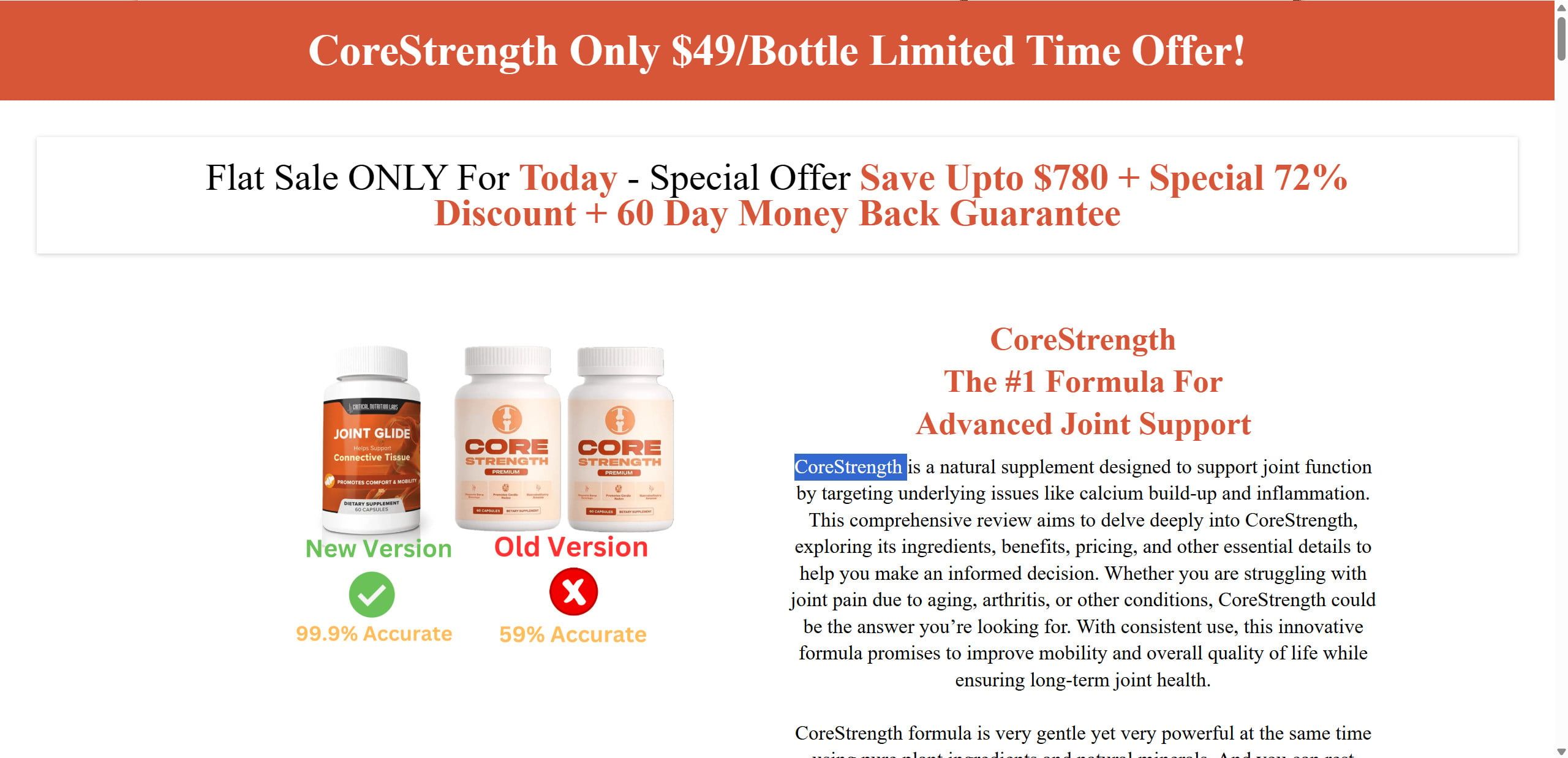
- The advertorial redirects to a supplement landing page. The honey method remains vague, while Core Strength Premium or another joint-support product becomes the commercial answer.
- The buyer believes they are purchasing one bottle. The page emphasizes a per-bottle amount and can make a preselected package look like a simple starter order.
- Six bottles and a full bundle charge can arrive. The customer realizes that the checkout processed a larger package only after seeing the statement or opening the box.
- Refill subscriptions are difficult to cancel. Future shipments may be processed while support requires repeated calls, return authorization, unopened bottles, or other conditions before considering a refund.
Terms vary between sellers, but this is the complete trap readers need to recognize. Before paying, confirm the bottle count, today’s total, whether refills are automatic, and the exact steps and deadline for cancellation.
Step 1: A Social Media Ad Targets Chronic Pain
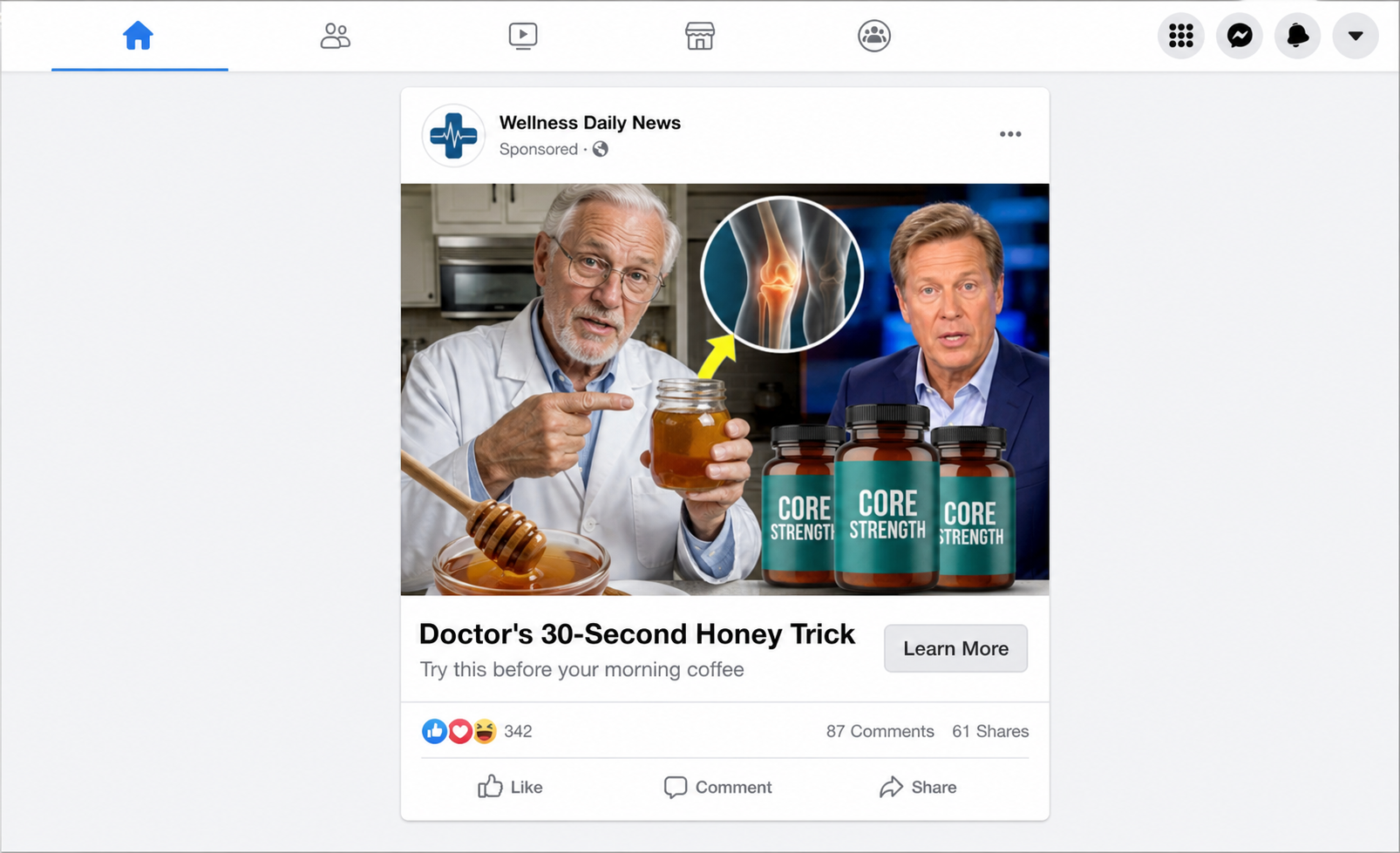
A short video on Facebook, Instagram, YouTube, or another social media feed speaks to people who struggle with stairs, sleep, walking, or daily stiffness. It promises that joint deterioration is not permanent and that doctors misunderstand the real cause.
The audience is often older and may have already tried medication, physical therapy, or procedures. The promise of a painless home alternative arrives at a vulnerable moment.
Step 2: A Real Scientist’s Identity Supplies Credibility
The narrator names Dr. Cox, displays photographs, and describes a remote laboratory. Viewers who search his name find a legitimate scientist, which can make the fabricated claims seem authentic.
The search proves only that Cox exists. It does not prove he formulated the advertised honey recipe or supplement.
Step 3: Fake CNN Personalities Frame the Pitch as Journalism
Anderson Cooper or Dr. Sanjay Gupta may appear to investigate the treatment. Network-style graphics and serious narration make a direct-response ad resemble an independent news report.
No recognizable logo should be trusted without checking the official broadcaster’s domain and archive. Copied graphics are easy to reproduce.
Step 4: The Video Invents a Hidden Cause
The script may blame “cavium chloride,” calcium buildup, inflammation, toxins, or another single mechanism for every kind of joint pain. It says conventional treatments address symptoms while the honey method repairs the root cause.
Joint pain can result from many conditions, injuries, and diseases. A universal explanation delivered by an anonymous video is not a diagnosis.
Step 5: Medical Images Create the Appearance of Proof
Viewers see X-rays, cartilage diagrams, laboratory benches, or charts claiming bones regenerated within months. The source, patient population, comparison group, and publication details are usually absent.
An image can be real yet unrelated. Without a verifiable study of the exact protocol and product, it does not support the advertised result.
Step 6: Celebrity Testimonials Raise the Emotional Stakes
A cloned Morgan Freeman voice may describe years of pain and a remarkable recovery. Other versions use additional public figures or anonymous seniors.
The celebrity did not provide the testimonial. Synthetic audio is being used to make an unverified health claim feel personal.
Step 7: The Honey Recipe Is Promised but Withheld
The narrator repeatedly mentions a natural home protocol. Honey is safe-looking, inexpensive, and already present in many kitchens, so viewers expect instructions they can try.
Measurements never arrive because the free recipe is not the commercial goal. It is an open loop designed to hold attention.
Step 8: Core Strength Premium Appears as the Solution
Near the end, viewers are told the active ingredients must be purified or combined precisely. Core Strength Premium capsules are introduced as the reliable way to obtain the benefits.
This is a classic bait-and-switch: a honey method attracted the click, but a multi-bottle supplement is what the page intended to sell.
The product landing page then reinforces that pivot with old-versus-new bottle comparisons, large discounts, and broad medical claims. Those sales devices do not validate the false expert story that delivered the visitor.
Step 9: Price Anchoring Encourages a Large Order
The sales page may display a high “regular” value, a limited price around $49 per bottle, and claimed savings above $100. The customer must buy several bottles to obtain the advertised per-bottle amount.
Calculate the full charge and inspect shipping, handling, taxes, and add-ons. A 72% discount graphic does not establish that the comparison price was commonly charged.
Step 10: Refund and Refill Risks Appear After the Sale
A lengthy guarantee may sound reassuring, but the practical details matter: return authorization, destination, unopened-bottle requirements, deadlines, and who pays return shipping.
Some supplement checkouts use continuity or auto-ship language. Confirm whether the transaction is one-time and how cancellation works before submitting payment.
Why This Is a Marketing Scam Even if a Bottle Arrives
Receiving capsules does not make the preceding claims true. The consumer’s decision was obtained through a false scientist endorsement, fabricated news coverage, synthetic celebrity testimony, and an invented honey protocol.
A product can physically exist while the story used to sell it is fraudulent. The relevant questions are whether the represented endorsements happened, whether the medical claims are supported, and whether billing terms were clear.
It is also possible for third-party affiliates to create deceptive ads without direct approval from a brand owner. Consumers generally cannot determine those relationships from the funnel. That uncertainty is another reason to avoid purchasing and to document every URL and merchant name.
A responsible seller should promptly disavow false endorsements, identify its legal company, explain how affiliates are monitored, and remove misleading claims. Silence, hidden ownership, and dependence on anonymous advertorials deepen the concern.
Company, Address, and Fulfillment Checks
The Company May Exist Only in the Checkout
Core Strength is a label, not a legal identity. Find the company that accepts the payment and compare its name across the terms, privacy policy, receipt, package, and card statement. A different name at every stage can be a deliberate shield against complaints and chargebacks.
Some operations register a thin company shortly before a campaign launches, while others display details copied from an unrelated business. If ownership, directors, and a real operating history cannot be verified, the professional-looking page is only a costume.
The Address May Be a Fulfillment Center, Not an Office
Search every address independently. A returns location may be a warehouse shipping hundreds of unrelated brands, a virtual mailbox, a residence, or property belonging to another company. The fulfillment center can scan a parcel without knowing who produced Core Strength, wrote the fake CNN script, or controls the subscription.
Support May Stop Answering When You Ask for Money Back
Call the number and email support before ordering. Ask who owns the brand, whether refills are automatic, where opened bottles go, and who authorizes refunds. Disconnected lines, generic agents, endless holds, and unanswered email make a prominent guarantee functionally useless.
Mass-Produced Capsules Without Traceability Can Be Dangerous
Products in rotating funnels may be generic private-label supplements sourced through brokers or contract factories, including manufacturers in China. A Chinese factory is not automatically unsafe. The danger begins when the seller hides the real manufacturer, importer, production standards, batch number, and independent laboratory results.
Without that trail, the customer cannot confirm ingredient identity, dose, purity, allergens, contamination, or undeclared drug substances. Terms such as “natural,” “doctor formulated,” “GMP,” and “FDA registered” do not replace a verifiable certificate of analysis for the bottle in hand.
Questions to Ask About the Joint-Repair Claims
Ask for the published study that tested the exact finished formula, not a study about one ingredient or a general biological mechanism. The paper should identify the product, dose, number of participants, comparison group, duration, outcomes, adverse events, and funding.
Claims about “regenerating cartilage” or rebuilding bone should have objective imaging and clinical outcomes assessed by qualified researchers. A sales-video animation, an X-ray with no patient history, or a chart without a citation cannot establish that result.
Also ask whether the claim applies to osteoarthritis, rheumatoid arthritis, an injury, neuropathic pain, or another condition. These problems have different causes and treatments. A formula advertised for all of them is using breadth as persuasion, not demonstrating careful diagnosis.
Check whether the alleged research appears in a recognized scientific database and whether the named institution acknowledges it. Scam presentations frequently cite Harvard, CNN, or a laboratory because they know most viewers will not pause the video to verify the reference.
Finally, compare the dramatic language in the ad with the bottle label. Marketers sometimes place the strongest disease claims in a video while the physical label uses softer phrases such as “supports mobility.” That gap can show that the seller understands the video promises go beyond what it can responsibly print.
Why Honey Is Used as the Bait
Honey evokes tradition, comfort, and home care. It makes an unfamiliar sales funnel feel less like a medical decision and more like advice passed between families. The visual also works across joint pain, memory, tinnitus, and diabetes campaigns.
The ingredient’s familiarity does not validate the claims attached to it. When the video refuses to provide the recipe and sells pills instead, honey was never the solution; it was the reason to keep watching.
Warning Signs
- Dr. Paul Cox appears in a product video that is absent from his official work.
- CNN personalities seem to endorse a supplement, but no report exists on CNN’s domain.
- A fictional toxin or single hidden cause explains every type of pain.
- Unidentified X-rays supposedly show cartilage or bone regeneration.
- Morgan Freeman or another celebrity gives an unverifiable testimonial.
- A honey recipe is promised for free but never disclosed.
- The video shifts suddenly from a kitchen method to Core Strength capsules.
- The company owner, office, and manufacturing location are difficult to verify.
- The page pressures buyers with timers, limited stock, and extreme discounts.
- Return and recurring-shipment terms are less visible than the order button.
What to Do if You Have Fallen Victim to This Scam
- Stop further upsells. Do not accept additional bottles from callers claiming to improve the original order or preserve a discount. Do not provide new payment details.
- Cancel in writing. Ask the merchant to cancel unshipped products, memberships, auto-ship plans, and future refills. Mention that the order followed a false Dr. Paul Cox and CNN endorsement. Keep the request and response.
- Contact the card issuer. Use the number on the card. Explain the deceptive marketing, any difference between advertised and charged totals, and any recurring billing you did not knowingly authorize. Ask about a dispute and future merchant blocks.
- Preserve the entire funnel. Save screenshots or recordings of the ad, AI video, fake news page, checkout, terms, receipt, emails, package, return label, and statement descriptor. Record all domains and phone numbers.
- Monitor for new charges. Merchant descriptors can differ from Core Strength. Enable alerts and review the account for several months. Report a rebill promptly.
- Seek appropriate care. Do not stop pain medication, postpone evaluation, or avoid a recommended procedure because the video promises cartilage regeneration. Tell a healthcare professional about the supplement and any symptoms.
- Report adverse events and fraud. In the U.S., adverse events can be reported to FDA MedWatch, while deceptive sales can be reported to the FTC and IC3. Report the social ad for impersonation and misleading health claims.
- Beware of refund recovery calls. A person who knows what you bought may be using a customer list. Do not pay an upfront recovery fee or allow remote access to your phone or computer.
Frequently Asked Questions
Did Dr. Paul Cox endorse the honey recipe or Core Strength?
No. The campaign uses a real scientist’s identity in manipulated or synthetic media. Dr. Cox did not join CNN personalities or celebrities to promote Core Strength as a treatment for joint damage or other diseases.
Is the Dr. Paul Cox social media ad genuine?
No verified source supports the sponsored honey-trick presentation. A believable feed post can be fabricated with an invented presenter, cloned voices, medical graphics, and a product image, then distributed through disposable advertising accounts.
Does the video provide a real honey recipe?
The usable measurements are generally withheld. After a long story about toxins, roots, and joint repair, capsules are introduced as the supposedly precise version of the method. Honey attracted the viewer; the bottle completes the sale.
Can Core Strength rebuild cartilage or bone?
The dramatic ad claims are not established by a product-specific clinical trial shown in the funnel. X-rays, animations, testimonials, and references to a laboratory cannot substitute for transparent research on the exact finished formula.
Will one order produce six bottles or recurring refills?
Terms can vary. Some buyers may face a larger preselected bundle or continuity language, while another checkout may be one-time. Confirm bottle count, complete total, refill status, and cancellation conditions before payment.
What should I do if the seller will not answer?
Send a written cancellation, keep proof of every attempt, and contact the card issuer. Save the ad, order page, terms, emails, package, and statement descriptor so an unexpected charge can be documented clearly.
The Bottom Line
Dr. Paul Cox did not endorse a honey recipe or Core Strength Premium as a cure for arthritis, joint damage, dementia, or other serious conditions. The CNN-style report, expert interviews, and celebrity testimonials are manufactured sales material.
The product may arrive, but that does not repair the deception that produced the order. Close any funnel built on a fake doctor video, and evaluate health products through transparent companies and qualified medical advice.








