

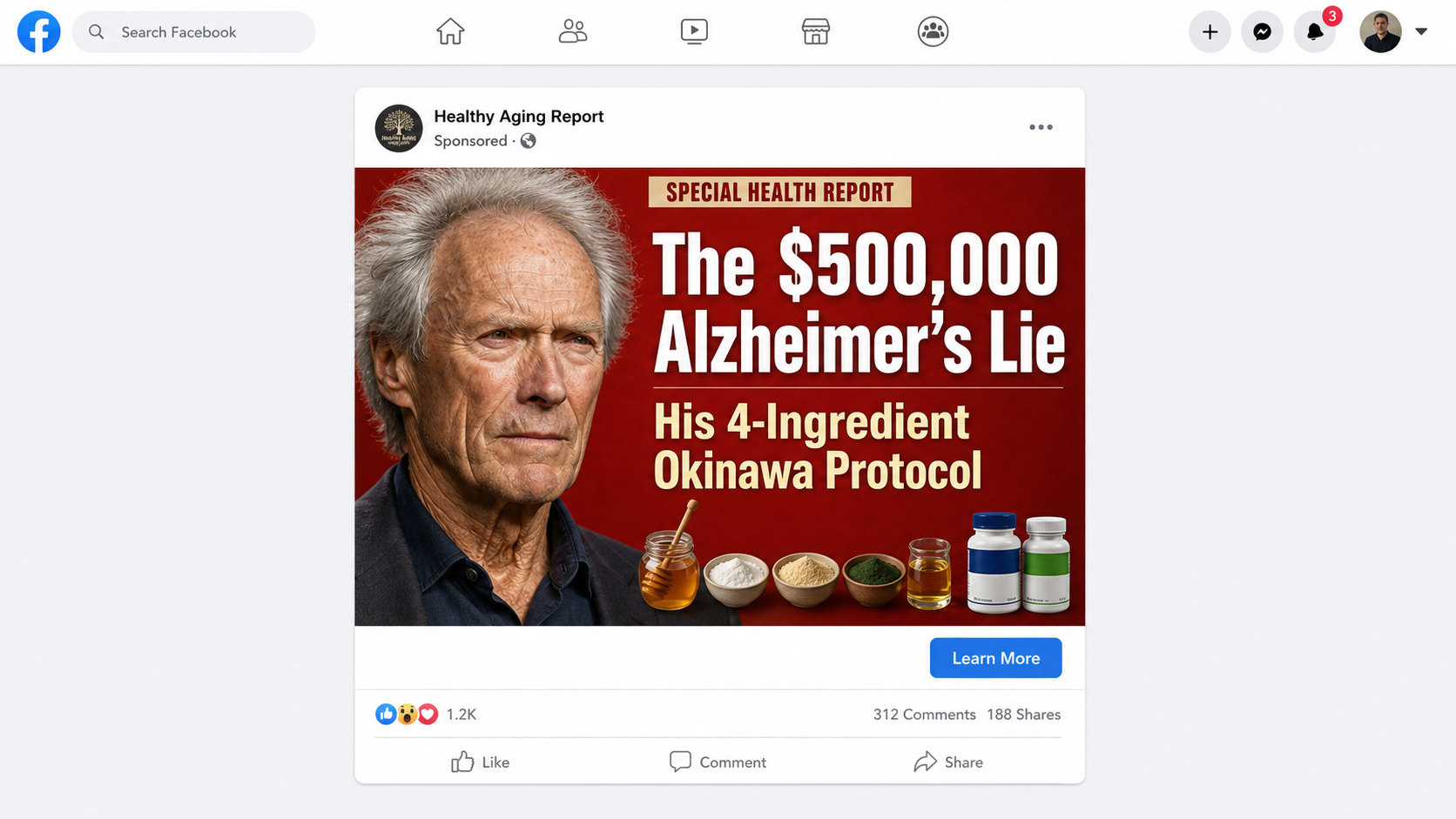
A magazine cover appears to show Clint Eastwood beside a headline about the “$500,000 Alzheimer’s lie.” It promises a four-ingredient Okinawa protocol that supposedly restored his memory at age 95.
The cover is not a real AARP publication, the recovery story is invented, and the “protocol” is a lure. The path ends not with a proven dementia treatment, but with a long sales video and a rotating offer for memory supplements.
Overview
What the Fake AARP Cover Claims
The fake AARP Alzheimer’s cure scam uses Clint Eastwood’s name and image to promote a fictional “4-ingredient Okinawa protocol.” The fabricated cover and article also may mention Bill Gates, Maria Shriver, and Nobel laureate Dr. Yoshinori Ohsumi.
None of those people endorsed the advertised cure. AARP did not publish a winter 2026 issue exposing a buried memory treatment, and Eastwood did not reverse dementia with a honey method or Japanese household recipe.
The Fake Article Leads to a Sales Video
One version sends visitors to a domain made to look like AARP rather than the organization’s official AARP.org website. The page describes pharmaceutical companies hiding a discovery for decades and uses a personal family story to lead into an embedded video.
The video promises ingredients that are never provided in a usable protocol. Viewers instead encounter claims about parasites, proteins, blood flow, or suppressed research. At the end, they are asked to buy capsules, drops, or another memory-support product.
The Same Narrative Can Promote Different Bottles
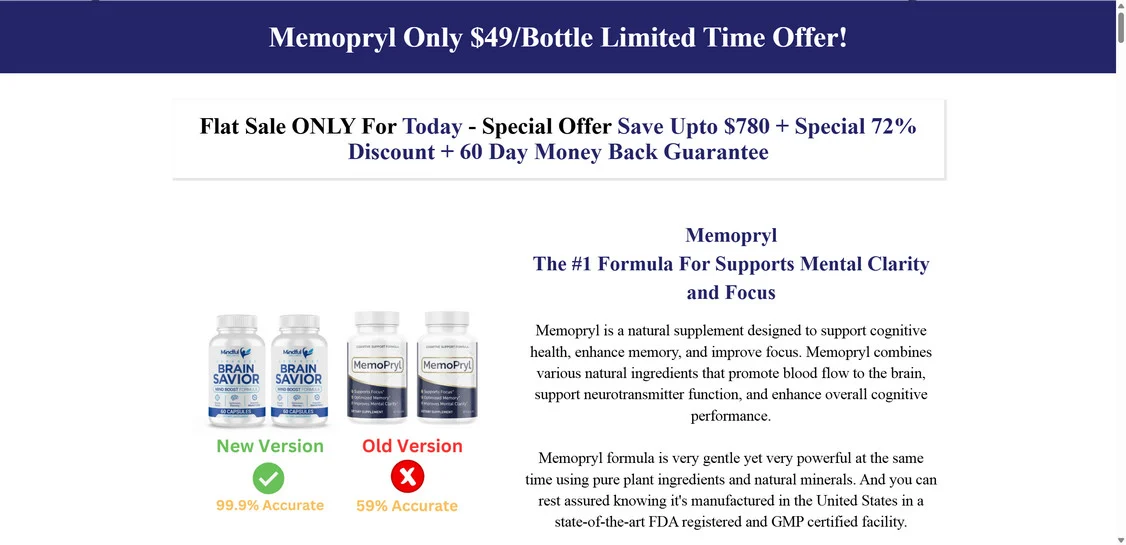
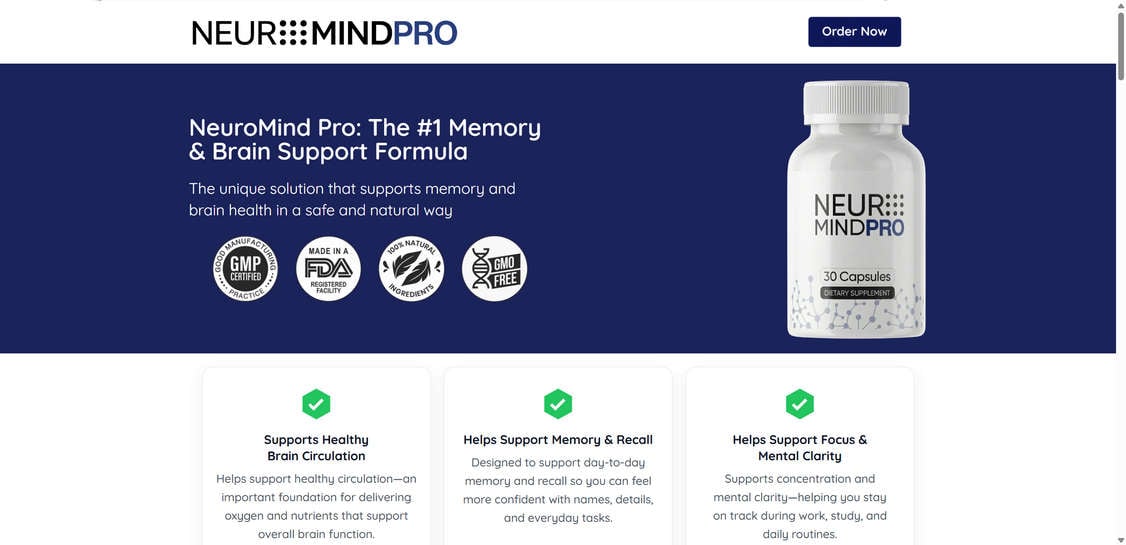
The brand may be MemoPryl, Neuro Mind Pro, MemoHoney, Max Brain, Brain Honey, or a different label. These examples do not prove every memory supplement is sold by one organization. They show how the fake AARP narrative can be connected to whichever offer is active.
MalwareTips has separate reports on MemoPryl, Neuro Mind Pro, and MemoHoney. This article focuses on the Clint Eastwood and AARP story used to sell changing products.
The Fake AARP Cover Explained
The cover is designed for a quick glance on social media. It uses AARP’s recognizable red branding, a large photograph of Eastwood, and multiple smaller headlines so the image resembles a real magazine issue.
The dates and claims do not withstand inspection. A purported winter issue may circulate months before winter. The cover promises that a 30-year medical secret was exposed after Eastwood reversed his own dementia, yet no corresponding report exists on AARP.org.
Scammers also crowd the cover with credible names. Gates supplies the image of science funding, Shriver is associated publicly with Alzheimer’s advocacy, and Ohsumi is a genuine Nobel Prize-winning scientist. Their real reputations are arranged to support a story they did not tell.
A fabricated magazine image can be produced in minutes and repeatedly altered. The presence of a barcode, issue date, professional typography, or familiar logo does not prove a publisher created it.
How the Fake AARP Alzheimer’s Cure Scam Works
The Entire Sales Funnel at a Glance
- An AI or fabricated celebrity ad reaches social media. Clint Eastwood appears beside a fake AARP cover promising a four-ingredient memory cure.
- The click opens a false trusted-site advertorial. The page imitates AARP, CNN, CBS, or a health publication even though the domain does not belong to that organization.
- The fake report sends the family to a supplement landing page. The Okinawa protocol is never delivered; MemoPryl, Neuro Mind Pro, MemoHoney, or a different memory product is revealed.
- The buyer believes one bottle or a small starter order was chosen. A low per-bottle figure can hide a preselected multi-bottle package.
- The delivery may contain six bottles. The full bundle amount is charged, creating a much larger loss than the family expected from the apparent one-bottle offer.
- Recurring refills become hard to cancel. More boxes and charges may follow while the seller relies on buried terms, lengthy calls, restricted returns, or slow refund handling.
This exact billing outcome does not occur in every checkout, but it is a serious risk in the funnel. Families should pause before payment and confirm the selected quantity, full transaction amount, refill schedule, and written cancellation instructions.
Step 1: The Cover Reaches Families Through Social Media
The image appears in an ad, recommended post, email, or search result. It is aimed at people worried about their own memory or caring for a relative with cognitive decline.
The emotional stakes are high, so the promise of a suppressed cure can overcome the instinct to check the publication date and domain.
Step 2: Clint Eastwood Becomes the Supposed Patient
The story says Eastwood suffered dementia, used the protocol, and regained years of memory. His age makes the transformation seem especially dramatic.
There is no verified statement from Eastwood supporting this claim. A photograph on a cover or an AI voice in a video is not a medical record or endorsement.
Step 3: AARP Branding Makes the Claim Look Independent
AARP is a trusted organization for many older Americans. Copying its design makes a commercial pitch look like consumer advocacy rather than advertising.
The crucial check is the domain. A page that looks like AARP but is not on AARP.org should not be treated as an AARP article.
Step 4: Other Public Figures Seem to Corroborate the Story
Bill Gates may be described as funding the discovery. Maria Shriver may appear as an interviewer or advocate. Dr. Ohsumi’s real scientific reputation is repurposed to make the Okinawa story sound plausible.
None of those connections validates the protocol. A genuine endorsement must be traceable to each person’s official statements, not repeated inside the same anonymous funnel.
Step 5: The “4-Ingredient Okinawa Protocol” Creates Curiosity
The name combines specificity and mystery. “Four ingredients” sounds practical, while “Okinawa” invokes longevity and traditional knowledge. Honey imagery may be added to make the method feel natural and gentle.
If a real protocol existed, the four ingredients, doses, preparation, contraindications, and evidence would be clear. The scam withholds them because curiosity is what keeps the video playing.
Step 6: The Video Invents a Simple Cause of Dementia
Different versions blame an evil protein, brain parasite, missing nutrient, or circulation problem. Complex neurodegenerative disease is reduced to one villain that the advertised formula can supposedly remove.
The FDA warns consumers about unapproved products claiming to prevent, treat, or cure Alzheimer’s disease. Such products can waste money, create risks, and delay appropriate diagnosis and care.
Step 7: Fake Testimonials Replace Clinical Evidence
The video may show older adults recalling names, driving again, or recognizing family members after days. These emotionally powerful stories are not independently documented.
A testimonial cannot show that a supplement reversed Alzheimer’s disease. Extraordinary treatment claims require rigorous research, not anonymous before-and-after clips.
Step 8: The Protocol Turns Into a Supplement
After the long delay, the narrator claims that the ingredients are rare, unstable, or difficult to combine at home. A bottle is presented as the standardized form of the Okinawa method.
The promised recipe has now become a conventional product sale. The audience that clicked for four ingredients is offered several bottles instead.
Step 9: The Product Can Be Replaced Overnight
Affiliates can change the final link while leaving the fake cover and most of the video intact. One viewer may see MemoPryl while another reaches a different product days later.
That rotation makes the story harder to track and allows a campaign to continue after a particular brand gathers negative attention.
Step 10: Bundles, Upsells, and Refills Increase the Loss
The initial offer may highlight a low per-bottle price but preselect a large package. Additional bottles, companion products, or priority shipping can follow after card details are submitted.
Some funnels also use recurring delivery terms. The FTC advises consumers to look for pre-checked boxes, clear cancellation methods, and disclosure of future charges before entering payment information.
Why Families Are Vulnerable to This Story
Memory decline creates fear, grief, and urgency. Caregivers may feel that standard care offers too little, while the person experiencing symptoms may want privacy and a simple action they can take at home.
The scam presents skepticism as cruelty. It implies that doctors dismissed a cure, drug companies hid it, and only viewers who finish the video will learn the truth. That framing can isolate families from people most able to help them evaluate the claim.
It also uses a respected older actor to make the outcome feel relatable. If Clint Eastwood supposedly recovered at 95, viewers are encouraged to believe no diagnosis is too advanced.
A compassionate response is essential. People who buy through this funnel are not foolish. They have been targeted with professional impersonation, false authority, and a story tuned to an intensely personal problem.
How to Verify an AARP Health Story
Type AARP.org directly into the browser rather than clicking the ad. Use the site’s own search function for the cover headline, celebrity name, and protocol. A genuine major cover story should be easy to locate in the official archive.
Check whether the issue date makes sense and whether other sections of the alleged page work. Fake sites often display navigation links that do nothing or route every click to the same video.
Search each quoted public figure’s verified channels. Do not accept one fake page as proof that four different people endorsed the same discovery.
Finally, look for the exact protocol in recognized clinical-trial registries and reputable medical sources. Marketing phrases such as “Japanese discovery” or “Nobel Prize science” are not study identifiers.
What the FDA Says About Alzheimer’s Cure Claims
The FDA has repeatedly warned about products sold online with claims that they can prevent, treat, delay, or cure Alzheimer’s disease. Many are marketed as dietary supplements even though the disease-treatment claims would require appropriate evidence and regulatory review.
The danger is not limited to losing the purchase price. An ineffective product can delay diagnosis, hide another treatable cause of symptoms, interact with medicine, or encourage a family to stop care that is helping. A natural label does not remove those risks.
No honey protocol or over-the-counter supplement has been shown to stop or reverse Alzheimer’s disease in the way the fake Eastwood cover promises. Research continues, and approved treatments may help selected patients under medical supervision, but that is very different from a universal four-ingredient cure.
Be especially cautious when a seller says regulators cannot be trusted while also using regulatory-looking badges to sell the product. Scam funnels frequently attack the FDA or medical establishment in the video, then display phrases such as “FDA registered” at checkout to borrow the same authority.
A facility registration is not product approval. It does not establish that the supplement treats dementia, that the ingredients match the label, or that the exact formula was tested in people with Alzheimer’s disease.
Families can ask a physician or pharmacist to review any bottle before it is used. Bring screenshots of the claims as well as the label, because the strongest promises may appear only in the ad and not on the packaging.
Questions the Seller Should Be Able to Answer
- What is the legal name of the company accepting payment?
- Where is that company physically located, beyond a returns warehouse?
- Who formulated the product, and what are that person’s verifiable qualifications?
- What study tested the exact finished formula for the exact claims in the video?
- What are the complete ingredient amounts, interactions, and contraindications?
- Is the order one-time, or will additional bottles and charges follow?
If a one-hour presentation cannot answer these basic questions plainly, a dramatic cover image should not fill the gaps.
Company, Address, and Fulfillment Red Flags
The Fake AARP Cover Hides the Real Merchant
The ad displays AARP, Clint Eastwood, and famous researchers in large type while the company taking the payment may appear only in dense terms. Identify that legal entity and compare it with the receipt, return policy, package, and card descriptor. If the seller cannot maintain one consistent identity, do not expect clear accountability later.
The Return Address May Be Only a Box-Handling Depot
Search the stated address. It may belong to a third-party fulfillment center, mailbox provider, home, shared office, or unrelated company. A depot can receive a six-bottle return without knowing who created the fake Eastwood story or whether a refund was approved.
Scammers sometimes borrow real addresses because they know the location will appear legitimate in a quick search. Contact the business through independently verified details and ask whether it has any connection to the supplement.
Phone Numbers and Email Accounts Can Lead Nowhere
Test support before ordering. A dead line, a voicemail that never returns calls, an overflowing inbox, or an agent who handles many unrelated pills is a preview of the cancellation process. A money-back seal cannot force an anonymous operator to answer.
An Untraceable Memory Pill Is Not a Harmless Gamble
Some memory products are private-label formulas manufactured in bulk and sold through brokers. Production may be domestic or overseas, including in China. Origin in China alone is not proof of danger; refusing to name the factory, importer, testing laboratory, and exact lot is the real red flag.
Older adults may be especially vulnerable to incorrect doses, undeclared allergens, contamination, or medication interactions. If the seller cannot provide a complete Supplement Facts panel and independent batch documentation, the family cannot know what the bottle actually contains.
Common Warning Signs
- An AARP cover appears online but cannot be found on AARP.org.
- The issue date is in the future or does not match the official archive.
- Clint Eastwood is said to have dementia without a verified public statement.
- Bill Gates, Maria Shriver, and a Nobel laureate are crowded into one sensational story.
- A “4-ingredient” protocol is promised but the ingredients never appear.
- The page blames one parasite, protein, or toxin for all memory problems.
- The video says the medical establishment is trying to remove it.
- Supplements appear only after a long emotional presentation.
- The responsible seller, address, and manufacturing details are vague.
- The total charge, renewal status, and return process are difficult to understand.
What to Do if You Have Fallen Victim to This Scam
- Contact the card issuer now. Use the official number on the card. Explain that the order followed a fake AARP and Clint Eastwood health story. Identify any unexpected total or recurring charge and ask about dispute deadlines.
- Cancel all future shipments in writing. Ask the merchant to cancel unshipped products, memberships, auto-ship plans, and refills. Request a written cancellation confirmation and keep a copy of your message.
- Preserve the false cover and full funnel. Save the ad, fake AARP domain, video, product page, checkout, terms, receipt, emails, package label, and statement descriptor. Record dates, phone numbers, and the name used by customer service.
- Monitor the payment account. The statement may show a company name unrelated to the supplement. Turn on alerts and review new charges for several months. Report a rebill promptly.
- Arrange appropriate medical care. New or worsening memory symptoms need evaluation. Do not stop prescribed medicine or delay an appointment because the video promises a cure. Tell the clinician about any supplement taken and bring the bottle.
- Report adverse effects. Seek urgent care for serious symptoms. In the U.S., supplement side effects can be reported through FDA MedWatch. Keep the lot number, ingredient panel, and purchase documentation.
- Report the fraud. U.S. consumers can report to the FTC and IC3. Report the social ad for impersonation, manipulated media, and misleading health claims. AARP can also be notified through contact details found directly on AARP.org.
- Protect against follow-up scams. Do not pay anyone who unexpectedly promises a refund or claims to represent AARP, a regulator, or a law office. Verify the organization through its official website before sharing information.
Frequently Asked Questions
Did AARP publish the Clint Eastwood Alzheimer’s cure cover?
No corresponding cover story or “4-ingredient Okinawa protocol” appears in AARP’s official archive. A copied red logo, barcode, issue date, and professional typography do not prove the organization created the image.
Did Clint Eastwood reverse dementia with a honey recipe?
There is no verified Eastwood statement supporting that story. His photograph and age are used to make the alleged recovery emotionally powerful, but an invented cover is not a medical record or endorsement.
What is the “4-ingredient Okinawa protocol”?
It is a curiosity hook in the fraudulent presentation. The four usable ingredients, doses, preparation, risks, and credible evidence are not supplied. The video eventually replaces the protocol with a supplement offer.
Which products can the fake AARP story promote?
Different versions may lead to MemoPryl, Neuro Mind Pro, MemoHoney, Max Brain, Brain Honey, or another memory formula. These examples may have different sellers even when the celebrity narrative is similar.
Can the checkout create a larger or recurring order?
A low per-bottle figure can be tied to a multi-bottle package, and some sellers use refill terms. Read the full total, package quantity, renewal language, return rules, and cancellation process before paying.
What should a family do after an order?
Cancel all future shipments in writing, preserve the fake cover and checkout, contact the card issuer, and arrange appropriate medical evaluation for memory symptoms. Do not replace professional care with the purchased supplement.
The Bottom Line
The Clint Eastwood AARP cover and “4-ingredient Okinawa protocol” are fabricated. AARP did not publish the cure story, and the public figures named in it did not endorse the rotating memory supplements sold at the end.
When a miracle Alzheimer’s claim arrives through a fake magazine cover, verify it on the publisher’s official domain before watching the video. Families deserve evidence and compassionate medical care, not a subscription checkout disguised as hope.








