

A stranger claiming to be a senior UAE minister offers you 25% of a $20,745,358 private transaction. The money is supposedly held in a Turkish bank, tied to oil proceeds, and needs a trustworthy foreign partner before political events put it at risk.
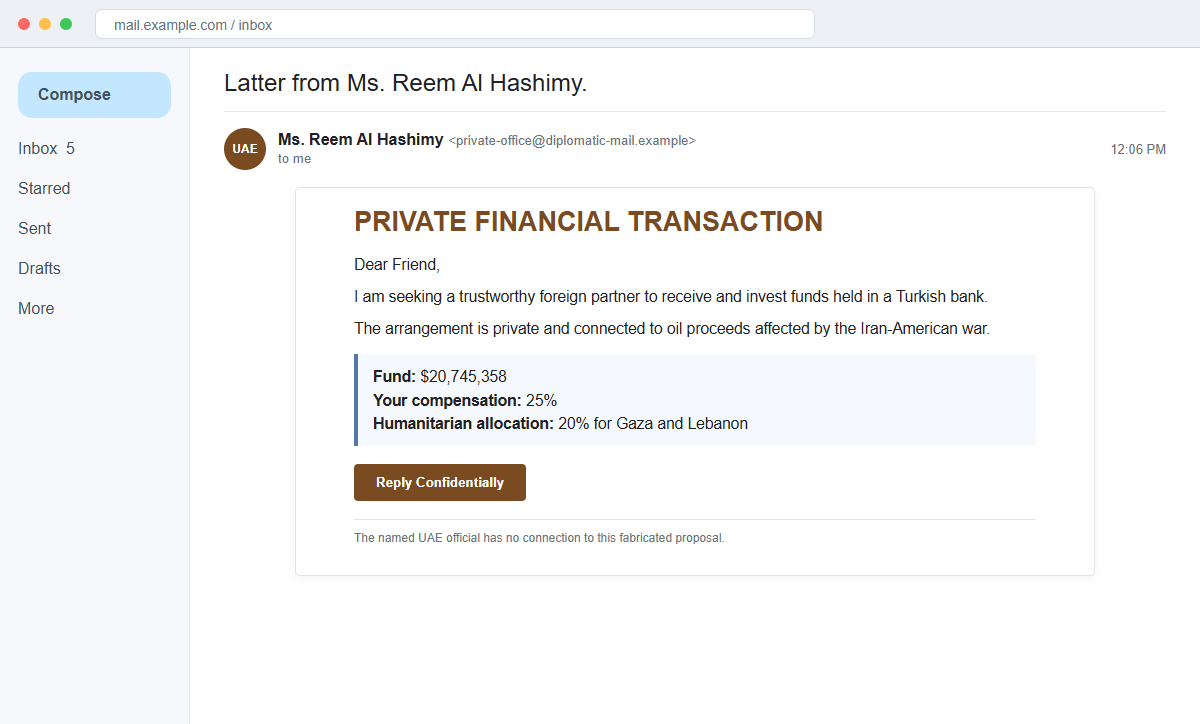
The Private Financial Transaction email scam is a classic advance-fee fraud dressed as a confidential international deal. The public official named in the message has no connection to the proposal.
The sender may first ask only whether you are interested. Once you respond, the conversation shifts toward identity documents, bank details, invented contracts, and fees that must be paid before the transfer can proceed.
Do not reply or treat the humanitarian references as proof of good intentions. A legitimate minister does not recruit an unknown email recipient to move millions from a foreign bank in secret.
Overview
A real public figure is used to support an invented role
The message claims to come from Ms. Reem Al Hashimy and may call her the UAE Minister of State for Finance.
The official UAE cabinet identifies her as Minister of State for International Cooperation, not the financial title used in the lure.
That mismatch helps expose the impersonation, but the core issue is larger: a government minister would not use an unsolicited personal email to arrange a secret transfer with a stranger. The named official is not involved.
War, oil money, and a Turkish bank create a dramatic explanation
The sender says the funds are connected to an Iran-American war and oil-related proceeds being held abroad. International conflict is used to explain why the money must move discreetly and quickly.
The story is vague enough to survive questions. Details can change during the exchange, while secrecy is presented as a condition of protecting the participants and the fund.
Generous percentages make the recipient feel like a partner
The recipient is offered 25% as compensation, while 20% is supposedly reserved for humanitarian work in Gaza and Lebanon. The moral component makes the arrangement feel more purposeful than simple greed.
No money is waiting. The percentages are used to make later fees look tiny compared with the imaginary reward and to create emotional resistance to abandoning the deal.
- The subject may misspell letter as Latter.
- The sender impersonates Ms. Reem Al Hashimy.
- Her real UAE government role is described incorrectly.
- The proposal is confidential and unsolicited.
- The supposed fund is $20,745,358.
- The money is said to be held in a Turkish bank.
- The story references oil proceeds and international conflict.
- The recipient is offered 25% of the fund.
- Another 20% is assigned to humanitarian support.
- Later stages request bank details, documents, and fees.
How a Confidential Investment Story Builds Trust Over Time
The opening email often contains more story than instructions. Its purpose is to find recipients who are curious enough to reply, after which a human scammer can adapt the narrative and answer objections.
Secrecy isolates the target. The recipient may be told that disclosure could endanger the minister, violate bank rules, or cause the fund to be seized.
That warning discourages advice from a banker, colleague, or family member who would recognize the fraud.
The 25% share creates an apparent business relationship rather than a prize. The victim is told their foreign status, bank account, or investment experience provides a service, which can make the reward seem earned.
Humanitarian language softens the questionable transaction. Assigning 20% to Gaza and Lebanon suggests that participation will help others, even though the recipient has no evidence of a registered charity, trust, or aid program.
Real public officials have documented roles and official communication channels. The UAE government's cabinet listing identifies Reem bint Ebrahim Al Hashimy as Minister of State for International Cooperation, exposing the financial title assigned by the sender.
The scam does not become legitimate if the sender provides a photograph, passport image, diplomatic letter, bank statement, or video call. Stolen media, forged documents, and impersonated accounts can all be used to maintain the fiction.
Where the Fake $20.7 Million Transaction Really Leads
After a positive reply, the criminal asks for the recipient's full name, address, occupation, telephone number, identity documents, bank details, and sometimes a sample signature. The information is described as necessary to prepare a partnership contract.
A second character may appear as a Turkish banker, lawyer, diplomatic courier, compliance officer, or investment manager. Multiple email accounts make the arrangement look like an active process with independent participants.
Documents may display bank logos, official seals, transaction codes, account balances, and anti-money-laundering language. They are produced by the same fraud network and cannot verify one another.
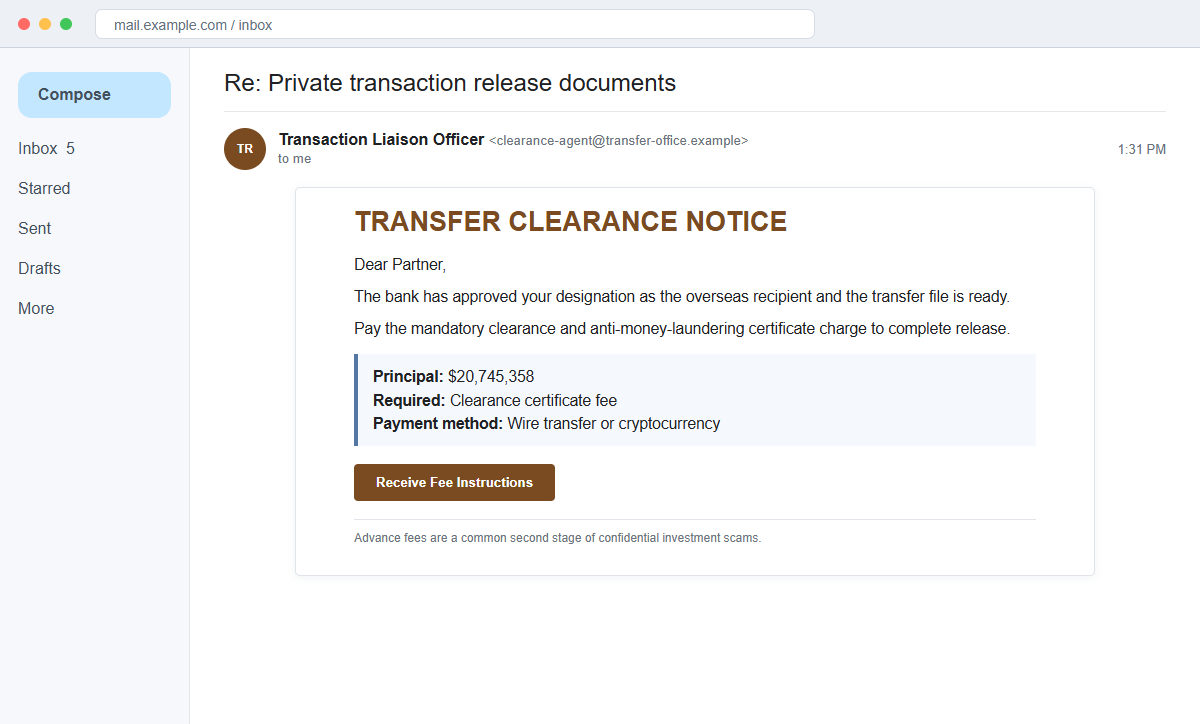
The first fee may be called a clearance certificate, notarization, insurance, tax, legal retainer, or bank activation charge. If it is paid, the sender invents another obstacle because each new payment is the actual source of profit.
Identity and bank data can be exploited separately from the advance fees. Criminals may open accounts, target the victim with more convincing calls, create fake payment evidence, or sell the profile to another fraud group.
A promised transfer that cannot pay its own expenses is a central contradiction. If $20,745,358 genuinely existed under the sender's control, there would be no need for a stranger to advance small charges through irreversible payment methods.
How the Private Financial Transaction Email Scam Works
Step 1: A senior official supposedly selects a stranger
The email says the sender needs a trustworthy foreign partner for a private transaction. The recipient is chosen without an introduction, professional connection, application, or due diligence.
The improbable selection is reframed as discretion. In reality, mass email allows the same proposal to reach thousands of strangers at almost no cost.
Step 2: A geopolitical story explains the secret fund
Oil proceeds, an Iran-American war, and money held in Turkey give the proposal international urgency. The details sound important while remaining difficult for the recipient to verify.
References to current suffering or conflict are emotional tools, not evidence that the claimed account exists.
Step 3: Large percentages reward cooperation and silence
The recipient is offered 25%, and 20% is assigned to humanitarian causes. The remaining share supposedly belongs to the sender or the transaction plan.
The numbers create a sense of structure, but no audited agreement, escrow, bank confirmation, or legal authority supports them.
Step 4: Personal and banking details are requested
The sender asks for identity records and a receiving account so a partnership file can be prepared. A signature or proof of address may be included.
This is valuable data delivered before the recipient has verified the sender. A legitimate financial arrangement would use known institutions, legal counsel, and secure due diligence.
Step 5: A network of fake professionals joins the exchange
A banker, lawyer, compliance officer, or courier confirms the story and provides additional forms. Each person may use a different address but repeat the same reference numbers.
The characters are not independent verification. They are parts of one controlled conversation designed to make progress feel real.
Step 6: Clearance fees block the supposed transfer
The recipient is told to pay for a certificate, tax, insurance policy, or legal release. Cryptocurrency, wire transfer, gift cards, or money services may be requested.
After payment, another authority discovers a new charge. The transfer remains one step away for as long as the victim continues paying.
Step 7: The victim is targeted again after the deal collapses
When the recipient stops, a recovery agent may claim the criminals were arrested or the money was found. That person already knows the loss details because the data was shared within the network.
A guaranteed recovery for an advance fee repeats the original structure. Report through official channels and do not fund a second promise.
Company and Checkout Checks
Confirm the person's actual government role
Use the UAE government's official cabinet directory entered independently. It lists Reem Al Hashimy as Minister of State for International Cooperation, not the finance role stated in the scam.
Do not use a biography, number, or social account linked by the sender. Look for the institution's own directory and published contact route.
Test the business logic
Ask why a minister would select an unknown recipient, why the transfer must be secret, why ordinary legal and banking channels cannot be used, and why costs cannot be deducted from the fund.
The story fails these questions because the supposed confidentiality exists to isolate the victim and the fees exist because there is no money.
Verify the bank and professionals independently
Look up the Turkish bank's official domain and call its published fraud department. Search professional registries for any lawyer or adviser, then contact the registered office rather than the details in the email.
Do not send documents merely to obtain a file number. A fake file number will be confirmed by every character controlled by the same group.
Treat secrecy and advance fees as decisive warnings
A legitimate cross-border investment has transparent legal documents, source-of-funds checks, tax advice, and accountable institutions. It does not depend on a stranger's private bank account or silence.
Refuse every payment and preserve the messages for the bank and cybercrime authority. Independent reporting is safer than confronting the sender.
Warning Signs to Check Before You Act
- A senior government official contacts you unexpectedly.
- The subject contains obvious spelling errors.
- The official's government role is described incorrectly.
- A confidential transaction needs a foreign stranger.
- The claimed fund is $20,745,358.
- War and oil proceeds explain why normal rules cannot apply.
- You are offered 25% for receiving money.
- Humanitarian causes are used to justify the arrangement.
- Identity documents and a signature are requested early.
- Several supposed professionals confirm one another.
- A clearance fee is required before transfer.
- You are told not to speak with your bank or family.
No legitimate minister, banker, or humanitarian program needs an unknown recipient to move $20.7 million secretly. The safe response is to stop contact, preserve the evidence, and verify the impersonation through official channels.
What to Do if You Have Fallen Victim to This Scam
- End the confidential conversation. Stop replying and block the email, telephone, and messaging accounts. Do not attempt to negotiate, expose the sender, or collect more proof through continued contact. Engagement gives the criminal more opportunities to apply pressure.
- Do not pay a clearance or investment fee. Refuse tax, legal, anti-money-laundering, certificate, courier, insurance, and bank release charges. The promised $20,745,358 does not exist, so no final payment can unlock it.
- Contact the payment provider immediately. If money was sent, call the bank, wire service, card issuer, or cryptocurrency platform through a verified channel. Request a recall, freeze, or tracing action and give the exact recipient details before funds move again.
- Protect identity documents. Report an exposed passport, driver license, tax number, address, or date of birth to the relevant issuing and identity theft authorities. Consider a fraud alert or credit freeze where available and watch for new accounts.
- Secure financial and email accounts. Change exposed and reused passwords, enable strong multi-factor authentication, revoke sessions, and inspect recovery methods. Ask the bank to monitor or replace account details if the scammer received them.
- Preserve the complete record. Save the original message with headers, attachments, chats, telephone numbers, bank instructions, wallet addresses, receipts, and documents sent. Record the timeline and each identity the sender used.
- Scan any device used for downloads. Run a full scan with Malwarebytes or another trusted security product if an attachment, remote-support program, or unfamiliar application was opened. Remove unknown software and update the operating system and browser.
- Use a blocking layer against follow-up links. AdGuard or another reputable DNS and content blocker may stop some known phishing and malicious advertising domains. It cannot verify a private investment proposal, so keep checking addresses and requests manually.
- Report the impersonation and financial fraud. Notify the national cybercrime authority, local police, the payment provider, email service, and the office whose official was impersonated. In the United States, a report can also be filed with IC3.
- Warn trusted contacts. The criminal may impersonate you using the documents and writing collected during the exchange. Tell family and business contacts to verify unusual requests through another channel.
- Avoid recovery scams. Do not trust an unexpected lawyer, investigator, bank officer, or blockchain recovery service that guarantees the funds can be returned for a fee. Victim lists are often recycled into a second fraud.
Frequently Asked Questions
Is the Private Financial Transaction email real?
No. It is an advance-fee scam that impersonates a UAE official and offers a fictional share of $20,745,358.
Did Reem Al Hashimy send the proposal?
No. The named UAE minister has no connection to the message, and the scam even assigns her an incorrect government role.
Why am I offered 25%?
The large share motivates cooperation and makes later fees appear small. There is no fund, partnership, or investment return.
Is the 20% humanitarian allocation legitimate?
No evidence supports it. References to Gaza and Lebanon add emotional credibility but do not identify a registered aid program or controlled account.
What if the sender provides bank documents?
Do not rely on them. Logos, statements, seals, and signatures can be forged. Verify the bank and any case through independently published contacts.
What if I already paid a transfer fee?
Contact the payment provider immediately, request recall or tracing, protect identity data, preserve the evidence, and report the fraud to police and the cybercrime authority.
The Bottom Line
The Private Financial Transaction email scam uses a public official's identity, a dramatic international story, and a 25% reward to make a fictional $20.7 million deal feel possible.
The named UAE minister is not involved. Do not send identity documents, bank details, or clearance fees to anyone who contacts you with a confidential transfer proposal.
If you engaged, stop now and secure the real assets that were exposed. Banks, identity authorities, and cybercrime investigators can address the genuine loss, while the promised fund remains only a lure.








