

The Tesla Stock email scam promises a life-changing prize to collect personal information and advance fees. An email with the subject “CONGRATULATIONS” says your address was randomly selected to receive 18,087.71 Tesla shares.
The notice values the prize at more than $4 million and invites a reply to begin the transfer.
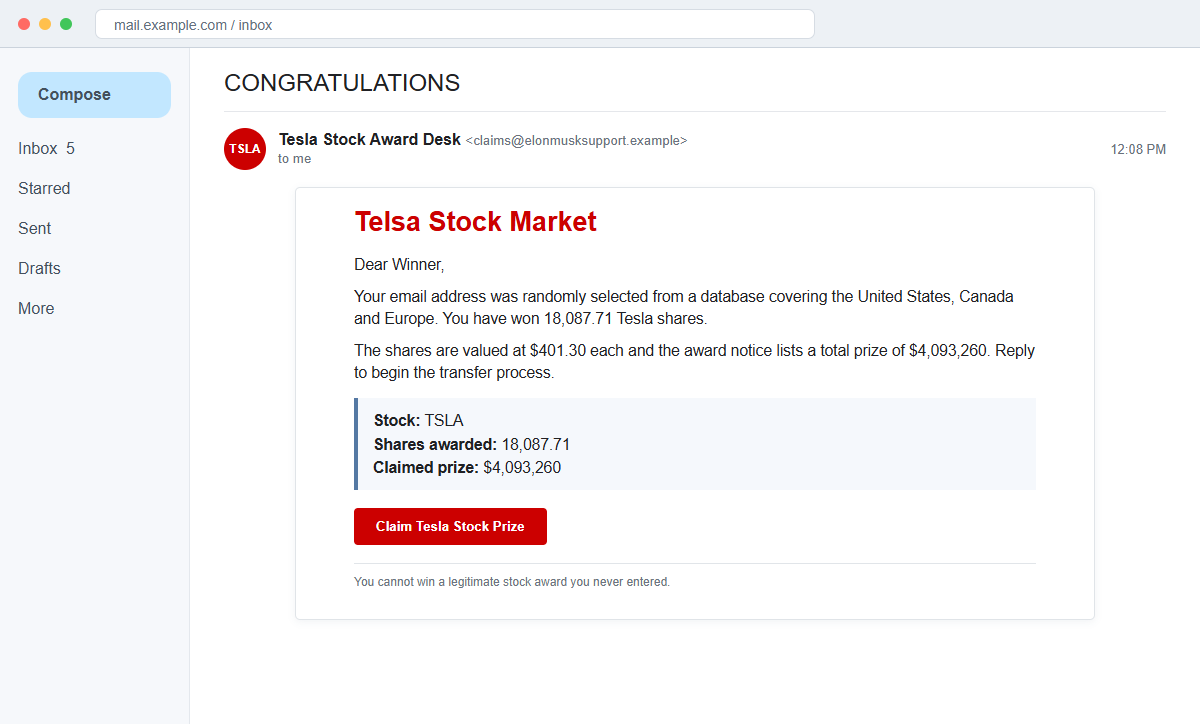
The You've Won Tesla Stock email is a prize and advance-fee scam. Tesla did not select the recipient, no shares are waiting, and the award desk has no authority to transfer company stock.
The first contact may ask only for a reply, which feels harmless beside such an enormous promise. Later messages can request identification, banking details, tax forms, legal charges, or a so-called clearance payment.
Do not reply, send documents, or pay. A legitimate prize is not awarded through a random email database, and no genuine transfer agent requires secret payments to strangers before releasing unexpected shares.
Overview
A famous company and huge share count create instant attention
The message claims that addresses from the United States, Canada, and Europe were entered into a random selection. It says the winner received 18,087.71 TSLA shares valued at $401.30 each.
The Tesla and Elon Musk names supply recognition, while a life-changing total pushes ordinary questions into the background. The email may even misspell Tesla as “Telsa,” revealing the imitation.
The arithmetic contradicts the stated prize
The notice lists a total value of $4,093,260. However, multiplying 18,087.71 shares by the stated $401.30 price gives approximately $7,258,598.02.
That difference is not a market fluctuation because both figures appear in the same supposed award. It shows that impressive-looking numbers were assembled without basic consistency.
Identity collection and release fees are the real objectives
A recipient who responds may be assigned a claims agent, stock-transfer officer, lawyer, or tax representative. Each role can request forms and documents that make the nonexistent award feel as though it is moving forward.
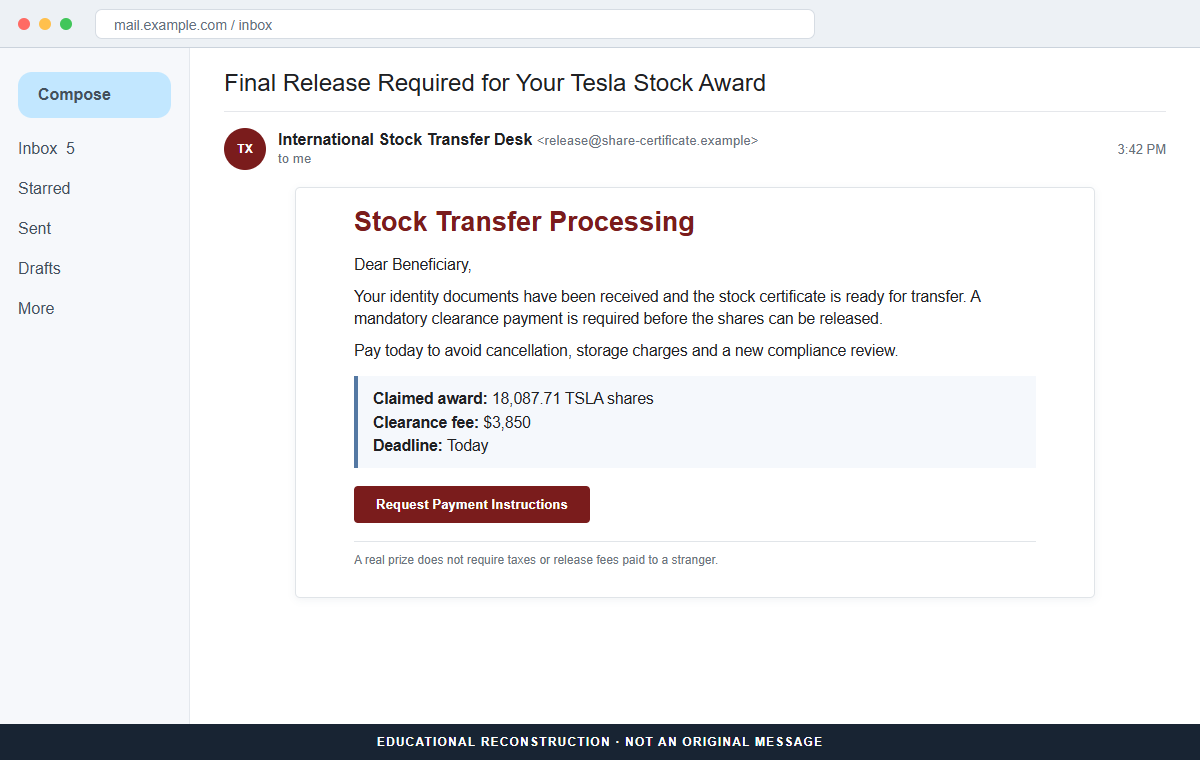
Eventually a tax, certificate, transfer, insurance, compliance, or brokerage charge blocks release. Every payment is real, while the promised shares remain a story.
- The subject contains only the word CONGRATULATIONS.
- The recipient supposedly won without entering a promotion.
- A random email database is used as the selection method.
- The message claims an award of 18,087.71 TSLA shares.
- A price of $401.30 per share is stated.
- The claimed $4,093,260 total does not match the multiplication.
- Tesla may be misspelled as Telsa in the sender or branding.
- The contact address uses an unofficial support-themed domain.
- A reply begins a longer identity and payment process.
- Taxes and release charges become the real financial demands.
How Real Stock Ownership and Prize Claims Differ
Public-company shares are recorded through regulated brokers, custodians, and transfer agents. Ownership is not created by an email saying that a marketing database selected an address at random.
Tesla's official investor-relations website publishes corporate reports, shareholder materials, events, and regulatory filings. That is a transparent corporate channel, not a private claims desk operating through an unrelated support-themed domain.
A legitimate award would have published terms, eligibility rules, a sponsor, entry method, drawing process, privacy notice, and a verifiable administrator. The recipient could confirm those details without replying to the person announcing the win.
FTC consumer guidance is direct about prize scams: a winner should not have to pay to receive a prize. Demands for taxes, shipping, processing, or another fee before release are a central warning sign.
Real tax obligations are handled through lawful reporting and payments to the relevant authority, not through cryptocurrency, gift cards, money transfers, or a private bank account selected by an email agent.
No celebrity name changes those rules. Scammers frequently borrow the identities of executives and well-known companies because recognition can substitute for evidence when a recipient is excited.
The Numerical and Identity Problems Inside the Email
The campaign describes random selection from geographic email databases but provides no promotion name, entry record, drawing date, official rules, or independent administrator. The winner cannot verify that any drawing occurred.
The share quantity contains two decimal places, making it look like a calculated brokerage allocation. Precision is a presentation technique and does not prove that an account or certificate exists.
The prize value is internally inconsistent. At the email's own stated share price, the purported 18,087.71 shares would be worth around $7.26 million, not $4.09 million.
An address connected to a phrase such as Elon Musk Support is not automatically affiliated with Elon Musk or Tesla. Domain ownership, official corporate publication, and independent contact matter more than the words before the ending.
The misspelling “Telsa Stock Market” is another clue that the sender copied a famous identity without proper review. A corrected spelling would still leave the impossible promotion and unofficial route unexplained.
Scammers can send share certificates, brokerage screenshots, executive letters, or identity cards in later messages. All are images or files until a regulated institution confirms an account through independently obtained contact details.
How the You've Won Tesla Stock Email Scam Works
Step 1: A mass email announces an unexpected winner
The campaign sends a generic congratulations notice to large lists of addresses. The criminal needs only a small number of recipients to reply because the eventual fees can be substantial.
A subject with no company detail may also evade some filters and spark curiosity. The famous brand appears only after the message is opened.
Step 2: A huge TSLA award overwhelms normal skepticism
The recipient is told that 18,087.71 shares are waiting and may be worth millions. Specific quantities, a ticker symbol, and a share price make the claim resemble a financial statement.
The reward encourages the reader to rationalize errors. A misspelling or strange address can feel unimportant when the imagined cost of ignoring the email is so large.
Step 3: The sender asks for a simple reply
Early contact may request the winner's name, country, telephone number, and confirmation of interest rather than money. This lowers the psychological barrier and separates responsive targets from the bulk mailing list.
The criminal then adapts the story to the victim's location, financial knowledge, and questions. Personal attention makes the campaign feel less automated.
Step 4: Fake specialists build a transfer process
A supposed claims officer, broker, transfer agent, attorney, or tax department joins the conversation. The victim receives reference numbers, forms, certificates, and deadlines.
Multiple roles create the illusion of independent verification, but one group can control every address, telephone number, website, and document in the exchange.
Step 5: Identity and banking information are collected
The victim may be asked for a passport, driver's license, tax number, utility bill, signature, bank details, and brokerage information. The requests are described as know-your-customer or beneficiary registration.
Those materials can enable identity theft, account applications, forged authorizations, targeted bank calls, and convincing future fraud even if no fee is paid.
Step 6: A final payment is invented before release
The shares supposedly cannot move until a tax, clearance certificate, legal stamp, insurance policy, or international transfer charge is paid. Urgency and confidentiality are emphasized.
After one payment, another obstacle appears. The victim is told that refusing now would forfeit both the promised fortune and every fee already sent.
Step 7: The prize vanishes and recovery fraud may begin
No brokerage account receives the shares. The criminals stop responding when payments end, or continue adding charges as long as the victim remains engaged.
Later, a new person may claim to have recovered the stock or traced the original scammers. A request for another advance payment shows that the second approach is also fraud.
Company and Checkout Checks
Look for published official promotion rules
A real promotion should be visible through the sponsor's independently opened corporate channels and identify eligibility, entry, drawing, prize, administrator, and claim procedure.
If the only evidence comes from the winning email and its sender, there is no independent promotion to verify.
Use Tesla's official corporate and investor routes
Navigate to tesla.com or ir.tesla.com yourself and review published notices. Do not trust a look-alike support domain merely because it contains Tesla or Elon Musk words.
Contact information must be obtained from the official site, not from the supposed claims agent.
Verify the transfer agent or broker independently
Ask for the institution's legal name and regulatory details, then locate its website and telephone number separately. Do not use numbers printed on the award certificate.
A real institution can confirm whether an account exists without demanding gift cards, cryptocurrency, or a private transfer.
Recalculate every financial claim
Multiply the share quantity by the price and compare the result with the stated total. Here, the email's figures disagree by more than $3 million.
Arithmetic does not authenticate a promotion, but obvious inconsistency shows that the sender's polished financial story cannot withstand a basic check.
Warning Signs to Check Before You Act
- You are declared a winner even though you never entered.
- Email addresses were supposedly selected from a regional database.
- The subject gives no promotion or sponsor information.
- A stranger promises 18,087.71 shares of a famous company.
- The share count, price, and stated total do not agree.
- Tesla is misspelled as Telsa.
- The contact domain is not an official Tesla corporate route.
- No published rules or independent administrator can be found.
- Identity documents are requested through ordinary email.
- Taxes or release fees must be paid before the award arrives.
- Payment is requested by cryptocurrency, wire, gift card, or transfer app.
- Secrecy and a same-day deadline are added after you respond.
A genuine stock position can be confirmed through a regulated account. An unexpected email, private claims agent, inconsistent arithmetic, and advance fee cannot create ownership of Tesla shares.
What to Do if You Have Fallen Victim to This Scam
- Stop all contact and do not pay another fee. Preserve the messages, then block the addresses and numbers. Do not tell the scammers which detail exposed them, because they can use that feedback to improve the next approach.
- Contact every payment provider immediately. Tell the bank, card issuer, wire service, exchange, money-transfer company, payment app, or gift-card issuer that the transaction funded a scam. Ask about a recall, freeze, dispute, or destination alert.
- Protect any identity document you supplied. Report exposed passports, licenses, tax identifiers, and banking documents to their issuers. Follow the local identity-theft process and consider a credit freeze or fraud alert where available.
- Secure email, financial, and brokerage accounts. Change exposed or reused passwords, enable strong multi-factor authentication, revoke sessions, and review recovery details. Tell institutions exactly what information the criminals received.
- Monitor for fraudulent applications and transfers. Review credit files, brokerage activity, bank payees, mobile accounts, and government records. Continue checking because stolen identity data may be used long after the initial contact.
- Save a complete evidence package. Keep original emails with headers, chat logs, telephone numbers, documents, receipts, account names, wallet addresses, and transaction hashes. Store copies outside any mailbox the criminals may access.
- Scan received files and software. Run a complete Malwarebytes scan or another trusted security product if you opened a certificate, archive, installer, browser extension, or remote-support tool. Remove unknown software and update the device.
- Use blocking as a secondary safeguard. AdGuard or another reputable DNS and content blocker can stop some known scam sites and malicious advertisements. New domains may not yet be listed, so independent verification remains essential.
- Report the fake prize. Notify the FTC or the relevant national fraud authority, local police when money or identity documents were lost, the email provider, and any platform used for payment or hosting.
- Warn relatives and professional contacts. Scammers may impersonate the victim or claim that family must help complete the transfer. Establish a separate channel for confirming unusual financial or identity requests.
- Ignore anyone promising guaranteed recovery. A supposed investigator, lawyer, hacker, or fund-recovery agent who demands payment first may be the same criminal group. Work only with payment providers, authorities, and professionals you verify independently.
Frequently Asked Questions
Did I really win Tesla stock through my email address?
No. The reviewed email is a scam. It provides no legitimate promotion, regulated account, or independently verifiable transfer of TSLA shares.
Why does the email use an exact number of shares?
Precision makes the claim look financial and calculated. Exact-looking numbers can be invented, and the figures in this message do not even produce the stated total.
How much would 18,087.71 shares at $401.30 be worth?
Using the message's own figures, the result is approximately $7,258,598.02, not the claimed $4,093,260. The mismatch is a major warning sign.
Can a winner be required to pay tax before receiving stock?
A real tax obligation follows applicable law and official payment procedures. A private claims agent demanding an advance transfer before releasing an unexpected prize is a scam indicator.
What if I replied but sent no documents?
Stop responding, block the sender, and expect more tailored approaches. Your address is now known to be active, but the risk is lower than if identity data, credentials, or money were provided.
Can an emailed stock certificate prove ownership?
No. Images, signatures, seals, and certificate numbers can be fabricated. Ownership must be confirmed through a legitimate broker, custodian, or transfer agent contacted independently.
The Bottom Line
The You've Won Tesla Stock email scam uses a famous company and an imaginary fortune of more than $4 million to begin an identity-theft and advance-fee scheme.
No promotion is independently verifiable, the contact route is unofficial, and the email's own share calculation is wrong. A real prize does not require private release payments.
If you sent money or documents, stop contact, notify payment and identity providers, secure accounts, preserve evidence, monitor for misuse, report the fraud, and reject recovery offers that demand another fee.








