

A governance page says Ethena users can vote on Season 7 reward distribution. The first 5,000 participants supposedly receive an exclusive multiplier, and a Connect Wallet button is waiting beside professional charts and proposal cards.
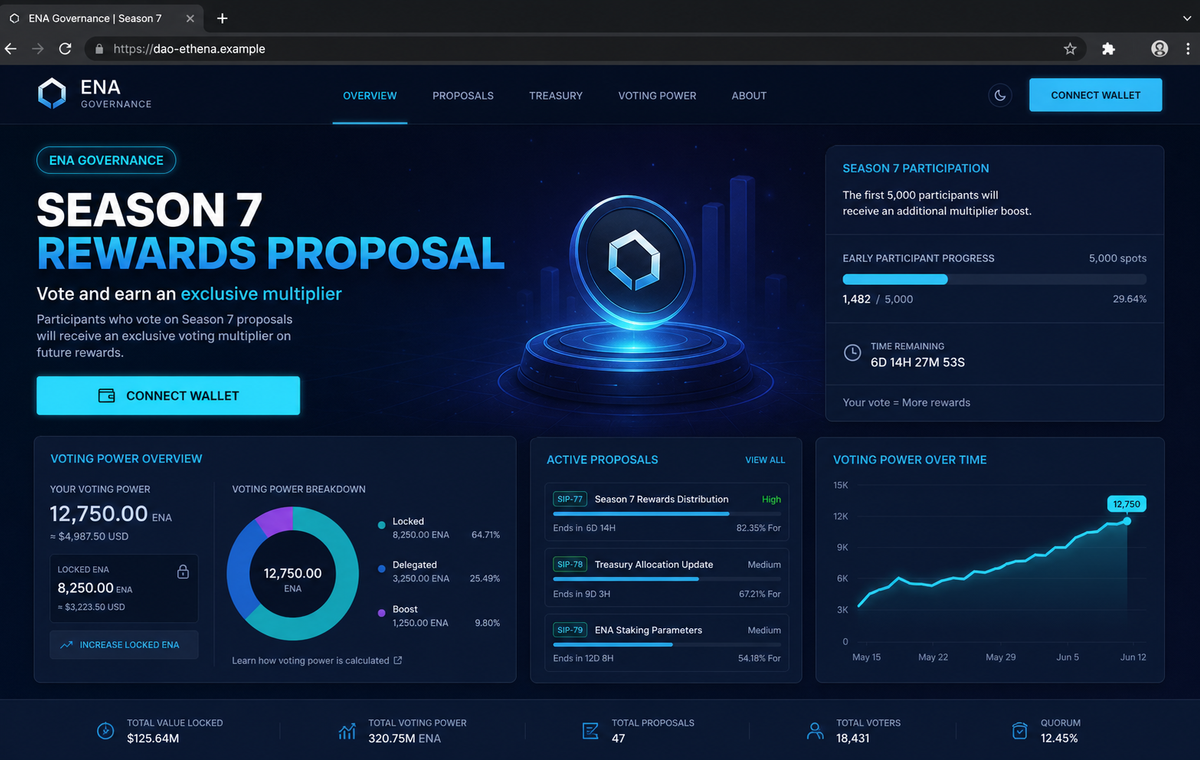
The Ethena Voting Rewards Scam copies the look of a decentralized-finance portal but not its trust. The reviewed page used an imitation domain and turned a fake vote into a wallet-draining opportunity.
The danger is not simply that a website knows a public address. A connected wallet can be shown a malicious signature or approval request that grants the operator authority to move tokens, sometimes without an obvious transfer appearing in the first prompt.
Before connecting to any governance page, begin from the project's verified website, follow its documented voting link, and read every request in the wallet. A reward multiplier does not justify blind approval.
Overview
The fake portal combines governance with a reward multiplier
The fraudulent page presents an “Ethena Season 7 Rewards Proposal.” Visitors are told they can influence how and when ENA rewards are distributed, while early participants receive an extra multiplier on existing positions.
This pairing is persuasive because governance and incentives both exist in decentralized finance. The scam merges familiar concepts into a proposal that feels plausible even when the specific vote and reward have no official record.
A polished dashboard hides the importance of the hostname
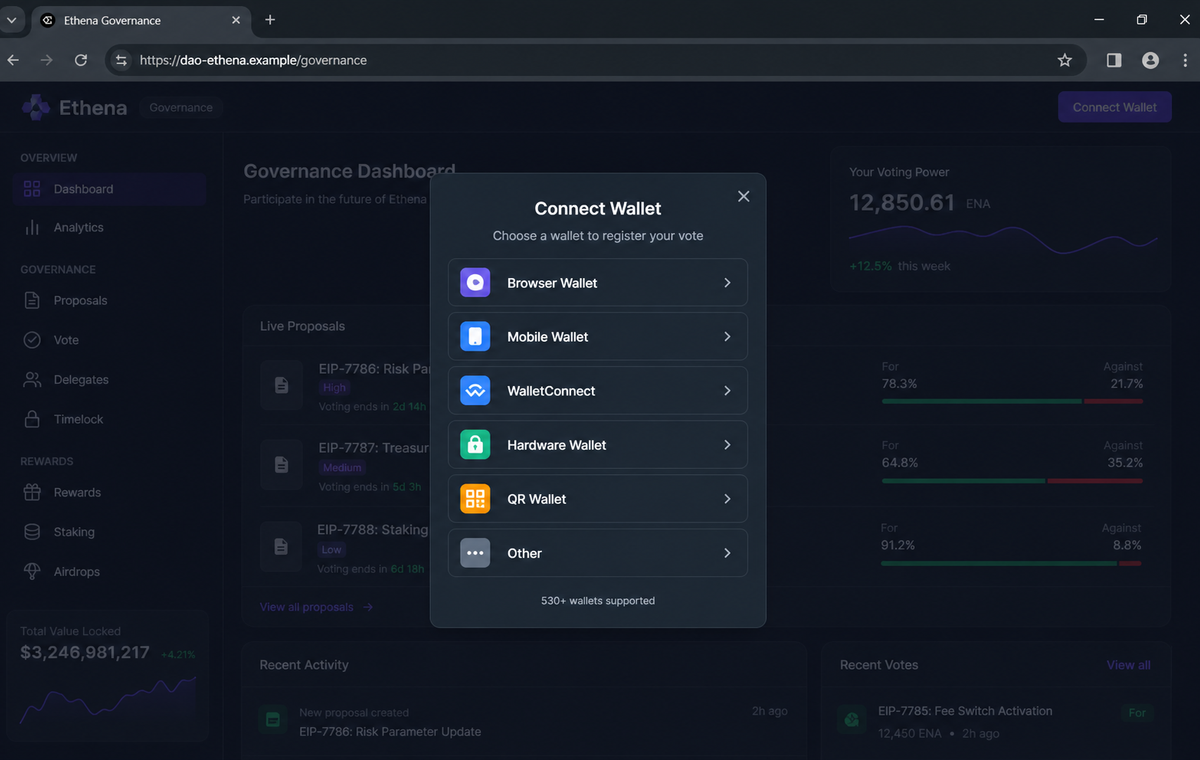
The site imitates a modern DAO interface with voting power, active proposals, treasury information, progress bars, and wallet options. None of those visual elements prove who controls the server or the contract behind the button.
The reviewed campaign used dao-ethena[.]fi rather than the legitimate ethena.fi domain. That rearrangement is small enough to escape a quick glance, especially when the visitor arrives from a promoted post or direct message instead of typing the address.
Connect Wallet is the beginning of the dangerous action
Connecting a wallet normally reveals the public address and network. The risk increases when the site immediately asks the user to sign a message, approve a token allowance, permit an operator, or confirm a transaction described vaguely as registration.
A drainer can analyze the connected address, identify valuable assets, and present permissions tailored to them. Once a malicious approval or signature is accepted, the attacker may transfer tokens to controlled addresses with little chance of reversal.
- The page impersonates an Ethena governance portal.
- A Season 7 proposal is presented without an official discussion record.
- Visitors are promised influence over reward distribution.
- The first 5,000 participants supposedly receive a multiplier.
- Progress bars and voting statistics create artificial activity.
- The hostname resembles but does not match ethena.fi.
- More than 500 wallet options are offered to widen the target pool.
- The Connect Wallet action exposes the address to the site.
- A later signature or approval can authorize token theft.
- The real voting route can be reached through official Ethena documentation.
How Real Ethena Governance and ENA Voting Work
Ethena is a decentralized-finance protocol, and ENA is its governance token. Official documentation describes governance responsibilities, delegation, committees, and voting routes rather than treating every wallet connection as proof of eligibility for a reward.
Real governance proposals should have a traceable discussion history. Users can look for a forum post, proposal identifier, author, voting period, quorum rules, choices, and a link from official documentation to the recognized voting platform.
Governance can involve signing a message or transaction, but the prompt should match the documented action. A vote should not silently grant unlimited spending permission over unrelated tokens or transfer assets to an unfamiliar address.
ENA holders may delegate or vote under published rules. That does not mean an anonymous page can invent a seasonal multiplier and ask wallets to connect before revealing the proposal's contract, snapshot, or eligibility calculation.
The safest navigation path begins at ethena.fi or the official documentation. From there, users can follow the verified governance forum and voting links rather than relying on search advertisements, replies, Telegram posts, or shortened URLs.
A legitimate project may use third-party governance infrastructure. The important point is that the route must be documented by the project, and the wallet prompt must reflect the known proposal rather than an unexpected approval or asset movement.
Details That Expose the Fake Season 7 Rewards Vote
The domain is the strongest external clue. Placing “dao” before the project name and using a similar ending creates a believable address, but it remains separate from the established ethena.fi domain and its documented links.
The early-participant multiplier lacks verifiable rules. The page does not provide a published allocation formula, contract address, audited reward mechanism, snapshot block, or official proposal history that explains how the benefit is calculated.
The claimed urgency is tied to participation count rather than governance. “First 5,000” turns a deliberative vote into a race, encouraging users to approve prompts before reading what the wallet says.
A large wallet list is not evidence of compatibility or legitimacy. Connection libraries can display many familiar options, while the site still controls the transaction or signature request shown after selection.
The interface may show balances, voting power, or asset estimates after reading the public address. Those figures can be retrieved from public blockchain data and do not prove the page has an official relationship with Ethena.
The decisive test is the requested authority. A transaction that transfers assets, grants broad token allowance, enables an unknown operator, or contains an unreadable signature is inconsistent with a simple reward-distribution vote.
How the Ethena Voting Rewards Scam Works
Step 1: Fake posts and ads promote an exclusive governance event
The link may circulate through compromised X accounts, fabricated project profiles, Discord, Telegram, direct messages, malicious advertisements, or search results. The post borrows real Ethena terminology and presents the reward as time-sensitive.
Users who already follow DeFi incentives are more likely to recognize the vocabulary and click before checking the account history.
Step 2: A lookalike domain hosts a convincing DAO dashboard
The page copies the colors, typography, token names, navigation, and statistical cards associated with a professional protocol. A slightly altered hostname is placed above a design that looks more trustworthy than the address itself.
Because browsers reduce or hide parts of the address on small screens, mobile visitors may never inspect the registered domain carefully.
Step 3: The Season 7 story creates legitimacy and urgency
A numbered season suggests an established campaign with previous rounds. The promise that only early voters receive a multiplier makes delay feel costly and reframes caution as a missed opportunity.
Fake progress counts can update automatically even when no real participants or proposal exist.
Step 4: Connect Wallet reveals the address and asset profile
The connection request identifies the wallet's public address and active network. The site can query blockchain data to see token balances, NFTs, approvals, and positions, then select the most profitable request to present.
Connection alone does not normally transfer funds, but it gives the page the context needed for the next step.
Step 5: Registration becomes a signature or token approval
The site may ask the visitor to sign a message described as voting, eligibility confirmation, or login. It may instead request an allowance, Permit signature, operator approval, or direct transaction with technical details hidden behind a friendly button.
A signature is not harmless merely because the wallet shows no network fee. Some off-chain signatures can still authorize token movement later.
Step 6: The drainer moves valuable assets to attacker addresses
After authorization, automated scripts can transfer approved tokens and NFTs. The operator may prioritize high-value holdings, split transfers across addresses, or bridge assets to another network to complicate tracing.
The wallet owner may notice only after balances fall or unfamiliar approvals appear in an explorer.
Step 7: The fake portal disappears and recovery impostors arrive
Campaign domains are disposable. Once reported, the same interface can move to a new hostname while the original goes offline, leaving victims without a support channel.
Replies to public loss reports may offer guaranteed asset recovery. Requests for fees, remote access, private keys, or recovery phrases are likely another stage of the scam.
Company and Checkout Checks
Begin with Ethena's verified website and documentation
Type ethena.fi directly or use a bookmark, then follow documented governance links. Do not trust a domain merely because it contains “ethena,” “dao,” “vote,” or “rewards.”
Compare the proposal title and identifier with the official forum and voting platform before connecting.
Demand a complete proposal record
Look for an identifiable author, discussion thread, voting dates, choices, quorum, snapshot, contract details, and published outcome rules. A reward banner without that history is marketing, not governance evidence.
Ask why an early-voter multiplier would be necessary and where the mechanism is documented.
Read the wallet prompt as a legal authorization
Expand every detail, including the origin, network, contract, spender, token, amount, and permission. Reject unlimited allowances, SetApprovalForAll requests, asset transfers, and opaque signatures unrelated to the stated vote.
Use transaction simulation when the wallet provides it, but do not treat simulation as a substitute for a trusted origin.
Use a separated wallet for unfamiliar applications
A low-value wallet can limit exposure during legitimate experimentation, but it does not make a fraudulent site safe. Never connect a treasury or primary wallet to an unverified campaign.
Hardware-wallet users must still read the device display because the hardware signs exactly what the user approves, including a malicious transaction.
Warning Signs to Check Before You Act
- A social post is the only evidence for a Season 7 governance proposal.
- The hostname resembles Ethena but is not ethena.fi or a documented route.
- The first 5,000 voters supposedly receive an exclusive multiplier.
- A countdown or progress meter makes the vote feel urgent.
- The page does not link to an official discussion thread.
- No proposal identifier, snapshot block, contract, or reward formula is provided.
- Hundreds of wallet options are used as a trust signal.
- The page reads balances and presents them as proof of account recognition.
- Voting requires an unlimited token allowance or operator approval.
- A no-fee signature is described vaguely as registration.
- The transaction would move assets rather than record a vote.
- Recovery helpers request fees, private keys, or wallet backups.
Governance should become clearer as you investigate it. If the proposal history is missing while the wallet permissions become broader, leave the page and revoke any approvals already granted.
What to Do if You Have Fallen Victim to This Scam
- Stop signing and disconnect the site. Reject any pending wallet prompts, close the page, and remove the connection from the wallet's connected-sites list. Do not revisit the domain through a recovery link or direct message.
- Identify exactly what was approved. Review the wallet activity and blockchain explorer for signatures, token allowances, SetApprovalForAll permissions, Permit authorizations, swaps, bridges, and transfers. Save transaction hashes and screenshots before changing anything.
- Revoke malicious permissions promptly. Use the wallet's trusted approval manager or a reputable explorer reached independently. Revoke unfamiliar spenders and operators on every affected network, understanding that revocation itself requires a legitimate on-chain transaction.
- Move assets if a recovery phrase or private key was exposed. Create a fresh wallet on a clean device with a new backup and transfer remaining coins, tokens, and NFTs. The old wallet cannot be made safe by changing a local password.
- Notify exchanges and stablecoin issuers when relevant. Give them the transaction hashes, destination addresses, time, network, and asset details. They may be able to flag receiving accounts, although blockchain transfers usually cannot be reversed.
- Scan the device for malicious software. Run a complete Malwarebytes scan if the site delivered a file, extension, or wallet application. Remove unknown software and extensions, then update the operating system, browser, and genuine wallet.
- Add protection against malicious links. AdGuard or another reputable DNS and content blocker can stop some known scam domains and harmful ads. Continue verifying addresses because new domains may appear before blocklists catch them.
- Report the domain and promotion account. Notify Ethena through official channels, the social platform, browser safe-browsing service, domain registrar, hosting provider, and the FBI IC3 or your national cybercrime authority.
- Preserve a complete evidence package. Keep the URL, wallet prompts, messages, transaction hashes, addresses, token amounts, timestamps, and correspondence. This record is useful to exchanges, investigators, insurers, and tax professionals.
- Ignore guaranteed crypto-recovery offers. No stranger can reverse a blockchain transfer by running special software. An upfront fee, wallet connection, private-key request, or remote-access demand is a strong sign of a follow-up scam.
Frequently Asked Questions
Is the Ethena Voting Rewards website genuine?
No. The campaign reviewed here used a lookalike domain and promoted an unverified Season 7 multiplier before asking visitors to connect wallets.
Is connecting a wallet enough to lose crypto?
Connection normally reveals the public address but does not transfer assets by itself. The danger comes from malicious signatures, approvals, or transactions requested immediately afterward.
Can a gasless signature be dangerous?
Yes. Some signatures can authorize token spending or other actions without an immediate network fee. Read the purpose, origin, contract, amount, and expiry before approving.
How can I find real Ethena governance proposals?
Start at ethena.fi or the official documentation and follow the recognized forum and voting links. Verify the proposal record before connecting a wallet.
Does a hardware wallet protect me from a drainer?
It protects private keys from leaving the device, but it cannot prevent an owner from approving a malicious transaction. The trusted display must be read carefully.
What should I do after approving the fake vote?
Disconnect, inspect the transaction, revoke suspicious permissions, move assets if secrets were exposed, preserve evidence, notify relevant services, and report the campaign.
The Bottom Line
The Ethena Voting Rewards Scam transforms a fake DAO proposal into a wallet-permission trap. Its professional interface and public blockchain data can look convincing, but the unofficial hostname and undocumented multiplier expose the deception.
Reach governance only through Ethena's verified documentation. Confirm the proposal record and read every wallet prompt as an authorization that may affect real assets.
If you approved anything, disconnecting is only the first step. Inspect and revoke permissions, move assets when private secrets were exposed, preserve transaction evidence, and reject anyone who guarantees recovery for a fee.








