

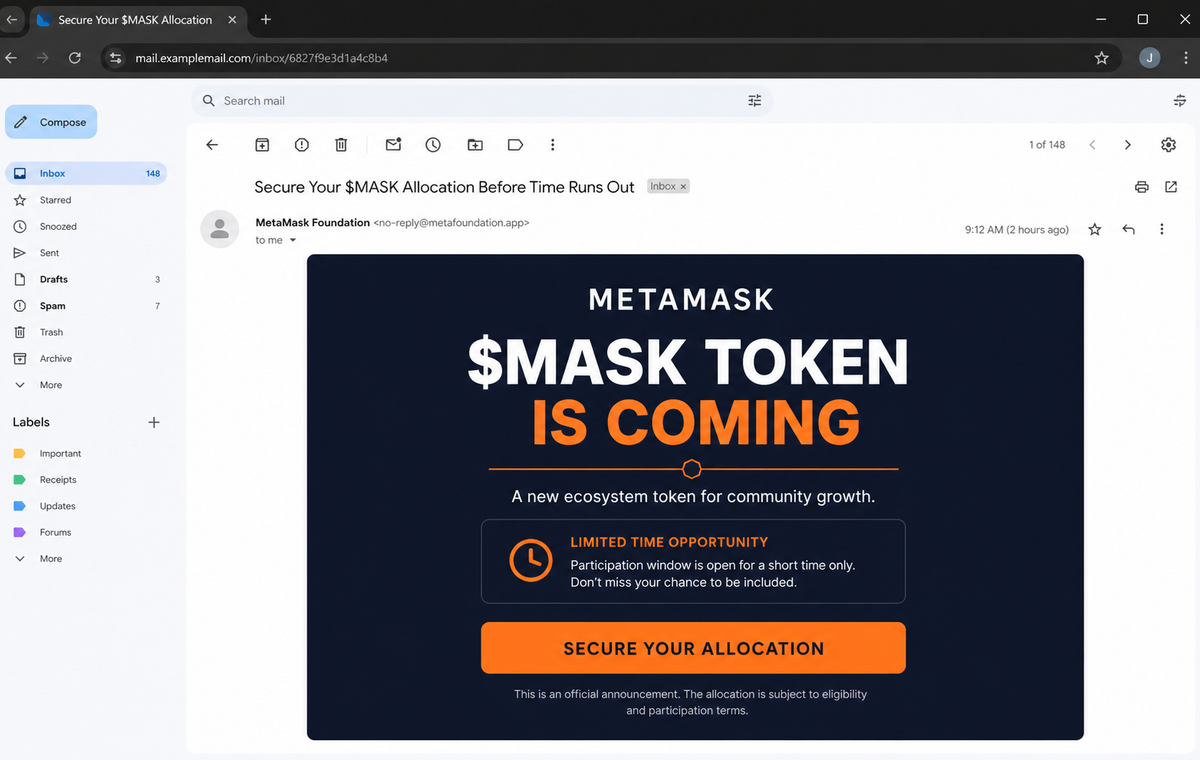
An email says MetaMask is launching a new $MASK ecosystem token. Your wallet may qualify for the first distribution, no payment is required, and a bright button offers to secure the allocation before time runs out.
The MetaMask $MASK Token Allocation Email Scam is not a genuine token announcement. It uses a fake registration sequence to move the reader from curiosity to a screen that requests the Secret Recovery Phrase, the master key to the wallet.
The earlier steps look harmless. A visitor may enter only an email address and public Ethereum address, receive a congratulatory message, and see a promise of 500 $MASK.
That staged progress is designed to make the final request feel like a normal completion step.
It is not. MetaMask says it does not send unsolicited account emails and will never ask for a password or Secret Recovery Phrase through an email campaign. Anyone who enters that phrase should assume the wallet is compromised.
Overview
The email invents a MetaMask token launch and private allocation
The campaign announces a supposed $MASK token built around community growth, active wallets, and on-chain participation. It claims eligible users can register for the first distribution phase and describes the process as protection against duplicate claims.
A statement that no upfront payment is required lowers suspicion. The message then adds a limited-time participation notice, creating urgency without the obvious warning sign of an immediate purchase request.
The fake claim journey uses several small commitments
The first page asks for an email address and public wallet address, information that can seem reasonable for an eligibility check. A second screen says registration succeeded and displays a large Receive 500 MASK button.
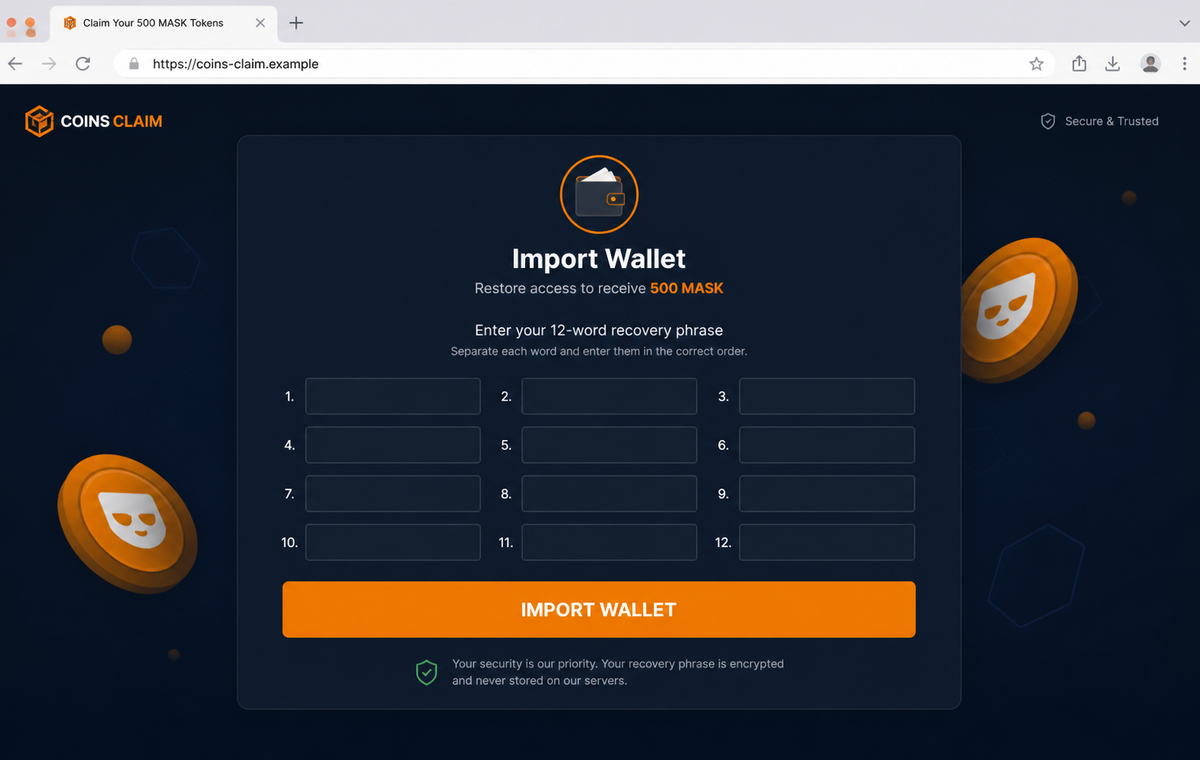
Only after the visitor has completed those steps does the site reveal the real objective. An Import Wallet page asks for the twelve-word recovery phrase, often surrounded by reassuring claims about encryption and security.
The recovery phrase gives the attacker complete wallet control
A MetaMask Secret Recovery Phrase is not an account-verification code. It can recreate the wallet and every account derived from it on another device. Whoever knows it can sign transactions without the owner's email password or approval.
Once the phrase is submitted, the attacker can transfer coins, tokens, and NFTs to other addresses. Transfers on public blockchains are normally irreversible, and the displayed reward never needs to exist for the theft to succeed.
- The subject promotes registration for a supposed $MASK distribution.
- MetaMask branding and community language make the launch feel official.
- Eligibility is linked to active wallets and on-chain participation.
- The email emphasizes that no upfront payment is required.
- A limited-time window encourages a quick claim.
- The first form collects an email address and public wallet address.
- A success screen promises 500 $MASK tokens.
- The final page requests the twelve-word Secret Recovery Phrase.
- The phrase can be used to recreate and drain the wallet.
- MetaMask has no legitimate need to collect a recovery phrase by email.
What MetaMask Actually Says About Emails and Recovery Phrases
MetaMask is a self-custodial wallet. The user, not MetaMask, controls the Secret Recovery Phrase. That phrase generates and restores the wallet's accounts and remains the ultimate key to the assets stored under them.
MetaMask's official guidance is direct: it will never send unsolicited emails asking for account credentials, and it will never ask for a password or Secret Recovery Phrase.
Support correspondence begins only after the user opens a case through official channels.
A public wallet address is safe to share for receiving assets, but it does not prove that a private claim page is trustworthy.
A scammer can use the address to inspect holdings, tailor the promised reward, and prioritize wallets with valuable balances.
The Secret Recovery Phrase is different from the local MetaMask password. The password generally unlocks the wallet on a specific device, while the phrase can restore the wallet elsewhere.
Changing the password does not neutralize a phrase that an attacker already copied.
MetaMask explains that a website should never ask for the phrase.
Legitimate restoration happens inside a fresh, verified MetaMask installation when the owner deliberately chooses to import an existing wallet, not on an airdrop or token-registration page.
This distinction is why the final Import Wallet screen is conclusive. No token allocation, support case, governance vote, or eligibility check requires the master backup of the entire wallet.
Why the $MASK Token Allocation Story Is Not Credible
The email presents a major ecosystem token launch but routes users through a domain unrelated to MetaMask. An announcement of that importance should be visible across the official website, support center, verified social accounts, and wallet interface.
Its promise is deliberately broad. “Active wallets” and “on-chain participation” describe millions of users but provide no transparent snapshot date, eligibility formula, distribution contract, governance proposal, or official claim address.
The reward amount appears only after basic information is submitted, a common persuasion technique. The page congratulates the visitor before proving eligibility, creating a feeling that the tokens are already waiting and only one final step remains.
The recovery phrase request contradicts MetaMask's security model. A legitimate distributor can send tokens to a public address or ask the user to sign a clearly described transaction.
It does not need the words that control every account in the wallet.
The fake form may claim that phrases are encrypted or never stored. Those statements cannot be verified from the page and make no technical sense as a trust argument.
The phrase should not leave the verified wallet environment at all.
Even a page that looks pixel-perfect remains fraudulent when the hostname, announcement trail, and requested secret are wrong. The security decision should be based on those facts, not on color, animation, or a familiar fox-like symbol.
How the MetaMask $MASK Token Allocation Email Scam Works
Step 1: Crypto-themed mailing lists receive the launch announcement
Addresses may come from exchange breaches, newsletter lists, fake giveaways, previous wallet forms, public community profiles, or data brokers. The same message can reach both experienced holders and people who have never used MetaMask.
The campaign benefits from speculation around a possible ecosystem token because recipients may fear missing an early distribution.
Step 2: Community language makes the fake token sound plausible
The email credits active wallets and on-chain participation for the ecosystem's growth. That inclusive language makes the distribution feel like a reward earned through ordinary use rather than a random gift.
The absence of an upfront fee helps the message avoid resembling a traditional giveaway scam at first glance.
Step 3: A limited window pushes the recipient toward an unofficial domain
Secure Your Allocation suggests the user is reserving something already assigned to the wallet. A time limit discourages checking official MetaMask channels or researching whether the token and claim contract exist.
The button can hide a redirect chain before the browser lands on the final claim site.
Step 4: The registration form collects identity and wallet intelligence
The first stage requests an email and public Ethereum address. Those fields do not immediately expose private keys, so the visitor may continue without feeling that a serious boundary has been crossed.
The operator can inspect the public address on-chain, associate it with the email, and reuse both in future personalized campaigns even if the victim stops there.
Step 5: A fake success message promises 500 $MASK
The site declares that registration completed successfully and places a concrete reward in front of the visitor. The amount gives the invented token emotional value even though no official market, contract, or allocation record has been established.
The Receive 500 MASK button reframes the next action as collection rather than disclosure.
Step 6: Import Wallet captures the Secret Recovery Phrase
The final screen imitates a wallet restoration interface and displays twelve numbered boxes. Any words entered can be sent directly to the attacker, sometimes after the form claims the phrase is invalid and requests another attempt.
This is the decisive theft. The page does not need to connect to MetaMask because the phrase lets the criminal rebuild the wallet independently.
Step 7: Automated transfers empty the wallet and hide the trail
Attackers can monitor submissions and transfer valuable assets quickly. Tokens may pass through several addresses, decentralized exchanges, bridges, or mixing services, making practical recovery extremely difficult.
Victims may later encounter impostors promising blockchain recovery for another fee. Those offers commonly extend the original loss rather than restore funds.
Company and Checkout Checks
Check the announcement through MetaMask's official channels
Open MetaMask, metamask.io, and the official support site through saved bookmarks. Look for the same token name, eligibility rules, contract address, snapshot date, and claim instructions.
A claim that exists only in an unsolicited email and an unrelated domain should be rejected.
Separate a public address from the wallet's private secrets
A public address can receive tokens and be viewed on a block explorer. The Secret Recovery Phrase and private keys authorize control and must never be entered on a reward website.
If a site blurs those roles, close it before signing or typing anything.
Inspect the contract and transaction before approving
A legitimate decentralized application should present a clear connection or signing request through the installed wallet. Read the origin, requested network, token amounts, spending permissions, and contract details.
Reject blind signatures, unlimited approvals, unexplained token transfers, and any request that provides too little context to understand the result.
Never use a web claim page to import an existing wallet
Restoration should occur only inside a verified wallet installation that the user intentionally obtained from the official source. An airdrop page has no reason to recreate the wallet.
The moment a reward site asks for the recovery phrase, the investigation is over. It is a theft attempt.
Warning Signs to Check Before You Act
- An unsolicited email announces a major MetaMask token allocation.
- Eligibility is described vaguely without a snapshot or published formula.
- The message creates a limited-time claim window.
- No upfront fee is emphasized as a trust signal.
- The button leads to a domain unrelated to MetaMask.
- A registration page collects both email and public wallet address.
- The site promises 500 $MASK before proving eligibility.
- No verifiable token contract or official governance announcement is provided.
- An Import Wallet screen appears inside a reward site.
- The page asks for twelve recovery words.
- Security claims about encryption are offered without evidence.
- Anyone later promises to recover lost crypto for an advance fee.
A genuine token distribution can work with a public wallet address and a transparent contract. It never needs the secret words that can recreate the entire wallet.
What to Do if You Have Fallen Victim to This Scam
- Change the exposed password immediately. Open the official MetaMask application and support site through a saved bookmark or its official application, not through the MetaMask $MASK Token Allocation message. Set a long password through the real provider after that metamask-$mask dApp. Change matching or closely related passwords on other accounts.
- If the fake $MASK allocation form received a Secret Recovery Phrase, create a new MetaMask wallet on a clean device and move all remaining assets. Changing the app password does not protect a wallet whose phrase is exposed.
- Revoke token approvals and disconnect the allocation site from every affected account. Check recent signatures and transactions on a trusted block explorer, including approvals that allow later transfers without another prompt.
- Secure the email, exchange, and social accounts connected to the wallet. Use unique passwords, strong multifactor authentication, and remove unfamiliar sessions, applications, API keys, and withdrawal addresses.
- Preserve the fake allocation email, domain, wallet addresses, transaction hashes, and screenshots. Report those details to MetaMask, relevant exchanges, law enforcement, and the hosting provider without sending additional funds.
- Move assets if the recovery phrase was exposed. Create a brand-new wallet on a clean device with a fresh Secret Recovery Phrase, then transfer any remaining assets before the attacker does. Do not reuse the compromised phrase, and do not rely on changing the local MetaMask password because that cannot revoke a copied recovery phrase.
- Run a complete Malwarebytes scan if the token page installed a MetaMask update, browser extension, or desktop client. Remove cloned extensions and reinstall only from the official store link reached through MetaMask’s website.
- AdGuard or another reputable DNS and content blocker may stop some known wallet-drainer domains and crypto ads. It cannot interpret a smart-contract signature, so inspect the asset, spender, and permission before approval.
- Report the phishing message. Use the mail provider's Report Phishing control and notify MetaMask support, the email provider, the fraudulent host, and the FBI IC3 or relevant national cybercrime service. The raw headers from this metamask-$mask approval scam should be preserved before reporting. They are especially valuable when the campaign reached multiple inboxes.
- Tell contacts if a compromised account promoted the fake $MASK allocation. They should ignore token claims, support messages, verification requests, and wallet-connect links until you confirm control elsewhere.
- Reject anyone guaranteeing recovery of drained crypto for an upfront fee. Blockchain transfers are usually irreversible, and fake investigators often approach victims with transaction details copied from public explorers.
Frequently Asked Questions
Is the MetaMask $MASK Token Allocation email genuine?
No. The campaign promises a private distribution and ultimately requests the Secret Recovery Phrase. MetaMask does not use unsolicited email to collect that secret.
Does MetaMask have an official $MASK token claim?
Do not rely on an email assertion. A genuine launch would be documented across official MetaMask channels with transparent contract and eligibility details, not only on an unrelated claim domain.
Is a public Ethereum address safe to share?
A public address is designed to receive assets and can be viewed on-chain. However, pairing it with your email gives scammers useful targeting information, while a recovery phrase must never be shared.
Why does the page ask for twelve words?
Those words are the wallet's master backup. The fake Import Wallet screen collects them so an attacker can restore the wallet elsewhere and transfer its assets.
Can changing my MetaMask password stop the theft?
Not if the Secret Recovery Phrase was exposed. The password usually protects a local installation, while the phrase can recreate the wallet on another device.
Can a blockchain transfer be reversed?
Usually not. Contact exchanges and law enforcement quickly, preserve transaction hashes, and ignore anyone who guarantees recovery in exchange for an upfront payment.
The Bottom Line
The MetaMask $MASK Token Allocation Email Scam uses a polished token story and several low-risk-looking screens to reach one high-value target: the Secret Recovery Phrase.
Ignore the allocation button and verify announcements through the installed wallet and official MetaMask channels. A reward page may ask for a public address or transaction signature, but it should never ask to import the wallet with its recovery words.
If the phrase was submitted, create a new wallet on a clean device and move remaining assets immediately. Preserve the fraudulent URL and transaction records, report the campaign, and reject paid recovery promises.

Join the discussion
0 commentsShare your experience or ask a question about this article.
Discussion
Start the conversation
Have a question or something useful to share? Add the first comment.