

The parent sounds organized, grateful, and almost too considerate. They are moving into town, need childcare quickly, and want to pay several weeks in advance so the provider can reserve the schedule.
A childcare client overpayment check can look like a promising new job.
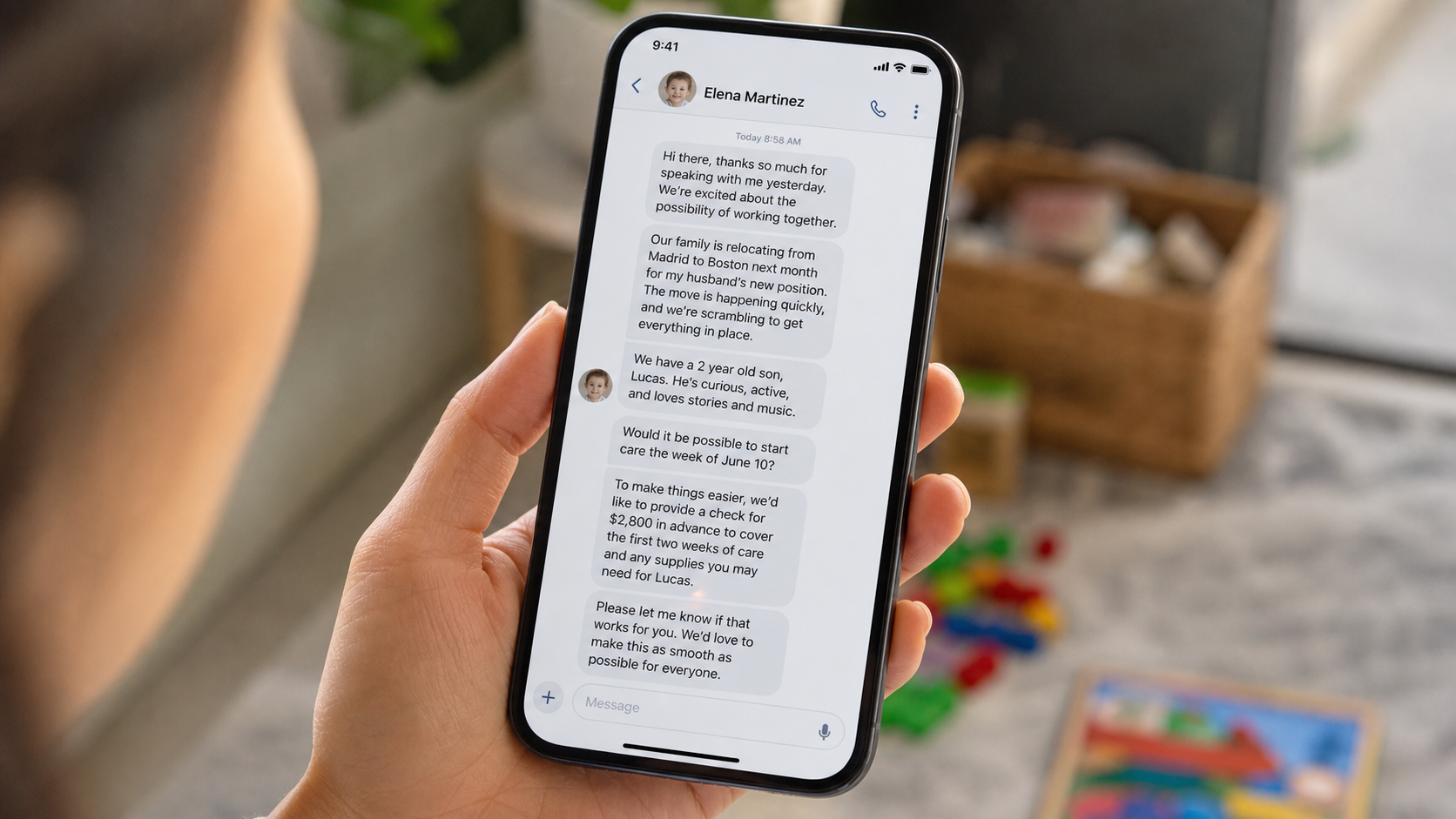
The approach often begins through email, text, social media, or an online caregiving platform. The supposed parent may say the family is relocating from overseas and cannot meet in person yet.
A check arrives for more than the agreed childcare fee. The sender explains that the excess must go to a furniture supplier, driver, relative, or other helper involved in the move.
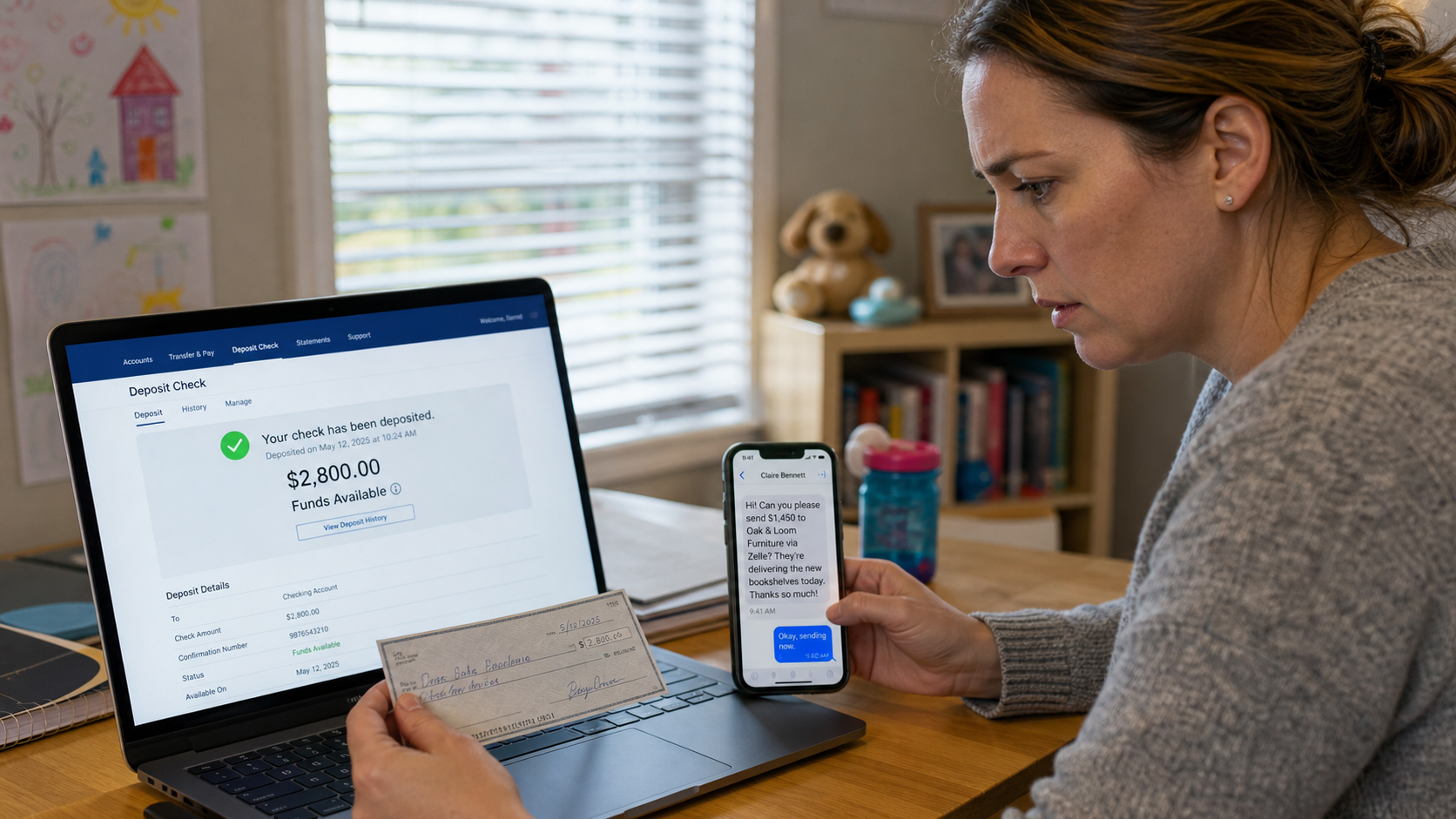
The bank may display the deposit as available before it discovers the check is counterfeit. Any real money the provider sends out belongs to the provider, not to the fake check.
Overview
The danger appears only after the deposit seems to clear.
The fake family story creates professional and emotional trust
The scammer discusses schedules, children, allergies, routines, and moving plans to resemble a genuine client. Compliments about the provider's profile can make the offer feel carefully chosen.
An overseas transfer, military relocation, sudden job move, or family emergency explains why video meetings and local introductions are difficult.
The check appears to fund both care and another expense
The amount covers the provider's advance plus money supposedly owed to a supplier. Combining the payments lets the scammer turn the provider into the person who sends the real transfer.
The sender may call the excess an accident, or may describe it in advance as payment for equipment, a wheelchair, toys, furniture, or transportation.
Available funds are mistaken for a verified check
Banks generally must make deposited funds available on a schedule, but that does not mean the check has completed every verification step. A counterfeit item can be returned days or weeks later.
When the check is reversed, the deposit disappears. The wire, payment-app transfer, gift card, or cryptocurrency sent by the provider remains real and may be unrecoverable.
- A new client cannot meet because the family is relocating.
- The childcare job is offered before a normal interview or child introduction.
- Payment must be accepted by check in advance.
- The check exceeds the agreed childcare fee.
- The provider must pay a mover, supplier, driver, or family assistant.
- The sender presses for a transfer as soon as funds appear available.
- The transfer uses a payment app, wire, gift card, or cryptocurrency.
- The check is later returned and the bank removes the full deposit.
Why Childcare Providers Are Attractive Targets
Childcare is built on trust, reliability, and personal communication. Providers expect parents to discuss intimate family details, which gives a scammer many natural ways to build rapport.
Independent caregivers also manage their own scheduling and payments. There may be no payroll department or fraud team between the provider and a new client.
Advance payment is not automatically suspicious. Families sometimes reserve limited availability or pay a deposit. The abnormal part is using the provider to move excess check funds to someone else.
A relocating family provides a flexible explanation for every missing verification step. They cannot tour the home, introduce the child, use a local payment method, or meet references because they have not arrived.
The scammer does not need the childcare service. The job story exists to persuade a responsible person to deposit a counterfeit check and send real money onward.
What the FTC Says About the Childcare Fake Check Scam
The FTC warned in 2026 that scammers were posing as parents and contacting childcare providers through email, text, social media, and caregiving platforms. They commonly claimed to be moving into the area and needing immediate care.
The supposed parent offered to pay in advance, but the check was for more than expected. The provider was then told to send the extra money back, often by wire transfer or payment app.
The FTC explains that seeing money in an account does not establish that the check is genuine. When the fake check bounces, the recipient must repay the bank while the money sent to the scammer is gone.
The agency identifies a simple rule: if someone sends a check and tells the recipient to return or forward part of the money, it is a fake check scam.
Childcare providers are advised to slow down with urgent new clients, refuse checks exceeding the real fee, and never use deposited check money to pay a stranger for the sender.
How the Childcare Client Overpayment Check Scam Works
Step 1: A polished parent profile contacts the provider
The message refers to the caregiver's experience, location, schedule, and positive reviews. A child name, age, photo, and routine make the inquiry feel specific.
The sender may copy a real family's photos or create a fictional identity. Warm details do not verify who controls the account.
Step 2: Relocation explains why normal meetings cannot happen
The family is supposedly overseas, on assignment, caring for a relative, or arriving after a sudden job transfer. The provider is asked to reserve dates before meeting the child.
Phone and video calls may be delayed by time zones, travel, or technical problems. Each excuse keeps the relationship inside text messages.
Step 3: An unusually generous advance is offered
The parent proposes several weeks of pay before care begins. The amount may be attractive enough that declining the check feels like losing a strong client.
The sender insists on a check even when the provider normally uses invoices, cards, or an established payment platform.
Step 4: The check includes money for a third party
The provider is told the payment also covers furniture, toys, a mobility device, a driver, or a moving company. The sender asks the provider to handle that local payment as a favor.
Another version calls the excess an accidental overpayment that must be refunded immediately.
Step 5: The deposit appears as available funds
A mobile deposit may update the account balance within a day. The scammer may ask for a screenshot and treat that status as proof the check cleared.
Availability is not final settlement. The banking system can later identify a forged account, fake cashier's check, altered amount, or closed account.
Step 6: Real money is sent to the scammer's recipient
The provider uses a payment app, wire, gift card, or cryptocurrency because the supposed supplier needs quick confirmation. The recipient may be the scammer or a money mule.
The provider believes the transfer uses the parent's money, but the only real funds in the transaction come from the provider's balance or overdraft.
Step 7: The check is reversed and the fake family disappears
Days or weeks later, the bank removes the deposit and may charge a returned-item fee. The account can become negative and legitimate payments may fail.
The parent stops responding or claims the provider caused the banking problem. A recovery contact may then offer to retrieve the loss for another fee.
Company, Address, and Fulfillment Checks
The family identity may be copied or entirely invented
Search the parent's name, email, phone, and profile image. A reverse-image search may connect the photo to a different family or older listing.
Do not treat a childcare-platform profile as identity verification unless the platform clearly explains and confirms what it checked.
The address may be a real home that belongs to someone else
A scammer can select an address near the provider or new employer to make the relocation plausible. Public property details and real-estate photos are easy to copy.
Verify ownership or tenancy only through appropriate records and a real-time tour. A correct street address does not prove the sender controls the property.
The supplier and payment contact may be part of the same operation
The furniture company, driver, or mover usually communicates only through details supplied by the parent. Searching the recipient independently may reveal no established business.
A childcare provider should never become the payment processor for a stranger's relocation expenses.
The check issuer must match a real, explainable payment
Look at the payer name, bank, amount, memo, and relationship to the supposed parent. Checks drawn by an unrelated business, charity, insurer, or individual are a serious warning.
Call the bank through a number independently found, but remember that even a professional-looking cashier's check can be counterfeit. The safest response to an overpayment request is refusal.
How to Screen a New Childcare Client Safely
Use the caregiving platform's messaging and payment tools when available. Moving off-platform too early can remove identity, dispute, and moderation protections.
Arrange a live video conversation and, before care begins, an in-person meeting with the parent and child in a safe setting. Verify that the person in the call matches the identity and story.
Use a written childcare agreement covering the family, child, dates, rate, emergency contacts, authorized pickups, cancellation, and payment method. Do not reserve a long schedule solely because a check was promised.
Accept only the amount genuinely owed. If a client sends too much, do not refund or forward anything. Tell the sender to stop payment and issue the correct amount through the agreed channel.
Never buy supplies or pay a third party with a new client's funds. The parent can pay their own vendors directly.
If a bank employee says deposited funds are available, ask specifically whether the check has completed final verification. Availability alone should never trigger an outgoing transfer.
Warning Signs to Watch For
- The family offers the job before a meaningful interview.
- Relocation prevents every attempt to meet or verify identity.
- The parent insists on paying by check.
- The advance is unusually generous for an untested arrangement.
- The check comes from an unrelated person or business.
- The amount exceeds the actual childcare fee.
- The provider must pay a mover, supplier, driver, or relative.
- The sender watches the deposit and pressures an immediate transfer.
- Payment must use a wire, app, gift card, or cryptocurrency.
- The parent disappears when the provider refuses to move money.
A real parent hires a caregiver to care for a child, not to route money between strangers. The moment the job becomes a payment-transfer task, stop.
What to Do if You Have Fallen Victim to This Scam
- Do not send any more money. Stop communicating with the parent, supplier, and recovery contacts. A claim that another transfer will release or replace the check is part of the loss.
- Call the bank's fraud department. Explain that you deposited a suspected counterfeit check and sent money based on it. Ask what can be stopped, what fees may apply, and how to protect essential payments.
- Contact the transfer provider immediately. Report fraud to the wire service, payment app, gift card issuer, or crypto platform. Provide recipient details and ask whether the funds or account can be frozen.
- Preserve the job and payment evidence. Save the profile, messages, phone numbers, email headers, check images, envelope, deposit record, recipient account, receipts, and any child or family photos used.
- Report the profile to the caregiving platform. Tell the platform which account, messages, and payment request were involved. Ask it to preserve records and warn other providers.
- Secure accounts and devices. Change any password shared with the scammer and enable multifactor authentication. If files or apps were opened, run a full Malwarebytes scan and remove unfamiliar software.
- Block malicious links and repeat outreach. AdGuard can reduce known phishing pages and malicious ad domains. It cannot reverse a check, so keep working directly with the bank and payment provider.
- Report the fraud. File at ReportFraud.ftc.gov and notify local police or appropriate state authorities when requested by the bank. Include the fake job, check, and outgoing transfer details.
- Prepare for recovery impersonators. Scammers may contact victims claiming to be investigators or fund-recovery agents. Do not pay an upfront fee or provide another code, account login, or transfer.
Frequently Asked Questions
Can a check be fake even when the money shows as available?
Yes. Funds can become available before the bank completes verification. A counterfeit check may be returned later and the deposit removed.
What if the parent says the overpayment was accidental?
Do not refund it. Tell the sender to stop payment and send the correct amount. A genuine client can resolve the error through their bank.
Why would the check come from a business?
Scammers may use stolen account details or counterfeit checks bearing unrelated organizations. The mismatch is a warning, not a normal payroll arrangement.
Is a cashier's check safer?
Counterfeit cashier's checks can look convincing. Never forward part of a check payment to someone you do not know, regardless of the check type.
Should I keep talking to gather evidence?
Once the pattern is clear, stop. Save what you already have and let the platform, bank, payment provider, and authorities handle further investigation.
Can Malwarebytes detect a counterfeit check?
No. It can detect some malicious files or software, but the bank and transaction pattern determine whether the check is fraudulent.
The Bottom Line
A childcare client overpayment check scam hides a money-transfer request inside a caring family story. The available balance is the trap, not proof that the payment is final.
Accept only the real childcare fee through a method you control, and never pay a client's mover, supplier, driver, or refund recipient.
If you already sent money, call the bank and transfer provider immediately, preserve the complete job conversation, secure exposed accounts, and report the profile before it reaches another caregiver.








