

NervoLyn is presented as a simple daily answer for burning feet, numb toes, restless nights, and other frightening nerve symptoms. The polished page feels reassuring, especially after an advertisement has suggested that ordinary medical care is missing something important.
This NervoLyn review follows the offer past the promises. The product exists, but the company trail, formula, price ladder, support details, and advertising funnel raise questions every buyer should answer before ordering several bottles.
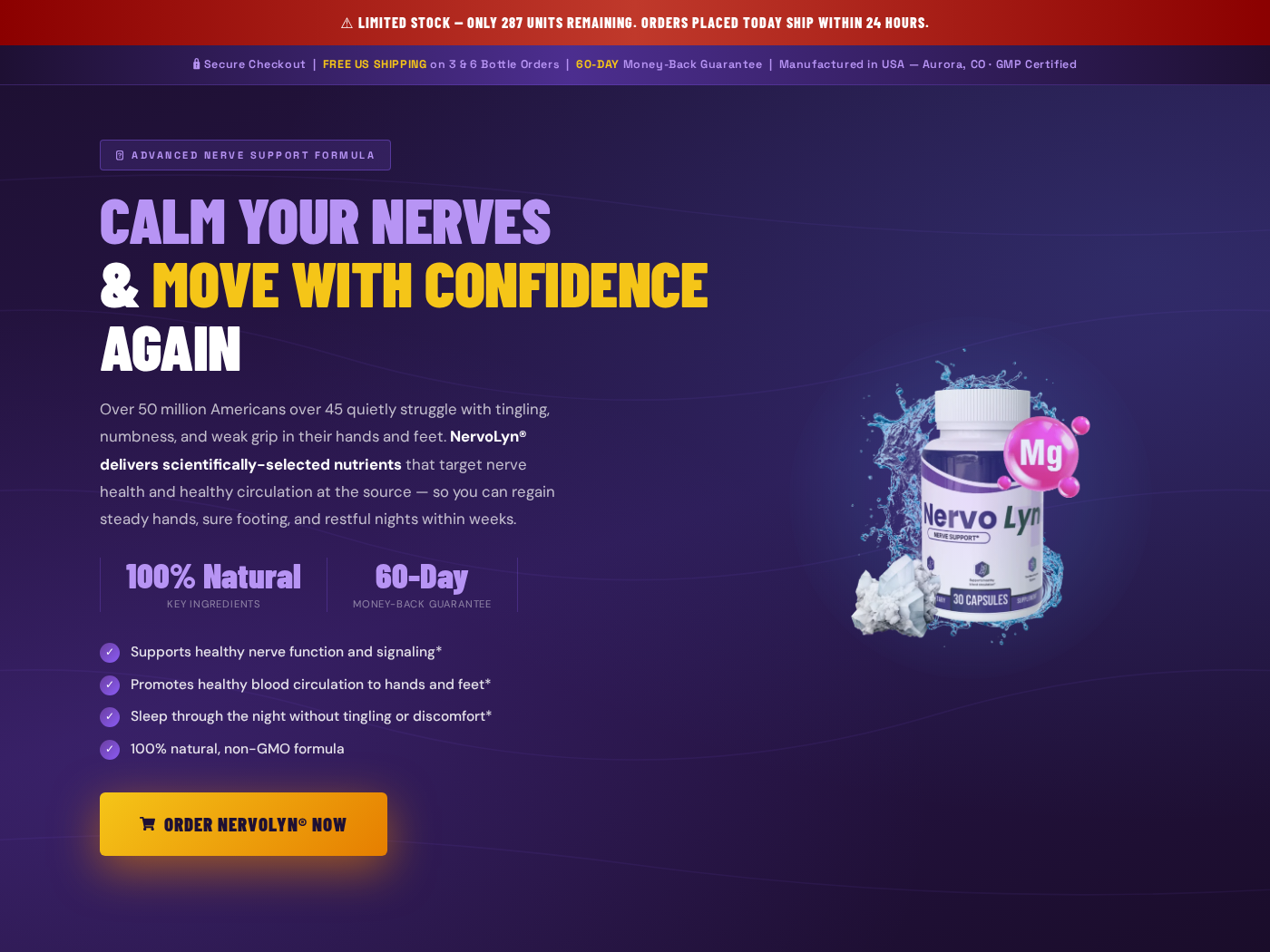
The NervoLyn sales page does not look improvised. It uses a clean supplement bottle, ingredient graphics, customer stories, a satisfaction guarantee, and large savings on multi-bottle packages. Each element is familiar enough to make the offer feel like an established health brand.
That first impression becomes more powerful when the visitor arrives through a symptom-heavy social media advertisement. Someone who has just watched an apparent expert discuss nerve damage is likely to read general support claims as if they confirmed the dramatic medical story shown moments earlier.
The important details sit beyond the hero section. Buyers need to know who legally operates the brand, whether the ingredient amounts justify the prominent claims, where the product is made, what happens if support stops responding, and whether the displayed return process matches the checkout terms.
Overview
NervoLyn is a real supplement sold through a direct-response funnel
NervoLyn is marketed as a dietary supplement for nerve comfort, circulation, and everyday wellness. The page reviewed for this report listed magnesium glycinate and a proprietary blend containing alpha lipoic acid, butcher’s broom, L-carnitine, turmeric, and CoQ10.
The bottle is not imaginary, but a physical product does not validate every story used to sell it. NervoLyn has appeared at the end of a fake Japanese neuropathy cocktail campaign that used borrowed medical authority and a secret-remedy narrative before revealing the supplement.
The visible offer says there is no automatic subscription
The current sales page states that orders are one-time purchases with no auto-billing. That matters. There is no responsible basis for calling the visible NervoLyn offer a confirmed refill subscription when the page explicitly denies one.
Buyers should still capture the final checkout and confirmation email because offers can change across domains and advertising funnels. The real concern on the page reviewed is the push toward an expensive multi-bottle purchase, not a subscription that has not been proven.
The business identity is less clear than the branding
The contact page lists an Aurora, Colorado address associated with a third-party fulfillment operation. The terms use generic company wording, include another brand name in a messaging clause, and provide a different support number from the main contact page.
None of those facts alone proves fraud. Together, they make it difficult to identify the precise legal entity responsible for the formula, advertising, payment, and refund. That uncertainty becomes more important when a seller asks a worried customer to spend up to $294 at once.
- NervoLyn is marketed for nerve support, comfort, circulation, and related wellness concerns.
- The page displayed bundles of two, three, or six bottles rather than a low-cost single-bottle trial.
- The visible offer says no subscription and no automatic billing.
- The formula includes a 575 mg proprietary blend that does not reveal each ingredient’s individual amount.
- The contact address is linked to a fulfillment center, not a disclosed nerve clinic or research facility.
- The support details and legal identity require more clarity before a large order feels low risk.
What This NervoLyn Review Found About Its Claims
The page frames NervoLyn as daily support for people dealing with uncomfortable nerve sensations. It refers to healthier circulation, steadier hands and feet, comfort, restful sleep, and broader wellness. These phrases sound measured when read by themselves.
The surrounding sales context can make them feel much stronger. An upstream advertisement may describe a hidden neuropathy cause, a Japanese discovery, or a remedy doctors supposedly ignore. By the time the bottle appears, a shopper may believe the supplement is a treatment rather than a general wellness product.
This distinction is essential. Dietary supplements are not approved by the FDA for effectiveness before sale in the same way as prescription drugs. A disclaimer saying a product is not intended to diagnose, treat, cure, or prevent disease also sits uneasily beside advertising that leads people to expect relief from a specific medical problem.
Peripheral neuropathy can have many causes. Diabetes, vitamin deficiencies, injuries, autoimmune conditions, infections, alcohol use, medications, inherited disorders, and other problems can produce overlapping symptoms. One capsule cannot diagnose which cause applies to a particular customer.
A person with new numbness, weakness, balance trouble, wounds that are not healing, or rapidly worsening pain needs medical evaluation. Buying a supplement first can delay the testing that identifies a treatable cause or prevents a complication.
What Is Actually in the NervoLyn Formula?
Magnesium is listed separately at 80 mg
The page lists 80 mg of magnesium glycinate. Magnesium participates in many normal body processes, but its presence does not prove that a customer’s nerve symptoms come from magnesium deficiency or that this dose will resolve them.
People with kidney disease, those taking several medicines, and anyone already using magnesium products should discuss the complete label with a clinician or pharmacist. More is not automatically better, and combining products can increase the total intake without the buyer noticing.
Five promoted ingredients share one 575 mg proprietary blend
Alpha lipoic acid, butcher’s broom, L-carnitine, turmeric, and CoQ10 appear inside a proprietary blend totaling 575 mg. The label may show the ingredients in order, but it does not tell the buyer the exact amount of each one.
That makes meaningful comparison difficult. A study on one ingredient at a particular dose does not establish that an undisclosed amount inside a blended capsule produces the same outcome. The shopper cannot tell which ingredient dominates the blend or whether several appear only in small quantities.
Familiar ingredient names can create an evidence shortcut
Many visitors recognize turmeric, CoQ10, or alpha lipoic acid from other health articles. The page benefits from that familiarity, even when the shopper has not checked the exact study population, dose, formulation, duration, side effects, or relevance to their condition.
The correct question is not whether an ingredient has ever been researched. It is whether the finished NervoLyn formula, at the disclosed serving size, has reliable evidence for the specific result implied by the advertising. The page reviewed did not provide a published clinical trial of the finished product.
How the NervoLyn Marketing Funnel Works
Step 1: A social ad starts with pain, fear, and recognition
The first video lists symptoms such as burning feet, pins and needles, numbness, poor sleep, or unsteady walking. These details make the viewer feel understood before the brand name is ever shown.
The presenter may resemble a medical expert or speak with the certainty of a television interview. AI-generated speech, edited footage, and fabricated presenters allow advertisers to create authority without obtaining a genuine endorsement.
Step 2: A secret cause replaces a real diagnosis
The video reduces a complicated medical issue to one hidden explanation. It may blame inflammation, circulation, toxins, damaged nerve coating, or a missing nutrient while suggesting that conventional care addresses only symptoms.
This narrative is persuasive because it offers both an enemy and an answer. It is also medically unreliable. The advertiser has no examination, laboratory results, medication history, or nerve testing for the individual watching.
Step 3: A fake editorial page makes the pitch look independent
The click can lead to a long advertorial that resembles a health article, news interview, or documentary page. Logos, studio graphics, urgent headlines, and embedded video give paid promotion the appearance of outside reporting.
Nearly every button leads toward the same offer. There may be no real author biography, editorial desk, publication archive, or reporting that challenges the seller’s claims. The apparent article is simply another sales stage.
Step 4: NervoLyn appears as the convenient version of the remedy
Only after the story has created hope does the brand appear. The visitor is encouraged to see NervoLyn as the ready-made form of the discovery, even though the product page itself uses softer dietary supplement language.
This is the central credibility problem. The most dramatic medical claims may exist outside the page where the legal disclaimer and checkout are located. The seller gains the emotional effect of a treatment claim while the final page retreats to general support wording.
Step 5: The price ladder makes six bottles look sensible
The page reviewed showed two bottles for $178, three for $216, and six for $294. Large claimed savings and a lower per-bottle number steer the customer away from considering whether they should buy the product at all.
There was no simple one-bottle trial in the prominent package choices. A customer who is uncertain about tolerance, ingredients, or support quality is therefore encouraged to make a larger commitment before learning how the product or refund process works in practice.
Step 6: Testimonials substitute for independent evidence
The page displays positive customer stories and claims a large user base. Testimonials can describe personal opinions, but they do not establish typical results, confirm a diagnosis, or replace a controlled trial of the finished formula.
Seller-controlled reviews deserve extra caution because the seller chooses what appears, how it is ordered, and what context is omitted. Search outside the checkout funnel and distinguish product complaints from affiliate pages that repeat the same promotional script.
Step 7: The customer discovers the business details after committing
Most people do not inspect the terms, warehouse address, support-number mismatch, or payment processor before ordering. Those details become important only when a parcel is delayed, a refund is disputed, or the customer wants to identify the legal seller.
By then, the emotional advertisement has disappeared from view and the buyer is dealing with policy wording. Saving every step of the funnel before payment is one of the simplest ways to preserve what was actually promised.
Company, Address, and Fulfillment Checks
The listed address is a shipping hub, not proof of a medical company
NervoLyn lists 19655 East 35th Drive, Suite 100, Aurora, Colorado. That location is associated with ShipOffers, a fulfillment provider that stores inventory and ships orders for outside brands.
A real fulfillment center is not automatically suspicious. It also does not prove that NervoLyn has researchers, clinicians, executives, or manufacturing operations at that address. The warehouse can ship a bottle without being responsible for the claims that convinced the customer to buy it.
The support numbers do not line up cleanly
The contact page reviewed displayed +1 (720) 619-8477, while the terms provided +1 720 513 2923 for cancellation or refund matters. Buyers should not have to guess which number controls a time-sensitive return.
The contact number also appears on pages connected with unrelated supplements. Shared call-center infrastructure can be legitimate, but it weakens the impression that the customer is contacting a dedicated NervoLyn company with specialized knowledge of this formula.
The legal entity remains too vague
The terms refer generically to the company and include a mobile messaging clause that names Nature’s Formulas. The checkout footer identifies BuyGoods as the retailer and explains that its retail role is not an endorsement of the product.
Those layers leave a basic question: which named legal entity created the advertising, owns NervoLyn, selected the manufacturer, and must honor the guarantee? A polished brand name is not the same thing as a clearly disclosed accountable business.
Unknown manufacturing deserves a hard stop
The page says the product is manufactured in the USA in Aurora, Colorado, and refers to GMP standards. The listed Aurora contact address, however, is associated with fulfillment. A shipping address does not independently verify the location where ingredients were sourced, blended, tested, or bottled.
Do not assume the capsules were made in China, and do not accept a USA badge as proof without documentation. Supplements can be mass-produced domestically or overseas. Buyers need a traceable manufacturer, complete label, lot number, expiration date, quality testing, and a reachable company, especially when the intended customers may have serious health conditions.
NervoLyn Pricing and Refund Policy
The six-bottle package carried the lowest displayed unit price, but the customer still had to pay $294. The page framed that bundle as a $780 saving. Such a large reference price can make the checkout feel urgent even when the shopper has no independent basis for the crossed-out value.
The visible offer promises a 60-day refund and currently says a customer can contact support without returning the bottles. That sounds generous, but buyers should save the exact version of the policy that applies on the purchase date. Terms, landing pages, and support instructions can change.
Ask support to confirm in writing when the 60-day period begins, whether shipping is refundable, whether opened bottles qualify, whether every bottle in a bundle is covered, and how long the refund takes to appear. Do this before ordering, not after the deadline has started running.
The sales page also says there are no subscriptions or automatic charges. Check that the final checkout repeats the same condition. If it does, keep a screenshot and the confirmation email. If the checkout introduces continuity language, a trial, or a renewal that was absent from the sales page, leave without completing the order.
Warning Signs to Watch For
- A social ad appears to diagnose neuropathy without examining the viewer.
- An AI presenter or borrowed expert introduces a secret remedy before the product reveal.
- The sales page uses softer support language than the dramatic advertisement.
- A 575 mg proprietary blend hides the amount of each promoted ingredient.
- The prominent choices begin with two bottles and push the customer toward six.
- The contact address leads to a fulfillment provider rather than a disclosed headquarters.
- Different pages provide different support phone numbers.
- Generic company language makes the responsible legal entity hard to identify.
- Seller-controlled testimonials carry more weight than independent product evidence.
- A made-in-USA claim is not accompanied by a clearly identified finished-product manufacturer.
The concern is not one typo or one warehouse. It is the combined pattern: medical urgency at the front, soft supplement wording at the checkout, a large bundle commitment, and an accountability trail that becomes less clear as the buyer looks closer.
What to Do if You Have Fallen Victim to This Scam
- Save the complete sales path. Capture the social ad, advertorial, NervoLyn page, bundle selected, final checkout, confirmation email, package label, and applicable refund policy. Include dates and page addresses because the campaign may change after complaints appear.
- Check what you actually authorized. Compare the quantity and total on the receipt with the bottles received and the card charge. Record the merchant descriptor exactly as shown. The statement name may differ from NervoLyn.
- Request the refund in writing. Email the support address on your order confirmation and quote the 60-day promise visible when you purchased. State the order number, amount, requested resolution, and the date. Ask for a case number and expected processing time.
- Do not return anything without instructions. The page reviewed says a return may not be required. If support asks for one, obtain the authorized address and RMA in writing, photograph the bottles, use tracking, and keep proof of delivery.
- Contact your card issuer when the charge is wrong. Explain whether the problem is an unauthorized amount, missing goods, a rejected promised refund, or merchandise materially different from the advertisement. Ask about the dispute deadline and evidence required.
- Watch several future statements. The visible offer says no subscription, so an unexpected later charge should be reported promptly. A statement check is still worthwhile because checkout errors, add-ons, and unauthorized charges can occur even without a published refill plan.
- Speak with a medical professional about symptoms. Do not stop prescribed care because an ad promised a natural answer. Bring the label and ingredient list to a clinician or pharmacist, particularly if you use diabetes medicine, blood thinners, or several supplements.
- Secure the device used for ordering. If the funnel made you download a file, extension, or support tool, remove it and run a full scan with Malwarebytes. Change reused passwords and enable multi-factor authentication on email and payment accounts.
- Reduce repeat exposure and report the ad. Report the promotion to the social platform and the FTC. AdGuard can reduce malicious ads, trackers, pop-ups, and repeat redirects, although it cannot determine whether every supplement claim is truthful.
Frequently Asked Questions
Is NervoLyn a scam?
NervoLyn is a real supplement offer, but the marketing funnel and business transparency raise serious concerns. Fake expert stories, a hidden product reveal, vague company identity, shared fulfillment, and an undisclosed proprietary blend are valid reasons to avoid a rushed purchase. Evidence reviewed does not establish that every bottle or transaction is fraudulent.
Is NervoLyn a subscription?
The NervoLyn page reviewed explicitly says the purchase is one-time, with no subscriptions or auto-billing. Buyers should verify that the final checkout and receipt say the same thing. It would be inaccurate to describe the current visible offer as a confirmed subscription trap without evidence of recurring terms or charges.
Who owns NervoLyn?
The pages reviewed did not present one clear legal entity that obviously owns the brand, created the advertising, selected the manufacturer, and guarantees refunds. BuyGoods is identified as the retailer, while generic company wording and another brand reference appear in the terms. Ask for the contracting legal entity before ordering.
Where is NervoLyn made?
The sales page says it is manufactured in the USA in Aurora, Colorado. The listed contact address is associated with a fulfillment provider, so that address alone does not independently prove where the capsules were blended or bottled. Look for the manufacturer, lot code, and origin information on the physical label.
Does NervoLyn cure neuropathy?
No reliable evidence reviewed shows that the finished NervoLyn formula cures peripheral neuropathy. The product is sold as a dietary supplement, and its disclaimer says it is not intended to diagnose, treat, cure, or prevent disease. Neuropathy has many causes, so persistent or worsening symptoms need proper evaluation.
Can I get a NervoLyn refund?
The page advertises a 60-day refund policy and currently suggests customers can contact support without returning the bottles. Save the policy from your purchase date, make the request in writing, and keep every response. If a promised refund is refused or ignored, contact the payment provider before its dispute deadline.
The Bottom Line
This NervoLyn review found a familiar direct-response supplement wrapped in a much more dramatic nerve-relief story. The visible page says there is no subscription, but the proprietary blend, expensive package ladder, unclear legal entity, support inconsistencies, and fulfillment-center address still deserve close scrutiny.
Do not let an AI expert or secret-remedy video turn fear into a $294 decision. Verify the company, read the final checkout, discuss the complete label with a qualified professional, and preserve the refund terms before paying. If the seller cannot answer basic questions clearly, the safest order is no order at all.








