

Airovine Mullein Drops is sold with a promise that reaches far beyond ordinary herbal support. The page speaks directly to smokers and people with COPD, then suggests a few drops can clear the buildup supposedly making every breath feel heavier.
That is a powerful story for anyone who wakes up coughing or worries that years of smoking have caught up with them. It is also exactly the kind of health offer that deserves a slow, careful look before a card number is entered.
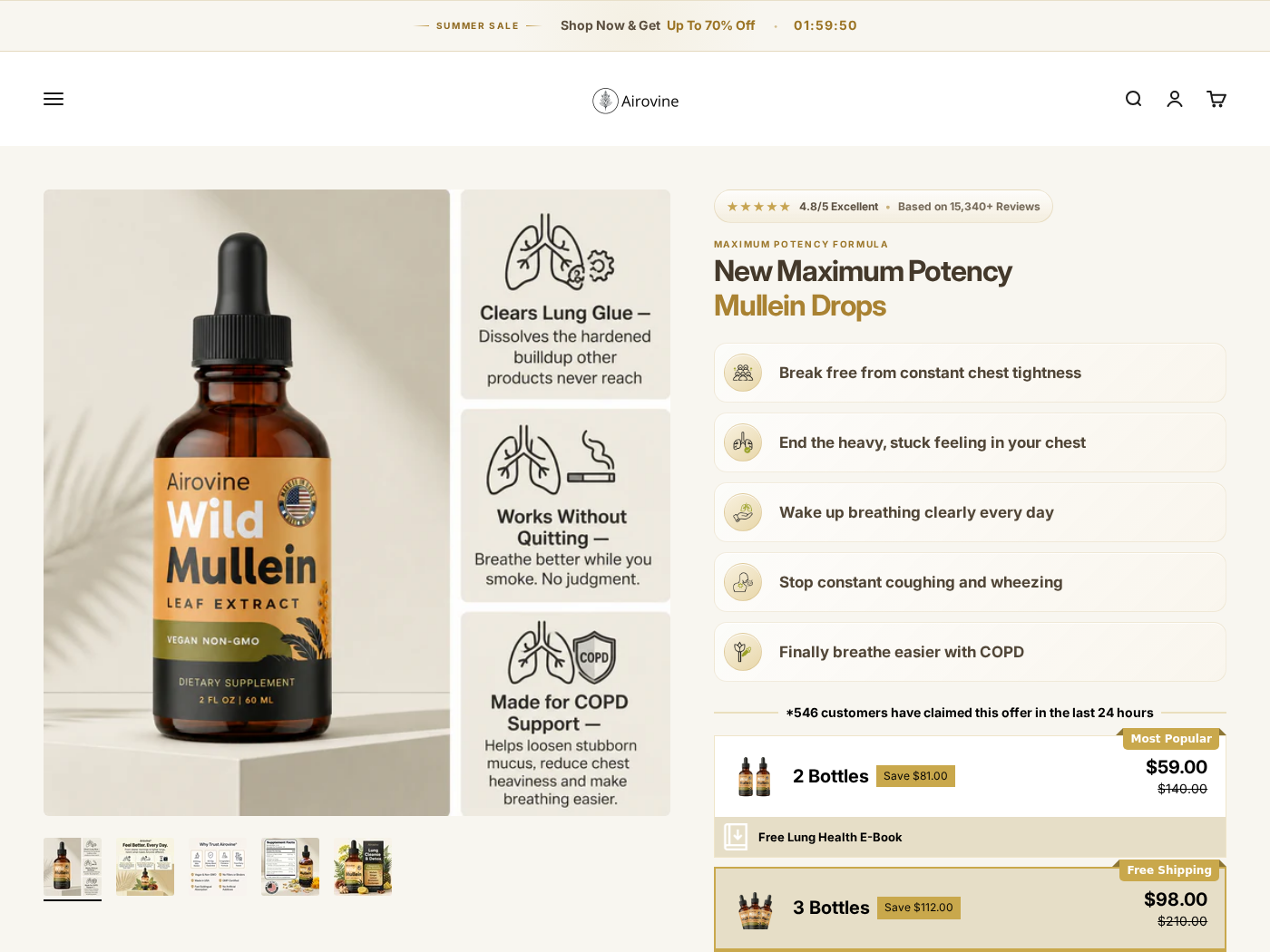
The product page we reviewed was polished, urgent, and unusually direct. It claimed the drops could clear what the seller calls “Lung Glue,” work without quitting smoking, and help people with COPD breathe more easily.
Airovine is not an imaginary bottle placed on an empty checkout page. It is a functioning Shopify offer with package prices, policies, contact details, a legal entity in the fine print, and a dedicated subscription-management page.
The real questions begin when those pieces are compared. The sales copy, renewal cadence, refund window, company address, trademark filing, and medical disclaimer do not tell one clean, consistent story.
Overview
The sales page promises more than gentle respiratory support
Airovine presents its Wild Mullein Leaf Extract as a “Daily Lung Clearance” system. The page says the formula targets hardened mucus and tar, loosens stubborn buildup, reduces chest heaviness, and produces noticeable results beginning on Day 1.
The message becomes more serious when it invokes COPD. The seller says the product is made for COPD support, tells shoppers their lungs are clogged rather than failing, and contrasts the drops with products that allegedly only mask symptoms.
The store is built around bundles and recurring refills
During our review, the visible packages included two bottles for $59 and three bottles for $98. The page also displayed a 70% off promotion, a countdown clock, a customer-activity claim, crossed-out reference prices, and a rating of 4.8/5 based on more than 15,340 reviews.
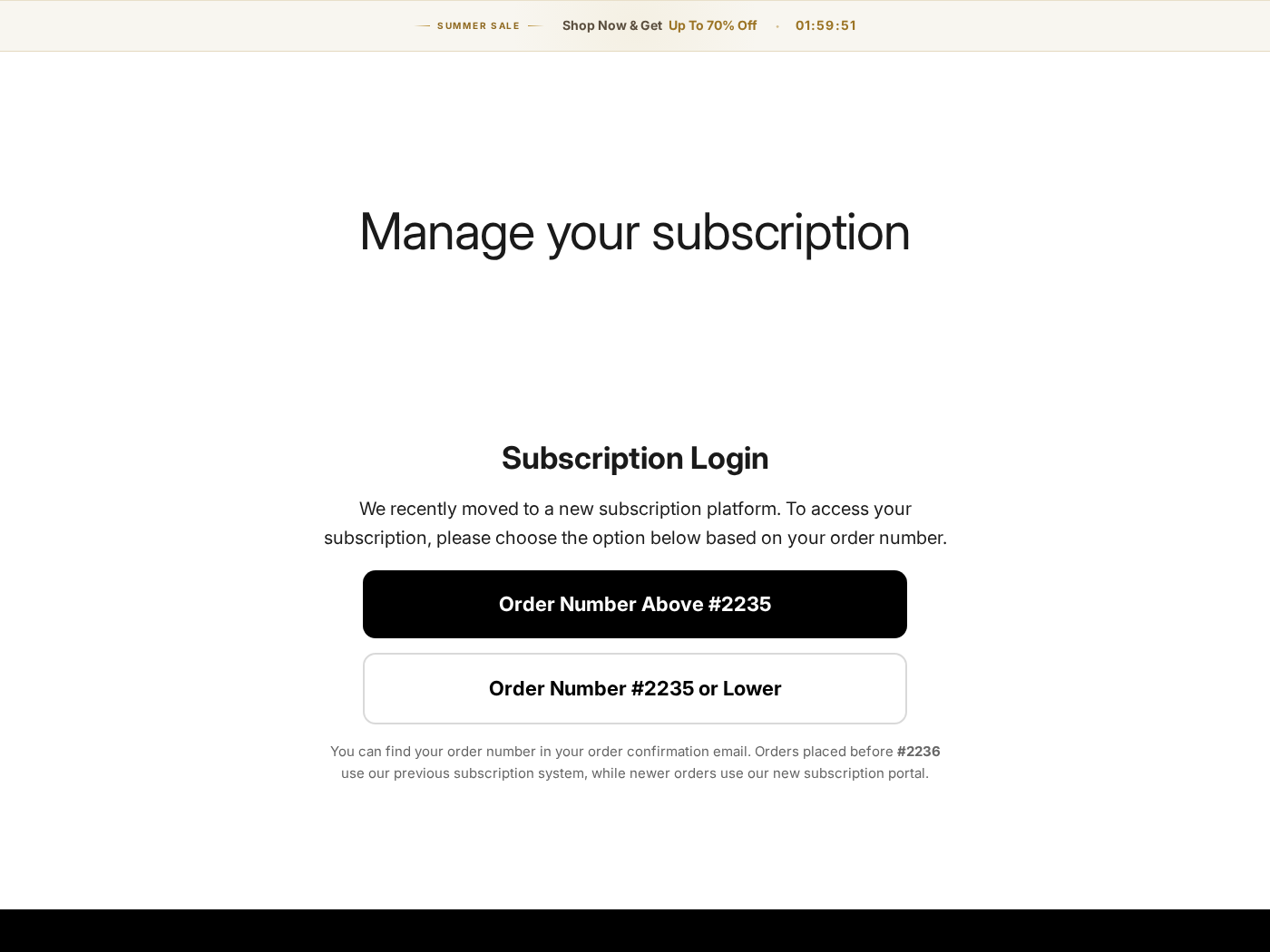
Most importantly, the offer states “Refills every 30 days” and “Cancel anytime.” Airovine also maintains a subscription login page that separates orders numbered #2235 or lower from newer orders using a different subscription platform.
The fine print creates material contradictions
The product and refund pages promote a 60-day guarantee, while the Terms and Conditions promise a 180-day money-back guarantee. The sales page says refills arrive every 30 days, but the refund policy describes automatic charges every 60 days or according to the selected cadence.
These are not cosmetic differences. Renewal frequency determines how often a card is charged, and the guarantee period determines whether a customer may still qualify for a refund.
- Airovine is sold as a liquid dietary supplement containing mullein, bromelain, cordyceps, ginger, and lemon peel.
- The page makes explicit COPD, wheezing, coughing, mucus, tar, and airway claims.
- The seller says the drops work without requiring the customer to quit smoking.
- Two bottles were displayed for $59 and three bottles for $98 during our review.
- The product page advertises refills every 30 days.
- The refund policy refers to charges every 60 days or the chosen cadence.
- The refund page limits its guarantee to 60 days and only the first subscription shipment.
- The Terms and Conditions separately promise a 180-day guarantee.
- The legal entity named in the policies is HC E-Commerce LLC.
- The listed Wyoming address is identified by BBB as a commercial registered-agent location.
What Airovine Mullein Drops Claims to Do
The Airovine story begins with a frightening but simple explanation. According to the seller, smoke, mucus, tar, and other debris create a hardened layer inside the lungs. The site gives this supposed layer a memorable name, “Lung Glue.”
The formula is then positioned as a targeted way to dissolve that buildup. Wild mullein is described as breaking down sticky tar like soap breaks grease. Bromelain supposedly dissolves protein bonds that hold the material to bronchial walls, while cordyceps powers the tiny cilia that move debris out.
Ginger is presented as opening constricted airways and reducing spasms. Lemon peel is described as supporting lung tissue and respiratory clarity. The page claims the liquid format reaches the bloodstream within seconds and works faster than capsules.
The seller provides a highly specific timeline. A customer may supposedly notice easier breathing on Day 1, more productive coughing by Day 4, improved sleep by Day 7, greater stamina by Day 14, and a much clearer chest by Day 25.
None of those milestones should be mistaken for a medical guarantee. A seller-created timeline is not the same as a published clinical trial testing the finished Airovine formula against a placebo in people with diagnosed COPD.
The page also says the ingredients do not interfere with common medications for the vast majority of people. That reassuring sentence is too broad to use as personal medical advice, especially for customers who take inhalers, blood thinners, diabetes medicines, or several prescriptions.
Why the Medical Story Is So Concerning
“Lung Glue” is a marketing label, not a diagnosis
People with COPD can experience chronic mucus, airway inflammation, coughing, wheezing, chest tightness, and difficulty breathing. Those are real symptoms, but “Lung Glue” is not the standard medical name for the disease or a recognized diagnosis that can be confirmed by a doctor.
Giving a frightening symptom cluster one vivid name makes the sales explanation easy to remember. It can also make a complex chronic disease sound like a plumbing blockage that merely needs to be dissolved and flushed away.
Traditional use does not prove the finished formula treats COPD
Mullein has a long history of traditional use for respiratory discomfort. Traditional use may justify scientific interest, but it does not establish that this specific bottle clears tar, reverses airway obstruction, prevents flare-ups, or improves COPD outcomes.
The product page refers to “clinically studied ingredients,” yet that phrase is not proof that the finished blend, dose, purity, and dosing schedule were tested in a rigorous clinical trial. Evidence for an ingredient in one preparation cannot automatically be transferred to every formula sold online.
A supplement disclaimer does not neutralize disease claims
The footer says the statements have not been evaluated by the FDA and that the product is not intended to diagnose, treat, cure, or prevent disease. Higher on the same site, shoppers encounter “Finally breathe easier with COPD,” “Made for COPD Support,” and claims that the formula targets the root cause of blocked airways.
The FDA explains that dietary supplements are not approved for safety and effectiveness before sale. It also warns that a product represented as treating, preventing, or curing a disease may be regulated as a drug, regardless of a small disclaimer elsewhere on the page.
“Works without quitting” sends the wrong health message
Airovine repeatedly emphasizes that smokers do not need to quit or change their lifestyle. That may reduce the emotional resistance of a customer who feels judged, but it risks suggesting that a supplement can offset continuing exposure to cigarette smoke.
The American Lung Association identifies quitting smoking as one of the most important parts of COPD treatment. It can improve symptoms and lung function, help medications work better, reduce flare-ups, and slow the progression of the disease.
Anyone with persistent coughing, wheezing, chest tightness, shortness of breath, blue lips, confusion, or rapidly worsening symptoms needs qualified medical care. Drops ordered from a social media funnel should never replace an inhaler, prescribed oxygen, pulmonary rehabilitation, or an urgent evaluation.
How the Airovine Mullein Drops Scam Works
Step 1: The ad finds people who are scared about their breathing
The ideal viewer is not casually shopping for vitamins. It is a smoker, former smoker, or person with respiratory symptoms who feels worried, embarrassed, or frustrated that conventional treatment has not made breathing feel normal.
The ad can turn that fear into hope with one easy explanation. Instead of discussing chronic inflammation, damaged air sacs, infections, medication adherence, or smoking cessation, it says the lungs are simply clogged.
Step 2: A dramatic mechanism makes the product feel medical
Terms such as bronchial walls, protein bonds, cilia, oxygen efficiency, hardened buildup, and therapeutic dose create a clinical atmosphere. Simple illustrations of lungs and mucus make the proposed mechanism feel visible and obvious.
Scientific vocabulary can describe a plausible idea without proving the product delivers the promised result. The important missing link is finished-product evidence showing that the exact Airovine formula produces the advertised outcomes in the people being targeted.
Step 3: Seller-controlled reviews remove normal uncertainty
The page displays a 4.8/5 rating based on more than 15,340 reviews, then presents stories about easier mornings, quieter coughing, and fast changes. These testimonials are hosted by the seller and are not a substitute for independent medical evidence.
Another review breakdown on the page lists 144 five-star reviews and 69 four-star reviews, with no three-star, two-star, or one-star reviews. Those 213 entries do not explain the separate 15,340-plus total, leaving the basis of the larger number unclear.
Step 4: Urgency pushes the buyer toward a larger bundle
A summer sale, countdown clock, crossed-out prices, “most popular” labels, free shipping, and a statement that hundreds of customers claimed the offer in the last 24 hours all encourage a quick decision.
The shopper begins comparing savings between two, three, or more bottles instead of asking whether the medical claims are supported. A large percentage-off figure also depends on a reference price that the customer may never have seen charged.
Step 5: The order becomes a recurring refill relationship
The product page states that refills occur every 30 days. Once a shopper authorizes recurring billing, the first package is no longer the entire transaction. Future bottles and card charges can continue until the subscription is successfully cancelled.
A recurring plan is not automatically fraudulent. The risk comes from how clearly the cadence, future amount, number of bottles, shipping, cancellation deadline, and refund eligibility are shown at the exact point where the customer agrees.
Step 6: Conflicting policies make cancellation and refunds harder to predict
Airovine tells customers to cancel at least 24 hours before the next billing date. The refund policy says a processed renewal cannot be cancelled or refunded, and that subscription renewals outside the 60-day window are ineligible.
At the same time, one page describes a 30-day refill, another mentions 60-day charges, and the Terms and Conditions promise 180 days while the refund page allows 60 days. A customer should not have to reconcile those conflicts after a renewal has already processed.
Step 7: The customer has to chase the right portal and the right entity
The subscription page says older orders use a previous platform and newer orders use a different portal. Maintaining access during a migration is reasonable, but it creates another point where a customer may choose the wrong system or struggle to locate the active plan.
The brand name is Airovine, while the policies name HC E-Commerce LLC. A bank statement may add a payment descriptor. Successful cancellation requires confirming that the seller, subscription platform, and card issuer all refer to the same recurring authorization.
Company, Address, and Fulfillment Checks
The legal entity is buried behind the Airovine brand
Airovine is the customer-facing name, but the Terms, refund policy, privacy policy, and shipping policy identify HC E-Commerce LLC. That legal name matters when a customer disputes a charge, writes a formal cancellation, or searches corporate records.
Do not accept a bottle label as complete transparency. Compare HC E-Commerce LLC with the seller shown at checkout, the email receipt, the return authorization, and the descriptor on the card statement. If the names differ, demand a written explanation before the dispute window closes.
The Wyoming address is not proof of a real headquarters
The site lists 30 North Gould St, Suite R, Sheridan, Wyoming 82801. BBB states that the address appears to be a commercial registered-agent location and is typically not a physical place of business.
That does not make the LLC nonexistent. It does mean the address should not be presented or interpreted as proof of a staffed office, supplement factory, laboratory, customer-service department, or returns warehouse. MalwareTips has also documented how the same 30 N Gould St address appears across many unrelated online stores.
The trademark trail points to China, not to a disclosed factory
A public trademark filing for AIROVINE, serial number 99887153, names Fei Zhao, an individual in Sichuan Province, China, as the applicant. The filing covers liquid, herbal, mineral, and nutritional supplements.
This is a real China connection to the brand name. It does not prove that the drops are manufactured in China, that the ingredients are unsafe, or that Fei Zhao personally operates the website. The site does not clearly identify the actual manufacturer or manufacturing country, so those facts remain unverified.
The support trail is too thin for a health subscription
The site lists support@airovine.com, the Wyoming registered-agent address, and a phone number, (651) 964-2227. The contact page says email responses generally take 24 to 48 hours.
Before ordering, call and email. Ask for the exact renewal amount, number of bottles per refill, next charge date, cancellation link, returns address, manufacturer name, country of manufacture, lot testing, and a complete Supplement Facts panel. If support cannot answer those basic questions before taking payment, walk away.
The Refund and Subscription Terms Do Not Line Up
Airovine’s product page advertises a 60-day money-back guarantee. The refund policy also gives customers 60 days from confirmed delivery, but it adds conditions that are easy to miss during the sale.
The item must be returned in its original condition. The customer normally pays return shipping, shipping and handling are non-refundable, and the seller requires authorization and a tracked package before inspecting the return.
For subscriptions, the guarantee applies only to the first shipment. Renewal orders that fall outside the stated window are not eligible, and the policy says a renewal cannot be refunded or cancelled after it has processed.
The Terms and Conditions create a separate problem by promising a 180-day money-back guarantee. A reasonable customer cannot know whether the binding period is 60 or 180 days when the seller’s own legal pages disagree.
The cadence also changes by page. “Refills every 30 days” is a clear statement on the product offer, while the refund policy describes automatic billing every 60 days or according to the selected cadence. The seller may offer multiple intervals, but each checkout must identify the selected one without requiring the customer to guess.
Customers should save a screenshot of the exact checkout option, not only the general product page. The amount and renewal date shown when consent is given are the most useful evidence if future shipments differ from what was authorized.
Is Airovine Fake or Real?
Airovine is real in the narrow retail sense. The store exists, the product is offered for sale, the seller names HC E-Commerce LLC, policies are accessible, the brand has a pending trademark application, and a functioning subscription portal exists.
“Real” does not mean proven effective, medically appropriate, or safe for every customer. We found no basis to treat seller testimonials, ingredient descriptions, diagrams, percentages, or a facility badge as proof that the finished drops clear tar or improve COPD.
The offer is especially risky because it combines a serious health condition with recurring billing. Someone worried about breathing may be more focused on immediate relief than on a 24-hour cancellation deadline, non-refundable renewal, customer-paid return, or policy contradiction.
Our conclusion is not that every bottle is fake or that every shipment will be unauthorized. The evidence supports a sharper warning: this is an aggressive supplement and subscription funnel whose medical promises, review totals, guarantee, renewal cadence, address, and manufacturing transparency deserve serious skepticism.
Warning Signs Shoppers Should Not Ignore
- The page directly invokes COPD while the footer says the supplement is not intended to treat disease.
- “Lung Glue” turns a complex chronic condition into a seller-created blockage story.
- The formula is promoted as working without quitting smoking or changing habits.
- The site gives a precise Day 1 through Day 25 result timeline without showing a finished-product clinical trial.
- A 4.8/5 score based on 15,340-plus reviews does not align with the smaller 213-review breakdown shown elsewhere.
- The product page promotes refills every 30 days.
- The refund policy separately refers to billing every 60 days or the chosen cadence.
- The seller advertises both a 60-day and a 180-day guarantee on different pages.
- Only the first subscription shipment is covered by the guarantee described in the refund policy.
- Processed renewals are described as non-refundable and non-cancellable.
- The Wyoming address is a commercial registered-agent location, not verified operating headquarters.
- The trademark applicant is in China, while the manufacturer and manufacturing country remain undisclosed.
No single warning sign proves criminal fraud. Together, they show why a shopper should not rely on the emotional sales page alone. The purchase should be judged by the exact checkout consent, independent medical evidence, verifiable manufacturing records, and terms that agree with one another.
What to Do if You Have Fallen Victim to This Scam
- Save the exact offer you accepted. Keep screenshots of the product choice, refill language, checkout total, renewal date, receipt, policies, package label, emails, and card statement. Evidence from the moment of purchase is stronger than a page that may change later.
- Cancel through the correct subscription portal. Use the order-number route shown by Airovine, then email support@airovine.com. State clearly that you cancel the subscription and revoke authorization for every future shipment and charge.
- Request written confirmation. Ask for the effective cancellation date, the final shipment number, and confirmation that no other plan remains active under your email, address, card, or order number. A portal screen alone may not show every recurring authorization.
- Do not confuse a refund with cancellation. Returning the first package does not necessarily stop future refills. Request two separate confirmations, one for the return or refund and another for the recurring plan.
- Contact the card issuer quickly. If a charge was not authorized or appears after cancellation, explain that it is a recurring supplement transaction. Provide the checkout evidence, cancellation timestamp, seller response, renewal charge, and tracking information.
- Speak with a healthcare professional. If you used the drops while taking medication, experienced a reaction, or delayed COPD care, contact a doctor or pharmacist. Do not stop prescribed inhalers or other treatment because of claims on the sales page.
- Check the device used for the purchase. If the ad caused redirects, pop-ups, downloads, or suspicious notifications, scan the device with Malwarebytes. Use AdGuard to block deceptive ad networks, trackers, and repeat funnel redirects.
- Report the documented conduct. Send recurring-billing and advertising complaints to the FTC, your state attorney general, and the card issuer. Report dates, amounts, claims, policy conflicts, and support responses without guessing about facts you cannot prove.
Frequently Asked Questions
Is Airovine Mullein Drops a scam?
Airovine operates a real store and offers a physical supplement, so this is not simply a nonexistent product. However, the COPD claims, invented “Lung Glue” explanation, conflicting terms, unclear review totals, recurring refills, registered-agent address, and undisclosed manufacturing details create a high-risk offer.
Does Airovine enroll customers in a subscription?
The product page explicitly says “Refills every 30 days,” and the site has a dedicated subscription portal. Customers should treat any selected refill option as recurring billing that continues until cancellation is confirmed.
How much do Airovine Mullein Drops cost?
During our review, the page displayed two bottles for $59 and three bottles for $98. Prices, bundle sizes, reference prices, and renewal amounts can change, so save the exact checkout before paying.
Can Airovine Mullein Drops treat COPD or clear tar?
We found no finished-product clinical evidence on the sales page proving that Airovine treats COPD, dissolves lung tar, or clears a recognized condition called “Lung Glue.” People with COPD should follow a treatment plan created with a qualified healthcare professional.
Who owns Airovine?
The website’s policies name HC E-Commerce LLC. A pending US trademark application for AIROVINE names Fei Zhao of Sichuan Province, China, as the applicant. The public records do not by themselves establish who manufactures each bottle.
How do I cancel an Airovine subscription?
Use the Airovine subscription page that matches your order number and email support@airovine.com at least 24 hours before the next billing date. Ask for written confirmation that all future shipments and charges have stopped, then monitor the card statement.
The Bottom Line
Airovine Mullein Drops is a real supplement offer wrapped in an aggressive lung-cleansing story. It targets people with genuine breathing fears, makes COPD and tar-clearing claims, encourages smokers to believe they do not need to quit, and converts the purchase into recurring refills.
The strongest warning is the pattern, not one isolated sentence. A 30-day refill conflicts with 60-day policy language, a 60-day guarantee conflicts with a 180-day promise, the address is a registered-agent location, and the actual manufacturer remains unclear.
Do not replace medical care with this product, and do not order until the seller explains the evidence, manufacturer, refill amount, cadence, cancellation method, and refund period in writing. If those answers remain vague, keep your card out of the funnel.








