

Hawaiian Harmony offers a tropical-sounding answer to cravings, afternoon tiredness, and blood sugar worries. A quick morning ritual is an appealing idea.
The dropper bottles arrive surrounded by confident promises and generous-looking discounts. Before making that routine yours, examine what the offer actually puts in front of you.
Overview
The reviewed offer does not earn a purchase recommendation
We would not buy Hawaiian Harmony through the promotion examined here. Its inconsistent product story and contradictory refund rules leave important questions unresolved.
This is not a verdict based on its tropical name or its being a supplement. The concerns are visible in the sales page’s own contents.
On hawaiianharmon.com, the headline promises blood sugar support from liquid drops. Several nearby testimonials instead describe a memory supplement, powder, or one-scoop routine.
One even names Neo Vital rather than Hawaiian Harmony. Those details undermine the relevance of the social proof surrounding the offer.
The broad money-back pitch has a second problem. The linked policy imposes sealed-bottle restrictions and deductions that the prominent guarantee does not explain.
Our October 8, 2026 review covered public pages and the initial order form. No payment, delivered product, laboratory analysis, or refund attempt was involved.
The label, the marketing and the transaction need to agree
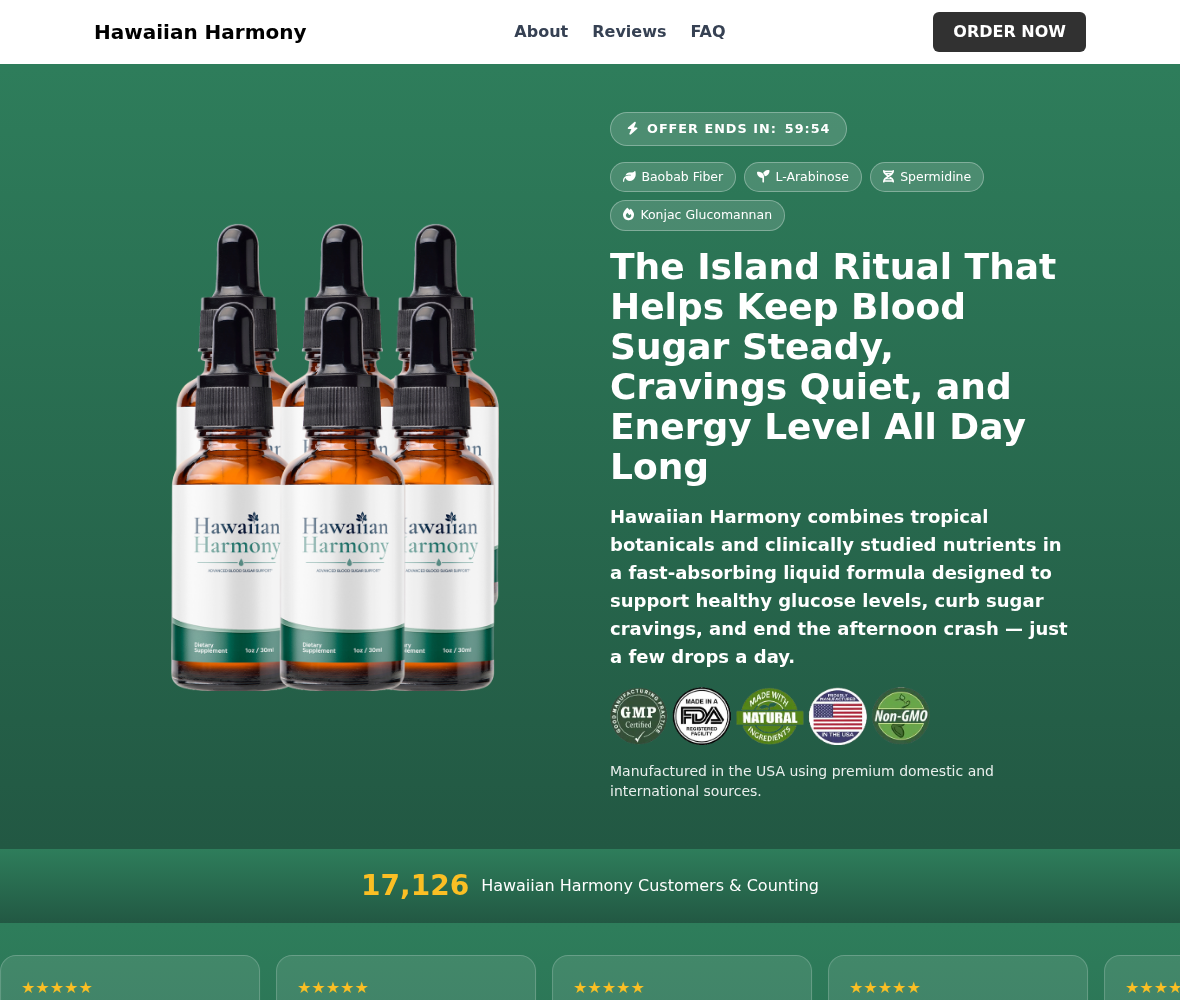
Hawaiian Harmony is promoted as a liquid dietary supplement for blood sugar, energy, and cravings. The pictured bottle is labeled 1 oz, or 30 ml.
The site describes approximately 1 ml daily. That volume is consistent with roughly 30 servings, unlike testimonials describing scoops of powder.
Its top ingredient callouts name baobab fiber, L-arabinose, spermidine, and konjac glucomannan. Other promotional pages use a different ingredient narrative.
We could not reconcile those descriptions with an authenticated, complete quantitative label for the exact bottles being ordered.
- Product mismatch: drops in the pitch, brain-support and powder language in the testimonial carousel.
- Guarantee mismatch: a full-refund promise versus a 15% restocking deduction and sealed-only reimbursement.
- Starting package: the main page offers two, three, or six bottles, not a simple one-bottle trial.
- Order-form evidence: one unit of the two-bottle package was displayed at $158.
- Billing limit: we found no visible recurring-payment schedule in that initial checkout.
The demonstrated problem is not a proven automatic refill
The homepage says the order is a one-time charge. The two-bottle checkout we opened did not visibly establish an automatic monthly shipment.
It also displayed an error saying delivery to Romania was unavailable. We did not bypass that restriction, enter another person’s details, or complete checkout.
That limits what we can conclude about later screens and other destinations. It does not erase the contradictions already documented on the promotional website.
Do not mistake a multi-bottle package for a subscription. One increases the upfront commitment; the other authorizes future payments. Each needs its own evidence.
If you see renewal wording in your order, save it and verify exactly what you accepted. Without that evidence, calling every Hawaiian Harmony order a refill trap is unsupported.
Blood Sugar Anxiety Is Not a Reason to Trust a Sales Story
The most effective part of this pitch is its familiarity. A person worries about readings, feels exhausted after meals, and wants something manageable.
The page offers a tiny action that supposedly makes the whole day steadier. That can feel more reassuring than dealing with an ongoing medical concern.
But reassurance is not clinical evidence. A story about better readings cannot tell you which intervention caused them or whether the described person exists.
The NCCIH guidance on diabetes and supplements warns against replacing medical treatment with unproven approaches and discusses possible interactions.
Keep prescribed care, monitoring, and professional advice in place. An advertisement should never decide when you stop or change diabetes medication.
Research on nutrients or individual plants also cannot establish the effects of an unidentified finished blend. The amounts, preparation, and population studied matter.
The reviewed website’s reference list focuses heavily on vitamins, cognition, and neurological conditions. It does not provide a clear trial establishing this exact drop formula’s advertised results.
That does not mean every referenced paper is invalid. It means a reading list is not an adequate bridge from blood sugar claims to this purchase.
The person selling the product needs to make that connection honestly. The buyer should not have to reconstruct a plausible formulation from unrelated headlines.
How the Hawaiian Harmony Sales Funnel Works
Step 1: An island ritual makes the offer sound simple and distinctive
The landing page frames its drops around a daily island-inspired ritual. Energy, cravings, and glucose concerns are grouped into one convenient promise.
A countdown and multiple quality badges create momentum before the reader has identified the manufacturer. Bottle graphics make the product look tangible and ready.
Those design choices can encourage a quick decision. Neither a timer nor a tropical origin story establishes the formulation, available stock, or effectiveness.
The site claims U.S. manufacture with domestic and international sourcing. That remains a seller assertion, not an independently traced supply chain.
Pause here and identify the exact website you reached. Pages sharing the product name can disagree about important details.
Step 2: The testimonials do not consistently describe the advertised drops
Reading the smaller review cards changes the impression. Some discuss concentration, memory, mental fatigue, or mixing a scoop with water.
Those are not straightforward accounts of the advertised liquid blood sugar routine. The mention of Neo Vital creates an additional brand mismatch.
Elsewhere, longer stories describe the dropper and blood sugar-related improvements. Mixing compatible and incompatible accounts does not resolve the evidence problem.
We cannot authenticate the customers or determine how those statements reached the page. Reused content is a reasonable concern, but its origin remains unverified.
A verified-purchase label added by the seller is not an independently accessible transaction record. Treat the testimonials as claims requiring substantiation.
You need not diagnose whether the portraits were generated by AI to reject irrelevant reviews as purchase evidence. The written mismatch is already observable.
Step 3: The largest package becomes the recommended starting point
The homepage presents two bottles at $158, three at $207, and six at $294. The largest package reduces the stated bottle price to $49.
Its preferred-package messaging makes six bottles seem like the sensible choice. A claimed customer preference adds social pressure to the price comparison.
The numbers still describe a $294 initial commitment. A lower unit cost does not make the whole order a low-cost experiment.
There is no one-bottle option among those displayed packages. A person wanting a short trial is being asked to buy at least two.
That is not proof of a secret quantity substitution. It is the openly promoted structure, which buyers should evaluate before entering payment details.
Also consider the guarantee horizon. A six-month package is being promoted alongside protection described as lasting only two months.
Step 4: Checkout quantity means a package, not a bottle
The two-bottle button led to a Digistore24 checkout domain. Its item was specifically named Hawaiian Harmony (2 Bottles).
The form displayed quantity 1, meaning one package containing two bottles. Interpreting that as a one-bottle order would misread the product description.
The visible total was $158, with shipping listed at $0. Destination restrictions remained unresolved because the form would not ship to Romania.
This is an observation of the initial form, not a guarantee about every country’s shipping, taxes, options, or final payment.
No personal information was submitted. We cannot describe a completed charge or post-payment upsell as something tested during this investigation.
At your own checkout, match the entire item name with the package illustration, full total, and payment frequency. A small quantity field cannot answer everything.
Step 5: The advertised refund protection shrinks in the policy
The guarantee section promises reimbursement even when bottles are empty. The FAQ presents the financial risk as belonging entirely to the seller.
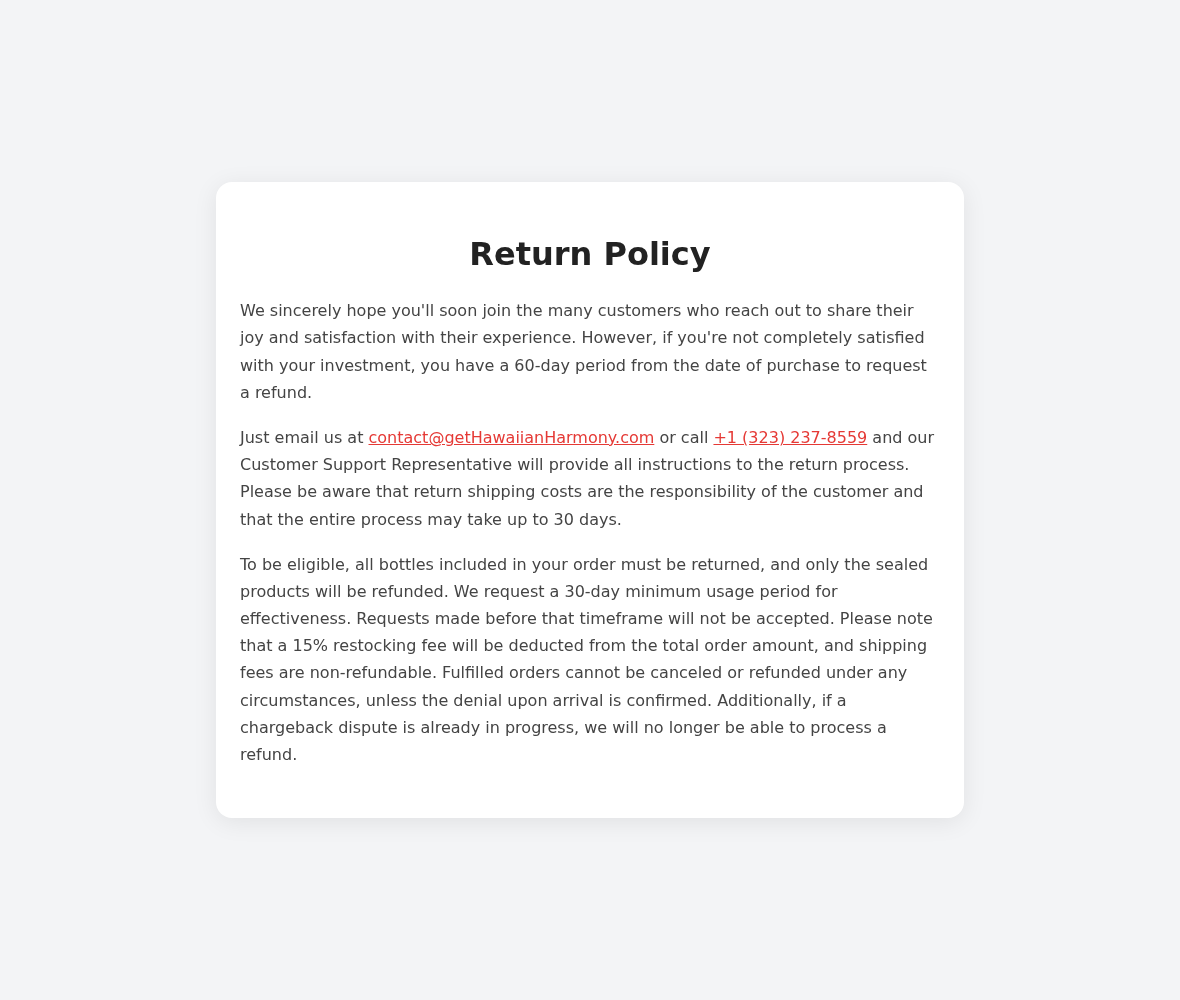
The actual Hawaiian Harmony return policy is much less reassuring. It requires all bottles back but limits reimbursement to sealed products.
It also demands a minimum 30-day usage period before accepting a request. That is awkward for a buyer told to test the product.
Further deductions include 15% of the order amount, original shipping exclusions, and customer-paid return postage. A full refund is not the same arrangement.
For illustration, 15% of a $294 order is $44.10. That example is a fee calculation, not a prediction of anyone’s final reimbursement.
The policy’s fulfilled-order clause introduces more uncertainty about cancellation and eligibility. Require a specific explanation before relying on this guarantee.
Step 6: Waiting for results can consume the return window
The sales FAQ suggests more meaningful changes develop over 60 to 90 days. The guarantee runs for 60 days from the original purchase.
That timeline is poorly aligned with the advertised experiment. Waiting until day 90 could leave you asking for money back after the stated window.
Time in shipping reduces the portion available for evaluation. Waiting for support instructions can introduce another delay.
The policy says the return process can take up to 30 days. It does not make every delay inevitable, but it makes early documentation important.
Do not let an instruction to keep using the product replace a concrete refund deadline. Ask for an actual date and preserve the answer.
Company, Address, and Fulfillment Checks
The website name does not establish the party behind the drops
A label saying Hawaiian Harmony identifies the marketed product. It does not, by itself, identify a registered manufacturer or the business responsible for a batch.
The inspected terms page largely describes data collection and marketing communications. It points readers to myhawaiianharmony.com without establishing a complete corporate identity.
The checkout platform is another part of the transaction. Its existence does not authenticate every health claim or testimonial on an affiliate page.
Request the seller’s legal name and the manufacturer or distributor on the physical label. Compare those names with the receipt rather than assuming they match.
The return destination is missing from the public instructions
The refund page tells customers to contact support for the return process. It does not provide a fixed warehouse address in the policy text examined.
We consequently cannot classify that unidentified location as a mailbox, residence, factory, or fulfillment center. Calling it fake would invent a finding.
The useful conclusion is narrower and practical: you cannot estimate return postage or confirm the destination from this document alone.
Ask for the complete authorized address, required reference number, carrier requirements, and deadline. Do that before accepting a costly multi-bottle commitment.
When an address is supplied, verify its role. A depot receiving packages is not automatically the headquarters or the place manufacturing the liquid.
The contact details connect this presentation with VitaReset
The contact and return pages give contact@getHawaiianHarmony.com and +1 (323) 237-8559. The guarantee on the homepage instead uses contact@customercs.com.
VitaReset’s inspected site displays that same telephone number and substantially identical return restrictions. The overlap is directly observable.
It suggests shared support infrastructure or reused commercial materials. It does not establish the same legal owner, laboratory, or manufacturer.
Neither number performance nor email delivery was tested. We cannot say agents never answer or that every customer experiences failed support.
Still, conflicting contact channels deserve clarification. Ask which business can authorize your refund and which email will provide a written record.
A transparent supply chain would resolve the ingredient confusion
The visible ingredient banner does not supply individual quantities. A complete label is needed to establish what the dropper actually delivers.
Other pages using the name describe guava, noni, turmeric, alpha-lipoic acid, chromium, and gymnema. Those promotional descriptions should not be merged into an invented formula.
Obtain the exact batch’s Supplement Facts, other ingredients, warnings, lot number, and responsible business details. The seller should reconcile any conflicting descriptions.
There is no independently verified China-origin finding in this review. A familiar private-label design is not a shipping record.
Likewise, we found no product-specific laboratory evidence proving contamination. Missing traceability creates uncertainty; it does not justify pretending a test was performed.
Which Claims Matter Most Before You Spend Anything?
Start with product identity. If the same page mixes drops with powder routines, its reviews cannot reliably tell you what your purchase will be like.
Next, settle the refund conflict. A buyer evaluating a supplement should understand whether opening it removes the very protection used to encourage the trial.
Then inspect the full commitment. A two-bottle starter package, six-bottle discount, and possible future billing are separate questions.
The current evidence supports a firm decision to pass on this offer. It does not require claiming every bottle is counterfeit or every order renews.
A different page would need a fresh assessment of its label, seller, price, and checkout. The same product name cannot transfer trust between websites.
Nor should a new domain wipe away old discrepancies. Compare the purchase terms, not just the updated bottle graphic or revised review headline.
What to Do If You Bought Hawaiian Harmony
Your first priority is your own transaction. Keep health decisions separate from the seller’s attempt to persuade you to retain the order.
-
Record the package you actually purchased. Save the order confirmation, full item description, number of bottles, total, payment method, and merchant name.
Remember that quantity 1 may describe a two-bottle package. Compare it with the receipt before alleging the wrong amount was shipped.
-
Preserve the incompatible promises. Capture the empty-bottle guarantee and the sealed-only restriction together, including the page addresses and purchase date.
Keep screenshots of the 15% fee and minimum-use condition. These concrete differences are more useful than a general complaint that the marketing felt suspicious.
-
Request a dated cancellation or refund decision. Ask whether dispatch can stop, which bottles qualify, and what exact amount will be returned.
Request return authorization and the destination in writing. Ask which contact channel controls your order when the homepage and policy supply different emails.
-
Investigate any later charge instead of guessing. Read the confirmation for renewal language, shipment frequency, add-ons, or a separate purchase.
When a recurring arrangement exists, cancel billing and deliveries explicitly. If consent is disputed, ask the merchant to produce the authorization record.
-
Contact your issuer about unresolved billing. Provide the promise, restrictive policy, receipt, and your written request. Explain the precise issue and ask about deadlines.
A seller’s restriction on refunds during a chargeback does not replace your issuer’s guidance. Discuss the available process directly with the payment provider.
-
Protect your medical care. Do not change prescribed diabetes treatment or monitoring because the advertisement suggests steadier readings.
Have a pharmacist or clinician assess the actual label before use. If symptoms develop, seek medical guidance and keep the package and lot information.
-
Keep reports factual. Describe the mismatched testimonial content, conflicting guarantee, or specific unauthorized payment you can document.
Avoid adding unproven claims about national origin or laboratory contamination. Evidence-based complaints make the real problems easier to evaluate.
Frequently Asked Questions
Is Hawaiian Harmony worth ordering?
Not through the reviewed promotion. Its liquid-versus-powder inconsistencies and restrictive refund policy outweigh the reassuring presentation. Obtain coherent product and purchase details first.
Is Hawaiian Harmony a monthly subscription?
The page describes one-time billing, and no recurring schedule was visible in our initial checkout. Later stages and other offers were not tested.
Why do its testimonials mention Neo Vital and scoops?
Those mismatches appear on the inspected page. Their original source was not authenticated, but they make the reviews unreliable evidence for these blood sugar drops.
Does quantity 1 mean one bottle?
Not in the checkout examined. Its item was Hawaiian Harmony (2 Bottles), so quantity 1 represented one two-bottle package priced at $158.
Is the 60-day guarantee a full refund?
The prominent promise says so, but the policy limits reimbursement to sealed bottles, deducts 15%, and excludes shipping costs. The seller must reconcile that conflict.
Are Hawaiian Harmony and VitaReset the same company?
Common support numbers and matching policy wording were verified. Common ownership was not. Shared materials cannot identify the factory or business behind either bottle.
The Bottom Line
Pass on the Hawaiian Harmony offer reviewed here. Irrelevant testimonials and contradictory refund conditions are meaningful purchase problems, not details to ignore.
If you paid, establish your actual package and billing terms, obtain a written return decision, and act before deadlines expire. Keep medical decisions with your healthcare team.








