

The Glyxora supplement looks almost deliberately ordinary. A clean green website, two simple bottles, plant-derived ingredients, fast delivery, and a button inviting Australian shoppers to support their daily wellness.
Nothing in that first screen prepares the buyer for what appears after the click. The ingredient story changes, the default order grows, and the payment form asks for consent to something far more expensive than a single wellness purchase.
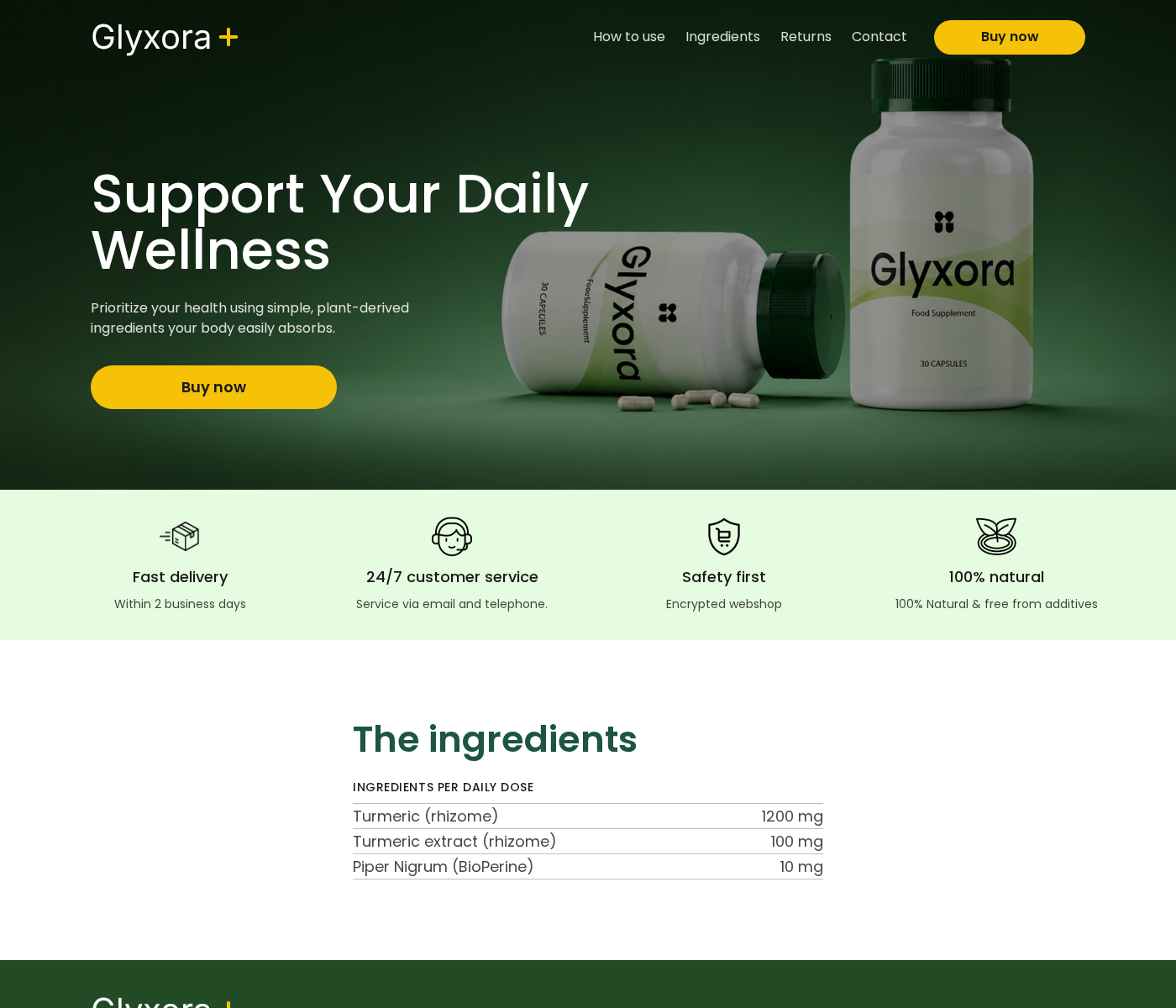
The Australian home page says a daily dose contains 1,200 mg of turmeric, 100 mg of turmeric extract, and 10 mg of Piper Nigrum branded as BioPerine. It also describes Glyxora as 100% natural and free from additives.
Glyxora’s separate Ingredients page shows a bottle label with a completely different formula. That label lists mulberry leaf, cinnamon bark, bitter melon, bitter orange, and chromium picolinate, with no turmeric or BioPerine in sight.
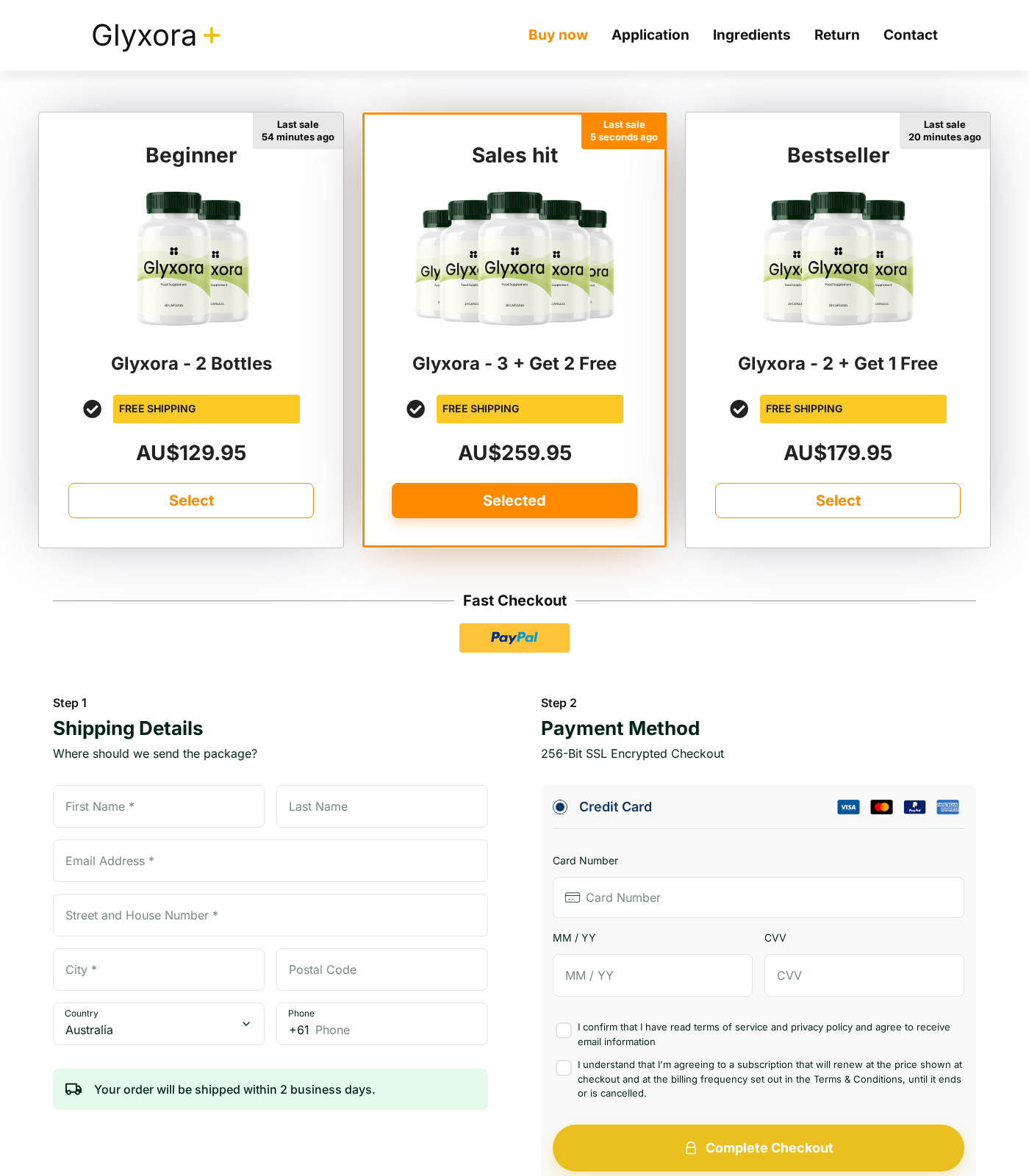
Clicking Buy now from the home page leads to a checkout where a five-bottle bundle is selected by default. Below the card fields, a required checkbox says the customer agrees to a subscription that renews at the price and frequency described in the Terms and Conditions.
Overview
Glyxora presents two incompatible supplement formulas
The main page promotes a turmeric and black pepper formula. The product label displayed on the official Ingredients page instead names mulberry leaf extract, cinnamon bark extract, bitter melon extract, bitter orange extract, and chromium picolinate.
These are not alternate spellings for the same ingredients. They describe two different products with different possible effects, interactions, warnings, and reasons for use.
The standard checkout requires subscription consent
The Buy now button on the page reviewed opened Glyxora’s cart checkout. It selected the “3 + Get 2 Free” package at AU$259.95 and required the shopper to confirm a recurring subscription before completing payment.
The checkbox itself does not display the selected renewal interval. It sends the customer to lengthy Terms and Conditions that describe 30-day, 60-day, and 90-day billing cycles.
The company and support trail is full of unfinished details
The Terms identify DirectCommerce Limited, a UK company incorporated on June 9, 2026. The Australian privacy text separately says the responsible entity’s registered details and address are “to be confirmed” and prints the placeholder phone number +61 2 0000 0000.
Returns go to Kleine Esch 669 in Moordrecht, Netherlands. That address is publicly listed by ShipOffers as a European fulfillment location, not as DirectCommerce Limited’s headquarters or the disclosed manufacturer of Glyxora.
- The Australian home page names turmeric, turmeric extract, and BioPerine.
- The official label image lists five different active ingredients.
- One page says to take two capsules daily, while an FAQ says no more than one capsule daily.
- A 30-capsule bottle is sold as a 30-day supply despite the two-capsule direction.
- The standard cart selects five bottles for AU$259.95 by default.
- The cart requires agreement to a recurring subscription.
- Other active Glyxora checkout templates contain a prechecked automatic-refill box.
- The Terms allow billing cycles of 30, 60, or 90 days.
- Cancellation must reach support at least 7 days before the next billing date.
- Returns must normally be unopened, pre-authorized, and sent to the Netherlands at the buyer’s expense.
What Glyxora Is Actually Selling
The main page avoids a narrow health promise. It uses the broad phrase “Support Your Daily Wellness” and says plant-derived ingredients are easily absorbed. That soft opening can make the product feel like an uncomplicated vitamin.
The checkout tells a more ambitious story. It says Glyxora can boost metabolism, burn fat faster, curb cravings, balance blood sugar, and support sustainable weight loss without harsh stimulants.
Those claims help explain why the two formulas matter. Turmeric and piperine would create one safety and evidence profile. Bitter orange, chromium, mulberry leaf, cinnamon, and bitter melon would create another.
A customer cannot make informed consent when the seller’s own pages disagree about what is inside the capsule. A doctor or pharmacist also cannot evaluate medication interactions confidently without a reliable formula and dose.
The funnel sells more than capsules. It sells a long-term supply through a checkout where the largest bundle is already selected and subscription consent is required.
The Formula, Dose, and Supply Cannot All Be Correct
The home page describes a turmeric product
Glyxora’s home page gives exact quantities per daily dose: turmeric rhizome 1,200 mg, turmeric extract 100 mg, and Piper Nigrum BioPerine 10 mg. This is presented as the product’s complete ingredient story.
The site also says the formula is 100% natural and free from additives. That claim is difficult to assess because the home page does not show a complete ingredient panel naming the capsule shell, fillers, flow agents, allergens, manufacturer, or country of manufacture.
The official label image describes a different capsule
The Nutrition Information image lists mulberry leaf extract 125 mg, cinnamon bark extract 100 mg, bitter melon extract 100 mg, bitter orange extract 25 mg, and chromium picolinate 30 mg per capsule.
Turmeric and BioPerine disappear completely. The change is too large to dismiss as a formatting problem or a minor website update. The seller needs to identify which formula is currently shipped to Australian customers and remove the incorrect page.
The directions contradict the claimed bottle duration
The Ingredients and How to Use pages tell adults to take one capsule twice a day. With 30 capsules in a bottle, that instruction creates a 15-day supply.
Elsewhere on the same How to Use page, the FAQ says the maximum is one capsule daily. Checkout cards describe one bottle as a 30-day supply. Only one of those dosing schedules can support that claim.
The chromium unit needs urgent clarification
The label image literally prints “Chromium Picolinate 30 mg.” Nutritional chromium is commonly discussed in micrograms, and the NIH lists adult adequate intakes in the 20 mcg to 35 mcg range.
Chromium picolinate is a compound, so its printed weight is not identical to elemental chromium. Even so, a milligram label beside a nutrient normally expressed in micrograms demands confirmation. It may be a unit error, a formulation error, or an accurate compound amount, but consumers should not have to guess.
How the Glyxora Supplement Scam Works
Step 1: A calm wellness page lowers suspicion
The funnel begins without wild celebrity endorsements or an obvious fake-news page. Glyxora uses clean design, plain bottles, natural-language claims, 24/7 support, fast delivery, and an encrypted-store badge.
This restrained opening makes the website feel safer than a loud miracle cure. The buyer may click Buy now before looking for a legal company, full label, price, or subscription disclosure.
Step 2: The promise expands after the first click
The home page speaks about daily wellness. Checkout variants move toward slimming, metabolism, cravings, blood sugar, and lasting weight loss. The product becomes more valuable as the customer moves closer to payment.
This is also where seller-controlled ratings and customer stories appear. One checkout states 4.8 stars and 5,000 customers, but the page does not show enough independent review data to verify that figure.
Step 3: A large package is selected before the buyer chooses
The main cart offered two bottles for AU$129.95, three bottles for AU$179.95, and five bottles for AU$259.95. The five-bottle “Sales hit” package was already selected.
The price was also broken down as AU$51.99 per bottle. A shopper focused on the smaller per-bottle figure can miss that the immediate card charge is AU$259.95.
Step 4: The payment form requires subscription agreement
The standard cart contains two required compliance boxes. One covers the Terms, Privacy Policy, and marketing email. The second says the buyer agrees to a subscription that renews at the checkout price and the billing frequency in the Terms.
The frequency is not printed next to that checkbox. The customer must leave the form and find the subscription clauses inside a long legal document.
Step 5: Other live checkout versions preselect auto-refill
We inspected additional active checkout templates hosted on checkout.glyxora.com. Their public HTML contains an `autoRefill` checkbox marked `checked`, beside the sentence that the shopper wants automatic refills so supplies do not run out.
This does not prove that every visitor sees the same route. It does prove that the official Glyxora funnel supports multiple versions, including versions where automatic refill begins preselected and must be noticed and unticked.
Step 6: Renewals continue on a 30, 60, or 90-day cycle
The Terms say subscription options may renew every 30, 60, or 90 days. Glyxora may automatically charge the then-current subscription price and ship more product until cancellation takes effect.
The company may change the price after giving 30 days’ written notice. To avoid the next charge, cancellation must arrive at least 7 days before the scheduled billing date.
Step 7: Returns and unfamiliar billing names create friction
The return page requires prior contact, unopened products, original packaging, a 30-day deadline, and customer-paid shipping to the Netherlands. It says a refund may be issued within 60 days after the return is received and processed.
The Terms also warn that the billing descriptor may differ from Glyxora or the product name. A customer who does not recognize the descriptor may lose valuable time identifying which transaction needs to be cancelled or disputed.
Company, Address, and Fulfillment Checks
The Glyxora brand hides a very new UK company
The Terms name DirectCommerce Limited, company number 17271086, at 3a Hamelin Street, Cannock, United Kingdom. The official Companies House record confirms that the company is active and was incorporated on June 9, 2026.
The Glyxora Terms were modified on June 18, only 9 days later. DirectCommerce Limited declares “other business support service activities,” not supplement manufacturing. A real registration proves the company exists, but it does not prove the formula, claims, factory, or subscription experience.
The return address is a fulfillment center, not headquarters
Australian customers are told to return Glyxora to Kleine Esch 669, 2841 MK Moordrecht, Netherlands. ShipOffers publicly lists that exact location as its Netherlands fulfillment facility.
A fulfillment company can receive, store, pack, and forward products for many brands. It is not automatically the seller, formula owner, laboratory, or manufacturer. Sending a parcel there does not explain who made the capsules or who approves a refund.
The advertised phone support leads to a placeholder
The home page promises 24/7 customer service by email and telephone. The visible Contact page provides support@glyxora.com but no useful telephone number.
The privacy text prints +61 2 0000 0000 and says the company’s registered details, registered address, and postal address are “to be confirmed.” That is unfinished template information, not a credible Australian support line or registered contact trail.
The manufacturer and Australian sponsor remain invisible
The pages reviewed do not clearly identify the finished-product manufacturer, importer, Australian sponsor, manufacturing country, batch-testing laboratory, certificate of analysis, or a visible AUST L, AUST L(A), or AUST R number.
The TGA explains that medicines supplied in Australia generally display an AUST number on the label. Whether Glyxora is legally treated as a food or therapeutic good depends on its presentation and claims, but buyers should demand the applicable regulatory status in writing.
The 30-Day Guarantee Is Much Narrower Than It Sounds
Checkout repeatedly promotes a 30-day money-back guarantee. Another sales message says it is “no-questions asked” and promises a full refund if Glyxora does not produce satisfactory results.
The return policy sets a very different practical standard. Items must be unopened, in their original condition, with all packaging and accessories, and returned within 30 days of receipt.
A customer cannot test a capsule for weight loss, appetite, blood sugar, or tolerability while keeping the bottle unopened. The large guarantee language therefore creates an expectation that the detailed return conditions may not honor.
Customers must contact support before mailing anything. Without prior notification, the site says a refund cannot be guaranteed. Return shipping is paid by the buyer and is non-refundable.
The page says the company may issue a refund within 60 days after receiving and processing the return. A separate FAQ says inspection may take up to 14 days before the refund is processed, extending the period of uncertainty.
Medical and Label Safety Concerns
Turmeric with BioPerine is not automatically harmless
If the home-page formula is correct, piperine is included to increase absorption. NCCIH notes that highly bioavailable curcumin products have been linked to liver injury in some users, and herbal products can interact with medicines.
The site’s blanket claim that Glyxora is natural does not answer those concerns. Natural ingredients can still cause side effects, alter drug exposure, or be unsuitable during pregnancy and for people with liver or gallbladder conditions.
Bitter orange changes the risk profile completely
If the label image is correct, Glyxora contains bitter orange. NCCIH says evidence for weight loss is unclear and some studies indicate bitter orange can increase heart rate and blood pressure.
That matters because the checkout claims the product supports weight loss without harsh stimulants. Bitter orange contains p-synephrine, a stimulant-like substance, and deserves specific warnings for people using medication or managing cardiovascular conditions.
Blood-sugar claims require extra caution
Mulberry leaf, cinnamon, bitter melon, and chromium are commonly promoted in glucose-related supplements. A marketing claim about balancing blood sugar is not proof that Glyxora can treat diabetes or safely replace prescribed care.
Combining uncertain doses with diabetes medication could potentially change blood glucose. Anyone taking insulin or other glucose-lowering medicine should show the actual bottle and complete label to a doctor or pharmacist before using it.
Is Glyxora Fake or Real?
Glyxora is real in the limited sense that it has active websites, working checkout forms, a named UK company, package prices, policies, and a European returns facility. Those facts do not resolve what is actually inside the bottle.
The formula conflict alone is enough to stop a careful buyer. A supplement cannot credibly be turmeric and BioPerine on one official page, then mulberry, cinnamon, bitter melon, bitter orange, and chromium on another.
The subscription evidence is equally concrete. The main cart requires recurring-billing consent, while other official checkout templates precheck automatic refill. The Terms allow repeated charges and shipments on several possible cycles.
The fairest conclusion is that Glyxora is a high-risk supplement and subscription funnel with unreliable product information. We cannot prove that every bottle is counterfeit or that every customer receives unauthorized charges, but the documented contradictions are serious enough to avoid the offer.
Warning Signs to Watch For
- The home page and official label image describe two different formulas.
- The directions alternate between one and two capsules per day.
- A 30-capsule bottle is described as both a 15-day and 30-day supply.
- The label prints chromium picolinate in mg without explaining the elemental chromium amount.
- The main Buy now route selects five bottles at AU$259.95 by default.
- A required checkbox commits the buyer to a renewing subscription.
- The renewal frequency is deferred to long Terms instead of appearing beside consent.
- Other active official checkout versions have automatic refill prechecked.
- Cancellation must arrive 7 days before the next billing date.
- The guarantee says risk-free, but the return policy requires an unopened product.
- Returns go from Australia to a Dutch fulfillment facility at the customer’s expense.
- The site promises telephone support but exposes a placeholder phone number.
- The privacy page says company details and addresses remain to be confirmed.
- The card descriptor may differ from Glyxora, making charges harder to identify.
The concern is not a single typo. It is the accumulation of conflicting health information, mandatory subscription consent, route-dependent refill behavior, default bundles, restrictive returns, unfinished legal data, and an untraceable manufacturing chain.
What to Do if You Have Fallen Victim to This Scam
- Save the complete checkout evidence. Keep the home page, ingredient page, label image, selected package, subscription checkbox, order total, Terms, confirmation email, shipping label, and card statement. Record the exact route and date because Glyxora uses several checkout versions.
- Cancel in writing immediately. Email support@glyxora.com and state that you cancel every Glyxora subscription and revoke authorization for future charges and shipments. Do not wait until the final week because the Terms impose a 7-day cutoff.
- Demand the renewal details. Ask support to identify the billing interval, next charge date, future amount, number of bottles, subscription ID, payment descriptor, and effective cancellation date. Request one written confirmation covering every active plan under your details.
- Separate cancellation from a return. Mailing bottles back does not automatically cancel recurring billing. Obtain return authorization, then request a separate message confirming that the subscription itself has ended.
- Contact the card issuer. If the subscription was unclear, a refill was preselected, the amount differs, or charges continue after cancellation, open a dispute promptly. Explain that the merchant warned its descriptor may differ from Glyxora and provide the supporting documents.
- Do not take capsules with an uncertain label. If the delivered ingredients differ from the formula you expected, stop and speak with a doctor or pharmacist. Seek medical help for concerning symptoms and report suspected adverse effects to the TGA.
- Check the device used to order. Run Malwarebytes if the funnel caused unusual redirects, pop-ups, downloads, or browser notifications. Use AdGuard to block deceptive ads, tracking scripts, and repeat redirects into similar supplement offers.
- Report the documented conduct. Australian customers can contact the ACCC’s Scamwatch, the TGA for product or advertising concerns, and their state consumer agency. Report exact ingredients, amounts, checkout language, dates, support responses, and charges rather than unsupported assumptions.
Frequently Asked Questions
Is the Glyxora supplement a scam?
Glyxora has a real checkout and named company, but its conflicting formulas, mandatory subscription consent, prechecked refill variants, unclear dosing, restrictive returns, placeholder phone, and undisclosed manufacturer make it a high-risk offer we recommend avoiding.
Does Glyxora automatically enroll buyers in a subscription?
The main cart requires buyers to tick a box agreeing to recurring billing before checkout. Other active templates on the official checkout domain contain an automatic-refill box that is already checked. The exact experience can depend on the route used.
What ingredients are in Glyxora?
The website gives two incompatible answers. The home page lists turmeric, turmeric extract, and BioPerine. Its Nutrition Information image instead lists mulberry leaf, cinnamon, bitter melon, bitter orange, and chromium picolinate.
How much does Glyxora cost?
The standard Australian cart reviewed selected five bottles for AU$259.95. It also offered two bottles for AU$129.95 and three bottles for AU$179.95. Other live checkout versions displayed different bundles and totals, so save the exact offer before paying.
Who owns Glyxora?
The Terms name DirectCommerce Limited, a UK company incorporated on June 9, 2026. The privacy text still says the responsible entity details and addresses are to be confirmed, creating an unresolved contradiction in the seller’s own legal disclosures.
How do I cancel a Glyxora subscription?
Email support@glyxora.com at least 7 days before the next billing date. Identify the order and demand written confirmation that all future charges and shipments are cancelled. Monitor the card for a descriptor that may not contain the Glyxora name.
The Bottom Line
The Glyxora supplement funnel asks customers to trust a product whose formula, dose, and bottle duration change between official pages. It then defaults to a five-bottle order and requires consent to recurring charges whose exact frequency is buried in the Terms.
A newly incorporated UK company, placeholder Australian phone number, Dutch fulfillment return, unopened-product refund rule, and undisclosed manufacturer add more uncertainty. None of those facts alone proves criminal fraud, but together they make informed purchasing nearly impossible.
Do not order Glyxora until the seller provides one consistent label, a traceable manufacturer, applicable Australian regulatory details, a clearly optional one-time purchase, and subscription terms beside the payment button. With the current evidence, the safest choice is to keep your card out of this funnel.








