

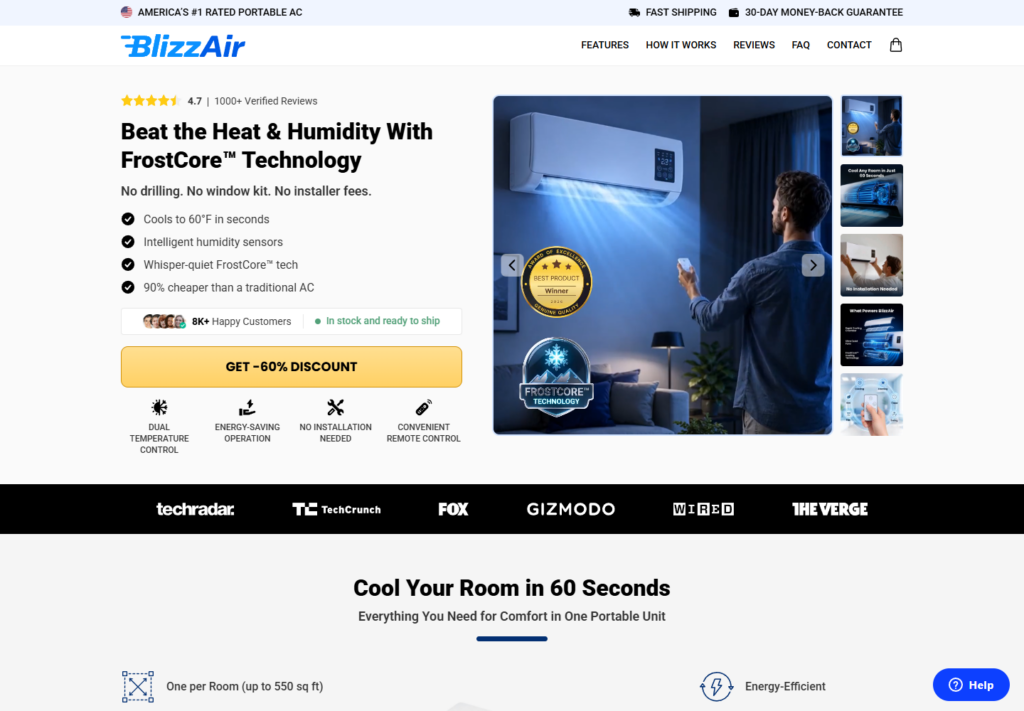
BlizzAir says one compact plug-in unit can cool or heat a room of up to 550 square feet, reach 60°F in seconds, and cut air-conditioning costs by 90%.
The page shows polished bedroom scenes, “FrostCore” diagrams, thousands of five-star reviews, media logos, and a discount that appears to expire while the buyer watches.
What happens between that promise and the final card charge deserves a much closer look.
Overview
The cooling claim conflicts with basic physics
BlizzAir is shown as a wall-style device with no exhaust hose, outdoor condenser, compressor specification, refrigerant type, or BTU rating. The page does not explain how heat leaves the room.
Without that heat-removal path, the device can circulate room air and may provide electric heat, but it cannot operate like a compressor air conditioner.
The checkout is built to increase the order
The one-unit option was $137.99 during our check. The checkout loaded with two units selected at $110.99 each and displayed a $241.96 total.
An extended warranty costing $9.99 per unit was already checked. A timer and “only 103 items left” message added pressure beside the form.
The merchant trail changes by page
The BlizzAir sales terms name UAB Rara Digital in Vilnius, Lithuania. The checkout runs on a topashopo.com subdomain, whose terms identify Evora LLC at a Georgia address.
The return process requires approval, an RMA, an address supplied by support, unused original condition for change-of-mind returns, and customer-paid postage.
- The sales domain was registered on July 15, 2026.
- The page claims 550-square-foot cooling in 60 seconds without an exhaust path.
- Two units are selected by default in the checkout we inspected.
- A per-unit extended warranty is preselected.
- The sales site and checkout identify different operating companies.
- The seller’s terms say marketing images may be digitally enhanced or AI-generated.
“FrostCore” Is a Marketing Name, Not a Cooling System
BlizzAir says FrostCore heat-exchange technology pulls in warm air and pushes out cold air in under a minute. It claims the user can set the temperature from 75°F down to 60°F, even when it is 104°F outside.
A heat exchanger does not make heat disappear. In an air conditioner, refrigerant transports indoor heat to a condenser that releases it outside. The system consumes electricity and also produces waste heat.
A one-piece device that rejects all heat into the same room cannot lower that room’s total temperature. A real portable AC therefore uses a hose, and a split system uses an outdoor unit.
The BlizzAir page shows neither. It also omits the compressor model, refrigerant, cooling capacity in BTU per hour, rated electrical input, and recognized efficiency metrics.
The phrase “FrostCore” sounds technical, but the page offers no independent test report or manufacturer documentation that defines it.
How the BlizzAir Scam Works
Step 1: The ad targets an urgent problem
Heat waves, poor sleep, rental restrictions, and high utility bills create a motivated audience. The page promises relief without an installer, window kit, drilling, or landlord approval.
The buyer is encouraged to compare the product with the expense of a split system rather than with an ordinary fan heater.
Step 2: Rendered scenes imply compressor-level cooling
The hero image shows intense blue air beams filling a bedroom. Other graphics suggest cooling coils, humidity control, precision temperature settings, and internal airflow channels.
Those visuals are not measurements. The terms explicitly state that product images may be edited, staged, computer-generated, or created with AI.
Step 3: Unverified numbers create social proof
The page calls BlizzAir “America’s #1 rated portable AC,” displays 4.7 stars, more than 1,000 verified reviews, and over 8,000 happy customers.
Farther down, it shows 1,768 reviews and additional testimonial blocks. The page does not link those numbers to an independent retailer or testing organization.
Step 4: Familiar media logos imply recognition
A black strip shows TechRadar, TechCrunch, Fox, Gizmodo, Wired, and The Verge. We found no article links or quotations beside the logos.
A logo is not proof that a publication tested, endorsed, or even mentioned the product. Consumers should search each publication directly.
Step 5: The discount favors two units
The checkout presents one BlizzAir at $137.99 and two at $110.99 each. The two-unit package is marked “best seller” and selected when the page loads.
This raises the initial commitment before the buyer has tested one device.
Step 6: Scarcity keeps attention away from the summary
The page claims only 103 items remain and reserves the discount for roughly ten minutes. The timer restarts when the page is revisited.
That pressure encourages the buyer to enter card details before checking the quantity, add-ons, merchant, and return terms.
Step 7: The extended warranty is already selected
The order summary includes “Yes, I Want Extended Warranty For $9.99 Per Unit” as a checked option.
For two units, the add-on can contribute $19.98. A buyer must actively notice and remove it.
Step 8: A broad guarantee becomes a conditional return
The checkout says the 30-day guarantee is swift, easy, hassle-free, and provides a full refund.
The linked policy says change-of-mind products must be unused, undamaged, and in original packaging. The customer pays return shipping, and original shipping is non-refundable.
The Order Form Is Designed Around a Bigger Basket
The checkout is hosted on get-blizzair.topashopo.com, not the main sales domain. It repeats the 60% discount and scarcity messages before the customer-information fields.
The two-unit package was selected. The order summary combined two devices, warranty, and free shipping in a total of $241.96 during our capture.
Prices, inventory counters, and timers can change. The important details are the selected quantity and the checked add-on.
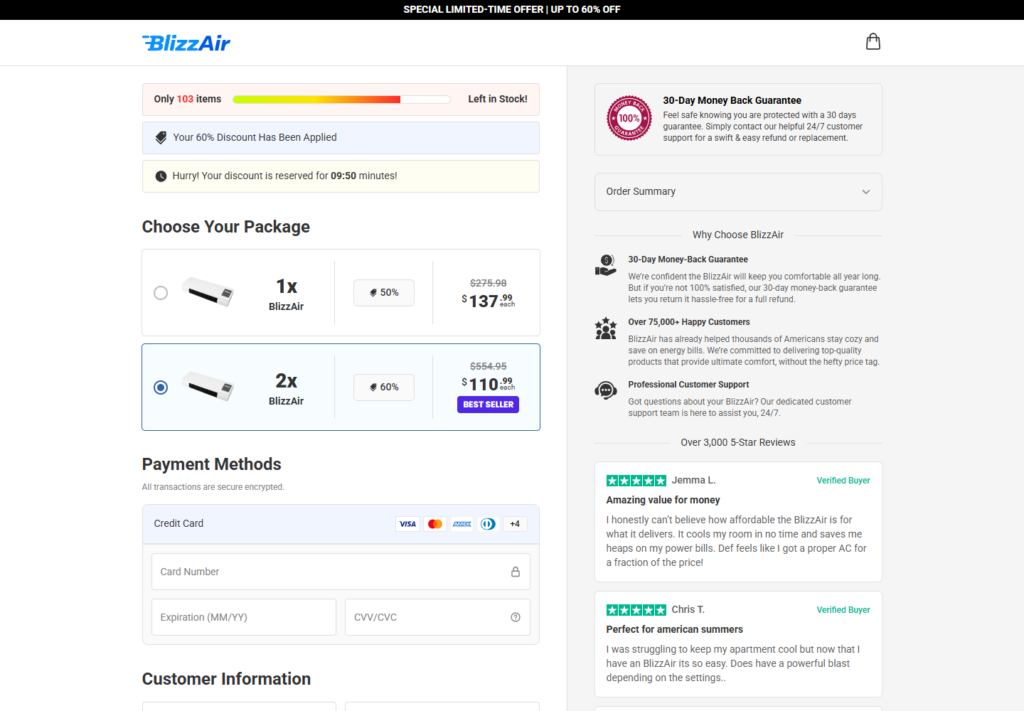
The page also displays seller-controlled testimonials beside the payment form. Review claims at the moment of payment can make the checkout feel safer without adding independent evidence.
Before entering a card, expand the summary and record every line. Clear optional coverage, select the intended quantity, and confirm that the displayed total updates.
If the page resists those changes or the receipt differs, contact the card issuer immediately. Do not wait for delivery to document an unauthorized amount.
What the Device Is More Likely to Be
The casing matches a common category of wall-mounted PTC fan heater. These products use a ceramic element to warm air and a fan to distribute it.
When the heating element is off, some sellers describe the airflow as “cool wind.” That means unheated fan mode, not refrigerated air.
A fan can improve comfort by helping sweat evaporate. It does not hold a 550-square-foot room at 60°F, especially when outdoor temperatures reach 104°F.
Comparable wall-mounted PTC fan heaters appeared on Alibaba around $26 to $39 at the quantities we checked. We found other sellers using similar imagery and “heating and cooling” language.
One secondary investigation claimed an even lower wholesale match, but we could not independently verify the exact BlizzAir factory unit. The responsible conclusion is that it resembles generic fan-heater hardware sold at a fraction of the advertised price.
The lack of an exhaust system is decisive. Even a premium fan heater cannot become a room air conditioner through a new logo.
The WellaCooler Connection
BlizzAir is not appearing in isolation. During our separate WellaCooler investigation, the buy button on wellacoolers.com passed through knownwalk.com and opened the BlizzAir sales page.
The customer started with WellaCooler, encountered copy that called the product EpiCooler, and arrived at BlizzAir before payment.
That chain demonstrates how quickly this product category can change names while keeping a similar device and payment structure.
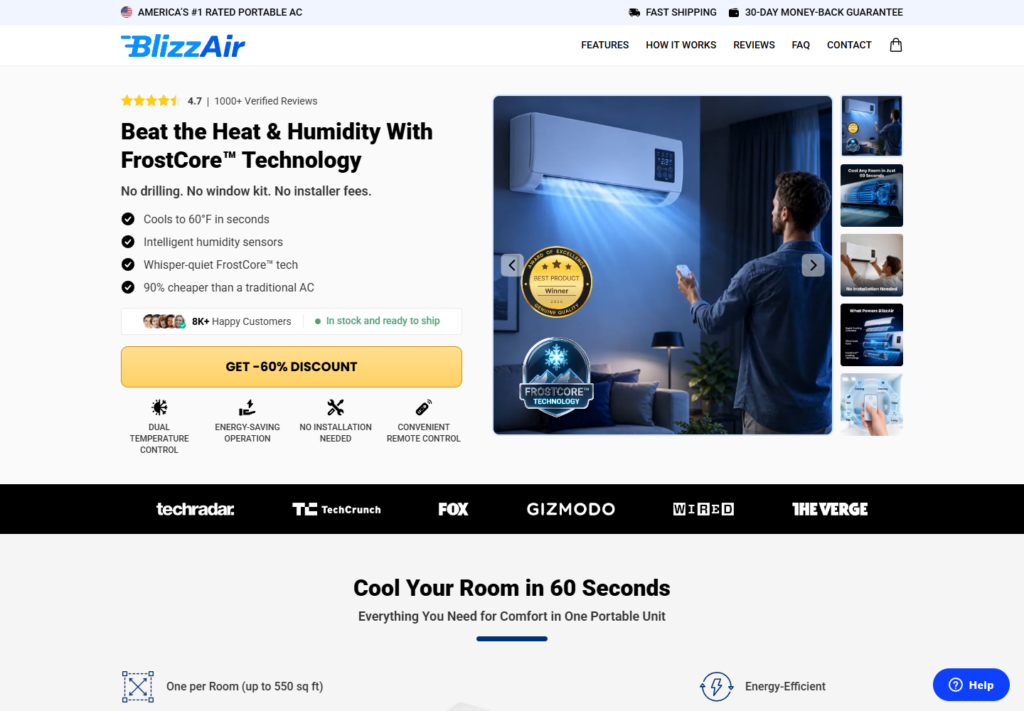
It does not by itself prove that every domain has the same owner. Affiliate marketers can route traffic to third-party offers.
It does prove that the BlizzAir checkout is being used as a destination for advertisements carrying another product name.
Consumers should research the final merchant and checkout, not just the brand displayed in the first video.
Company, Address, and Fulfillment Checks
The sales terms name a Lithuanian operator
The get-blizzair.com terms identify BlizzAir as a brand operated by UAB Rara Digital, with a registered address at J. Jasinskio g. 16B, LT-03163 Vilnius.
The contact page lists support@get-blizzair.com and +1 (689) 588-5432.
The checkout terms name a Georgia company
Topashopo’s terms identify Evora LLC at 9110 Selborne Lane, Suite 220, Office P, Chattahoochee Hills, Georgia 30268.
Those terms describe Evora as the seller and payment-processing company for topashopo.com. Buyers should confirm which name appears on the receipt and card statement.
The domain has almost no history
Verisign RDAP shows get-blizzair.com was registered on July 15, 2026. Topashopo.com was registered on February 11, 2025.
A fresh domain does not automatically mean fraud, but it conflicts with the impression of a long-established, nationally rated bestseller unless evidence supports that history.
The return address comes only after approval
The policy requires customers to contact support, wait for review, receive an RMA, and use the specific address supplied by the team.
It warns that packages sent without authorization or to a registered company address may not be processed.
The Refund Promise Has More Conditions Than the Ad
The checkout says customers can return BlizzAir hassle-free for a full refund. The formal return policy draws a sharp line between defective items and a change of mind.
For a change of mind, the item must be unused, undamaged, and in its original packaging with all accessories. That condition creates a problem when the complaint is that the device was tested and did not cool as advertised.
Customers pay return shipping, original shipping is not refunded, and support chooses the destination after approving the request.
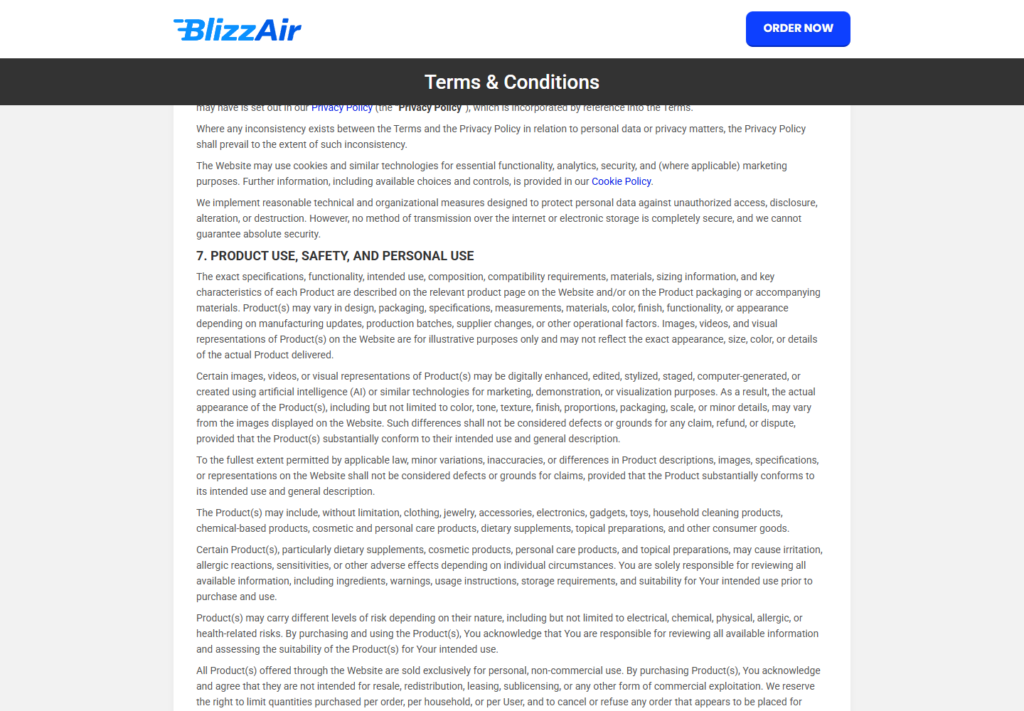
The terms also contain broad clauses for supplements, creams, subscriptions, and AI-generated imagery. That boilerplate suggests a general multi-product commerce template rather than a policy written specifically for one climate appliance.
We did not find a BlizzAir refill subscription selected in the checkout. The recurring-billing clauses are still worth noting because buyers should examine PayPal automatic payments and future card statements.
A preselected warranty is the confirmed add-on in this transaction.
What Independent Review Pages Do and Do Not Prove
Search results contain Trustpilot profiles for buyblizzair.com, blizzair.org, and other BlizzAir-named pages. Those are different domains from get-blizzair.com.
Some reviewers on related profiles praise an easy ordering process before receiving the product. Others allege weak fan-like performance, hidden warranty charges, shipping delays, or difficult refunds.
We do not merge those profiles into one rating because similar branding does not establish identical ownership. The domain mismatch itself is a reason to read the URL carefully.
The direct evidence is stronger: reproduce the sales claims, inspect the hardware image, view the selected basket, read the terms, and check the domain registration date.
That evidence is enough to conclude that the offer creates an air-conditioner expectation without supplying the necessary technical proof.
What to Do if You Have Fallen Victim to This Scam
- Save the ad and landing page. Capture the 60°F, 60-second, 550-square-foot, energy-saving, and guarantee claims.
- Check the package quantity. The checkout selected two units during our test.
- Check for the extended warranty. Confirm whether $9.99 per unit appears on the receipt.
- Identify the merchant descriptor. Record BlizzAir, Topashopo, UAB Rara Digital, Evora LLC, and any different name on the card statement.
- Request cancellation quickly. Use written email and preserve the time, full headers, and reply.
- Do not discard the packaging. Photograph the sealed parcel, model plate, plug, device, accessories, and shipping label.
- Request an RMA and full terms. Ask for the return address, deadline, postage responsibility, and exact refundable amount.
- Use a tracked return. Keep the receipt, weight, tracking number, and delivery confirmation.
- Open a payment dispute when appropriate. Provide screenshots that show misleading cooling claims, selected extras, and the return-policy conflict.
Report deceptive U.S. advertising to the FTC and the relevant state attorney general. A card dispute normally has deadlines, so contact the issuer promptly.
If the ad route triggered suspicious downloads or browser prompts, scan the device with Malwarebytes. This is a device-safety step, not a refund service.
AdGuard can reduce exposure to aggressive advertising and known malicious redirects. It cannot evaluate cooling physics or remove a selected checkout option.
For the wider pattern, read our 90-second portable AC investigation and Cooling Ace rebrand report.
Frequently Asked Questions
Is BlizzAir a real air conditioner?
The page does not show a compressor, refrigerant, exhaust hose, outdoor condenser, or BTU rating. The device appears closer to a wall-mounted fan heater than a room air conditioner.
Can BlizzAir cool 550 square feet in 60 seconds?
We found no independent test supporting that claim. Without a mechanism to reject heat outside the room, the advertised hardware cannot perform like a compressor AC.
Why are two BlizzAir units selected?
The checkout marks the two-unit package as its best seller and loads it as the selected option. Buyers must choose one unit manually if that is all they intend to order.
What is the BlizzAir warranty charge?
An extended warranty priced at $9.99 per unit was checked in the checkout we inspected. For two units, it can add $19.98.
Can I return BlizzAir after testing it?
The prominent guarantee sounds broad, but the formal change-of-mind policy requires unused, undamaged merchandise in original packaging. Defect claims follow a separate review process.
Who operates BlizzAir?
The sales terms name UAB Rara Digital in Lithuania. The checkout platform’s terms name Evora LLC in Georgia. Confirm the actual merchant on your receipt and statement.
The Bottom Line
BlizzAir asks buyers to believe that a small hose-free fan-heater can cool 550 square feet to 60°F in seconds. The page provides dramatic images and review counts, but not the engineering evidence needed to support that promise.
The checkout then selects two units and a paid warranty while a timer runs. Stop at the summary. This is generic hardware wrapped in air-conditioner language and a sales funnel designed to make the basket bigger.








