

The text lands on a Friday. IPDN Careers. A remote coordinator seat. Daily pay, flexible hours, start this week. You did not apply. You have never spoken to anyone in that building. The message still talks as if your resume already cleared a desk.
If you reply, the next step is not a video call on a calendar you can decline. It is a chat. WhatsApp, a web box, a thread that already has your first name. The questions are short. The offer is fast. Then the tone changes. They need a photo of your driver’s license to finish onboarding. Or a passport page. Or the tax IDs you would only give a payroll office you already trust.
That pipeline is the trap. The name on the text is doing borrowed work. Professional Diversity Network, Inc. is a real company, listed as IPDN, based in Chicago. The real network is not the sender of a random job text. What follows is how a diversity-hiring costume is used to take an ID, then a fee, then nothing.
Overview
The trap is an unsolicited IPDN Careers pitch that pretends you already qualified for an open remote role. The contact can be SMS, WhatsApp, or email. The words are hiring words. Coordinator. Operations. Remote. Daily pay. Flexible hours. A start date that is already this week. None of those words is a job. They are there so you will answer a stranger who already knows how tired the search feels.
What they want is not your labor. First they want a government ID: a driver’s license, a passport page, a Social Security number, a tax ID, sometimes all of them in one upload. Then they want money, or a bank deposit that looks like money. Training. A background check. A laptop kit. A “software license” you must buy before day one. Or a check they tell you to deposit, with a leftover amount they want wired back. After that, the role goes quiet. The chat dies. The portal stops loading. The number that sounded like a recruiter is no longer a number you can call.
The sequence is stable even when the costume changes. Blind contact. A chat that stands in for an interview. An instant offer with no video call. A rush to upload ID. A pay-to-work step. Silence. A later message from a different name that offers recovery, a refund, or a second seat if you “verify” again. That last step is not customer service. It is another harvest wearing a helpful voice.
This is the same job-text family that already uses other hiring brands as letterhead. The move to WhatsApp. The vague remote title. The daily pay bait. Then a fee or an ID harvest. IPDN Careers is that trap in a diversity-hiring jacket. The jacket is useful because the real company is public, the ticker is real, and inclusive hiring already sounds like a pipeline a stranger might open for you. The jacket is not the sender.
A real employer can post a role, screen a resume, and ask for I-9 documents after you have a written offer from a person you can find in a directory. A real employer does not cold-text a phone that never applied, skip the video call, and demand a passport photo in the same afternoon. The FTC’s job scam guidance is blunt about that gap. If the first conversation is a text, and the first “onboarding” is a photo of your license, you are not in a hiring loop. You are in a collection loop.
The Federal Trade Commission also treats unexpected job contact as a classic phishing shape: a trusted name, a problem or a prize, a link or a chat that wants a password, a payment, or a file you would never send a stranger. The IPDN Careers lure is that shape with a staffing badge. The FTC phishing page is worth a slow read if the text already has you halfway to the upload button. The name on the message is not proof. The proof is how you got there and what they ask for before you have ever sat in a real interview.
The text is not a hiring pipeline
Read the first message the way a tired person reads it between two other alerts. You have been selected. Your profile matches. A remote seat is reserved. Training is free until it is not. Hours are light. Pay is daily. Reply YES. Tap to confirm. Open the chat. Every line is doing the same job. It makes a stranger’s thread feel like a desk that already filed you.
A hiring desk you did not contact does not need to find you on a random Friday. Recruiters who work for real companies start from an application you can see, a referral they can name, or a public post they can point to without sending you into WhatsApp. A blind text reverses that. It starts with your phone, not with your consent. That reversal is the first tell. You did not knock. They did.
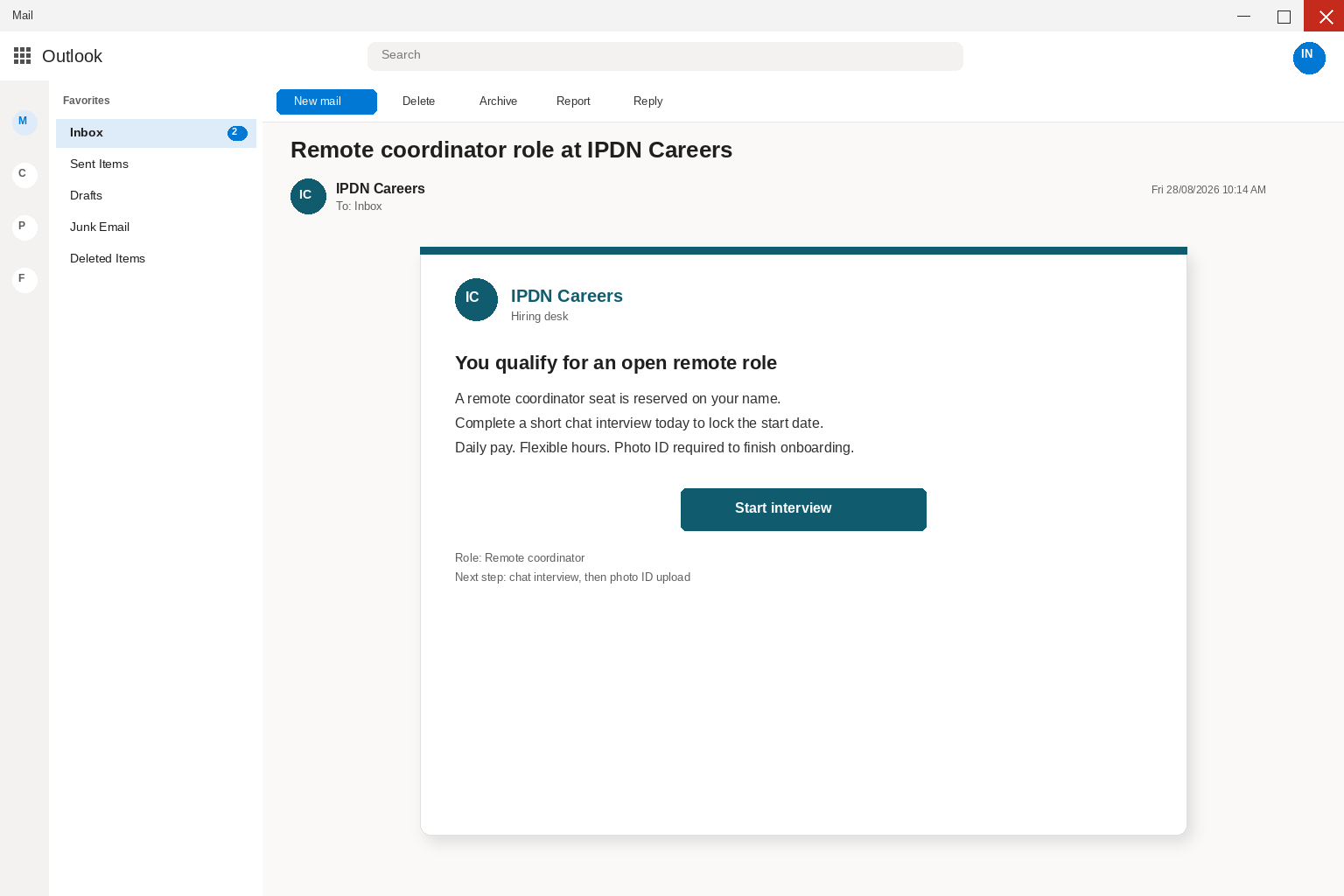
The channel is part of the costume. SMS looks like a short system note. WhatsApp looks like a person. Email looks like a portal notice with a Start interview button. All three can carry the same script. The script does not get safer because it arrives in a thread you already use to talk to family. A chat app is not a background-check office. A blue button in a mail card is not a calendar hold.
Daily pay is the bait that keeps people from hanging up. It sounds like relief, not like a contract. It also sounds like a reason to move fast, because a daily rate can be pulled if you “miss onboarding.” That hurry is the point. A role that pays every day and still needs your passport before it will tell you the manager’s last name is not protecting payroll. It is protecting the window in which you will still upload.
Vague titles do the same work. Remote coordinator. Operations assistant. Data clerk. Community liaison. The words are wide enough that anyone who has ever filled a form can picture themselves in the seat. They are also wide enough that you cannot check a public req and see a matching posting. If the title cannot be found without the chat, the title is decoration.
Unverified reply domains sit under that decoration. The display name can say IPDN Careers while the reply path is a free mailbox, a lookalike, or a number that will not survive the weekend. You do not need to collect that path. You need to stop treating the display name as a badge. Anyone can set a From line. Anyone can set a WhatsApp profile photo. The FTC’s phishing advice is to type a site you already trust, or call a number you already have, instead of letting the message choose the next page.
A real ticker is doing the costume
Professional Diversity Network, Inc. trades on NASDAQ as IPDN. It is a Chicago company. That fact is why the lure works. A ticker you can look up feels like a building. A diversity-hiring name feels like a program that might reach people who do not live inside a corporate campus. The costume does not need to tour that company’s products. It only needs you to believe a public firm would text a stranger a remote seat and then ask for a license photo in a chat.
The real network is not the sender of a random job text. Impersonation is cheap. The name is public. The ticker is public. A scammer does not need a contract with that firm to put those letters on a prepaid SIM. They need the letters because the letters already did the trust work. You are not being recruited by a listing on an exchange. You are being recruited by someone who counted on you to stop at the name.
If you want to know whether that Chicago company even listed a role, do not tap the text. Open a browser you already use and type the address yourself. The page you want is the official IPDN site. The host you should see is ipdnusa.com. Arrive there by typing. Do not arrive there through a button in a stranger’s card, and do not treat a chat portal they paste as a substitute for that check.
A type-it-yourself check is boring on purpose. Boring is the feature. A real careers path does not expire in ninety minutes. It does not require WhatsApp to “unlock” an application you never started. It does not hide the hiring manager behind a Start interview control that only works if you keep the chat open. If the only way to see the role is to stay inside the stranger’s thread, you are not looking at a role. You are looking at their funnel.
Do not write to investor relations from the lure and ask them to bless the text. Do not forward the chat to a help desk the lure itself named. Those paths can be part of the costume. If you feel you must ask the real firm anything, use a channel you found without the text. Even then, the faster tell is already in your hand. A public company does not hire by surprise SMS and a photo of your passport.
The chat is the interview
A chat window is a poor place to hire and a good place to rush. There is no waiting room. There is no calendar hold another person can see. There is a typing bubble and a script. The script asks easy questions first. Your city. Your hours. Whether you can start this week. Whether you have a smartphone. Those answers cost you nothing, which is why people give them. They are there to make the later ask feel like one more form field.
An instant offer is the hinge. No video. No panel. No task that would take a real hiring manager time. You are “cleared.” You are “a fit.” A start date appears. The message may even congratulate you before it has a last name for you that you did not type yourself. That speed is sold as respect for your time. It is the opposite. It is a way to skip the one step that would break the costume: a live face on a call you scheduled.
Some threads paste a fake portal. A login. A candidate ID. A progress bar that jumps to Onboarding. The portal is not proof. Anyone can stand up a form that says Welcome. The tell is what the form wants. If the next required field is a color photo of a license, a passport, or a Social Security card, the portal is a drop box. If it wants a card number for “equipment,” the portal is a register. Close it. Do not finish the form to “see if it is real.” A fake onboarding page does not become safer because you only wanted to peek.
The interview link in the email card is the same door. Start interview. Continue application. Confirm seat. Those labels sound like a calendar. They often open the chat that will ask for the ID. That is why the button is the trap, not the folder list around it. You are already in mail. A real interview would send a hold you can open in the calendar you already use, from a person you can find without the card. A button that only lives in the lure is not a hold. It is a handoff.
Pressure language keeps the chat from going cold. The seat will be reassigned. The batch closes tonight. Payroll needs the file before Monday. HR cannot move you to the next step without the upload. Each line is a clock. Clocks are how people send a passport they would not send on a calm Tuesday. If the role is real, it will still be there after you close the thread and look the company up yourself. If the role is a trap, the clock is the product.
The ID is the first take
Onboarding is the polite word for harvest. A driver’s license has your face, your address, your date of birth, and a number a thief can reuse. A passport page has more. A Social Security number is a key to credit, tax refunds, and accounts you have not opened yet. A tax ID in a chat is not payroll setup. It is a file they can keep after the job evaporates.
The ask is dressed as compliance. Background check. I-9. Equipment insurance. Bank verification. Diversity onboarding. Those phrases are chosen because they sound like offices you already fear slowing down. A real I-9 happens after you have a job, with a person or a system the employer already uses, not as a JPEG in WhatsApp. A real background check is not a reason to text the front and back of a license to a number you met today.
Once the image leaves your phone, you do not get to unsend it in any way that matters. The chat can be deleted. The file cannot be pulled back from their disk. It can be used to open accounts, to file returns, to pass a know-your-customer check on a wallet or a bank you will never see, or to sell a bundle that still has your face on it next year. That is why the ID is the first prize even when a fee never appears. The fee is optional. The file is not.
Some threads ask for a selfie holding the card. That is not extra professionalism. That is a matching set: face plus document, in one frame, for whoever buys the pack. Some ask for a voided check or a bank login “so payroll can test a deposit.” That is a second key. If you have already sent the license, stop before you send the bank. The first file is already too much. The second file is how they spend it.
Do not send a second photo to “correct” a blurry first one. Do not send a different ID because they said the first state was not accepted. Do not send a utility bill because they said the address had to match. Each extra file is a cleaner record. The story will stay helpful. HR is picky. Compliance is strict. The batch cannot move. Helpful is how the folder fills.
A fee is the second take
After the ID, or sometimes instead of it, a bill appears. Training. Certification. A background-check fee they cannot “advance.” A laptop kit. A software key. A deposit to “activate” payroll. Gift cards. A crypto transfer because the “vendor” is overseas. The story is always that this is how the first paycheck gets unlocked. The story is a lie. A job that charges you to start is not a job. It is a sale.
The other money trick is a check that looks like a win. They send a signing bonus, an equipment allowance, or a client refund you are told to deposit. Then they ask you to buy gear from their seller, or to wire the leftover to a “logistics partner.” The check later bounces. The money you sent does not. That pattern is old. It still works because the deposit hits before the bank’s warning does, and because the chat is already calling you a new hire.
You do not need a dollar figure from someone else’s case to know the shape. Any pay-to-work step is the tell. Any request to move money that arrived as a “bonus.” Any demand for a card number so they can “order your kit.” The FTC job scam page treats those asks as the moment the costume should fall. A real employer pays you. They do not invoice you for the privilege of being hired, and they do not use your checking account as a pass-through.
Crypto and gift cards are worse because they are built to be final. A chat that will only take those rails is not working around a payroll glitch. It is choosing a rail you cannot reverse. If they also want the ID, they are stacking prizes: a payment they can keep, and a file they can reuse when the payment is done. That stack is why a “small” training fee is never small. It is a test of whether you will also send the license.
If you already paid, the next message will often sound like care. The payment is processing. The kit is delayed. Compliance needs one more file. That is not a status page. That is a hook to keep you in the thread while they try a second charge or a second upload. Leave. The status you need is at your bank, your card issuer, and, if an ID went with the payment, at the credit bureaus. The chat will not give you that status. It will give you another button.
How The Scam Works
1. An unsolicited job text shows up
A message arrives on a phone that never applied. SMS, WhatsApp, or email. IPDN Careers. A remote title. Daily pay. A start date that is already close. The note talks as if a desk already picked you.
That cold open is the door. A hiring process you did not start does not need to find you first. If the first contact is a surprise text, treat it as a stranger with a costume, not as a pipeline that skipped the line for you.
2. The name copies a real hiring brand
The display name borrows a public company people can look up. Professional Diversity Network is real. The ticker is real. The Chicago office is real. The random text is not that office talking.
The name is there so you will skip the check. Anyone can put those letters on a profile. The costume works because inclusive hiring already sounds like a program that might reach you. The letters are not a badge. They are bait.
3. The interview is a chat window
Reply and the “interview” is typing. Short questions. Fast praise. An offer with no video call and no calendar hold you can open in the tool you already use.
A chat is easy to script and hard to verify. There is no face, no shared meeting, no person you can find in a directory. The window is there to keep you moving until the next ask feels like paperwork, not theft.
4. Onboarding wants your ID
The helpful voice turns into compliance. Upload a driver’s license. A passport page. A Social Security number. Tax IDs. Sometimes a selfie with the card so the pack matches.
That upload is the first harvest. A real I-9 does not live in WhatsApp. A real background check does not need the front and back of a license in the same afternoon you met a stranger. Once the photo leaves, you cannot pull it back.
5. A fee appears before day one
Training, a background-check bill, equipment, or a software key shows up before any work does. Or a check arrives with instructions to deposit it and send a leftover amount along.
Pay-to-work is the second harvest. A job does not invoice you to start, and it does not use your bank as a pass-through. Gift cards and crypto are chosen because they are hard to reverse. The story about unlocking payroll is the costume for that rail.
6. The job never starts
After the file, or after the payment, the seat goes quiet. The portal fails. The number stops answering. The start date slides, then vanishes. There is no manager and no first shift.
Silence is not a delay. It is the end of their use for this thread. They have the ID, the money, or both. You have a chat history and a hole. The role was never going to meet you on Monday.
7. A second crew sells recovery or a new offer
A new name appears later. They can refund the fee. They can restore the ID. They have another remote seat if you verify one more time. Sometimes they even claim to be the platform that will “fix” the first crew.
That follow-up is a second trap, not a help desk. Recovery that asks for more money, more photos, or remote access is another harvest. Hang up. Use the steps below. Do not hire the person who found you through the same wound.
What To Do If You Have Fallen Victim to This Scam
If you only read the text and closed it, you are not finished, but you are not doomed. If you typed in the chat, uploaded an ID, or paid, treat those actions as real and move in this order. Speed helps on money and on credit. Panic does not.
- Stop the thread and keep a copy. Do not send another photo, another code, or another payment. Do not click the next interview link. Screenshot the number, the display name, the date, and what you sent. Then block the chat. You will need those notes for the bank and for a report. You do not need the stranger for a status update.
- If you paid, call the bank or the card issuer the same day. Tell them it was a job lure that billed training, equipment, or a background check, or that you deposited a check and sent money onward. Ask them to reverse what they can and to watch the account. If you used a payment app, freeze that balance too. Gift cards and crypto are often gone. Still report the transfer. Still save the TX or the card numbers. A second “recovery” chat will ask you to send more to unlock the first amount. Do not.
- If an ID, SSN, or tax number went out, treat it as exposed. File at IdentityTheft.gov and follow the plan it builds. Place a fraud alert or a credit freeze with Equifax, Experian, and TransUnion. A freeze is a lock on new credit in your name. It is annoying in a week when you want a card. It is cheaper than a loan you did not take. If a tax ID went with the file, use the IRS identity-theft path the FTC plan points to, not a number from the chat.
- Change passwords on the mail and the bank you used in that thread. Use a browser you open yourself, not a link they pasted. Turn on an authenticator if it was off. If you typed a one-time code because “payroll needed to verify,” assume that code was the key and kill other sessions. If this is a work phone, tell IT. They can pull the device faster than you can guess what the chat installed.
- Report the lure in more than one place. In the United States, forward the SMS to 7726 (SPAM). File at ReportFraud.ftc.gov. If money or an ID moved, add IC3. Forward a copy of a phishing email to reportphishing@apwg.org. Use Report phishing in Outlook if that is where the card arrived. These reports will not refund a gift card. They document the costume so the next text is easier to kill.
- Tell the people who can spend your name. If a license or a passport left, say so to your bank and to anyone who files taxes with you. If the chat asked for a voided check, call that bank even if you did not send the check. If a family member forwarded you the IPDN Careers text, send them the steps above and not the interview button. These lures travel in group chats because they look like help.
- Scan the phone or the PC if you tapped a link or opened a file. A full scan with Malwarebytes or the antivirus you already keep updated is the cleanup for a download. It does not get a license photo back. The freeze and the password change do the identity work. If a page asked you to install a “meeting” add-on, remove it. If a portal asked you to enable remote control so HR could “finish setup,” assume that session was not yours and shut it down.
- Ignore the recovery offer that arrives next. A new crew will sell a refund, a takedown, or a cleaner second job. They found you because the first crew already marked the number. They will want a fee, a fresh ID, or a remote session. Close it. If you need help, use the FTC plan, the bank, and a lawyer or a legal-aid clinic you found without the chat. Do not hire the person who texted you first.
If you sent nothing and paid nothing, still block the number and report the text. That is enough. You do not owe the thread a debate about whether IPDN is a real ticker. The ticker can be real and the text can still be a thief. Those two facts sit next to each other without a problem.
The Bottom Line
An unsolicited IPDN Careers text is not a hiring pipeline. The chat interview is there to take your ID, then a fee, then nothing. Professional Diversity Network is a real Chicago company with a real ticker. The real network is not the sender of a random job text. The costume is the name. The trap is the upload and the bill.
Close the thread. Type the official site yourself if you still want to know whether a role exists. Do not tap Start interview to find out. If you already sent a license or a payment, freeze credit, call the bank, and use the FTC steps above. A second crew will offer to fix it. That offer is the same harvest with a softer subject line.








