

You were already hunting a remote seat when the listing landed. Consulting. Digital nomad. Work from anywhere. Flexible hours. A title wide enough that anyone who has ever run a spreadsheet can picture themselves in it. Apply before the window closes. It sits in the same feed as real postings, which is why it does not look like a stranger selling a classroom.
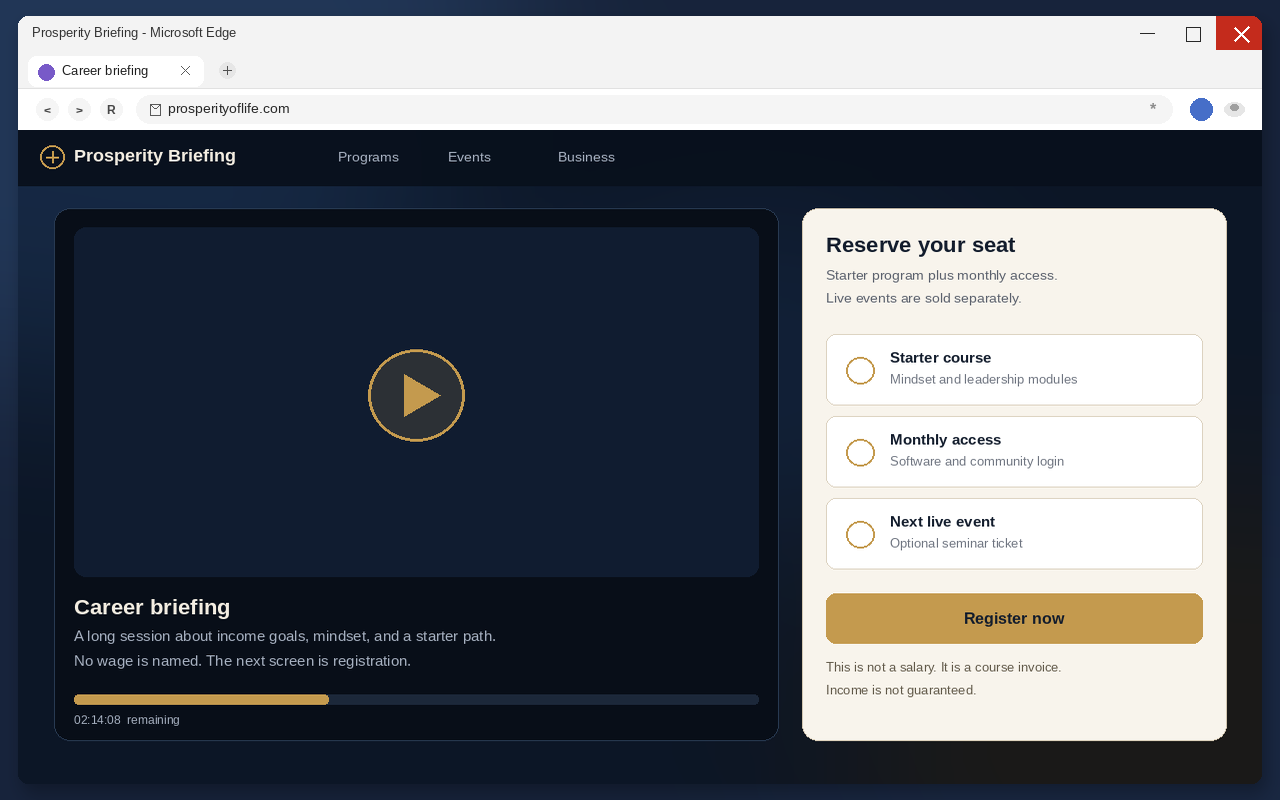
Someone calls. They are warm. They ask what you want to earn this year, not what you shipped last quarter. They talk about mindset, leadership, a life you can design. Then they send homework. A long video. A webinar. A briefing you should finish before the next chat.
There is no offer letter at the end of that tape. There is a registration, a starter course, a monthly software fee. The salary was never the product. The invoice is.

Overview
Prosperity of Life is a real personal-development brand. The legal entity behind it is Polaris Global Marketing LLC, listed in Fountain Hills and Phoenix, Arizona. The company page names Shane Krider, Rachel Krider, and Gregory Strom as founders. The public story is adult education, leadership, mindset, and live events. The sales force is a network of independent distributors who are not employees. That last sentence is the one a job board does not print.
The trap is not a fake storefront with a stolen logo and a checkout that never ships a box. It is a job-ad lure that opens a high-ticket education pitch. You thought you were applying for remote consulting. You were being walked into a course catalog and, often, a distributor seat. The listing did hiring work. The call did sales work. The video did closing work. The invoice is what remains after the wage talk goes quiet.
The company describes itself as digital learning and immersive events. It says customers can buy courses without becoming distributors. It says the offer is not a job, not a salary, not an investment, and not a franchise. It says income is not guaranteed and that loss is possible. The FAQ denies being a traditional MLM and claims associates keep a large share of a sale and do not stock inventory. Report those lines. Then look at what a job seeker actually meets: a LinkedIn or Indeed card that sounds like hiring, a phone or video chat about income goals, and a multi-hour promo that never names a wage.
If you want the company’s own description, type the official Prosperity of Life site yourself. The host you should see is prosperityoflife.com. Arrive there by typing. Do not arrive there through a stranger’s “opportunity” link, and do not treat a distributor’s calendar hold as a substitute for that check. The company page lists 13771 N. Fountain Hills Blvd Suite 618-114, Fountain Hills, AZ 85268. An address on a company page is a mailbox line. It is not proof that the person who called you is on payroll.
Complaints from people who answered those ads describe four-figure courses, monthly software or platform fees, and extra tickets for seminars and destination events. Those are complaint patterns, not an official price list and not a loss table. Do not treat any one invoice as the company’s published catalog. Treat the shape. You came in looking for a paycheck. You were asked to become a student, then a promoter, then a person who buys the next room.
Related prior entities associated with some of the same names drew lawsuits in earlier years, which is history, not a current finding against Prosperity of Life. The present product is education sold through distributors. The present problem for job seekers is simpler than a courtroom. A listing that talks like a hiring manager is a poor place to discover that the “role” is buying a course and then advertising that course to other tired people.
Day to day, after the first invoice, the work described in those reports is not a client book you inherit. It is running ads, booking calls, and walking other applicants through the same video so they buy the same programs. That is why the salary never appears. A wage would make you an employee. A course sale makes you a customer. A later “director” or associate path makes you a salesperson whose inventory is the same education you just paid for.
The listing is bait, not a req
Read the card the way a tired person reads it between two other tabs. Remote consultant. Digital nomad. Flexible hours. Work from anywhere. Training provided. High income potential. A start date that sounds close. Every line is doing the same job. It makes a stranger’s call feel like a desk that already filed you.
A hiring desk you can trust starts from a role you can find without the chat. A public req. A manager with a last name. A wage band, even a wide one. A company page that says “we are hiring” in language a lawyer would keep. These listings skip that. They stay vague on purpose. Consulting can mean anything. Digital nomad is a lifestyle photo, not a job family. If the title cannot be matched to a public opening without the person who called you, the title is decoration.
LinkedIn and Indeed are bulletin boards. Anyone with a credit card and a script can post a remote card that looks like the one next to it. A blue “Easy Apply” button is not a background check. A recruiter photo is not an employee badge. The FTC’s job scam guidance is blunt about ads that promise work and then ask you to pay. The guidance is about the sequence, not about whether a classroom company also exists on paper.
That is why the pitch works on people who would never wire a stranger for a “kit.” Applying for a job feels like logging into a future, not like opening a cart. The listing never has to scream that you will be invoiced. It only has to make Apply feel like collecting a seat. The invoice names the amount later, after the video has already spent two hours on your hope.
People already in a long search are the first audience. If you have sent fifty resumes this month, a warm call feels like relief. People who already did freelance or coaching work are a second audience. A “consulting” card sounds like the work they already know. Friends who forwarded the listing are a third. If a group chat said the remote seat is open, the call sounds like housekeeping. You are not discovering a brand. You are finishing an application someone else already trusted.
The listing spends that maybe. It does not need your portfolio. It needs the hour you will give a stranger because the board looked like work. Once you are on the phone, the job language can thin out. Income goals can thicken. Personal development can take the chair where a manager’s name should have been.
Education is the costume
Mindset is doing sales work. Leadership is doing sales work. Financial independence is doing sales work. Those words are not automatically a con. Plenty of real courses sell them. The costume matters because a classroom feels safer than a booth. You are not being asked, in the first hour, to think like a buyer. You are being asked to feel like a candidate who is being invested in.
Prosperity of Life sells structured programs and live events. The company talks about digital modules, virtual seminars, and destination gatherings. That catalog can be bought by a person who never saw a job ad. The problem is not that education exists. The problem is the door. A door marked Hiring that opens onto a cart is still a cart. The room after the door does not become a payroll office because the wallpaper says transformation.
A real training budget, when an employer has one, is boring on purpose. The company pays. The course sits inside a role you already have. You do not buy your own onboarding to unlock a wage that was never written down. You do not watch a three-hour promo as the interview. You do not get told that belief is the qualification. Belief is a useful feeling for a closer. It is a poor substitute for a contract.
Live events thicken the costume. A seminar in a nice room. A cruise language. A destination that sounds like a reward for people who “did the work.” Complaints describe extra tickets after the first course is already paid. That upsell is not a promotion you earned. It is the next SKU in a catalog you entered through a job board. If the only way to “keep growing” is to buy the next room, you are not in a career ladder. You are in a funnel.
The company can say, correctly on its own terms, that this is education and an optional business. Job seekers are not reading those terms when they tap Easy Apply. They are reading a salary-shaped silence. The costume uses that silence. It lets the call sound like a screen and the video sound like training, right up until the card form loads.
The close is an invoice, not a wage
Listen for the missing sentence. There is no hourly rate. There is no salary band. There is no W-2 talk, no contractor rate, no start date that survives a follow-up email. There is a registration. A starter path. A monthly login. A seat at the next event if you want to “go deeper.” Those are product words. They are doing the work a job offer would have done if this had been a job.
People report four-figure course invoices and recurring fees. Some report another charge for a seminar after they already paid for the first program. Use the figure on your own statement when you talk to a bank. Do not borrow a number from a thread and treat it as the official catalog. The tell is not a specific sticker. The tell is that money is leaving your account before any client, any shift, or any wage has arrived.
Pay-to-start is the hinge. A job does not invoice you to begin. A school can, if you meant to enroll. The harm here is the swap. You were recruited with hiring language. You were closed with student language. If you later “join the business,” you are asked to spend more time putting the same listing in front of other people. That is not a promotion. That is how the funnel reproduces.
The company says loss is possible and income is not guaranteed. Hold that line next to the ad that brought you. An ad that sounded like a remote seat never mentioned a possible loss. It mentioned hours and location and a future. That gap is the trick. The pitch uses a job seeker’s urgency, then hands them a disclaimer written for a customer.
None of this requires you to decide that the classroom is fake. A real company can still use a door that misleads. A real address in Fountain Hills can still sit behind a listing that never should have said hiring. The question for you is narrower. Did you apply for a wage, and did you get a cart? If yes, you are not confused. You are in the mechanism.
How The Pitch Works
1. A remote-job listing shows up
A vague remote card appears on LinkedIn, Indeed, or a similar board. Consulting. Digital nomad. High income. Work from anywhere. The apply button looks like every other apply button you have used this month.
That card is the bait. It is there to get a phone number and a time, not to fill a req you can find on a careers page without the poster.
2. The interview talks about income goals
The call or video chat is warm and long on future talk. What do you want to earn. Are you coachable. Are you willing to grow. Your resume sits at the edge of the table. Your number is in the center.
A screen for a job asks what you have done. A screen for a course asks what you wish. That swap is the tell. You are already being qualified as a buyer.
3. Homework is a long promo video
They send a webinar, a multi-hour briefing, or a “training” you should finish before the next conversation. The tape talks about mindset, leadership, and a life you can design. It does not talk about a wage.
Homework is a closer that runs without the closer in the room. If you sit through it, you have already spent the evening a real interview would have spent on the role.
4. There is no salary
When you ask what the job pays, the answer slides. Residual. Leverage. A business you can build. A lifestyle. No hourly rate. No annual band. No start date that will survive a written follow-up.
That silence is not a negotiation. It is the moment the listing’s costume comes off. There was never a salary to name.
5. The course invoice is the close
Registration, a starter course, and monthly software or platform fees appear. Complaints describe four-figure programs and recurring logins. Use your own statement. Do not treat a thread’s number as official.
This is the product. You are not being onboarded. You are being enrolled. A job does not bill you to begin.
6. The work is selling the same course
If you stay, the day-to-day “role” is running ads and booking calls so other people watch the same video and buy the same programs. You are not given a client list. You are given a funnel.
That loop is why the listing had to sound like hiring. Hiring language is how new buyers are found. The work is the listing you already answered.
7. A second pitch sells the next event
After the first invoice, another room appears. A live seminar. A destination event. A higher module. Extra tickets. The first course is framed as incomplete without the next seat.
That upsell is the catalog continuing, not a promotion you earned. Nobody who hired you for a wage needs you to buy a second stage to keep the first shift.
What To Do If a Job Ad Led You Here
If you only watched a video and closed the tab, you are not finished, but you are not doomed. If you paid, shared card details, or started running ads because someone called it a job, treat those actions as real and move in this order. Speed helps on money. Panic does not. Do not buy the next event to “recoup” the first course. Do not recruit a friend so your invoice feels like a business. Those are second payments that feed on the first.
- Stop the next payment. Do not finish a registration that is still open. Do not add monthly software you have not started. Do not buy a seminar ticket because the last chat said the first program is incomplete. Close the tab. This does not move the first charge back. It stops a second one while you are still rattled. Stay off the distributor’s calendar. Do not reload the webinar to see if a wage appeared overnight.
- Call the card issuer the same day if you paid. Ask for a dispute or chargeback on a purchase that was presented as a path into work and delivered as a course or a monthly login. Say the date you were charged and the amount on the statement. Complaints describe four-figure courses and extra event tickets. Use the figure on your own statement, not a number from a forum, when you speak to the bank. If you used a debit card, ask about a point-of-sale dispute. Speed matters more than a perfect script. If a recurring platform fee is already scheduled, cancel it in the issuer app before you argue about the story.
- Save the paper trail. Keep the job listing, the recruiter name, the call notes, the webinar link you already opened, the confirmation email, and the card alert. Export the statement line if the bank app allows it. Those records are what a dispute form can actually use. A feeling that a remote seat turned into school is not a record. Do not return to the listing to capture a prettier picture, and do not ask the person who closed you to “resend the offer letter” so you have something official. They will send another cart.
- File the reports if the ad sold you work. In the United States, file at the FTC fraud report form and read the FTC page on job scams. Say you answered a remote listing and were then invoiced for education. If money moved, add IC3. If the listing is still live, report it through the job board’s official help page, the one you open yourself, not a link the caller pasted. A board is not the company. Taking a misleading card down still helps the next applicant.
- Do not “join the business” to earn the fee back. The recovery story inside this funnel is a distributor seat. Run ads. Book calls. Sell the same course. That path can add monthly fees and more event tickets while you chase a first invoice. It is not a refund. If you already signed something that looks like an associate agreement, take it to a lawyer or a legal-aid clinic you found without the caller. Do not sign a second packet because a chat said your first payment will “unlock” once you are official.
- Watch the card and lock what you reused. Course checkouts sometimes store a number. Watch the next two statements for a second registration, a platform fee, or a charge that uses a similar merchant string. If you typed the same password you use for email or banking, change those logins on a device you trust. If the “interview” asked you to install a meeting add-on or share a screen so they could “finish setup,” remove that add-on and treat the session as not yours.
- Warn the people you forwarded. If the listing hit a family thread, a graduate group, or a job-hunt chat, go back and say the call led to a course invoice, not a wage. One quiet note is worth more than a later apology. Do not paste a new “opportunity” link you found while you were angry. The next card will hope you only remember the lifestyle language and not the sequence that took the last fee.
- Ignore the helper who wants a second card. After a sour close, people offer to refund the course if you pay a processing fee. People need a login to unlock a case ID. People pose as a compliance desk or a recovery firm. They are hunting the same payment a second time. Nobody legitimate needs a second registration to reverse the first. Nobody legitimate needs you to pay them to talk to your own bank. Block them. The dispute you already filed is the official path.
If you typed a card and then backed out before the charge, still watch the statement. Curiosity is not a crime, but a pre-authorization can settle later. If the page asked for a photo of an ID to “verify the associate account,” assume that file can be reused. Do not send a replacement image to anyone who claims they need it to process a refund.
If you only shared a resume and a phone number, treat the inbox as noisy for a while. Job-ad funnels share leads. A second brand can call next week with the same income-goal script and a different classroom name. You do not owe that caller a debate about whether Prosperity of Life is a real company. The company can be real and the listing can still have done hiring work it had no wage to finish. Those two facts sit next to each other without a problem.
Tax and recordkeeping are unglamorous and still worth a calendar reminder. A course fee you did not mean to buy is still a transaction you may need. Keep the statement line with the date you paid. If you use an accountant, send that packet once rather than piecing it together from memory later. Do not pay anyone who promises to turn the receipt into a guaranteed reversal.
Going forward, keep job hunting off the card that pays rent. A virtual card or a one-time number can survive a bad tap. The everyday debit card cannot. Real remote seats, when they are real, will wait for you on a page a company already uses, with a wage you can screenshot and a manager you can find without a webinar. They will not need you to sit through a three-hour promo because a listing said a window was closing.
The Bottom Line
A remote-job listing that opens a Prosperity of Life call is not a hiring pipeline. It is a door into high-ticket personal-development courses and, if you stay, a distributor loop that sells those courses to the next applicant. Polaris Global Marketing LLC is a real Arizona company. The founders are named on a company page. The catalog is education. The listing is still the trick. The salary was never the product.
Type the official site yourself if you still want the company’s own words. Do not tap Apply on a vague consulting card to find out. If you already paid, stop the next charge, call the issuer, save the listing, file the reports, and hang up on anyone selling a refund desk or a bigger event. The wage was never yours. The statement still can be.








