

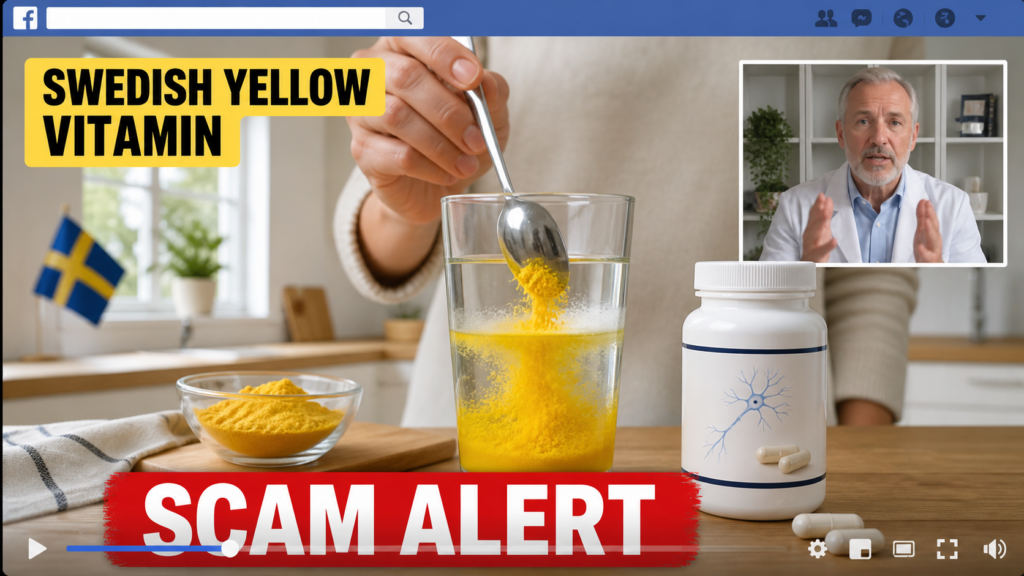
A spoonful of bright yellow powder is mixed into a glass while the narrator promises a forgotten Swedish answer for burning feet, tingling hands, and nighttime nerve pain. The clip feels like the beginning of a practical home recipe.
Keep watching, however, and the promised kitchen discovery quietly turns into something very different.
Overview
What the “Swedish yellow vitamin” story claims
The advertisement suggests that Swedish doctors or researchers identified a yellow vitamin mixture capable of repairing damaged nerves or eliminating neuropathy symptoms. It may show powder, a drink, or a simple preparation that appears inexpensive and easy to make.
The exact ingredient is kept vague. Viewers are encouraged to click or watch a long presentation to discover the secret.
The recipe is a hook for a supplement sale
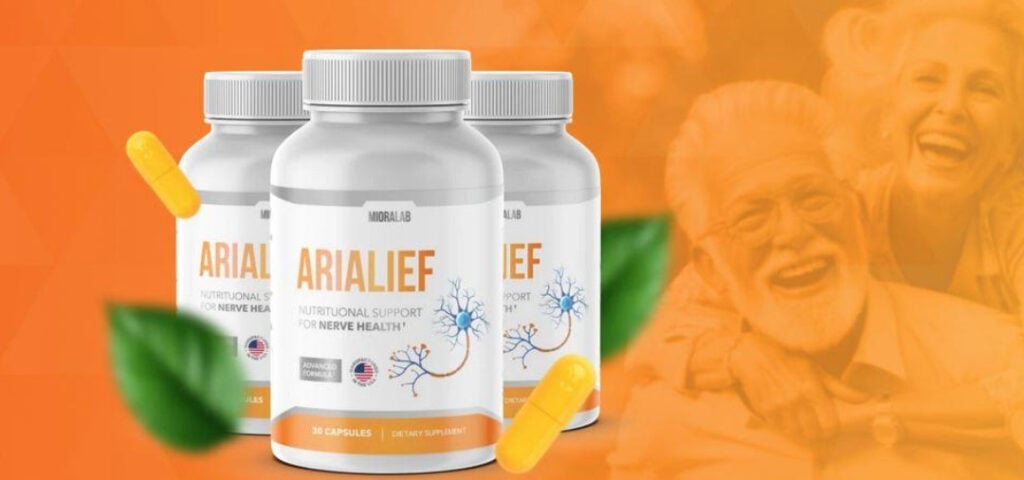
The presentation eventually moves away from the household mixture and toward a branded supplement. Arialief is one product currently associated with the Swedish yellow vitamin story, but the narrative is portable and can be used for another nerve-support bottle.
That change from recipe to capsules is the key. The viewer was promised useful health information, yet the funnel withholds the answer until a proprietary product becomes the solution.
Why people with neuropathy are especially vulnerable
Neuropathy symptoms can be painful, persistent, and difficult to treat. Someone who has tried several approaches may be ready to believe that a simple missing nutrient explains everything.
- The ad offers a single answer for symptoms with many possible causes.
- The Swedish origin story creates borrowed medical authority.
- The powder demonstration is not proof of what is inside the capsules.
- Testimonials create certainty that product-specific trials may not support.
- Package discounts push a larger order before the buyer verifies the seller.
The safest response is not to dismiss every vitamin. It is to demand a real ingredient identity, meaningful dose, reliable evidence, and a diagnosis that explains why that ingredient would help the particular person watching.
There Is No Single Vitamin That Explains Every Neuropathy Case
Peripheral neuropathy is a broad term for conditions involving damage to nerves outside the brain and spinal cord. Symptoms can include burning, tingling, numbness, weakness, altered temperature sensation, and pain from light touch.
According to the National Institute of Neurological Disorders and Stroke, possible causes include diabetes, injuries, autoimmune diseases, kidney or liver disorders, infections, medication effects, toxins, and nutritional imbalances. Vitamin B12 deficiency can contribute to neuropathy, while too much vitamin B6 can also damage nerves.
That is why blindly adding a “yellow vitamin” can be the wrong response. A deficiency should be identified, and a supplement dose should be chosen with the full medical picture in mind.
The color of a powder tells the viewer almost nothing. Turmeric, B vitamins, coloring agents, and many unrelated ingredients can look yellow. Without a verified label and a clear link between the demonstration and the finished product, the kitchen scene is simply a visual prop.
Claims about Sweden do not solve the evidence problem. If a Swedish university, hospital, or medical team developed a neuropathy treatment, the seller should provide a traceable study, identifiable researchers, and a formulation that matches the product being sold.
How the Scam Works
Step 1: A visually memorable recipe stops the scroll
The campaign begins with bright yellow powder, a spoon, and an ordinary glass. That simple scene makes the offer feel accessible, natural, and less commercial than an obvious supplement advertisement.
The narration connects the mixture with a familiar symptom such as burning feet at night. The viewer immediately wants to know the ingredient.
Step 2: The ad introduces a foreign medical secret
Sweden is used as a credibility shortcut. The story may mention Scandinavian doctors, a hospital discovery, or a vitamin that Americans supposedly overlook.
Specific institutional details are often missing. The viewer hears a country and medical-sounding language, but not a study title, registry number, named research team, or link to an independent publication.
Step 3: The promised answer is delayed
The click leads to a long video or advertorial that repeats the symptoms, criticizes conventional treatment, and tells emotional recovery stories. Each section hints that the recipe is about to be revealed.
Delaying the answer increases commitment. After spending 20 or 30 minutes with the story, a viewer is more likely to accept the final offer.
Step 4: The yellow drink becomes a bottle of capsules
Instead of a clear home recipe, the presentation introduces Arialief or another nerve-support supplement. The seller may say ordinary ingredients are ineffective unless combined in a proprietary ratio.
That is where curiosity turns into commerce. The ad does not prove that the powder shown at the beginning is the product, or that the finished formula repairs nerves.

Step 5: Testimonials supply the missing proof
Reviews may describe feet that stopped burning, restored sleep, better balance, or a return to normal life. The people may be stock models, actors, AI-generated faces, affiliate writers, or unverified customers.
Even a sincere testimonial cannot identify the cause of improvement. Neuropathy symptoms can change, and customers may also be using medication, changing glucose control, or receiving other treatment.
Step 6: Package pricing raises the commitment
The offer may present one bottle as inadequate and a three or six-bottle package as the recommended choice. A lower per-bottle figure makes the bundle look economical while increasing the total charge.
Before paying, verify the exact total, number of bottles, shipping, tax, recurring option, and refund conditions. Never assume the largest button represents a medically necessary course.
Step 7: The buyer discovers the real terms after the order
Refunds may require return authorization, tracked shipping, unopened or empty bottles, and action within a set period measured from the purchase date. Support information can differ between the ad, checkout, and receipt.
The advertising focuses on relief. The contract focuses on deadlines. Save both before ordering so the emotional promise cannot erase the legal conditions.
Why Existing Arialief Articles Do Not Make the Story Obsolete
Arialief has been marketed for nerve health for some time, and product-specific warnings already exist. The Swedish yellow vitamin campaign deserves separate attention because the story can outlive that brand.
If advertising pressure forces one product name to disappear, the same powder video can be edited with a new bottle and checkout link. People searching only for “Arialief scam” may miss the new version.
Recognizing the narrative is therefore more useful than memorizing one label. The warning signs are the mystery recipe, unsupported foreign authority, long advertorial, rotating supplement, bundle checkout, and unclear accountability.
Questions the Advertisement Carefully Avoids
A serious medical presentation should identify the yellow ingredient immediately. It should explain why a person might be deficient, how deficiency is tested, what dose was studied, which patients were included, and what risks or interactions were observed.
The viral advertisement does the opposite. It uses the ingredient’s color and supposed origin to create mystery, then spends more time on dramatic recoveries than on a testable formulation.
Ask whether the finished supplement was studied, not whether one ingredient has a research citation. A study about a nutrient’s role in the nervous system does not prove that a multi-ingredient capsule reverses neuropathy.
Ask whether the advertised people had confirmed neuropathy and whether their underlying cause was known. Burning feet can have several explanations, and a story that treats every symptom as the same condition is not medically reliable.
Ask why the recipe cannot be stated plainly. If the purpose were education, the viewer would not need to sit through a long sales video to learn the ingredient. Withholding it until the purchase stage is a marketing tactic.
Also ask whether the label warns about vitamin B6. Excessive B6 exposure is one recognized cause of nerve problems. A product aimed at people with neuropathy should make doses and cumulative exposure easy to evaluate, especially for customers taking other supplements.
Finally, ask for the original Swedish evidence. A country name is not a citation. The seller should be able to identify the institution, researchers, publication, formula, and study population without sending the customer to another affiliate video.
A seller who answers these questions clearly gives the buyer something concrete to evaluate. A seller who responds with another countdown, testimonial, or secret-recipe video is avoiding the evidence that matters.
That distinction is more useful than arguing over whether the powder shown on screen looks real. The appearance of the demonstration is secondary to the missing medical and commercial documentation.
Company, Address, and Fulfillment Checks
The website must name the real legal seller
Find the entity accepting the payment, not only the Arialief brand. Compare the terms, privacy policy, guarantee, checkout, receipt, card descriptor, and label.
If the names do not match, the site should explain the relationship. A shopper should not need to investigate three companies after a refund request has already been denied.
The return location may not be the company behind the product
Search the address and inspect what kind of property it is. Many online supplement brands use fulfillment centers that serve numerous unrelated sellers.
A real warehouse address does not prove that the brand has offices, researchers, or manufacturing at that location. Ask who made the capsules and who has legal responsibility for their quality.
Support details should survive a pre-purchase test
One site associated with the Arialief offer has displayed a customer-service email and an SMS number. Contact details are useful only if the team answers precise questions about the exact product and order.
Before paying, ask whether refills are automatic, what appears on the statement, whether opened bottles must be returned, and which address is authorized. Save the reply.
Missing manufacturing details are a health risk
Look for the complete Supplement Facts panel, dose, warnings, lot number, manufacturer or distributor, country of origin when stated, and adverse-event contact. Do not rely on “natural,” “doctor formulated,” or “FDA registered” language.
Do not claim a product was mass-produced in China without evidence. Be just as strict in the other direction. If the seller does not disclose traceable manufacturing and testing information, do not assume the glossy label represents a verified facility or formula.
What to Do if You Have Fallen Victim to This Scam
- Do not abandon medical evaluation. Contact a doctor if neuropathy is new, worsening, one-sided, associated with weakness, or affecting balance. The underlying cause may require timely treatment.
- Preserve the full funnel. Save the yellow-powder ad, advertorial, claims, product label, checkout, total, guarantee, receipt, support details, and card descriptor.
- Ask the seller for a written resolution. Request cancellation or a refund, state that future shipments are not authorized, and obtain return instructions before mailing anything.
- Contact the payment provider. Explain any misleading medical representation, unauthorized quantity, recurring charge, or refused refund. Ask how to block another merchant charge.
- Keep the bottles and packaging. A refund may require them, and a clinician may need the label or lot number if you experienced a reaction.
- Review every supplement with a professional. Too little of some nutrients can be harmful, but too much of others can also damage nerves. Bring a complete list of medications and supplements.
- Check the device used to order. If the funnel opened suspicious downloads or browser alerts, run Malwarebytes and remove unfamiliar extensions and notification permissions.
- Block repeat ad exposure. AdGuard can reduce malicious advertising, redirects, and tracking used to retarget people who visited the first page.
- Report the campaign. Report the social ad, deceptive health claims to the FTC, and any adverse reaction or questionable supplement issue to the FDA.
Frequently Asked Questions
What is the Swedish yellow vitamin?
The ads do not establish one medically recognized ingredient or treatment by that name. “Swedish yellow vitamin” functions mainly as a curiosity hook in the sales story.
Does the yellow powder in the video prove what is in Arialief?
No. A marketing demonstration is not a verified ingredient analysis. Use the actual Supplement Facts panel and independent testing, not color, to identify a formula.
Can a vitamin cure peripheral neuropathy?
A vitamin deficiency can contribute to some neuropathies, but causes vary widely. Treatment depends on diagnosis, and excessive doses of certain vitamins can also be harmful.
Is Arialief the only product sold with this story?
It is a current example, not necessarily the last. The recipe narrative can be reused with a different supplement name, which is why the story itself matters.
Are the customer reviews reliable?
Reviews inside the seller’s funnel are not independent evidence. Look for verifiable purchasers, detailed billing experiences, consistent support information, and clinical evidence on the finished product.
What should I do before trying a nerve supplement?
Ask a healthcare professional to evaluate the cause of the symptoms and review the exact ingredient panel, dose, medications, and health conditions. Do not buy because a foreign origin story sounds scientific.
The Bottom Line
The Swedish yellow vitamin neuropathy story turns a memorable kitchen image into a supplement sale. The foreign medical secret, delayed recipe, testimonials, and bundle offer create persuasion without proving that the product repairs nerves.
Remember the story, because the bottle can change. A real answer should survive questions about diagnosis, ingredients, evidence, manufacturer, price, and support without hiding behind a spoonful of yellow powder.








