

A remote job appears to solve a familiar problem. The work is simple, training starts immediately, and each click makes the balance on a polished dashboard grow.
Then one special task turns the account negative. The worker is told to deposit crypto, finish the set, and withdraw everything, but every rescue payment creates a deeper hole.
Overview
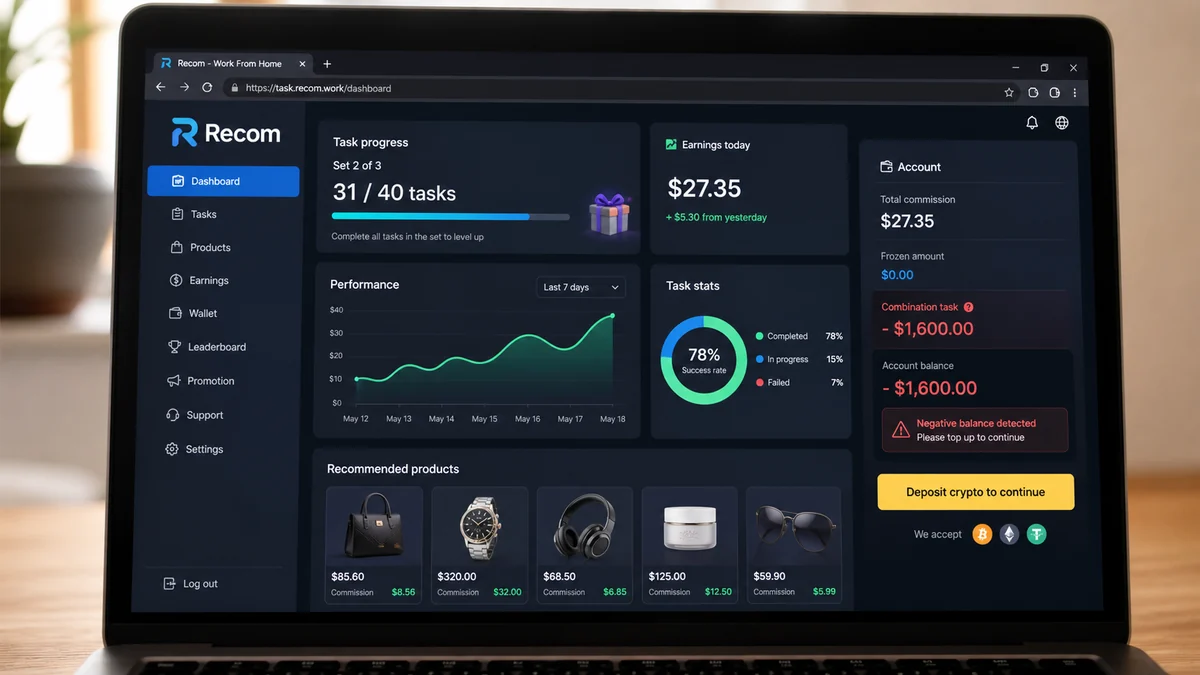
The reported job became a 1,600 deposit demand
A detailed consumer report described a remote “Recom” role found after job-search activity on LinkedIn and Indeed. A trainer and group chat guided the applicant through sets of 40 product-boosting tasks.
The worker reportedly began with 10 and watched supposed commissions appear. A combination or package task then pushed the dashboard into a negative balance. The worker deposited enough crypto to cover about 1,600.
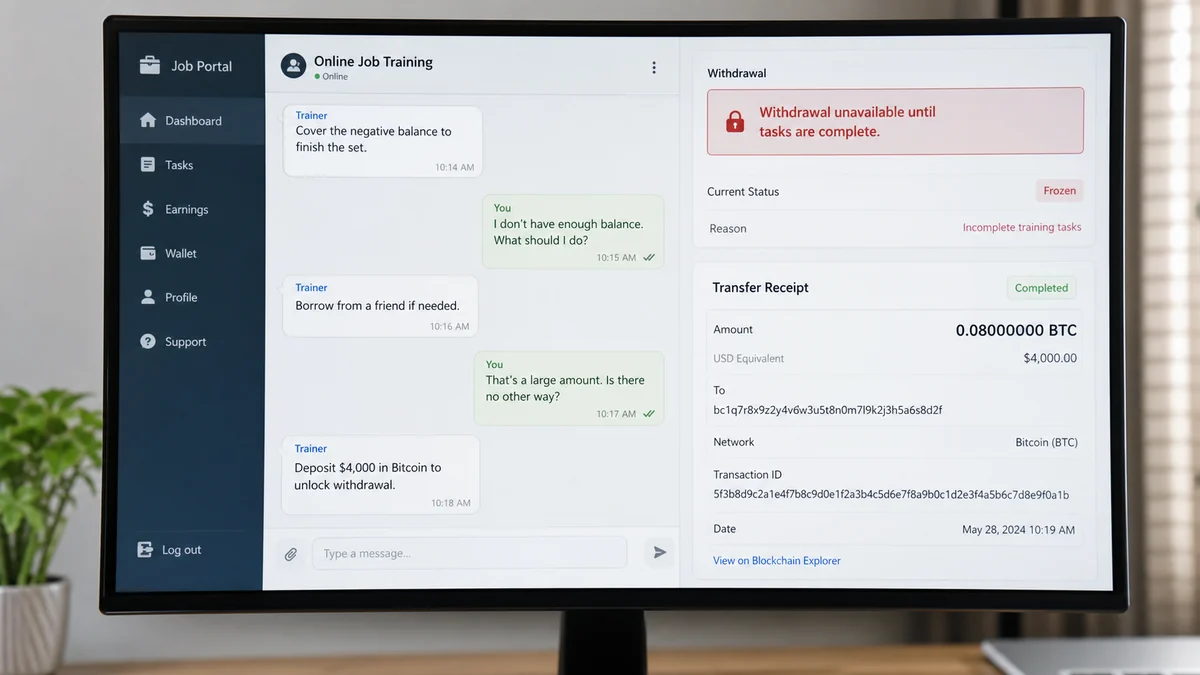
Instead of unlocking the promised withdrawal, another task reportedly created a negative balance near 4,000. The trainer encouraged borrowing money to continue. That is the moment the fake job becomes unmistakable: the employee is paying the employer, and the amount required has no fixed limit.
The earnings are interface graphics, not money
A task platform can display any balance its operator chooses. Commissions, bonuses, VIP levels, frozen amounts, and successful withdrawals inside the dashboard are not proof that funds exist.
The real transaction moves in the opposite direction. The victim buys cryptocurrency and sends it to an address controlled by the scam. The platform may add a matching number to the on-screen balance, but it does not place recoverable money in the worker’s account.
When withdrawal depends on another deposit, there is no employment relationship. The dashboard is a pressure mechanism designed to turn real crypto into fake earnings.
Recom domains can change while the script stays the same
The Reddit report identifies recom-lab.com. Third-party registration data says that domain was created on June 5, 2026, only a short time before complaints appeared.
A BBB Scam Tracker report says the operation later used recomhub.co and describes recom-lab.com as the previous site. Domain rotation is common in task scams because a new address can replace one that has accumulated warnings.
Before accepting a product-boosting job, check:
- Did a recruiter contact you unexpectedly through text or WhatsApp?
- Is the role absent from the real company’s careers page?
- Does the job consist mainly of clicking “optimize” or “boost”?
- Are commissions visible only inside a private dashboard?
- Must you deposit money to begin or continue work?
- Does a combination task create a surprise negative balance?
- Are payments required in cryptocurrency?
- Can you withdraw without paying tax, verification, or unlock fees?
- Does the trainer encourage loans or borrowing?
Why Product Boosting Feels Like Real Digital Work
Online stores do pay for advertising, analytics, search optimization, merchandising, and user research. Scammers borrow those legitimate concepts and reduce them to a button anyone can click.
The job is intentionally easy. A victim does not need an interview, references, training history, or specialized skill. The fast acceptance feels encouraging to someone who has been submitting applications without replies.
A trainer provides personal attention. They explain the dashboard, celebrate early commissions, and answer questions quickly. That relationship makes the platform feel staffed and accountable.
Group chats add social proof. Other “workers” post withdrawals, congratulate promotions, and describe how borrowing allowed them to complete a difficult package. Those participants may be accomplices or controlled accounts.
Gamification keeps the victim moving. Task counters, consecutive sets, bonuses, VIP tiers, and progress bars create a desire to finish. Stopping at 31 of 40 feels like abandoning nearly completed work.
The scam also exploits normal account language. A negative balance resembles an overdraft or inventory cost, even though an employee should never need to fund a merchant’s customer orders.
A small initial withdrawal may be permitted. Losing 10 or 20 to gain a victim’s trust can be profitable if the next package extracts hundreds or thousands.
The essential test is simple: real employers pay workers. They do not require employees to send crypto to restore an account balance before wages can be withdrawn.
How the Recom Task Scam Works
Step 1: The recruiter intercepts a job seeker
The approach may arrive after the victim applied on a real job board, making it seem connected to a legitimate application. The recruiter can mention LinkedIn, Indeed, a staffing agency, or a known employer.
The conversation quickly moves to WhatsApp, Telegram, text, or another private channel where the platform has less visibility.
Step 2: A trainer demonstrates simple tasks
The worker creates an account on a website and clicks through product cards. The activity is called boosting, optimization, rating, data generation, or improving product exposure.
No meaningful marketing service is explained. The dashboard supplies the appearance of productivity.
Step 3: Small commissions create belief
Each click adds a number to the account. The trainer may fund a practice account or permit a small withdrawal so the victim sees a real payment.
That early success becomes the answer to later doubts: “You already withdrew once, so the system works.”
Step 4: The worker deposits personal funds
The platform says a minimum balance is required to receive tasks. The worker sends crypto to a wallet address supplied in chat or on the dashboard.
The site credits the internal balance immediately, making the transfer feel reversible even though the blockchain payment is already final.
Step 5: A combination task creates a deficit
An expensive product bundle appears late in a task set. Its value exceeds the on-screen balance, which becomes negative.
The task cannot be skipped or canceled. Support says the worker must deposit the difference before completing the remaining clicks.
Step 6: Sunk-cost pressure forces a rescue payment
The victim sees existing deposits and commissions frozen behind the unfinished task. Sending 1,600 feels like the only way to recover a larger displayed total.
The trainer calls the event lucky because combination tasks supposedly pay a higher commission. A loss is reframed as a rare opportunity.
Step 7: Another deficit appears
After the victim covers one negative balance, the system produces another larger package. The reported Recom case escalated toward 4,000.
The supposed randomness is controlled by the operator. There is no auditable reason the next task cannot demand 8,000 or more.
Step 8: Withdrawal grows new conditions
If the victim completes the set, support may invent tax, verification, anti-money-laundering, credit-score, VIP, or liquidity requirements.
None is deducted from the displayed earnings. Every obstacle demands fresh external money because deposits are the scam’s only real revenue.
The Dashboard Is a Closed Accounting System
A legitimate balance can be reconciled against a bank, regulated custodian, payroll record, or blockchain address controlled by the account owner. The task platform’s number has no such independent backing.
The operator controls task values, commissions, deficits, withdrawal status, and support responses. It can increase a balance to make the victim feel wealthy and freeze it the moment withdrawal is requested.
Do not calculate whether the next deposit is rational based on the dashboard total. The total is not an asset until it reaches an account or wallet you control without a further payment.
A transaction hash proves that crypto moved. It does not prove that the receiving wallet belongs to a real employer or that the platform owes the sender a withdrawal.
The group chat is part of the same closed system. Screenshots from other workers may show balances created by the operator. Even a real small withdrawal can be marketing spend for the fraud.
Combination tasks are presented as random, but victims have no access to the algorithm, product order, merchant, or actual advertising outcome. The result appears exactly when it is most effective for extracting more money.
A negative task balance is not a debt to a merchant. The worker did not buy inventory, sign a loan, or receive the product. It is a number created by the site.
Threats that the balance will hurt credit or create legal liability are designed to prolong payment. An anonymous task portal cannot create a legitimate debt merely by displaying a minus sign.
What Government Warnings Say About Task Scams
The Federal Trade Commission’s task scam warning describes unexpected job messages offering optimization or product-boosting work. It says the displayed commissions are fake and that scammers demand crypto deposits to unlock tasks or earnings.
The FTC also notes that some operators send a small payment, often between 5 and 20, to build trust. That explains why one successful withdrawal does not validate the job.
The FBI’s work-from-home scam advisory describes simple rating or optimization tasks, confusing compensation, crypto payments, and fake interfaces that show unavailable earnings.
Its red flags include an employer requiring cryptocurrency payments, the use of “optimization,” and the absence of normal references. The Recom account contains all three elements.
Both agencies give the same core advice: never pay an employer to get paid. A real employer may require lawful payroll documents, but it does not demand a worker-funded crypto balance.
Be careful with job-board attribution. A scammer saying “we found you on LinkedIn” does not prove the platform shared the lead or endorsed the role. Resumes, public profiles, breached data, and mass messages can all provide the context.
Verify the job on the employer’s official careers page. Contact human resources through a number or domain you find independently and ask whether the recruiter and role exist.
Do not let a trainer rush that check. A legitimate recruiter will not withdraw an offer because a candidate verifies the company before sending financial information.
Domain Rotation Makes Name Searches Less Reliable
The name “Recom” is short and generic. Search results may include unrelated legitimate businesses, products, laboratories, and recommendation services. Their existence does not validate recom-lab.com.
Search the exact domain, not only the brand. Include the phone number, WhatsApp number, recruiter name, wallet address, and wording used in the task instructions.
Third-party domain data places recom-lab.com creation on June 5, 2026. A very recent domain cannot support claims of years of successful employment unless the operator documents a prior web presence.
The BBB Scam Tracker has a victim-submitted report saying Recom later used recomhub.co. Treat that as a reported connection, not an official corporate finding. The important lesson is that one operation can move faster than search warnings.
When a domain disappears, do not interpret the outage as proof that your account is being upgraded. Preserve the address and report it. Scammers may contact victims with a replacement link and claim the balance migrated.
A new domain showing the same balance does not mean funds moved. The operator can copy the database or simply reproduce the number.
Browser padlocks are not company verification. HTTPS encrypts the connection to the site; it does not guarantee honest employment or recoverable deposits.
Do not install a mobile app or configuration profile merely because the website changes. A disappearing domain is a reason to stop, not to grant the operation deeper device access.
Company, Address, and Fulfillment Checks
Find the employer’s exact legal identity
Ask for the company name, registration number, jurisdiction, physical address, official domain, and hiring manager. Verify them in government records and through an established careers page.
Do not merge an anonymous “Recom” portal with an unrelated legitimate business that uses a similar name.
Check the recruiter through the real company
Contact human resources using an address or number from the official corporate site. Ask whether the recruiter, WhatsApp number, role, and task platform are authorized.
A recruiter who refuses email from a corporate domain or skips every normal interview step has not established authority.
Inspect the domain and payment recipient
Compare domain creation with the claimed company history. Search the exact wallet addresses on a block explorer and preserve transaction hashes.
Crypto sent to unrelated or frequently changing wallets is not payroll funding. The worker has no control over those addresses.
Real job fulfillment runs from employer to worker
A legitimate employer defines work, verifies completion, and pays wages through documented payroll or contractor invoicing. It does not create a negative task balance that the worker must finance.
If earnings cannot be withdrawn without another personal payment, no wage has been fulfilled.
Warning Signs in a Product Boosting Job
- An unexpected recruiter references a real job board but cannot identify your application.
- The interview happens only through text or WhatsApp.
- The role requires no relevant experience or references.
- Work consists of repetitive clicking, boosting, or optimization.
- A private dashboard creates instant commissions.
- The trainer permits a small early withdrawal.
- You must deposit your own money to receive tasks.
- Cryptocurrency is the required payment method.
- A combination task creates a surprise negative balance.
- The current set cannot be canceled or skipped.
- The trainer encourages borrowing from friends or lenders.
- Withdrawal requires new taxes, verification, or liquidity deposits.
- The domain is very new or changes during the job.
- Group members pressure doubters and celebrate large deposits.
MalwareTips’ order optimization job investigation explains the broader task-commission pattern. Recom is one name attached to a script that can be rebuilt under many brands and domains.
The safest filter is independent of the name: never send money to an employer to unlock work or withdraw earnings.
What to Do if You Have Fallen Victim to This Scam
- Stop all deposits. Do not finish the set, cover the new deficit, pay tax, upgrade VIP status, or fund a withdrawal review.
- Do not borrow to rescue the dashboard balance. The displayed earnings are controlled by the scammer and do not become more real when you add debt.
- Preserve the evidence. Save recruiter messages, group chats, domains, task screens, wallet addresses, transaction hashes, account IDs, phone numbers, and instructions.
- Contact the crypto exchange immediately. Report the transfer as fraud, provide the destination and hashes, and ask what account or law-enforcement information it needs.
- Report to the FBI and FTC. File at IC3.gov and ReportFraud.ftc.gov. Include every transaction and replacement domain.
- Notify the impersonated company or job board. Use official support channels. Make clear which domain and recruiter contacted you.
- Secure exposed accounts. Change reused passwords, revoke sessions, enable strong multifactor authentication, and review email forwarding rules.
- Protect identity information. If you shared a driver’s license, tax form, bank details, or Social Security number, follow the recovery plan at IdentityTheft.gov.
- Do not delete the wallet app or transaction history. Preserve records needed for reports, but disconnect suspicious sites and revoke risky token approvals.
- Reject recovery offers. Anyone promising guaranteed crypto recovery for an upfront payment is likely running a second scam.
- Scan affected devices. Run a full Malwarebytes scan if the recruiter supplied an app, extension, installer, archive, or remote-access tool.
- Block malicious infrastructure. AdGuard can reduce exposure to known phishing and malware domains used in follow-up messages. It cannot reverse a blockchain transfer.
Frequently Asked Questions
Is product boosting a real job?
Legitimate digital marketing exists, but a job that pays for repetitive clicks and requires worker-funded crypto deposits matches the task scam pattern described by the FTC and FBI.
Why did the platform let me withdraw once?
A small payment can buy trust. The scammer may spend 10 or 20 to persuade a victim to deposit hundreds or thousands later.
Do I owe the negative task balance?
A minus sign on an anonymous dashboard does not create a legitimate debt. Do not pay it. Preserve the screen and report the operation.
Will completing all 40 tasks unlock my money?
There is no reliable reason to believe it will. The operator controls both the task sequence and withdrawal conditions and can create another deficit at any time.
Can cryptocurrency sent to Recom be recovered?
Recovery is difficult and never guaranteed. Report immediately to the exchange and law enforcement, and do not pay a private recovery agent upfront.
Is recom-lab.com the only domain involved?
No. A victim report links the operation to recomhub.co after recom-lab.com. Focus on the scheme, wallets, recruiters, and payment demands rather than trusting a new domain name.
The Bottom Line
The Recom Task Scam turns a job search into a ladder of crypto deposits. Product boosting, combination tasks, and negative balances are interface tricks that make the victim finance imaginary work.
Real employers pay you. The moment a trainer says you must borrow or send Bitcoin to unlock wages, stop, preserve every transaction, and report the operation before the domain changes again.








