

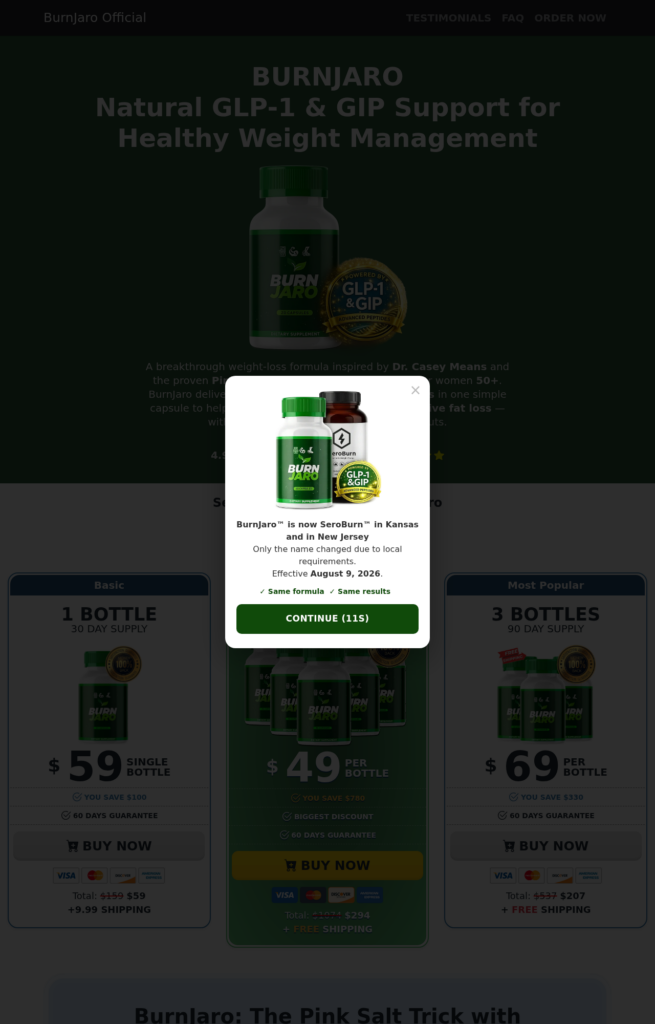
SeroBurn looks like a familiar weight loss offer until one small popup gives away the larger story: another supplement, BurnJaro, is now SeroBurn in two states, with the “same formula” and “same results.”
That message turns a routine product review into a question of identity. Which bottle is current, which website is official, and which company stands behind the guarantee?
We checked the live pages, terms, pricing, clones, and rebrand trail.
Overview
What SeroBurn Is Supposed to Do
SeroBurn is marketed as a dietary supplement that supports weight management by addressing serotonin, cravings, appetite, mood, sleep, and metabolism. The sales story suggests that low serotonin makes weight loss unusually difficult and that the formula can restore balance.
The current official offer sells two bottles for $158, three for $207, or six for $294. It advertises a 60-day guarantee and identifies ClickBank as the retailer.
The live page says purchases are one-time and do not require a subscription. We found marketing-email and recurring-text consent language in the privacy terms, but that is not the same as automatic product refills.
Why the Rebrand and Clone Network Matters
A popup on burnjaro.pro says BurnJaro is now SeroBurn in Kansas and New Jersey, effective August 9, 2026, while promising the same formula and results. The wording is unusual because a national supplement rebrand normally does not need a state-specific announcement on an old product domain.
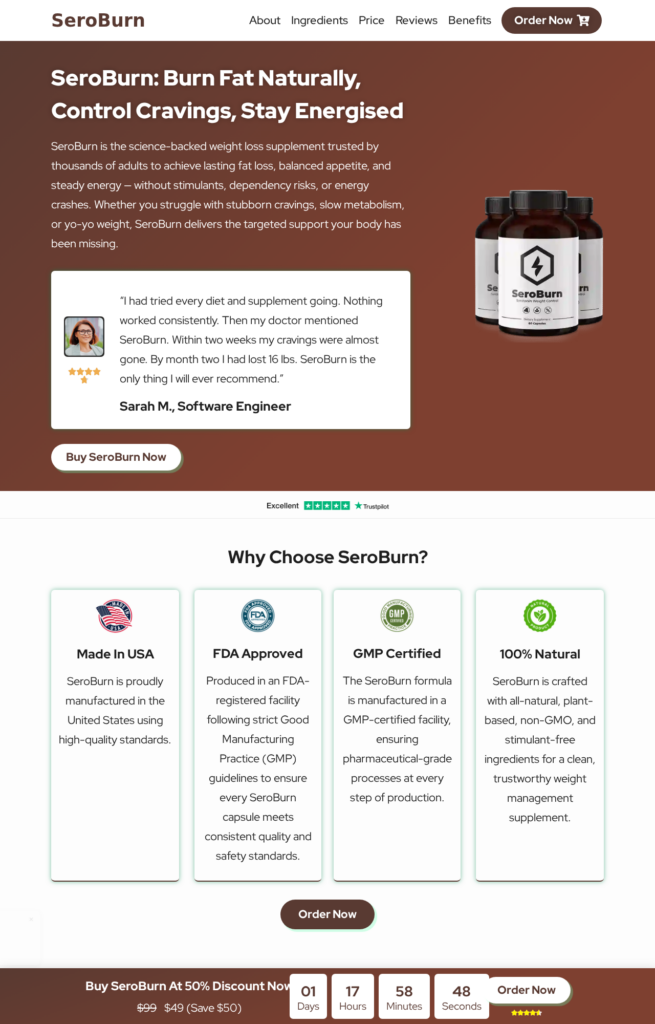
We also found saroburn.com, a lookalike domain using the SeroBurn name but describing a different ingredient blend, different package prices, different badges, and a different presentation.
A third variant, serro-burn.com, has advertised contradictory 90-day and 180-day guarantee language. Similar domains do not prove common ownership, but they make it difficult for buyers to know which seller, formula, and refund policy they are accepting.
Our Verdict on SeroBurn
We recommend avoiding SeroBurn offers until the brand can provide one authoritative domain, one consistent label, one legal seller identity, and evidence for the finished formula’s weight loss claims.
The ClickBank disclosure and published support number are useful. They do not resolve the BurnJaro rebrand, clone pages, template errors, mixed retailer references, unsupported serotonin story, or inconsistent business details.
The most important warning signs are:
- BurnJaro is publicly presented as becoming SeroBurn.
- Lookalike domains use different formulas and prices.
- The official page contains unfinished template placeholders.
- Legal text mixes ClickBank, BuyGoods, and Digistore24 references.
- Marketing copy switches between weight loss and brain-health language.
- Contact numbers differ across pages and promotional coverage.
The SeroBurn Website Looks Like a Reused Sales Template
Visible Placeholders Were Never Replaced
The official page contains template remnants such as “{domain}” where a real website address should appear. That tells visitors the legal and support copy was not fully reviewed before publication.
A placeholder does not prove the capsules are fake, but it matters on a page collecting payment and making health claims. If the seller did not finish the public terms, buyers cannot assume the invisible operational details are accurate.
Template errors also make it easier for affiliates and copycat sites to reproduce the same offer under slightly different names.
The Legal Text Names Multiple Retail Systems
The main disclosure identifies ClickBank as the retailer. Elsewhere, the terms include references associated with BuyGoods and Digistore24, including text that does not fit the visible checkout.
Those platforms are separate companies with their own order and refund systems. A buyer needs to know which one processed the actual payment rather than guessing from a footer copied across templates.
The order confirmation and card descriptor should be treated as authoritative for support. A generic policy page that names three retailers cannot replace them.
The Page Drifts Into Unrelated Product Copy
Sections of the page refer to brain health even though SeroBurn is presented as a weight management supplement. Other wording changes “SeroBurn” to “SeroLean,” another sign that content was reused without careful editing.
The product also promoted an August 2025 contest long after that date. Old urgency and unrelated claims weaken confidence that the live terms are maintained.
For a supplement, sloppy copy is more than cosmetic. It can leave buyers unsure which formula, serving direction, warning, or guarantee applies.
The BurnJaro Rebrand Is Not Properly Explained
The BurnJaro popup says customers in Kansas and New Jersey will see SeroBurn branding while receiving the same formula, quality, and results. It does not clearly explain why the change is limited to those states.
The notice does not identify a corporate acquisition, trademark issue, regulatory change, or revised label. It simply asks customers to accept that two brand names represent the same product.
That matters because a buyer searching a card charge, adverse event, or refund may encounter the old name while holding the new bottle. Save the popup and confirmation if your order crosses the two brands.
The Serotonin Weight Loss Story Is Not Finished-Product Evidence
A Complex Condition Is Reduced to One Chemical
SeroBurn marketing presents serotonin imbalance as an overlooked root cause of weight gain. The idea is emotionally appealing because it reframes cravings and failed diets as a hidden biological block.
Body weight is influenced by many factors, including diet, activity, sleep, medication, endocrine conditions, mental health, genetics, and environment. A simple serotonin narrative cannot diagnose an individual shopper.
The site does not present a controlled human trial showing that the finished SeroBurn formula causes the advertised weight loss through the claimed mechanism.
Testimonials Make the Outcome Feel Predictable
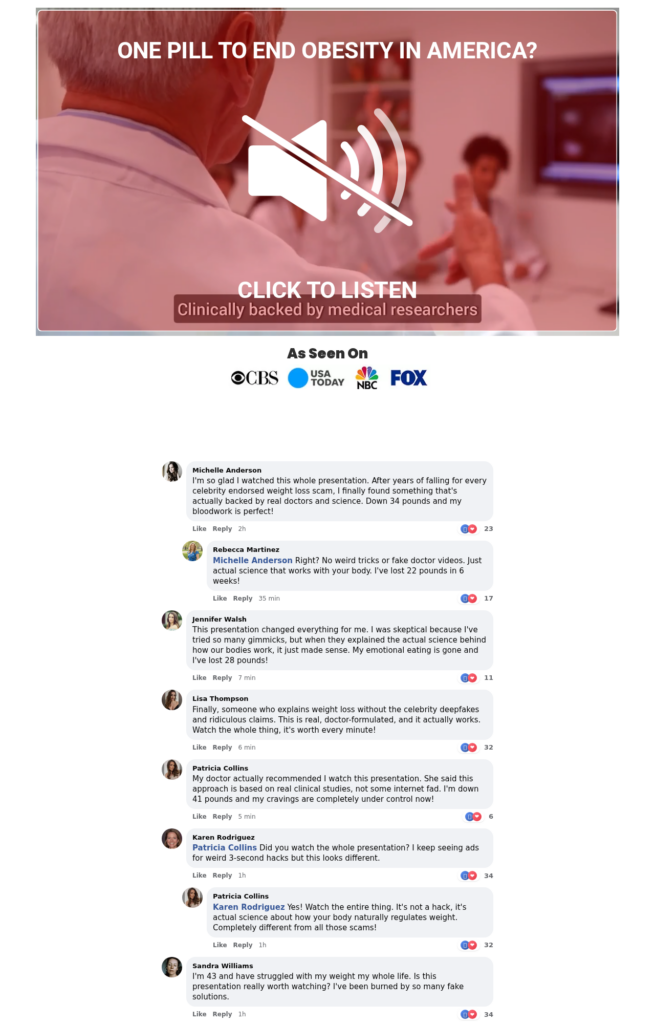
The page uses video comments, customer stories, and television network logos to make the offer feel popular and covered by major media. It does not establish that CBS, NBC, Fox, or USA Today reviewed or endorsed the product.
Seller-selected testimonials cannot show what a typical buyer should expect. They rarely disclose concurrent diet changes, exercise, medication, starting weight, or how the customer was selected.
A meaningful claim requires evidence about the exact product, not a row of logos and enthusiastic comments beneath a sales video.
“Natural” Does Not Resolve Interaction Risk
Different SeroBurn pages describe different ingredients. The saroburn.com clone highlights chromium, L-carnitine, and BioPerine, while other versions use a different formula story.
Consumers cannot evaluate safety when the authoritative formula is unclear. Even common supplement ingredients can interact with medication or be inappropriate for pregnancy, surgery, diabetes, mood treatment, or other conditions.
Use the physical Supplement Facts panel and consult a pharmacist. Do not assume that a formula on one SeroBurn domain matches a bottle purchased through another.
The Clone Uses Different Prices and Trust Signals
Saroburn.com advertises two bottles at $69 each, three at $79 each, and six at $49 each. That does not match the official page’s current two-bottle $158, three-bottle $207, and six-bottle $294 structure.
The clone displays a Trustpilot-style rating and an “FDA Approved” badge without providing a verifiable basis that the finished product is FDA approved. Dietary supplements are not FDA approved as weight loss treatments.
When two pages use the same brand but disagree about formula, price, and certification, shoppers cannot safely mix their claims or refund terms.
How the SeroBurn Scam Works
Step 1: A Weight Loss Ad Introduces a Hidden Cause
The funnel begins with a video about cravings, mood, nighttime eating, or a metabolism that stopped responding. Serotonin is presented as the missing explanation.
The ad may use testimonials, expert-looking narration, or television-style graphics to make the theory feel medically settled before the product appears.
Step 2: A Long Video Delays the Product and Price
The landing page asks viewers to keep watching through personal stories, simplified science, and warnings about ordinary diets. The delay increases emotional investment.
By the time SeroBurn is named, the viewer has already been taught to interpret cravings and weight as evidence that the formula is needed.
Step 3: Testimonials and Media Logos Supply Social Proof
Comments and familiar media names surround the video. The design suggests that many customers and major outlets have validated the claims.
Without links to genuine coverage, independent review records, or finished-product trials, those elements are marketing, not verification.
Step 4: Bundle Pricing Encourages a Large First Order
The page begins at two bottles for $158, then makes six bottles at $294 the lowest per-bottle price. Free shipping and bonus products strengthen the multi-month option.
The customer is encouraged to commit before learning whether the exact formula suits them or whether the promised serotonin theory applies.
Step 5: The Retailer Handles the Payment
The current official page identifies ClickBank as retailer and provides +1-888-704-1133. Other pages and terms mention different platforms or phone numbers.
Use the receipt to identify the real processor for your order. Do not send payment information or a return to a similarly named site merely because its bottle image looks familiar.
Step 6: Rebrands and Clones Complicate Research
A shopper may start with BurnJaro, receive SeroBurn, and later find Saroburn or Serro-Burn when searching for help. Each page can present different claims and policies.
This fragmentation makes it easier for the marketing story to outlive one brand and harder for complaint history to follow the new name.
Step 7: Refund Rights Depend on the Exact Order
The official offer states a 60-day guarantee and one-time purchase. A clone has used 90-day and 180-day language. Those terms cannot be combined.
Obtain the policy from the retailer named on your confirmation. Save the order date, guarantee copy, RMA, and tracking rather than relying on a badge from another domain.
Company, Address, and Fulfillment Checks
ClickBank Is the Disclosed Retailer, Not an Endorser
The official page states that ClickBank is the retailer and explicitly says its role does not constitute endorsement, approval, or review of the product claims.
That distinction is important. A functioning checkout can provide transaction support without proving that SeroBurn causes weight loss.
The Listed Address Looks Like a Mail and Fulfillment Contact
Public SeroBurn contact material lists 7780 49th St North, PO Box 513, Pinellas Park, FL 33781. A PO Box can receive correspondence, but it does not identify a manufacturing facility or laboratory.
Verify the return address with the retailer before shipping. A fulfillment destination may handle many products and should not be assumed to be the corporate headquarters.
The Phone Numbers Are Not Consistent
One official disclosure lists +1-888-704-1133, while promotional coverage has also published +1-877-276-9717. The contact page uses support@seroburn.com.
Different numbers may serve different campaigns or periods. Call the number on your receipt and confirmation, then request written follow-up so the promise is attached to your order.
The Manufacturing Chain Is Not Clear Enough
The pages make quality, natural, and laboratory-style claims, but the public material does not provide one consistent finished-product identity across every SeroBurn site.
Ask for the responsible distributor, manufacturing country, lot number, expiration date, complete panel, warnings, and lot-specific testing. We found no proof that SeroBurn is mass-produced in China, so that should not be stated as fact.
If a seller cannot reconcile the BurnJaro rebrand and the competing formulas, do not ingest the bottle based on a website screenshot alone.
What to Do if You Have Fallen Victim to This Scam
- Match the bottle to the confirmation. Photograph the front, Supplement Facts, distributor, lot, and shipping label. Note whether you ordered BurnJaro but received SeroBurn, or whether the formula differs from the page.
- Check with a pharmacist. Stop and seek advice if the label is unexpected, you take medication, or you develop symptoms. “Natural” does not guarantee that a supplement is appropriate for you.
- Identify the retailer on the receipt. Use ClickBank’s order support if ClickBank processed the charge. If another retailer appears, use that confirmation rather than contact details copied from a clone.
- Cancel any marketing consent or recurring option. The official offer says one-time purchase, but review the confirmation for the exact agreement. Opt out of SMS with STOP and unsubscribe from marketing email if desired.
- Request a refund within the stated period. Ask for an RMA, return address, bottle requirements, and exclusions in writing. Do not wait for the longer guarantee displayed on an unrelated lookalike site.
- Contact the card issuer for unauthorized charges. Describe the issue accurately, such as wrong product, duplicate charge, canceled refill, or promised refund not received. Provide the page and return evidence.
- Report deceptive claims or impersonation. File with the FTC at ReportFraud.ftc.gov and report problematic ads to the platform. Report adverse events or unlawful disease claims involving a supplement to the FDA.
- Secure the device used for checkout. Use Malwarebytes if you encountered suspicious downloads or redirects. AdGuard can reduce deceptive ads and tracking, but it cannot determine which SeroBurn site sold your order.
Frequently Asked Questions
Is SeroBurn the same as BurnJaro?
A popup on burnjaro.pro says BurnJaro is now SeroBurn in Kansas and New Jersey and calls it the same formula. The limited geographic explanation is unclear, so keep evidence if your order changes names.
Is Saroburn.com the official SeroBurn site?
It is a lookalike site using different formula and pricing information. Do not assume it controls an order made through seroburn.com or a ClickBank confirmation.
Does SeroBurn automatically enroll buyers in refills?
The current official page says the product is a one-time purchase with no subscription. We found recurring marketing-message terms, not proof of universal product refills. Verify your exact checkout.
Is SeroBurn FDA approved?
No dietary supplement should be treated as FDA approved for weight loss. Badges about facilities or manufacturing standards do not equal approval of the finished product’s effectiveness.
What is the SeroBurn refund period?
The official page states 60 days. Other lookalike sites have displayed different periods. Use the policy attached to the retailer and order confirmation that processed your payment.
Can SeroBurn balance serotonin and cause weight loss?
The marketing makes that connection, but we did not identify a controlled clinical trial of the finished SeroBurn formula proving the advertised weight loss through this mechanism.
The Bottom Line
SeroBurn is surrounded by an identity problem. BurnJaro announces a partial rebrand, clone domains use different formulas, the official page contains unfinished templates, and the legal text mixes multiple retail systems.
The current ClickBank disclosure and one-time-purchase statement are more concrete than a vague sales video, but they do not fix the unsupported serotonin story or the brand confusion. Until the seller can present one product, one formula, one company, and one set of terms, the safest choice is not to order.








