

A remote data entry application leads to a friendly text interview, a weekly contractor offer, and professional onboarding documents. The job even appears through a university career portal.
The Cloque LLC Data Entry Job shows why a real company registration and a real job platform still cannot authenticate the person asking for payroll details.
Overview
The applicant received a $400 weekly offer after texting
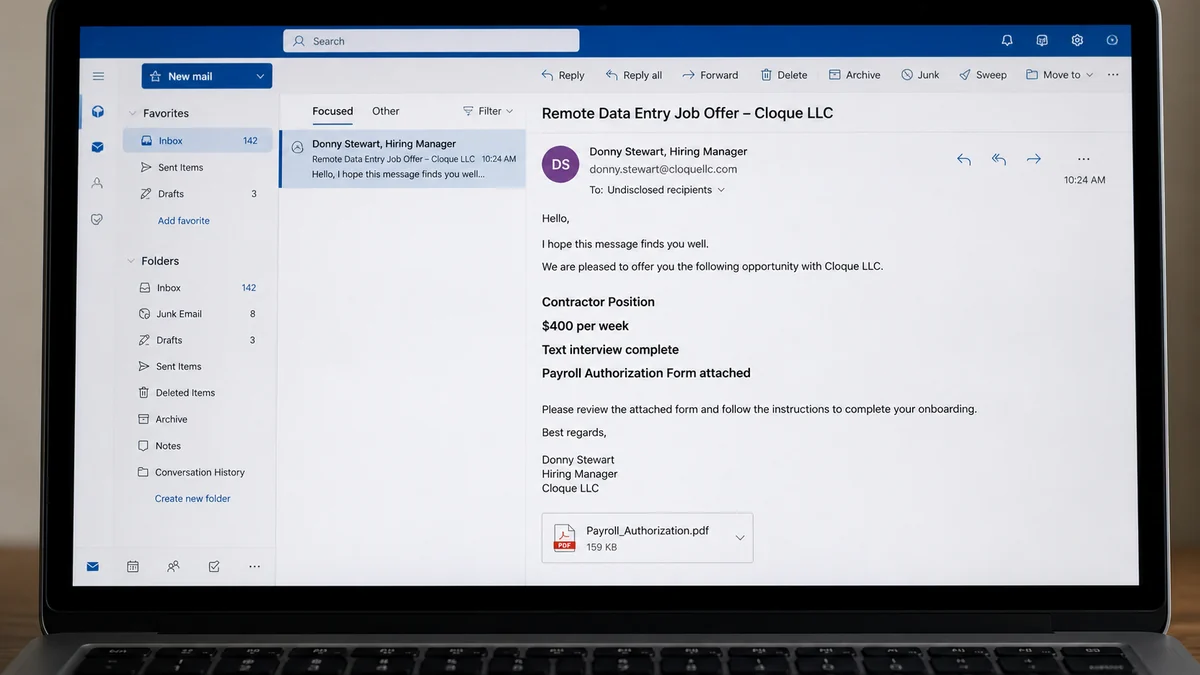
A recent job-seeker report describes applying for a data entry position associated with Cloque LLC. A person using the name Donny Stewart conducted an interview by text and offered a contractor role paying $400 weekly.
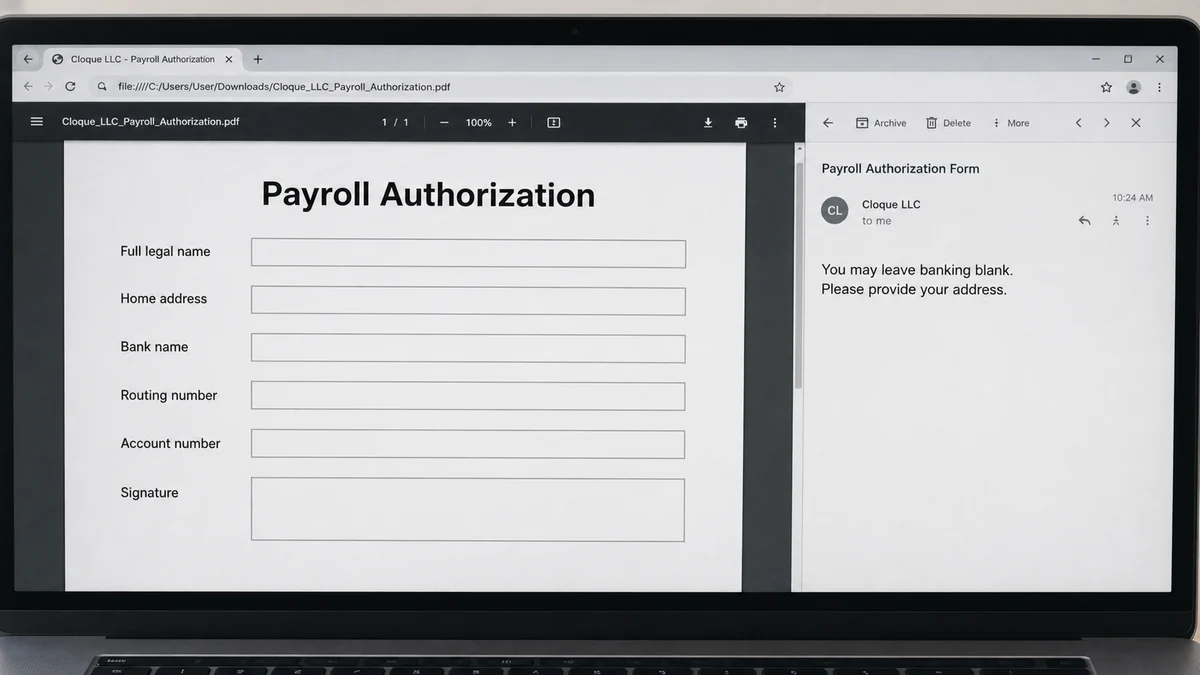
The applicant received an offer letter and a payroll authorization form by email. When the applicant said they did not want to provide bank details, the supposed hiring manager said the banking fields could remain blank if the home address was supplied.
Other commenters said they encountered the listing through Handshake. One reported that the telephone line went dead and that the posting was later removed. These are consumer statements, not proof that the registered company created or authorized the outreach.
The company exists, but that does not verify the recruiter
The Florida Division of Corporations lists Cloque, LLC as active, formed in August 2023, with a Miami address and named managers.
A University at Albany career page previously displayed a Cloque data entry listing that ran from June 4 to July 5, 2026. It advertised $15 to $25 hourly and linked to cloquelc.com. The listing now returns a 410 Gone response, so it is historical context, not proof that the recruiter contacting victims was authorized.
Those facts show that the name, registration, domain, and listing existed. They do not prove that every email, telephone number, attachment, or person using the name was authorized.
The payroll form is where the risk becomes concrete
Job scammers want information that feels normal after hiring: legal name, address, identity documents, Social Security number, bank name, routing number, account number, signature, and tax forms.
The FTC warns that fake recruiters often send polished offers and payroll paperwork before a real interview, then use the information for identity theft or a fake-check scheme.
Verify the entire hiring chain before filling out onboarding documents:
- Did you apply through a traceable platform record?
- Does the sender use the exact corporate domain?
- Can the recruiter be verified through an independent company contact?
- Was there a live video or telephone interview?
- Does the pay match the public job listing?
- Do duties match the original advertisement?
- Does the offer identify employee or contractor status correctly?
- Why is payroll data needed before identity is verified?
- Will a check be sent for equipment or disbursements?
- Does the company confirm the offer from a separately found number?
A criminal can copy public registry details into a letter in minutes. Verification must connect the recruiter to the organization, not merely connect the organization to a registry.
What the Public Job Listing Actually Said
The archived University at Albany page described a part-time remote Data Entry Clerk position suitable for students. Duties included updating databases, checking accuracy, maintaining digital records, and basic administrative support.
The public compensation was $15 to $25 hourly for 10 to 25 hours per week. The Reddit applicant instead described a contractor offer at a flat $400 weekly.
That difference is not automatic proof of fraud. Employers can change pay structures or offer contractor arrangements. It is a discrepancy that requires written confirmation.
The applicant later quoted duties involving “financial disbursement,” invoicing, badge printing, and rollover tasks. Those responsibilities are more sensitive and less clearly aligned with a basic student data-entry listing.
Financial disbursement language is especially important. A fake employer may later send a check and direct the worker to pay a vendor, buy equipment, print checks, or move funds.
The FTC says a legitimate employer will not send a check and instruct a new hire to redirect part of the money. The deposit can appear available before the bank discovers it is counterfeit.
The criminal keeps the real payment sent by the victim. The bank reverses the fake deposit, leaving the victim responsible for the balance.
A job platform is a lead source, not a guarantee. Fraudulent employers can create accounts, compromise legitimate accounts, copy company identities, or pass an initial screening before complaints arrive.
University career pages may automatically display listings distributed through a third-party system. The presence of a university logo does not mean university staff interviewed the employer or approved every recruiter.
Applicants should preserve the original job URL and platform messages. If outreach moves to text immediately, the platform loses visibility into what happens next.
How the Cloque LLC Data Entry Job Scam Works
Step 1: A remote listing reaches students and job seekers
The role offers simple work, flexible hours, and accessible qualifications. That combination attracts applicants who may have little hiring experience and an urgent need for income.
A listing on Handshake or a university portal supplies borrowed credibility before any direct contact occurs.
Step 2: Communication moves to email and text
The supposed recruiter says text is preferred for scheduling or conducting the interview. Written questions can be copied, automated, or generated quickly while still sounding professional.
Text removes voice, video, office context, and spontaneous interaction that could expose inconsistencies.
Step 3: Generic questions simulate a formal interview
The applicant answers questions about accuracy, software, availability, and remote work. The conversation may continue long enough to create emotional investment.
Fast responses to follow-up questions can feel human without proving the person’s identity or authority.
Step 4: The offer arrives before independent verification
A letter uses the company name, address, logo, job title, and weekly pay. Public business information makes the document easy to assemble.
The applicant feels chosen and becomes less likely to challenge small discrepancies.
Step 5: Payroll paperwork collects identity data
The form requests direct-deposit information, home address, signature, or tax details. Each field has a plausible employment purpose, which lowers suspicion.
Accepting only the address can keep the conversation alive. It may also prepare delivery of a fake check or equipment package.
Step 6: The role expands into financial disbursement
The worker may be told to deposit a check, buy equipment from an approved vendor, print payments, send funds, or reimburse another contractor.
That is not ordinary data entry. It makes the victim the financial bridge between a fake deposit and an irreversible payment.
Step 7: The recruiter disappears or changes names
Once the platform removes the listing or the check fails, the email, website, and telephone route may stop working. The same script can return under a different company identity.
Victims may then receive fake recovery or identity-monitoring offers based on the information they submitted.
Why an Active LLC Is Not a Recruiter Verification
State registries record legal entities and filing status. They do not certify every website, job offer, invoice, or person claiming to work for the entity.
A scammer can search the registry, copy the principal address and manager names, and place them on letterhead. The resulting document matches public records because that was the source.
The company itself may also be newly active, small, or difficult to reach. That creates ambiguity without proving that its owners operate a scam.
Impersonation is another possibility. A real company can be harmed when criminals use its name to collect applicant data.
Domain email helps but is not conclusive. Domains can be newly registered, lookalikes can differ by one character, and company mailboxes can be compromised.
In this case, the public job page listed human_resources@cloquelc.com. An email from that exact domain would be stronger than free webmail, but the recipient should still verify the offer through another channel.
Use the telephone number from the company’s independently found site and ask for the recruiter by name. If the line fails, document the attempt and contact the job platform.
Ask the company to confirm the exact job title, compensation, contractor status, interview process, and onboarding form. A yes-or-no confirmation is more useful than asking whether the company is “real.”
Search the recruiter on the company’s staff pages and professional networks, but do not rely on a profile alone. Fake profiles can copy real employees.
A registry proves that Cloque, LLC exists. It does not prove that “Donny Stewart” was hired by it, owned the email account, or had authority to collect payroll information.
How to Verify a Remote Job Before Onboarding
Return to the job platform and confirm the application appears in your account. Compare the recruiter, pay, schedule, and duties with the preserved listing.
Contact the employer through a number or email found independently. Do not use only the signature block supplied by the recruiter.
Request a live interview with camera or a telephone call to the company office. Video is not perfect proof, but refusal removes an important verification layer.
Inspect the sender domain character by character. Check for missing letters, added words, alternate endings, and reply addresses that differ from the visible sender.
Ask who supervises the role and where that person appears in company materials. Request a written explanation of the team’s work and the first week’s tasks.
Do not send bank data simply because an offer letter exists. Direct-deposit information is normally collected after identity, employment status, tax documents, and company authority are established.
Contractor status deserves special scrutiny. A company should explain the contract, payment schedule, tax treatment, deliverables, and invoicing process.
Never accept a check to buy equipment from a named vendor. A real employer can purchase and ship its own equipment or use a verifiable reimbursement process after employment begins.
Do not conduct “financial disbursement” from a personal account. Moving company funds through a new worker’s account is a classic fake-check and money-mule warning.
Report suspicious listings to the career center and platform. One fast report can prevent the same recruiter from reaching more applicants.
Why the Contractor Label Does Not Reduce the Risk
Contractors can legitimately receive flexible schedules and different tax treatment, but they still need a real contracting party, defined work, agreed compensation, and a verifiable payment process.
A vague contractor label may let a fake recruiter avoid questions about employee benefits, payroll withholding, office policies, or a formal human-resources system.
The contract should name the legal entity, effective date, services, rate, invoicing schedule, termination terms, confidentiality duties, and governing law. A one-page welcome letter is not a substitute.
Ask whether the weekly amount depends on hours, deliverables, or availability. A flat $400 promise with unclear duties makes it difficult to know what performance is being purchased.
Contractors often provide tax information after an agreement is verified. That does not justify sending sensitive data to an unconfirmed person after a text interview.
A real contractor should invoice the company or use its established platform. The company should not route operational funds through the contractor’s personal bank account.
Equipment arrangements should be explicit. If specialized hardware is required, the business can buy it directly, ship from a known supplier, or reimburse documented expenses through a verified process.
A check that includes extra money for a vendor is not normal reimbursement. It creates the exact gap exploited in fake-check fraud.
Ask for a completed copy signed by an authorized company representative. Verify that person independently and retain the document before doing work.
Do not let the word contractor create urgency. Independent workers are expected to evaluate clients carefully because they may have fewer workplace protections than employees.
If the recruiter cannot explain whether the public hourly listing became a weekly contractor offer, stop. Compensation changes should have a clear business reason and written approval.
The same verification standard applies whether the form requests a bank account or only an address. The person collecting either item must first prove who they represent.
Keep unpaid sample work limited. A supposed employer that requests large production assignments before a verified contract may be harvesting free labor even without a fake check.
Ask how disputes and corrections are handled. An accountable client can name a supervisor, billing contact, and escalation route that remain available outside one recruiter’s text thread.
If those basic controls are missing, declining the offer protects both your identity and your time.
A genuine opportunity remains verifiable after reasonable questions are asked.
That pause can prevent lasting damage.
Company, Address, and Fulfillment Checks
Confirm the Florida entity
The Florida registry lists Cloque, LLC as active and names its Miami principal address and managers. Treat that as entity information, not job approval.
Compare any offer against the current official filing.
Confirm the company contact
The public site lists a Miami address, telephone number, and company email. Reach them independently and ask whether the recruiter and exact position are authorized.
A dead or unanswered line is a reason to stop onboarding.
Confirm the listing and recruiter together
A university page shows that a listing existed, but the recruiter must still be connected to it. Ask the platform whether the employer account remains verified and whether complaints caused removal.
Preserve platform messages before they disappear.
Confirm how work and pay are fulfilled
Get the supervisor, tasks, hours, rate, contract, payroll provider, and first payment date in writing. Reject any process that requires personal funds or check forwarding.
Real work should produce pay, not a debt to an equipment vendor.
What to Do if You Have Fallen Victim to This Scam
- Stop sending information. Do not complete more forms, deposit checks, buy equipment, or perform financial disbursement.
- Preserve the hiring trail. Save the job URL, platform application, emails, text messages, offer, attachments, telephone number, and sender headers.
- Contact Cloque independently. Ask whether the recruiter, position, compensation, and documents were authorized without using the disputed contact route.
- Report the listing. Notify Handshake, the university career office, and any other platform that distributed it.
- Protect bank accounts. If routing or account numbers were shared, call the bank and ask about monitoring or replacement.
- Protect identity data. Visit IdentityTheft.gov, consider a credit freeze, and monitor tax and employment records if sensitive details were exposed.
- Do not spend a deposited check. Tell the bank’s fraud team why it may be counterfeit and wait for final verification.
- Report to the FTC. Submit the recruiter, company identity used, platform, payment request, and documents at ReportFraud.ftc.gov.
- Run Malwarebytes. Scan devices if you opened unfamiliar attachments, installed interview software, or followed onboarding links.
- Use AdGuard as a supporting layer. It can reduce malicious ads and tracking but cannot validate a recruiter or protect data already submitted.
- Change reused passwords. Secure email and job-platform accounts, revoke sessions, and enable strong multifactor authentication.
- Ignore recovery recruiters. Do not pay anyone who promises to recover a fake check, erase identity exposure, or restore the lost job.
Frequently Asked Questions
Is Cloque LLC a real registered company?
Yes, an active Florida entity with that name appears in the state registry. Registration alone does not authenticate a recruiter, job offer, email, or payroll form.
Was the data entry job listed through a university?
A University at Albany career page preserved a 2026 listing linked to Handshake. A platform listing still requires independent employer and recruiter verification.
Are text interviews always fake?
Not universally, but text-only hiring removes important identity checks. High pay, immediate offers, financial duties, and early payroll forms make the pattern much riskier.
Why would the recruiter accept only my address?
An address can support identity theft, delivery of a fake check, equipment fraud, or future targeting. Accepting less data may also keep a cautious applicant engaged.
Can I trust an email from the company domain?
It is stronger than free webmail but not decisive. Verify the domain, headers, recruiter, and exact offer through a separately found company contact.
What if I already deposited an equipment check?
Do not spend or forward any funds. Contact the bank’s fraud department immediately and explain that the check may be connected to a fake job.
The Bottom Line
The Cloque LLC Data Entry Job demonstrates a modern verification trap. The company name, Florida filing, website, university career page, and polished offer can all exist while the person collecting payroll data remains unverified.
Verify the recruiter through an independent company channel before submitting bank or identity information. If the role shifts toward checks, equipment vendors, financial disbursement, or personal payments, stop. A real employer pays for work; it does not turn a new applicant into its bank.








