

A website promises a fast path from a short online questionnaire to housing protection for a beloved animal. The checkout feels simpler than finding a clinician, and the word “official” makes the result sound settled.
The MySupportAnimal ESA Letter deserves a closer look because the value of the purchase is not the PDF itself. It is whether a housing provider can rely on the professional judgment behind it.
Overview
The sales promise and the legal standard are not the same thing
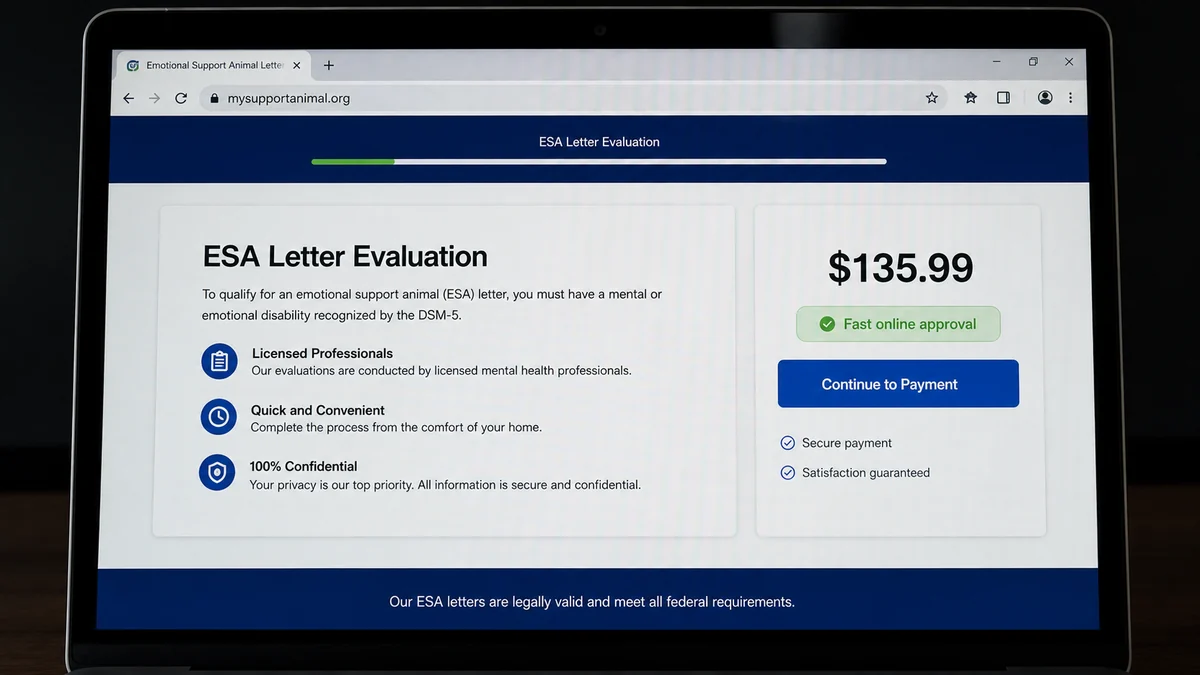
MySupportAnimal.org markets emotional support animal letters for housing. Its site says customers answer questions, are matched with a licensed mental-health professional, and can receive documentation intended to support a reasonable-accommodation request.
That does not mean every letter bought online must be accepted. The U.S. Department of Housing and Urban Development says a request may need reliable disability-related information when the disability or need is not apparent.
HUD also warns that documents sold by websites to almost anyone who answers questions or completes a short interview may be insufficient. Telehealth documentation can be reliable, but the professional relationship and individualized judgment still matter.
Customer reports describe missing letters and rejected documents
A recent consumer report alleged that MySupportAnimal asked little about mental-health history, provided no therapist conversation, failed to answer support emails, and produced a letter the person’s rental office said it would not accept.
Other complaints collected on Trustpilot describe payments followed by missing or delayed letters, unanswered messages, refund difficulty, documents covering the wrong number of animals, and letters that customers said landlords rejected. These are customer allegations, not court findings.
A BBB Scam Tracker report similarly says a customer paid after a questionnaire, was told to wait 48 to 72 hours, and still had no letter or response after a week.
The terms narrow the comforting language on the sales page
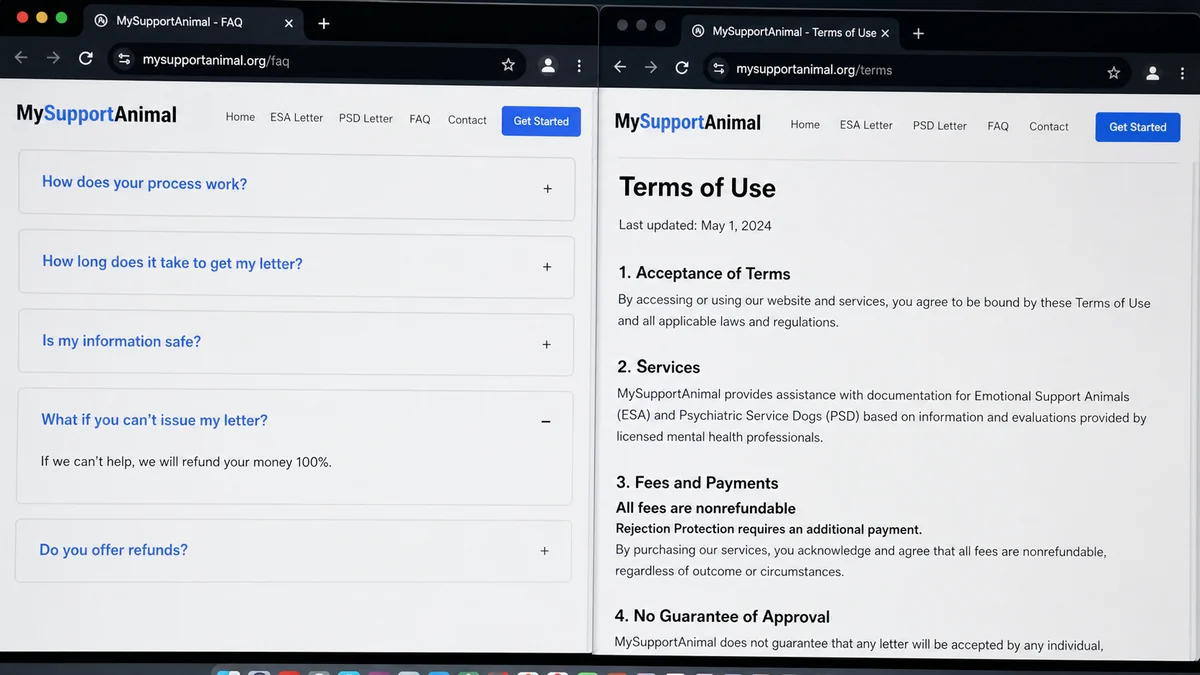
The homepage says the company is confident it can help and refers to a full refund when it cannot. The current terms say all fees are nonrefundable, except when a user does not qualify, and say fulfilled third-party provider services are not refundable.
The terms also say acceptance by a landlord, airline, or other third party is not guaranteed. Refund protection for rejection requires an additional payment and supporting details about the party that rejected the letter.
Before paying, compare the sales page, checkout, terms, and refund conditions side by side:
- Will you speak directly with a licensed professional?
- Is that professional licensed in your state?
- Will the clinician have personal knowledge of your condition?
- Can the landlord verify the license independently?
- Does the service guarantee delivery, qualification, or acceptance?
- Is rejection protection included or sold separately?
- When does the service become nonrefundable?
- Is there a telephone number and accountable business identity?
- What happens when the landlord requests clarification?
- Can you save the exact policy shown before checkout?
An ESA letter is not valuable because it has a seal, QR code, or polished letterhead. Its value depends on a legitimate clinical assessment and documentation that fits the housing request.
What MySupportAnimal Promises at Checkout
The marketing is built around relief. A renter sees a way to avoid pet restrictions, deposits, or recurring pet fees without waiting weeks for a traditional appointment. Speed is presented as convenience rather than a potential weakness.
The site says its letters contain the professional’s letterhead, business information, signature, and license details. It also says the clinician can contact a landlord to validate the letter.
Those features sound official, but they do not answer the most important question: what evaluation occurred before the professional reached a disability-related conclusion?
A license number proves that a named professional may hold a license. It does not prove that the professional personally evaluated this customer, reviewed accurate information, or formed the opinion expressed in the letter.
Likewise, a landlord’s refusal does not automatically prove that a letter is fraudulent. Housing rules are fact-specific, some properties are exempt, and providers can request reliable information when the disability or need is not apparent.
The problem is the gap between “you will receive a document” and “the document will support this accommodation.” A buyer often discovers that gap only after paying and presenting the letter.
MySupportAnimal’s terms describe the company as a platform. They say a third-party provider performs qualification testing and that MySupportAnimal itself does not provide the evaluation, decide qualification, or issue the ESA letter.
That division of responsibility matters when something goes wrong. The buyer may believe they hired one clinical service, while the contract says the visible brand is mainly a medium connecting them to another provider.
The terms also state that using the service does not establish a doctor-patient or psychotherapist-client relationship with the company. Consumers should ask exactly which provider relationship does exist and how follow-up questions will be handled.
Do not assume a fast checkout creates a legal shortcut. A disability accommodation rests on facts and professional judgment, not on purchasing a category of document.
How the MySupportAnimal ESA Letter Trap Works
Step 1: Housing anxiety creates a ready customer
The renter may be facing a no-pet policy, a new lease, a deadline, or a costly pet fee. Search results lead to services promising quick and legitimate ESA documentation without the friction of finding a local provider.
The urgency is genuine even if the offer is unreliable. That makes words such as official, compliant, fast, and guaranteed especially persuasive.
Step 2: A short questionnaire feels like a clinical evaluation
The site gathers answers about symptoms, the animal, and housing. A formal-looking progress bar can make the process feel medical even when the customer has not had a meaningful conversation with a professional.
Online care is not inherently invalid. The concern is whether a licensed professional actually assesses the individual and develops the personal knowledge HUD describes.
Step 3: Payment arrives before the hard questions
At checkout, the buyer may focus on price and delivery time. Questions about state licensing, follow-up access, landlord verification, and refund exclusions receive less attention.
The customer is buying an outcome under pressure, so a statement about full refunds can outweigh several pages of narrower contractual language.
Step 4: A polished letter provides visual reassurance
A PDF may contain a clinician’s name, license, signature, letterhead, and statements about disability-related need. Those elements look persuasive when viewed outside the relationship that produced them.
A property manager may still verify the professional, compare the license state with the tenant’s location, or ask whether the document reflects personal knowledge rather than a form purchase.
Step 5: The landlord asks for verification or rejects the letter
The housing provider may contact the signer, request clarification, or say the documentation does not reliably establish the need. The renter then needs responsive clinical support, not merely another copy of the PDF.
If messages go unanswered, the service that felt instant before payment can become difficult to reach at the exact moment its usefulness is tested.
Step 6: Refund language becomes conditional
The buyer cites a satisfaction or acceptance promise. The terms may instead classify the service as fulfilled and nonrefundable or require separately purchased rejection protection.
Evidence may be required, including the rejecting company’s name, contact details, address, and written denial. An administrative deduction may also apply to an approved exception.
Step 7: The renter pays twice or loses time
A rejected customer may seek another online vendor, pay a local provider, renegotiate the lease, or move. The original cost is then only part of the damage.
Delays can also affect a housing application. That is why verifying the professional process before checkout is more useful than evaluating the PDF after rejection.
An ESA Is Not an ADA Service Animal
The legal vocabulary is frequently blurred in advertising. Under ADA guidance, a service animal is generally a dog trained to perform work or tasks directly related to a person’s disability.
A dog whose presence provides comfort is not a service animal under the ADA. Service animals do not need paid certification, a vest, or registration.
Housing is different. The Fair Housing Act can require reasonable accommodation for an assistance animal, including an animal that provides emotional support related to a disability. HUD, not a certificate seller, administers that federal housing framework.
This distinction does not make emotional support unreal. It means the right concerns housing accommodation and disability-related need, not universal public access to restaurants, stores, hotels, or other ADA-covered places.
A website cannot convert a pet into a public-access service animal. It also cannot guarantee how every housing provider will evaluate documentation in every jurisdiction.
State and local laws can add rules. Some states restrict how healthcare professionals may issue ESA documentation, including relationship duration or licensing requirements.
Customers should therefore begin with the housing request, their state, and a real care relationship. Starting with a purchasable certificate reverses the order.
If a seller emphasizes registration numbers, ID cards, vests, or databases, ask what law requires those products. HUD accommodation depends on reliable disability-related information, not accessories.
How to Verify an ESA Letter Service Before Paying
Ask for the exact legal entity operating the service. A brand name alone is difficult to use when you need a refund, complaint, or licensing inquiry.
Confirm which clinician will review your case and where that person is licensed. Use the state licensing board’s own database, not a verification page controlled by the seller.
Ask whether the evaluation includes a live conversation and how long it lasts. A telehealth appointment can be legitimate, but an automated questionnaire should not be disguised as individualized care.
Ask who answers a landlord’s call. If the signer is unavailable and support cannot connect the parties, the letter may fail during routine verification.
Read the refund clause before submitting health or payment information. Save screenshots because policy wording can change.
Compare the refund promise with exclusions in the terms. Determine whether the promise covers nonqualification, nondelivery, rejection, dissatisfaction, or only a separately purchased protection plan.
Check whether the listed address is an operating office or a registered-agent address. MySupportAnimal’s terms list 30 N Gould Street in Sheridan, Wyoming. The Wyoming Secretary of State roster shows commercial registered agents at that address.
A registered-agent address is lawful and does not prove misconduct. It simply does not show where clinicians, customer support, or management actually work.
Search recent complaints, but distinguish allegations from verified findings. Repeated reports about nondelivery, silence, and rejection are warning signals that deserve answers.
Contact the housing provider before paying. Ask what documentation it uses for a non-observable disability and whether it has a form or verification process.
Talk with an existing doctor, therapist, psychiatrist, or licensed professional who knows your circumstances. Personal knowledge can make the documentation more reliable and the follow-up route much clearer.
Why Refund Friction Changes the Purchase Decision
A refund promise can be central to the buyer’s decision because landlord acceptance is uncertain. If the visible promise sounds broad while the contract covers only nonqualification, the customer may misunderstand the risk being transferred.
Rejection protection sold as an extra changes the economics again. The customer is paying once for the letter and again for protection against the exact event that determines whether the letter is useful.
Read when the service is considered fulfilled. Delivery of a PDF, review by a third party, clinician signature, and successful housing accommodation are four different milestones.
Ask how quickly a rejection claim must be filed and which documents are required. A renter should not discover after a denial that the landlord’s full contact details or a formal rejection letter were mandatory.
Check whether an administrative deduction applies. Even an approved exception may return less than the amount paid.
Keep every version of the policy shown during checkout. The most useful evidence is the promise that influenced the transaction, not a page found after the dispute began.
A responsive company should explain these distinctions before payment. If support cannot answer a pre-sale question about refunds or clinician access, expect the same difficulty after a landlord objects.
Consumers should not rely on a chargeback as a substitute for due diligence. Card issuers evaluate evidence and contract terms, and a completed digital service can be harder to dispute than a product that never shipped.
Company, Address, and Fulfillment Checks
Identify the contracting company
The terms refer to MySupportAnimal as the company but do not prominently name a separate corporation in the opening definition. A buyer should know the legal entity taking payment and the provider delivering the clinical service.
Save the merchant descriptor from the card statement and every invoice.
Understand the Sheridan address
The listed Wyoming address is associated with registered-agent services. That can provide a lawful address for notices while revealing little about daily operations.
Do not treat a registered address as proof of a staffed clinic or support center.
Check the provider and license
Verify the clinician’s name, license type, state, status, and disciplinary history through the relevant board. Confirm that the clinician actually signed the document and can be contacted.
A valid license attached to a weak evaluation does not automatically satisfy a landlord.
Define what fulfillment means
The seller may consider the service fulfilled when a letter is delivered. The customer may define fulfillment as landlord acceptance and responsive follow-up.
Resolve that difference in writing before paying, including the precise refund route.
What to Do if You Have Fallen Victim to This Scam
- Save the purchase record. Keep the checkout page, invoice, card descriptor, questionnaire confirmation, letter, terms, refund promise, and delivery estimate.
- Request support in writing. State the exact missing service or rejection and ask for a dated response through the official support address.
- Document the landlord’s decision. Ask which part of the documentation was insufficient without volunteering unnecessary medical details.
- Verify the signer. Contact the state licensing board and the professional through an independently found channel.
- Invoke the correct refund clause. Quote the policy shown at purchase and provide rejection evidence only through a verified channel.
- Contact your card issuer. Explain whether the dispute concerns nondelivery, misrepresentation, or a promised refund that was not processed.
- Protect health information. Ask how submitted data can be accessed, corrected, or deleted and monitor for suspicious follow-up messages.
- Report deceptive practices. Use ReportFraud.ftc.gov and the consumer-protection office in your state.
- Seek reliable documentation. Contact a licensed professional who knows your circumstances and review HUD guidance with the housing provider.
- Run Malwarebytes if needed. Scan devices if the process required an unexpected download, extension, or document viewer.
- Use AdGuard as a supporting layer. It can reduce exposure to aggressive ads and tracking, but it cannot assess a clinician or make a letter legally sufficient.
- Avoid recovery offers. Do not pay a stranger who promises a guaranteed chargeback, landlord approval, or backdated clinical relationship.
Frequently Asked Questions
Is MySupportAnimal.org definitely a scam?
We found serious complaint patterns and restrictive terms, but no court finding that lets us label every transaction fraudulent. Consumers should evaluate the professional relationship, delivery, acceptance limits, and refund conditions before paying.
Can a landlord reject an online ESA letter?
A landlord may seek reliable documentation when the disability or need is not apparent. HUD says telehealth documentation can be reliable, but mass-sold certificates or brief paid interviews may be insufficient.
Does an ESA letter give public-access rights?
No. Emotional support alone does not make an animal a service animal under the ADA. Housing accommodation follows a different Fair Housing Act framework.
Is ESA registration required?
No federal ESA registry creates housing rights. The relevant issue is reliable documentation of disability-related need, not a purchased registration number, vest, or ID card.
What if the clinician is licensed in another state?
Verify whether the professional was authorized to provide the relevant service where you were located. Licensing rules vary, so check the state board and local requirements.
Can I dispute the charge if no useful letter arrived?
You can ask your card issuer about a dispute, but approval depends on the facts, evidence, timing, and card rules. Preserve the offer, policy, correspondence, and rejection.
The Bottom Line
A MySupportAnimal ESA Letter is not automatically valuable because it looks official. The real test is whether a properly licensed professional formed an individualized opinion, can support it, and produced documentation a housing provider can reliably evaluate.
Do not buy a legal-looking PDF first and investigate the clinical relationship later. Verify the provider, license, refund conditions, support route, and landlord requirements before checkout. If the seller cannot clearly answer those questions, keep your payment and seek help through a professional who already knows your circumstances.








