

A remote job pays a small crypto commission after training. The work is simple: complete sets of 40 online tasks and withdraw the earnings.
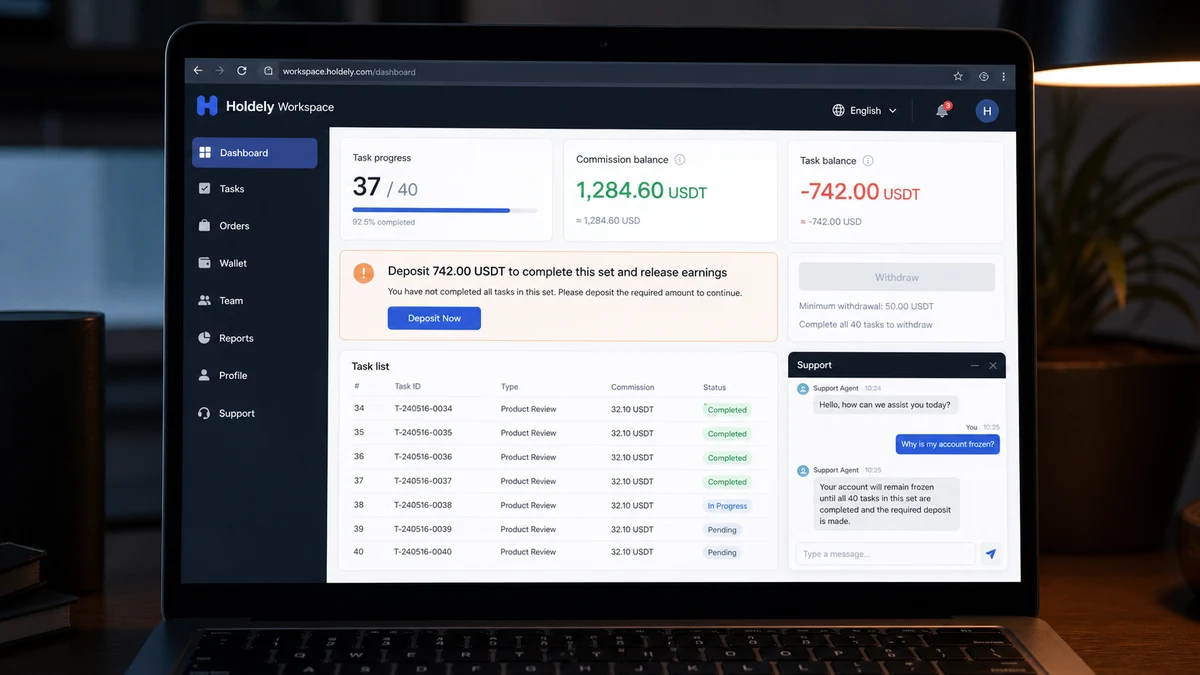
The first payout works. Later, task 37 creates a negative balance and the worker must deposit personal USDT before the “salary” can be released.
Overview
The job reportedly paid first and demanded deposits later
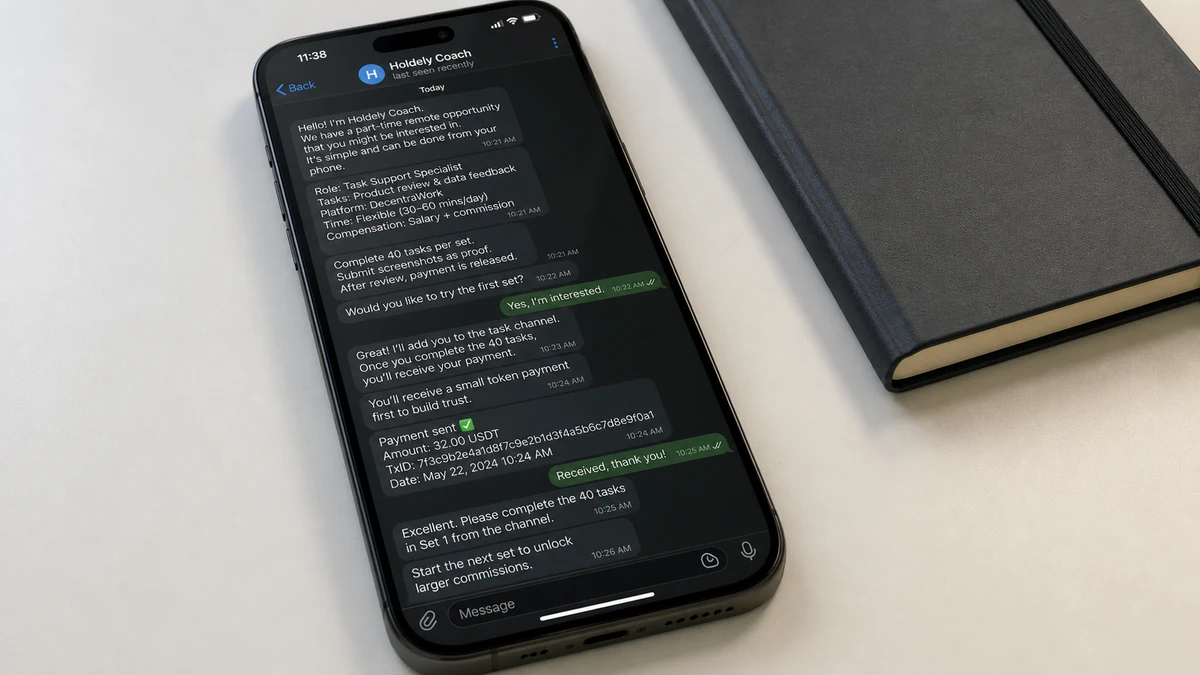
A worker described a part-time remote job offered under the Holdely name. A “coach” taught them to log in to a private platform and complete sets of 40 or more clicks.
After training, the worker received a salary and commission payment in cryptocurrency. That real payout appeared to prove the platform was genuine.
The rules then changed. Certain tasks required deposits, while the platform showed bonuses and earnings as frozen until every task in the set was completed.
The pattern matches official task-scam warnings
The FBI’s cryptocurrency job scam warning describes simple click-based work, negative task balances, crypto deposits, escalating commissions, and support groups that control each round.
The FTC also warns that task scams create an illusion of earning money before requiring workers to deposit their own funds.
The live Holdely website does not describe this job
During our latest check, holdely.com described a performance-marketing and paid-media agency. Its public pages promoted paid search, paid social, SEO, Amazon advertising, and creative services.
We found no public description of 40-task sets, crypto salary, phone-based optimization work, or employees depositing USDT. That mismatch needs an explanation from the company through a verified channel.
The red flags are clear:
- A stranger offers easy remote work through messaging apps.
- The work consists of repetitive sets of clicks or ratings.
- A small early payout is used to build confidence.
- Compensation and deposits move through cryptocurrency.
- A task unexpectedly creates a negative balance.
- Personal money is required to finish work.
- Displayed earnings remain frozen until another deposit.
- The public company site does not describe the employment program.
A real employer pays for work. It does not make employees finance tasks so wages can be withdrawn.
How the Holdely Task Job Scam Works
Step 1: An unexpected recruiter offers flexible work
The message arrives through text, WhatsApp, Telegram, or social media. The role can be done on a phone, requires little experience, and promises daily pay.
A formal interview, references, and a corporate email are minimized because the operator wants a quick start.
Step 2: A coach demonstrates simple tasks
The worker learns to click, rate, optimize, or review products through a dashboard. The coach stays available and frames every button as part of a real marketing campaign.
No customer, invoice, campaign result, or useful work product is identified. The activity exists mainly to create progress on the screen.
Step 3: The first task set produces real crypto
A small withdrawal reaches the worker’s wallet or exchange. The coach may help configure it, ensuring the target sees money outside the private platform.
This payout is an acquisition cost. It can be funded from earlier victims and is designed to unlock a much larger deposit later.
Step 4: The displayed earnings grow
Commissions, bonuses, and account levels rise. The platform suggests that completing more sets will produce reliable daily income.
The operator controls every number on the screen, so the displayed profit need not correspond to money held for the worker.
Step 5: A task creates a negative balance
Near the end of a set, a “combo,” “premium order,” or high-value task costs more than the available balance. The worker must add USDT before the next button becomes available.
Support claims the selection is random and cannot be canceled. In reality, the platform can be programmed to create the deficit at any point.
Step 6: Each rescue payment produces a larger demand
After the worker covers one negative balance, another special task appears. The new deficit is larger because the dashboard now includes the previous deposit and invented commission.
The worker is told that stopping would lose everything already paid.
Step 7: Withdrawal remains conditional forever
Finishing the set leads to tax, verification, security, account-upgrade, or liquidity fees. None is deducted from the visible balance; fresh crypto is always required.
The platform is not withholding wages until work is finished. It is using fictional wages to collect deposits.
Why the First Payment Is So Convincing
Most people know that fake dashboards can display imaginary money. A real transfer to a personal wallet feels different because it can be verified on the blockchain.
The transfer proves only that someone sent a small amount. It does not prove where future deposits go, whether the employer exists, or whether the large balance can be withdrawn.
The coach wants the worker to say, “I was skeptical, but they paid me.” That personal experience becomes stronger than warnings from a bank, relative, or search result.
The early payment may also encourage referrals. Friends join because they trust the worker, repeating the same chain seen in investment groups.
Always compare the first payout with the next requested deposit. A platform willing to spend $20 to collect $500 has not proven an employment relationship.
What the Live Holdely Site Reveals
Holdely.com remained live during our review and described itself as a performance-marketing and paid-media agency. It advertised work for brands through paid search, paid social, creative services, SEO, and related marketing systems.
Those are recognizable agency services. They do not explain why a remote worker would complete 40 anonymous tasks, receive crypto, or deposit personal funds into a private account.
The use of a real company name may be unauthorized. A scammer can copy the business, address, and logo while operating through a separate dashboard and messaging account.
Contact Holdely through information on its official site and ask whether the recruiter, task domain, coach, and crypto-payment program are authorized. Do not use an email address supplied only by the recruiter.
Until that connection is confirmed, describe the task operation separately from the public marketing agency. The mismatch is evidence to investigate, not permission to accuse every employee at the named company.
Why the Set Breaks Near the End
Progress creates commitment. At task 37 of 40, the worker feels almost finished and can see a large balance waiting. Walking away then feels harder than refusing the first assignment.
The platform uses that commitment by placing the negative task near the finish line. The deposit appears to be a temporary bridge rather than the actual product being sold.
After payment, the set may reach 40, but withdrawal introduces another condition. Sometimes a new set begins automatically or the worker must complete a combined order.
No amount of task completion changes who controls the dashboard. If support can create the deficit, it can create another one after every deposit.
How to Check a Task Job Before Sending Crypto
Ask for the employer’s legal name, corporate email, manager, contract, payroll terms, and a clear description of the work product. Verify them through the company’s official website.
Search the task domain separately from the brand name. Check registration date, operator details, and whether workers outside the recruiter’s chat describe real wages without deposits.
Refuse any job that requires a top-up, recharge, negative-balance payment, wallet activation, or deposit to unlock commission. That rule catches the scam before the dashboard becomes emotionally important.
A withdrawal test should involve all available principal, not a small bonus. Never add funds to perform the test.
Keep control of your wallet seed phrase and exchange login. A coach who helps create an account does not need the password, remote access, or a screen share during transfers.
What the Crypto Trail Can Tell You
Every genuine blockchain transfer has a transaction hash, network, sending address, receiving address, amount, and timestamp. Save those facts directly from the wallet or exchange, not only from the task dashboard.
The first small payment may come from an exchange hot wallet, another victim, or an intermediary. Its source does not prove employment, but it can connect related cases when investigators compare addresses.
Later deposits often go to several wallets. Record each address exactly and note which coach or support account supplied it. Do not assume a changed address means a different company.
Blockchain explorers show movement, not the legal identity behind every wallet. A tracing graphic alone cannot tell you that funds are recoverable or that a private analyst can seize them.
If the destination belongs to a regulated exchange, law enforcement may be able to request identity and account records. Fast reporting matters because the funds can be moved again quickly.
Do not send a tiny “verification” payment to a recovery wallet. That is another outgoing transaction and may connect your wallet to a second scammer.
Keep the wallet and exchange records even if the task site disappears. Public transactions remain available and may support a combined investigation with other victims.
Never publish the seed phrase, private key, or full exchange account screenshots while asking for help. Investigators need public transaction data, not control of your assets.
Create a simple table listing each transaction hash, date, amount, network, destination, and the message that requested it. This makes a long, confusing payment chain easier for an exchange or investigator to follow.
Record the first payout as well as the losses. Its sending address may connect the recruiter to funds from other victims or to an exchange account with identifying records.
Do not move remaining crypto because someone claims the wallet is compromised unless the advice comes from a provider you contacted. Recovery scammers use fear of another theft to obtain seed phrases or fresh transfers.
Share public wallet data with law enforcement, but carefully redact account balances and personal identifiers when warning others online. Public posts can attract more recovery scammers.
Company, Address, and Fulfillment Checks
The public website describes a different business
Holdely.com markets paid-media services, not a crypto task job. The recruiter must prove an authorized connection to the company.
A real address can be copied
A Colorado or other business address does not authenticate a private dashboard. Call the business through independently sourced contact information.
The coach’s contact route matters
Save the WhatsApp or Telegram account, email domain, task site, and wallet addresses. They identify the operation more accurately than the borrowed brand.
Fulfillment means wages without worker deposits
A genuine employee completes useful work and receives pay. Frozen dashboard earnings that require USDT are not fulfilled wages.
What to Do if You Have Fallen Victim to This Scam
- Stop all deposits. Do not finish the set, cover another negative balance, pay tax, or unlock a withdrawal.
- Contact the exchange immediately. Report the destination wallet and transaction IDs. Ask whether any recipient account can be frozen.
- Preserve the full record. Save recruiter and coach profiles, dashboard URLs, task history, wallet addresses, transaction hashes, group chats, and withdrawal demands.
- Do not delete the wallet. Keep the public transaction history and seed phrase secure. Never share the seed phrase with a recovery agent.
- Notify the real company. Contact Holdely through its official site and report the job, domain, and accounts using its name.
- Secure exposed accounts. Change passwords, revoke sessions, and replace shared identity or bank information.
- Remove task software. Scan with Malwarebytes if you installed an app, browser extension, or remote tool. Change credentials from a clean device.
- Block malicious routes. AdGuard can reduce exposure to scam ads and known malicious domains, but it cannot release a fake dashboard balance.
- Report the scheme. Use IC3.gov, ReportFraud.ftc.gov, the FBI’s crypto job scam reporting route, and local authorities.
- Reject recovery services. No legitimate investigator guarantees crypto recovery or needs an upfront wallet payment.
Frequently Asked Questions
Why did the Holdely task job pay me first?
The small payout builds trust and can be funded from other victims. It is designed to make a larger later deposit feel safe.
Can I finish the 40 tasks and withdraw?
Do not send more money to test it. Task scams create new deficits or fees after the current condition is paid.
Is holdely.com the private task platform?
The public site describes a marketing agency, not the reported crypto task job. An authorized connection must be confirmed directly with the company.
Does a Colorado address make the job legitimate?
No. Public business addresses are easy to copy. Verify the recruiter and program through the business occupying that address.
Can an exchange reverse my USDT transfer?
Blockchain transfers are usually irreversible, but report immediately. An exchange may freeze a destination account or preserve identity information.
Should I trust a crypto recovery agent?
Not one who contacts you first or demands payment. Recovery scammers target victims with promises to unlock balances or trace wallets.
The Bottom Line
The first crypto payout is the most important part of the Holdely task pitch because it turns a stranger’s promise into something the worker can see. It is still bait.
No real job requires employees to deposit USDT to complete clicks or release wages. When task 37 creates a negative balance, the work has ended and the payment scam has begun. Stop before the dashboard invents the next condition.








