

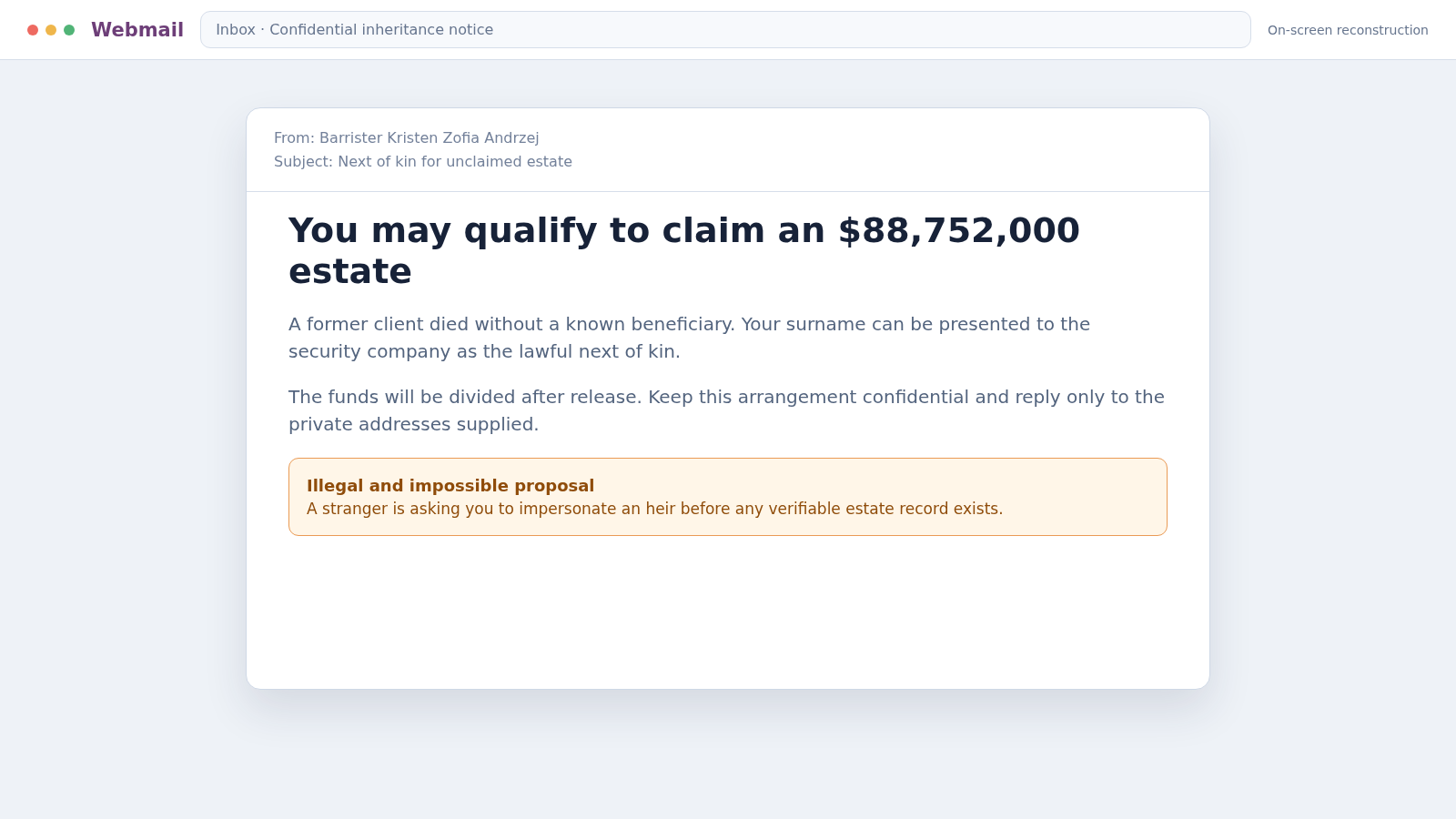
An unexpected lawyer says a deceased client left behind $88,752,000 in cash, gold, diamonds, or an unclaimed estate. By coincidence, you can supposedly become the next of kin and share the fortune if you agree to cooperate quietly.
The Barrister Kristen Zofia Andrzej scam turns that impossible coincidence into a long legal performance. The fortune never appears, but the payments and documents requested from the recipient are very real.
Overview
The message invents a lawyer and an unclaimed fortune
The sender uses the name “Barrister Kristen Zofia Andrzej” and claims to have represented a wealthy client who died without an identified heir. The estate may be described as cash, an insurance payment, or a diplomatic trunk containing gold and diamonds.
Recipients are told that a security company, bank, or government office is waiting for a beneficiary. The supposed lawyer wants to present the recipient as next of kin and then divide the proceeds.
The proposal asks the victim to join a dishonest claim
The email may say the recipient has the same surname as the deceased person, although bulk versions are sent without checking any family connection. Secrecy and trust are emphasized because the proposal cannot withstand ordinary legal scrutiny.
A legitimate lawyer does not recruit a random stranger to sign false inheritance papers. The invitation itself describes misconduct, even before the scammer asks for money.
The inheritance is bait for fees and identity documents
Once someone replies, the criminal introduces administrators, bankers, couriers, and government officials. Each participant provides another form and another reason the fortune cannot be released yet.
Targets may be asked for:
- Legal, tax, and inheritance-clearance fees
- Courier, insurance, or diplomatic delivery payments
- Passport, driver’s license, or national ID images
- Bank details for the promised transfer
- Proof of address and a specimen signature
- Gift cards, wire transfers, or cryptocurrency
- Signed declarations falsely claiming family status
No estate is being distributed. The story exists to obtain irreversible payments and assemble an identity package that can be used in additional fraud.
What the $88,752,000 Story Reveals
The examined version describes a deceased wealthy person and a trunk box or diplomatic consignment worth $88,752,000. Exact figures can make a fabrication sound as if it came from a ledger, but precision is not evidence.
The story mixes legal, banking, diplomatic, and security-company language without explaining which court has jurisdiction or where the probate record can be found. Real estates leave a public and professional trail that can be checked independently.
The sender may use free Gmail or AOL addresses while presenting the matter as an international legal transaction. A professional title placed before a name does not create a law license or firm.
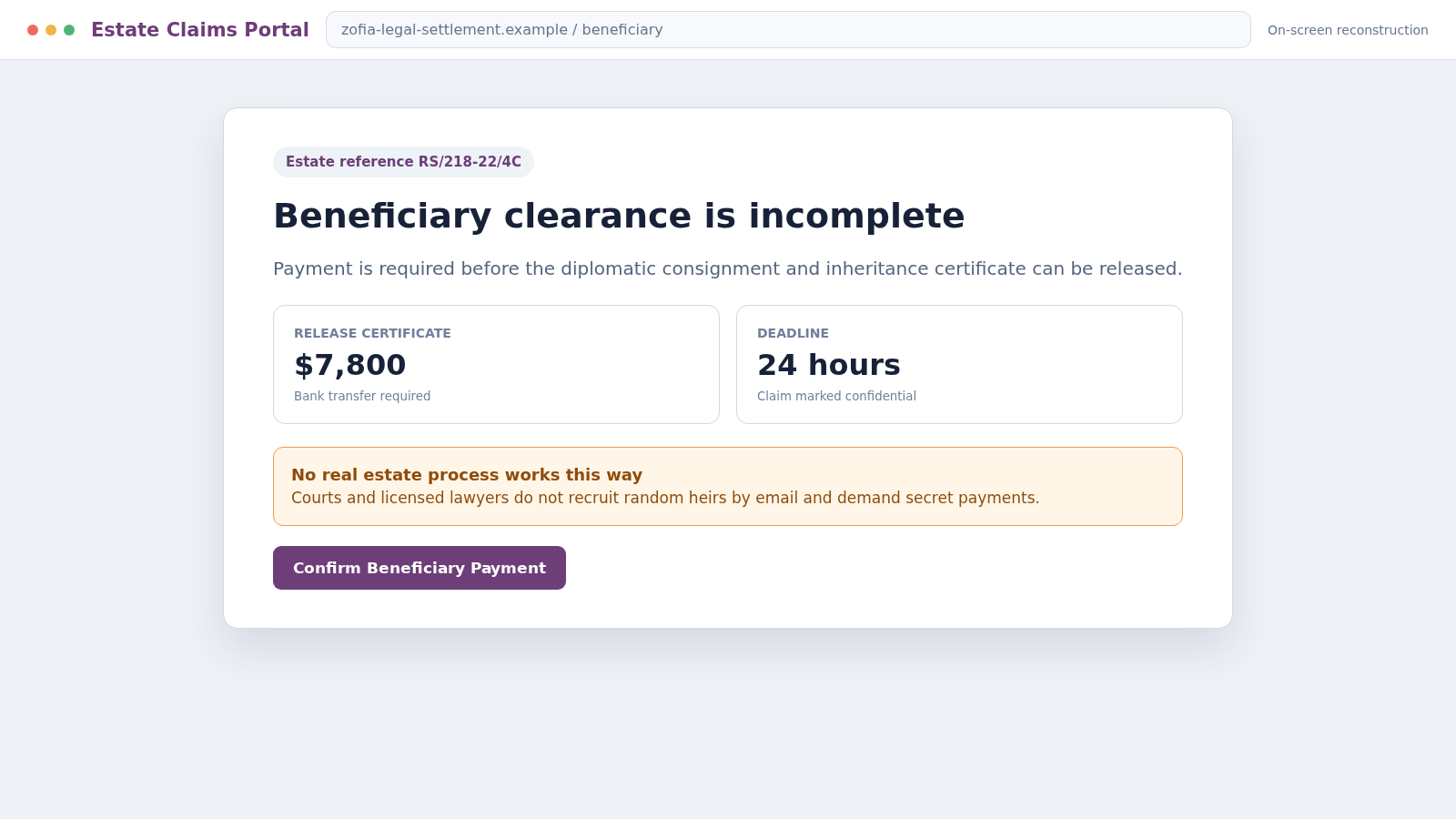
The supposed lawyer asks the recipient to reply only to private addresses and keep the matter confidential. That isolates the target from family members, accountants, and real counsel who would recognize the advance-fee pattern.
A telephone number with a U.S. area code can be added even when the story is set in Spain, the United Kingdom, Switzerland, or another country. Internet calling makes geographic appearance easy to manipulate.
The most important contradiction is moral as well as procedural. The sender is asking a stranger to impersonate an heir. Anyone proposing fraud is not a trustworthy custodian of $88,752,000.
How the Barrister Kristen Zofia Andrzej Scam Works
Step 1: A mass inheritance email reaches the recipient
The campaign sends broadly to addresses collected from breaches, public directories, business sites, and social networks. A generic greeting allows the same letter to reach thousands of people.
The sender presents the approach as private and exceptional. Surprise is reframed as fate rather than a reason for caution.
Step 2: The fake barrister explains the unclaimed estate
A client supposedly died years earlier after placing money or valuables with a bank or security company. No relatives can be found, and a deadline threatens to send the assets to the government.
The recipient is told that their surname or nationality makes the claim plausible. The story never begins with a verifiable court file or executor’s formal notice.
Step 3: Secrecy and a profit split secure cooperation
The lawyer offers a share of the estate in exchange for acting as next of kin. A large promised percentage makes small inconsistencies and later fees feel unimportant.
Confidentiality is described as essential for legal or security reasons. In practice, it stops the target from getting independent advice.
Step 4: Personal documents build the false beneficiary file
The scammer requests a passport, address, phone number, occupation, bank details, and signature. These items are said to be necessary for preparing affidavits and inheritance certificates.
The information can support identity theft. It can also be inserted into forged papers shown to other victims as proof that a beneficiary or business partner is involved.
Step 5: Several fake professionals confirm the claim
A bank officer, probate registrar, security company, courier, or tax official contacts the victim. Each role uses separate letterhead and may have a different telephone number.
The apparent network is controlled by the scammers. Calling a number contained in the paperwork only lets another member of the group confirm the same lie.
Step 6: The first release payment becomes urgent
The victim must pay for a death certificate, beneficiary bond, legal stamp, tax clearance, or vault inspection. The sender says the cost cannot be deducted because the funds are legally frozen.
That is a familiar advance-fee excuse. The promised fortune is always inaccessible, so every expense must supposedly come from the victim.
Step 7: A fake transfer creates hope
The group may provide an online bank login showing millions in a pending account. Another version displays a courier tracking page for the trunk box or diplomatic package.
Those pages are controlled by the sender. A balance or tracking event can be changed with a few lines of website code and does not prove that money or property exists.
Step 8: Additional fees continue until the victim stops
Payment uncovers another obstacle: currency conversion, anti-money-laundering clearance, storage charges, customs inspection, or insurance. Every demand is described as the final one.
When the target refuses, the entire professional cast disappears or a “recovery lawyer” offers to retrieve the loss for a fresh fee.
How Real Inheritance Contact Normally Differs
A genuine executor or probate lawyer can identify the deceased person, court, file number, estate representative, legal basis for contact, and relationship being investigated. Those facts can be checked without using a telephone number selected by the sender.
Real genealogy work does not require a stranger to pretend to be family. An heir must establish an authentic relationship using lawful records, not agree to create one for a percentage of the estate.
A legitimate law firm has lawyers listed with a bar or law society, uses a domain connected to the firm, and can be reached through a separately verified office. A photograph, signature block, or copied address is insufficient.
Fees and taxes are documented through accountable legal processes. A beneficiary is not instructed to buy gift cards, send cryptocurrency, or wire money to a private individual in order to unlock an estate.
Large inheritances involve courts, financial institutions, tax authorities, identity checks, and written professional duties. The idea that $88,752,000 can be redirected because an unknown person answered an email is incompatible with those controls.
If you believe there may be a genuine family estate, hire your own probate lawyer in the relevant jurisdiction. Do not let the person promising the money choose your adviser, bank, courier, or payment route.
Company, Address, and Fulfillment Checks
Confirm the lawyer with the licensing authority
Search the relevant bar association or law society using the full name and firm. Then contact the published office through a number from that official record.
A similar name is not enough. Confirm the individual, license status, firm, address, and whether that lawyer sent the communication.
Locate the probate case independently
Ask which court, registry, executor, and case number control the estate. Contact the court through its government website and verify that the deceased person and proceeding exist.
Do not use a registry link or telephone number supplied in the email. A fake website can imitate a court as easily as it imitates a bank.
Compare addresses, domains, and payment names
A law firm’s verified domain, registered office, telephone number, and client-account name should form a consistent record. Free email services and payments to unrelated individuals are serious contradictions.
Check whether the claimed office is a real firm, private residence, mailbox, or unrelated business. Remember that copying a genuine address proves only that the sender can search the web.
Require fulfillment through your own professionals
Any authentic distribution should be reviewed by a lawyer and bank you select. Do not sign a false beneficiary statement or let the sender guide you through an unfamiliar banking portal.
Money is received only when your own bank confirms cleared funds. A transfer screenshot, courier page, or PDF certificate is not fulfillment.
If the story names a real deceased public figure, search does not end with confirming that the person died. Criminals choose recognizable names precisely because public obituaries and business histories supply believable dates, relatives, and wealth estimates.
The relevant question is whether a real court record connects you to that estate, and the sender must not be the only source saying it does. Independent confirmation must come before documents, travel, or payment.
Do not meet a supposed courier carrying valuables and never pay cash at an airport, hotel, or private office. A change from email to an in-person handoff does not make the underlying inheritance lawful. Tell a trusted person and local authorities if anyone pressures you to attend such a meeting.
What to Do if You Have Fallen Victim to This Scam
- Stop all contact and payments. Do not send a final tax, storage, legal, or recovery fee, even if the sender says earlier payments will otherwise be lost.
- Contact the payment provider immediately. Ask the bank, wire service, card issuer, crypto exchange, or gift card company whether the transaction can be frozen or recalled.
- Save the evidence. Preserve complete email headers, attachments, contracts, identity images, telephone numbers, bank accounts, wallet addresses, and payment receipts.
- Secure your email account. Change the password from a trusted device, remove forwarding rules, sign out unknown sessions, and enable multifactor authentication.
- Protect exposed identity documents. Freeze credit and follow a tailored plan at IdentityTheft.gov if an SSN, passport, or driver’s license was shared.
- Warn your financial institution. Explain what bank details, signatures, and account statements the criminal obtained so suspicious instructions can receive extra scrutiny.
- Notify impersonated organizations. Send the fake documents to the real law firm, court, bank, courier, or government office using independently found contact details.
- Report the fraud. File at ReportFraud.ftc.gov and with the appropriate national fraud agency or police service.
- Scan devices used to open files. Run a full Malwarebytes scan if you downloaded documents, opened archives, or installed remote-access software.
- Block repeat scam destinations. AdGuard may stop many reported phishing pages and deceptive redirects used in follow-up messages.
- Tell trusted people what happened. Secrecy protects the scammer. A family member, lawyer, or accountant can help review new demands and protect remaining funds.
- Expect a recovery scam. Anyone who contacts you unexpectedly and guarantees retrieval for an upfront payment may be using information from the first fraud.
Frequently Asked Questions
Is Barrister Kristen Zofia Andrzej a licensed lawyer?
The email does not establish a verifiable law license or firm. Treat the identity as fictitious or misused unless a relevant licensing authority and independently contacted office confirm it.
Could an unclaimed inheritance really be worth $88,752,000?
Large estates can exist, but they are not reassigned to random email recipients in exchange for secret cooperation. A genuine claim would be tied to a verifiable probate case and real family evidence.
Why does the sender want someone with the same surname?
The surname story makes the proposed fraud sound administratively possible. Lawful inheritance depends on genuine relationships and legal records, not a convenient name match.
Can fees be deducted from the inheritance?
The scammer says they cannot, because that forces the victim to send real money. Do not debate the fee structure; independently verify the entire estate before paying anything.
What if the online bank shows the money?
A website operated by the sender can display a fictional balance. Only a verified institution reached independently and cleared funds in your own account establish that money exists.
Am I in trouble for replying to the email?
Replying alone does not make you part of a crime, but stop before sending documents, signing false declarations, or moving funds. Preserve the messages and report the attempt.
The Bottom Line
The Barrister Kristen Zofia Andrzej scam wraps an old inheritance trick in a precise $88,752,000 figure, foreign legal language, fake professionals, and a promise that secrecy will make the impossible transaction work.
No real lawyer needs a random stranger to impersonate an heir. Do not send money, identity documents, or signatures, and verify any genuine estate through a court and legal adviser you contact independently.








