

A warning suddenly fills the screen. Your bank account, retirement money, or Social Security number is supposedly tied to a serious crime, and a calm voice offers to help.
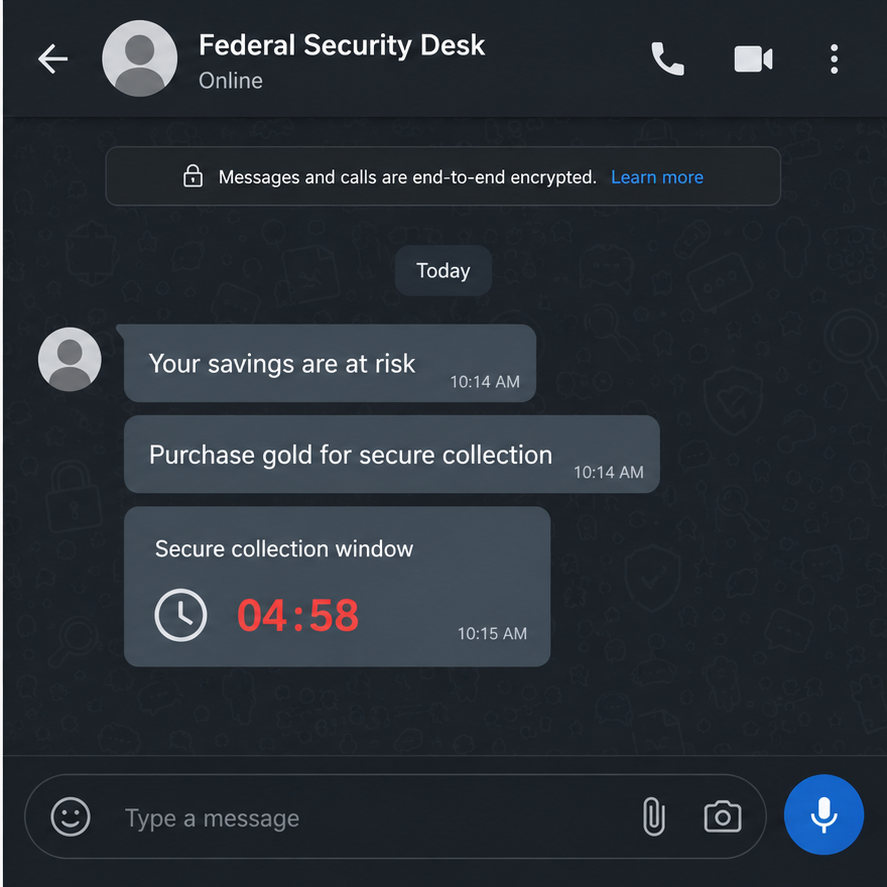
The gold bar protection scam turns that manufactured emergency into an unusual instruction: move your savings into gold and let a courier secure it.
Every part of the conversation is designed to make a dangerous request sound like a careful financial decision.
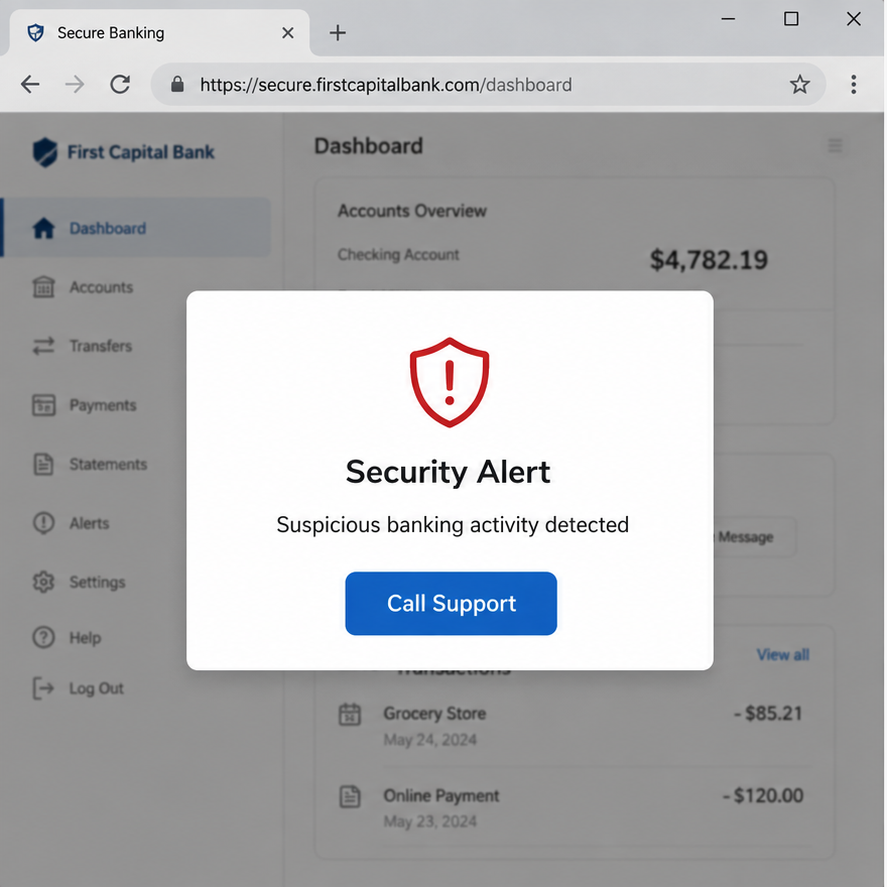
The first person may claim to be a bank employee, technical-support agent, fraud investigator, or government official. A second caller then appears to confirm the story.
Victims are often told that their accounts are no longer safe. The supposed solution is to buy gold bars, photograph the receipts, and hand the metal to an authorized courier.
The courier is not protecting anything. The gold is carried away, the phone numbers stop working, and the victim discovers that the officials never existed.
This is not a theoretical warning. Law enforcement has documented a large, organized campaign in which criminals use remote access, impersonation, secrecy, and in-person pickups to steal life savings.
Overview
The emergency is invented to isolate the victim
The approach often begins with a pop-up, text, email, or telephone call claiming that money or identity information has been compromised. The story may involve hackers, drug trafficking, money laundering, or an arrest warrant.
The criminal says ordinary banking channels cannot be trusted. That claim clears the way for instructions that would otherwise sound absurd.
Gold is presented as a temporary safety measure
The victim is told that buying gold will preserve the money while investigators secure the account. Criminals may describe the purchase as a conversion, verification procedure, federal hold, or protected asset transfer.
None of those phrases changes what is happening. The victim buys an asset that is easy for a courier to collect and difficult to recover.
A complete version of the scheme can include
- a frightening security alert or fake virus warning;
- remote-access software installed on the victim’s computer;
- callers impersonating banks, police, or federal agencies;
- instructions to withdraw money without explaining the real reason;
- purchases of gold bars from legitimate dealers;
- a password, receipt, or photograph used to identify the pickup;
- a courier arriving at the victim’s home or another meeting point;
- strict orders not to tell relatives, bank staff, or local police.
This Is a Confirmed, High-Loss Fraud Campaign
In August 2026, the New York Attorney General warned about the gold bar courier scam after reports of older adults losing their savings.
The warning described victims seeing fake pop-ups, speaking with supposed security representatives, installing remote-access software, and being transferred to criminals posing as government or law-enforcement officials.
According to the alert, the New York City Police Department had investigated more than 100 cases during the previous two years. Reported losses exceeded $100 million.
The size of those losses explains why a criminal network can spend days grooming one target. A successful pickup can be worth far more than thousands of ordinary phishing messages.
The gold dealer, bank, or courier company named in the story may be legitimate and completely uninvolved. Criminals borrow real names because familiarity lowers suspicion.
A government badge, caller ID label, case number, or photograph of an identification card is not proof. Images and documents can be copied, edited, or generated in minutes.
Why Intelligent People Follow the Instructions
The scheme does not begin by asking for gold. It begins with fear, authority, and a problem the victim cannot independently see.
A pop-up says the computer is compromised. A bank specialist says accounts are being drained. A federal investigator says the victim’s identity appears in a criminal case.
Each character validates the previous one. The victim hears several voices and mistakes a coordinated script for independent confirmation.
Remote access makes the performance more convincing. A scammer can move the cursor, display fake account pages, hide windows, or point to ordinary transactions and call them evidence.
The criminal also controls the pace. The victim may remain on the phone while traveling to a bank and gold dealer, leaving no quiet moment to reconsider.
Secrecy is framed as a legal duty. Victims are told that speaking to a teller could compromise an undercover operation, alert a corrupt employee, or lead to arrest.
That instruction is the scam’s protective shield. A relative, banker, police officer, or gold dealer could expose the story immediately, so the criminal works hard to keep them outside it.
Older adults are frequently targeted because they may have retirement savings, home equity, and a strong respect for official authority. Anyone, however, can be caught during a stressful moment.
How the Gold Bar Protection Scam Works
Step 1: A fake alert creates immediate danger
The victim sees a browser pop-up, receives a security text, or answers an unexpected call. The message claims there is fraud, malware, identity theft, or criminal activity connected to an account.
A telephone number is presented as the only safe way to respond. Calling it places the victim directly inside the criminal’s controlled script.
Step 2: A helper requests access and personal details
The first operator may ask the victim to install remote-support software. The program itself may be a real product, but the person using it is an impostor.
While connected, the scammer can view financial information, observe passwords, manipulate what appears on screen, and learn how much money is available.
Step 3: A fake official escalates the story
The call is transferred to a supposed bank fraud officer, police detective, Federal Trade Commission investigator, Treasury representative, or other authority.
The new caller supplies a badge number and case reference. They may send forged documents or direct the victim to search for the real agency online.
Finding that the agency exists proves nothing about the caller. The contact still began through a number or link supplied by the criminals.
Step 4: The victim is ordered to keep the case secret
The impostor says the investigation involves corrupt bank employees or organized crime. The victim must not discuss it with anyone, including family members.
When a teller asks why cash is being withdrawn, the victim may be coached to say it is for home repairs, travel, or a private investment.
Step 5: Savings are converted into gold
The criminal recommends a gold dealer, a bar size, and sometimes a specific purchase amount. They may stay on the telephone throughout the visit.
The dealer can be real. Receiving real gold does not make the protection story legitimate. The purchase is only the middle of the theft.
Step 6: A courier collects the bars
The victim is told that an authorized courier will place the gold in a secure government locker. A password or serial number may be used to make the handoff feel controlled.
The courier arrives at a home, parking area, or agreed location. Once the package changes hands, the network moves it quickly.
Step 7: The criminals demand more or disappear
If the first pickup succeeds, another account problem appears. The victim may be pushed to buy additional bars, pay taxes, or transfer the remaining balance.
Eventually the callers vanish. Some victims are then approached by recovery scammers who claim they can retrieve the gold for another fee.
Identity, Address, Support, and Traceability Checks
The agency name must be verified outside the conversation
End the call. Find the agency’s official website independently and use the published number. Do not ask the suspicious caller to transfer you to a supervisor.
Real law enforcement does not secure personal savings by sending a courier to collect gold from your home.
The caller’s badge and telephone number prove very little
Caller ID can be spoofed. Badge photographs, warrants, and official-looking letters can be fabricated. A criminal can also use the name of a real employee.
Verification means contacting the organization through a separate, trusted route and asking whether the case actually exists.
The pickup address should expose the contradiction
A meeting in a driveway, parking lot, hotel lobby, or roadside area is not a secure federal asset procedure. Neither is handing valuables to an unidentified driver.
Do not travel to a second location or open the door for a courier. Call local police if a pickup has been arranged.
The money trail ends with personal control
Ask who legally owns the gold after the handoff, where it will be stored, and which independently verifiable document records custody. The scam cannot provide a real answer.
A receipt from the gold dealer proves only that the victim bought gold. It does not authorize a stranger to take it.
Warning Signs That Should End the Conversation
- A pop-up tells you to call a security number immediately.
- A stranger asks to install remote-access software.
- Several supposed officials transfer the call among themselves.
- You are told that your bank cannot be trusted.
- A caller orders you to lie about a withdrawal.
- A criminal case supposedly requires total secrecy from family.
- Gold, cryptocurrency, cash, or gift cards are called protected assets.
- A courier will collect valuables from your home.
- The caller becomes hostile when you want to verify independently.
- Another payment is needed before earlier funds can be returned.
One of these signs is enough to stop. You do not need to win an argument with the caller or prove the story false while they remain connected.
How to Interrupt a Pickup Safely
If a courier has not arrived, do not confront the criminal network yourself. End the call and contact local police from another device.
Tell the dispatcher that a suspected fraud courier is scheduled to collect gold, cash, or valuables. Provide the meeting time, address, vehicle details, password, and phone numbers used.
Do not move the meeting to another location unless law enforcement instructs you. Do not place yourself between a courier and an exit.
If the gold remains in your possession, secure it and contact the dealer and financial institution. Ask whether any pending transfers or orders can still be stopped.
If remote-access software is still open, disconnect the device from the internet. Do not use that computer to change banking passwords until it has been checked.
Use a separate, trusted device to contact banks. Ask them to secure online access, review recent transactions, and record that you were targeted by an impersonation scam.
What to Do if You Have Fallen Victim to This Scam
- Call local police immediately. A recent pickup may create a limited opportunity to identify a courier, vehicle, route, or surveillance footage.
- Contact the gold dealer. Preserve receipts, serial numbers, packaging details, camera footage, delivery information, and any records connected to the purchase.
- Alert every financial institution involved. Explain that withdrawals or transfers were induced by impersonation. Ask whether pending activity can be stopped.
- Remove remote access. Disconnect the affected computer, record the software name, and have the device inspected before using it for sensitive accounts.
- Change passwords from a clean device. Start with email, banking, retirement, mobile-carrier, and password-manager accounts. Enable strong multifactor authentication.
- Review account recovery settings. Remove unfamiliar telephone numbers, email addresses, forwarding rules, devices, app passwords, and authorized sessions.
- Preserve the entire script. Save messages, forged documents, call logs, courier descriptions, vehicle plates, meeting details, receipts, remote-access records, and shipping information.
- Protect your identity. If Social Security or identity data was exposed, place credit freezes and review reports for unfamiliar accounts.
- Report the network. File with local police, the FBI Internet Crime Complaint Center, the FTC, and your state attorney general.
- Warn trusted relatives. Criminals depend on isolation. A second person can help document calls, screen new messages, and prevent another payment.
- Scan the affected device. Malwarebytes can detect malicious downloads and unwanted remote-access tools. It cannot recover gold already handed to a courier.
- Block repeat contact. AdGuard can reduce malicious pop-ups and known phishing pages, but it cannot authenticate a caller or government agent.
- Reject recovery offers. Anyone promising a guaranteed return of the gold for an upfront fee may be targeting the victim again.
Frequently Asked Questions
Would a bank ever tell me to buy gold for protection?
No legitimate bank fraud department needs you to convert deposits into gold and surrender it to a courier. End the call and use the number on your card.
Can police or a federal agency collect gold as evidence?
Law enforcement follows documented legal procedures. An unsolicited caller will not order a private purchase and secret driveway handoff to protect your account.
What if the caller knows my real account balance?
That information may have been seen through remote access, stolen data, or earlier phishing. Accurate personal details do not authenticate the person using them.
Is the gold dealer part of the scam?
Not necessarily. Criminals often send victims to legitimate dealers because real receipts and real bars make the story feel safer. Verify the supposed protection program, not only the purchase.
Should I warn the courier that police are coming?
No. Avoid confrontation and follow law-enforcement instructions. Preserve messages and descriptions without putting yourself or anyone else in danger.
Can a bank reverse a gold purchase?
Recovery is difficult after gold is collected. Immediate reports may still help stop pending transfers, identify the pickup, or preserve evidence.
The Bottom Line
The gold bar protection scam succeeds by making surrender sound like security. The bank alert, federal case, confidential instructions, and courier are parts of one coordinated theft.
No legitimate institution will protect your savings by asking you to buy gold, hide the reason from your family, and hand the bars to a stranger.
End the call, verify through official numbers, and involve local police before any pickup occurs. One independent conversation can break the spell the criminals worked so hard to create.








