

A message says your opinions are worth a generous payment and a respected research company wants you for a mystery-shopping assignment. The first task sounds simple: deposit a check, visit a store, and report on the service.
The Atkins Research Global scam hides its most expensive instruction behind that ordinary work story. The name belongs to a real research business, but the recruiter, check, and assignment may all belong to an impersonator.
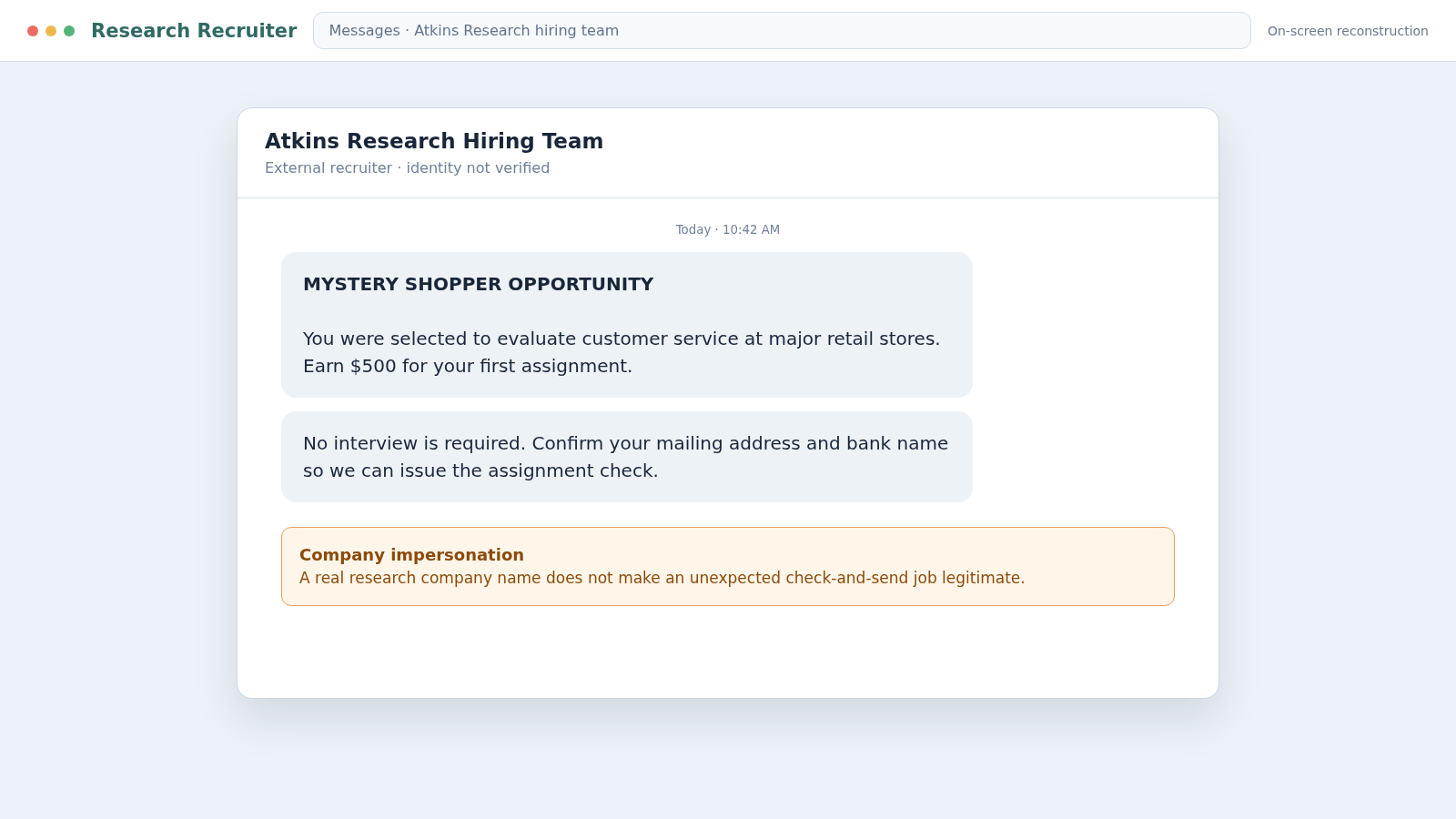
Overview
Criminals are impersonating a legitimate research company
Atkins Research Global is a real market-research and focus-group business in Los Angeles. Genuine researchers recruit qualified participants for specific studies and compensate them for their time and opinions.
The Atkins Research Global scam is an impersonation. Someone borrows the company’s name when offering a mystery-shopper, survey evaluator, feedback specialist, product tester, or remote research position that the real company did not authorize.
The fake job uses a counterfeit check as its engine
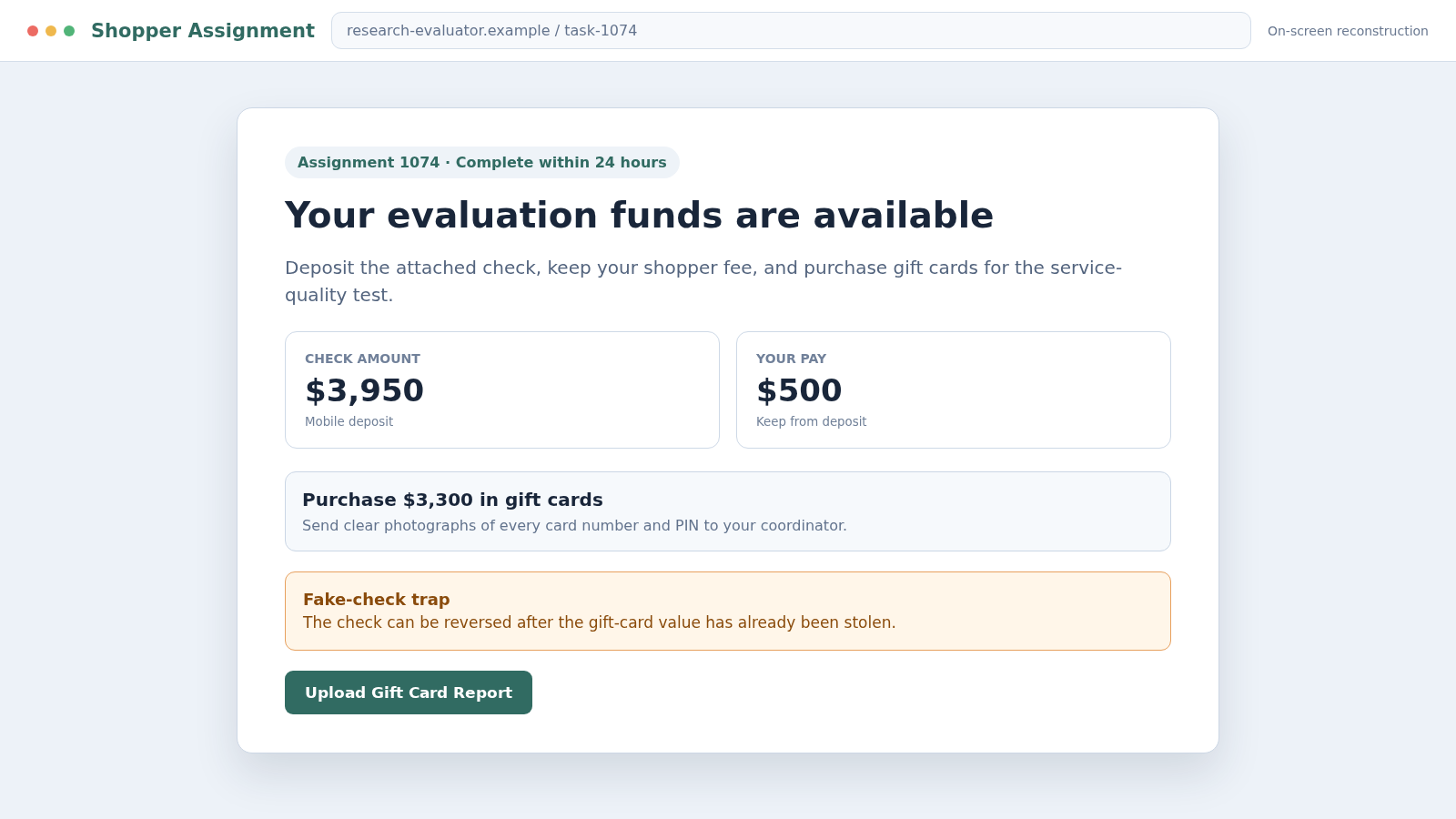
The supposed employer sends a check before meaningful work begins. The recipient is told to deposit it, keep a portion as wages, and use the remaining money to buy gift cards, send a transfer, purchase cryptocurrency, or pay a designated supplier.
A banking app may show the deposit as available. That does not mean the issuing account has been authenticated or the check has finally settled. When the bank discovers the fraud, the deposit is reversed while the victim’s outgoing payment remains real.
The scam can steal identity information before money moves
Applications and onboarding forms may request details that feel normal in a hiring process. The problem is that they arrive before the recruiter and vacancy can be independently verified.
Information at risk can include:
- Full name, address, telephone number, and date of birth
- Social Security number and tax forms
- Driver’s license or passport images
- Bank routing and account numbers for supposed payroll
- Online banking screenshots and mobile deposit limits
- Signatures, selfies, and answers to security questions
- Names of relatives, employers, and professional references
A legitimate company name does not make an unexpected recruiter genuine. Verification must connect the individual, email domain, study, and payment process to the real organization.
What the Fake Mystery-Shopper Offer Looks Like
The invitation may arrive by text, email, social media, or a job-board message. It often promises flexible work, no experience requirements, and unusually high pay for evaluating a familiar retailer.
The recruiter says the company needs reliable people to measure customer service, gift-card handling, money-transfer counters, or product displays. The task feels plausible because real market research and legitimate mystery shopping both exist.
Little is done to determine whether the applicant is suitable. A short form may ask for contact details and a preferred bank, then the candidate is accepted within hours.
A package or email arrives with a check and printed instructions. The total is larger than the stated wage because most of it is supposedly the assignment budget.
The victim must act quickly, send photographs of purchased gift cards, reveal their PINs, or transfer funds to an “evaluation target.” The report itself is irrelevant. Moving real money before the check fails is the entire purpose.
How the Atkins Research Global Scam Works
Step 1: The impersonator finds people seeking flexible work
Targets may have posted a résumé, completed a survey, joined a local job group, or responded to an advertisement. Other messages are sent broadly and rely on the appeal of easy side income.
The opening note uses the Atkins Research name to borrow credibility. A logo, office address, staff name, or link to the genuine business may be copied directly from public information.
Step 2: A simple role lowers the barrier
The position is described as mystery shopper, quality evaluator, product tester, survey agent, or feedback specialist. No technical background is needed, and assignments supposedly fit around another job.
High pay makes the offer emotionally attractive, while the low qualification threshold prevents detailed interviews that might expose the recruiter’s lack of knowledge.
Step 3: A lightweight application gathers personal data
The applicant fills in a form with an address, age, telephone number, and bank name. The scammer may say the bank name is needed only to avoid issuing a check from the same institution.
That question actually helps the criminal choose a counterfeit check that may take longer to identify. More intrusive forms collect an SSN, identity document, or direct-deposit information for later misuse.
Step 4: Acceptance arrives without genuine screening
The candidate is approved quickly and told that the first assignment is already funded. There may be an employment letter, evaluation sheet, coordinator signature, or worker identification number.
Those items are inexpensive to create. A legitimate-looking PDF does not show that the sender controls a company account or that a real study exists.
Step 5: A realistic check creates apparent purchasing power
The check may be delivered by courier, attached as an image for mobile deposit, or printed by the victim. It can display a real bank’s name, routing information, security pattern, and the identity of an unrelated business.
Counterfeit checks can temporarily pass automated processing. Availability of funds is a banking convenience, not a guarantee that the check is valid.
Step 6: The victim must spend most of the deposit
Instructions say to keep a fee and use the rest for gift cards, money orders, wire transfers, cryptocurrency, or products from a supplier. The shopper must report serial numbers, PINs, receipts, or transaction references.
Once a gift-card code is shared, criminals can redeem or resell it immediately. The victim has converted an uncertain check into irreversible value that the scammer controls.
Step 7: Pressure keeps the assignment moving
The coordinator asks for progress updates and warns that delay will damage the research project. If a cashier or bank employee questions the purchase, the victim may be told to say the cards are personal gifts.
A real employer does not require a worker to mislead a financial institution or retailer. The false explanation is meant to defeat fraud controls protecting the victim.
Step 8: The check returns and the recruiter disappears
Days or weeks later, the bank determines that the check is counterfeit, altered, or drawn on a stolen account. The deposit is removed, fees may be charged, and the account can be restricted while the incident is reviewed.
The criminal blocks the victim or invents a second payment to fix the problem. Any identity information collected during onboarding can remain useful long after the fake assignment ends.
Why “Funds Available” Does Not Mean the Check Is Good
Consumers often believe a bank would never let them use money from a bad check. In reality, financial institutions can be required to make deposited funds available before every part of the check is verified.
The check may use a valid routing number but a false account, a closed account, or the details of an innocent organization. Discovery can take longer when the real account holder does not immediately notice the item.
The bank credits the deposit provisionally. If the paying bank later rejects it, the provisional credit disappears. The customer who deposited the item can still be responsible for the negative balance.
Scammers understand this timing gap. Their deadline is built to make the victim send money during the period when the account appears healthy but the check remains unresolved.
Before depositing an unexpected employment check, tell the bank exactly who sent it and what you are being asked to do. A teller seeing available funds cannot promise that the item will not be returned later.
Warning Signs of a Fake Research Assignment
- An unsolicited recruiter offers work without a meaningful interview.
- The sender uses a free email address or a lookalike domain.
- Pay is unusually high for a short, simple shopping task.
- A check arrives before any work has been completed.
- The check includes money that must be sent elsewhere.
- The assignment centers on gift cards or money transfers.
- The coordinator wants photographs of gift-card codes.
- You are told to hide the real purpose from a cashier or bank.
- Everything must be completed the same day the deposit appears.
- The recruiter becomes hostile when you contact the real company.
A mystery-shopping assignment can be legitimate, but it should not turn your personal bank account into the project’s payment processor. Honest companies do not need a new worker to convert their check into gift-card codes.
Company, Address, and Fulfillment Checks
Start with the real company’s independently found website
Type the company’s address yourself or use a trusted business registry. Do not rely on a link, telephone number, or social profile supplied by the recruiter.
Confirm the exact study and recruiter
Contact the research company through its published channel and ask whether the named person, project, job title, and payment arrangement are authorized. A real company may exist while the contact remains fake.
Compare the email domain and physical address
Read the domain character by character and compare it with the verified site. Check whether the office belongs to the company rather than a virtual mailbox, residence, or unrelated tenant.
Verify how genuine participants are paid
Ask when and by whom compensation is issued. A real participant payment should not require depositing a larger check, purchasing gift cards, or forwarding most of the funds to a third party.
How Legitimate Market Research Works Differently
A genuine focus-group invitation describes a study, eligibility requirements, approximate duration, location or platform, and incentive. Screening questions determine whether the participant fits the research audience.
Compensation may arrive after participation through a check, prepaid card, or electronic payment. The participant is paid for time and feedback rather than asked to finance purchases from a personal account.
Some research projects require confidentiality, but confidentiality does not prevent verification of the company and recruiter. It also does not require lying to a bank or retailer.
Real mystery shoppers may purchase an item and submit a receipt for reimbursement under clear terms. That is different from receiving a large check and sending most of its value away before the assignment is complete.
If an opportunity is genuine, it will survive a callback to the official business. An honest coordinator will understand why a participant wants to confirm an unexpected check.
What to Do if You Have Fallen Victim to This Scam
- Stop the assignment. Do not buy another card, send another transfer, or refund the supposed employer. Block the recruiter after preserving the conversation.
- Contact your bank’s fraud department. Explain that you deposited a check connected to a job scam. Ask the bank to review the item, secure the account, and explain how any negative balance will be handled.
- Contact gift-card or transfer providers. Give them receipts, card numbers, and transaction references. Ask whether unused value can be frozen or a transfer recalled, but do not pay anyone who guarantees recovery.
- Preserve the package and documents. Save the envelope, shipping label, check image, assignment sheet, emails with headers, texts, telephone numbers, and payment records. Handle the check as evidence rather than destroying it.
- Report identity exposure. If an SSN or identity document was shared, create a recovery plan at IdentityTheft.gov, review credit reports, and consider a fraud alert or freeze.
- Secure your email and job accounts. Change reused passwords, enable multifactor authentication, and review active sessions. Remove any forwarding rule or recovery address you do not recognize.
- Scan files and devices. If you opened an attachment or installed an interview tool, use Malwarebytes to check for remote-access software, credential stealers, and unwanted programs.
- Reduce malicious redirects. AdGuard can help block reported phishing and advertising domains used in fake job campaigns, but it cannot validate a recruiter by itself.
- Report the impersonation. Submit the incident at ReportFraud.ftc.gov, notify the job board and real company, and report substantial losses to local police.
- Prepare for a second approach. Stolen applicant data may trigger fake bank calls, payroll messages, or recovery offers. Independently verify every contact that refers to the original incident.
Frequently Asked Questions
Is Atkins Research Global a real company?
Yes, a legitimate market-research business uses that name. The scam comes from criminals impersonating the company, so the existence of the real organization does not authenticate a recruiter.
Are all mystery-shopping jobs scams?
No. Legitimate mystery-shopping work exists, but a genuine assignment does not require depositing a large check and sending most of the money away through gift cards, wires, or cryptocurrency.
Why did my bank make the check available?
Funds can become provisionally available before the paying account and check are fully verified. If the item is later returned, the bank can reverse the deposit.
Can I keep the portion described as my pay?
No. If the check is fraudulent, none of its value is legitimate wages. Contact the bank before moving or spending any part of the deposit.
What if I received a check but did not deposit it?
Do not deposit or cash it. Preserve the envelope and instructions, tell the real company about the impersonation, and report the attempt to the platform and appropriate authorities.
What if the recruiter used the real company address?
Public addresses are easy to copy. Confirm the individual’s authorization and the exact assignment by contacting the business through a channel you locate independently.
The Bottom Line
The Atkins Research Global scam works because a real company and a familiar type of side job make the counterfeit check feel less suspicious. The visible balance encourages the victim to spend before the bank finishes verifying the item.
No honest researcher needs gift-card PINs or money forwarded from a new participant’s account. Verify the recruiter with the real company, reject any check-and-send assignment, and contact the bank immediately if the deposit has already been made.

Join the discussion
0 commentsShare your experience or ask a question about this article.
Discussion
Start the conversation
Have a question or something useful to share? Add the first comment.