

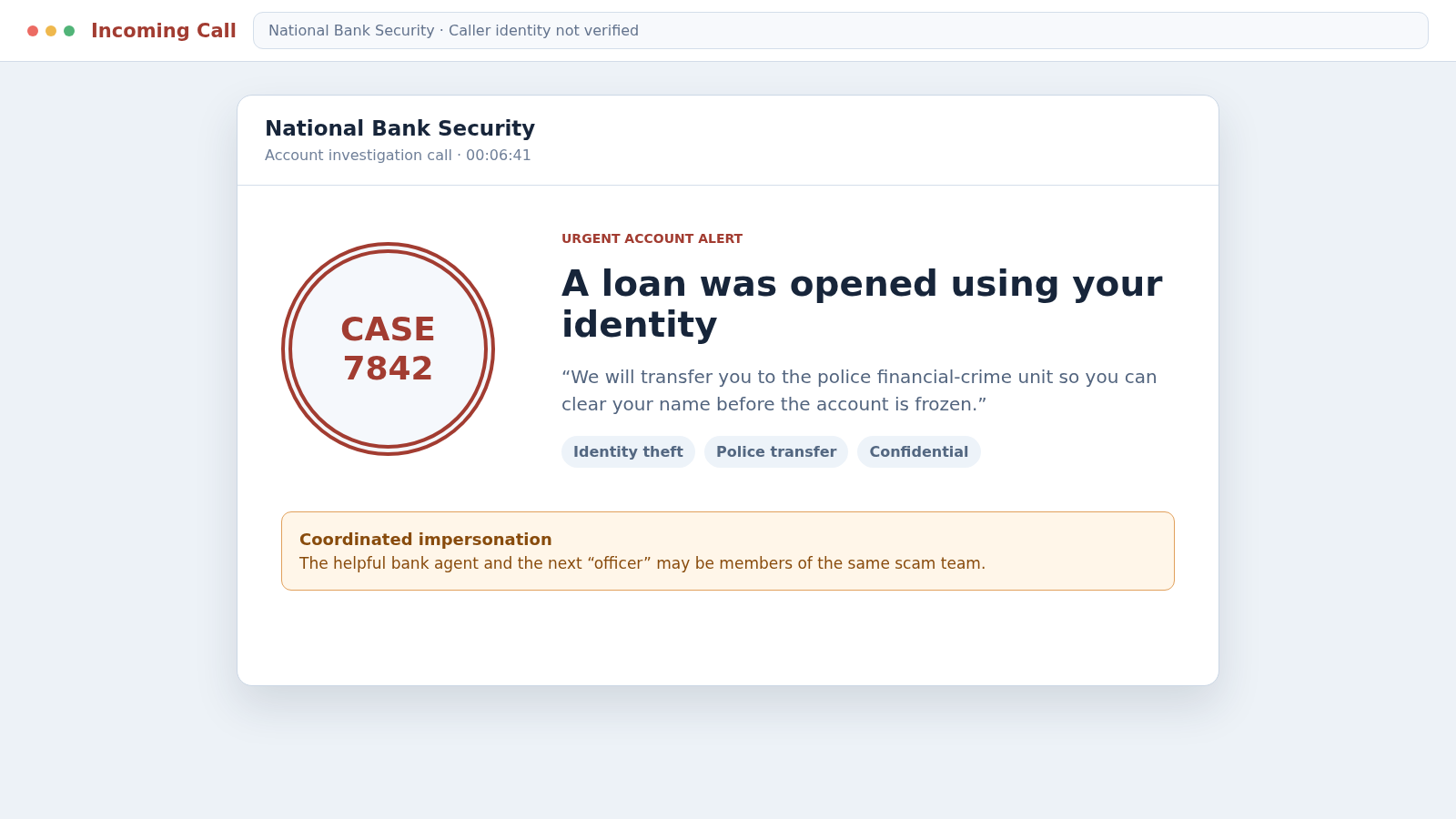
A caller says your identity is tied to an unpaid account, illegal parcel, or money-laundering investigation. The call is transferred to a police officer who already seems to know the case.
Macau Scam Calls are coordinated impersonation fraud, not an informal request for information. Each new official tightens the story until moving money feels like the only way to avoid arrest.
Overview
The term describes a pattern, not one telephone number
A Macau scam usually begins with an unexpected call from someone posing as a bank, delivery company, telecom provider, court, tax office, or government department. The victim is accused of a serious financial or criminal problem.
The name is widely used in Malaysia and parts of Asia for this organized call-transfer fraud. It does not mean every call originates in Macau, and caller ID cannot reliably show where the operation is located.
Several fake officials build one continuous case
The first caller may discuss a card, loan, parcel, or telephone line. They then transfer the target to an accomplice acting as a police investigator, central-bank officer, prosecutor, or senior official.
Each person confirms the previous story and adds formal language, badge numbers, case references, or forged documents. The apparent cooperation between agencies is staged by the same criminal group.
The investigation ends with stolen access or money
Victims may be told to reveal banking credentials, install an application, open a new account, hand over one-time codes, or transfer savings to a safe account for auditing.
The criminals may demand:
- Identity-card, passport, address, and employment information
- Bank balances, account numbers, and card details
- Online-banking credentials and transaction codes
- Remote access or a malicious mobile application
- Transfers to a third-party safe or investigation account
- Secrecy from family, bank employees, and local police
- Repeated payments described as security or evidence checks
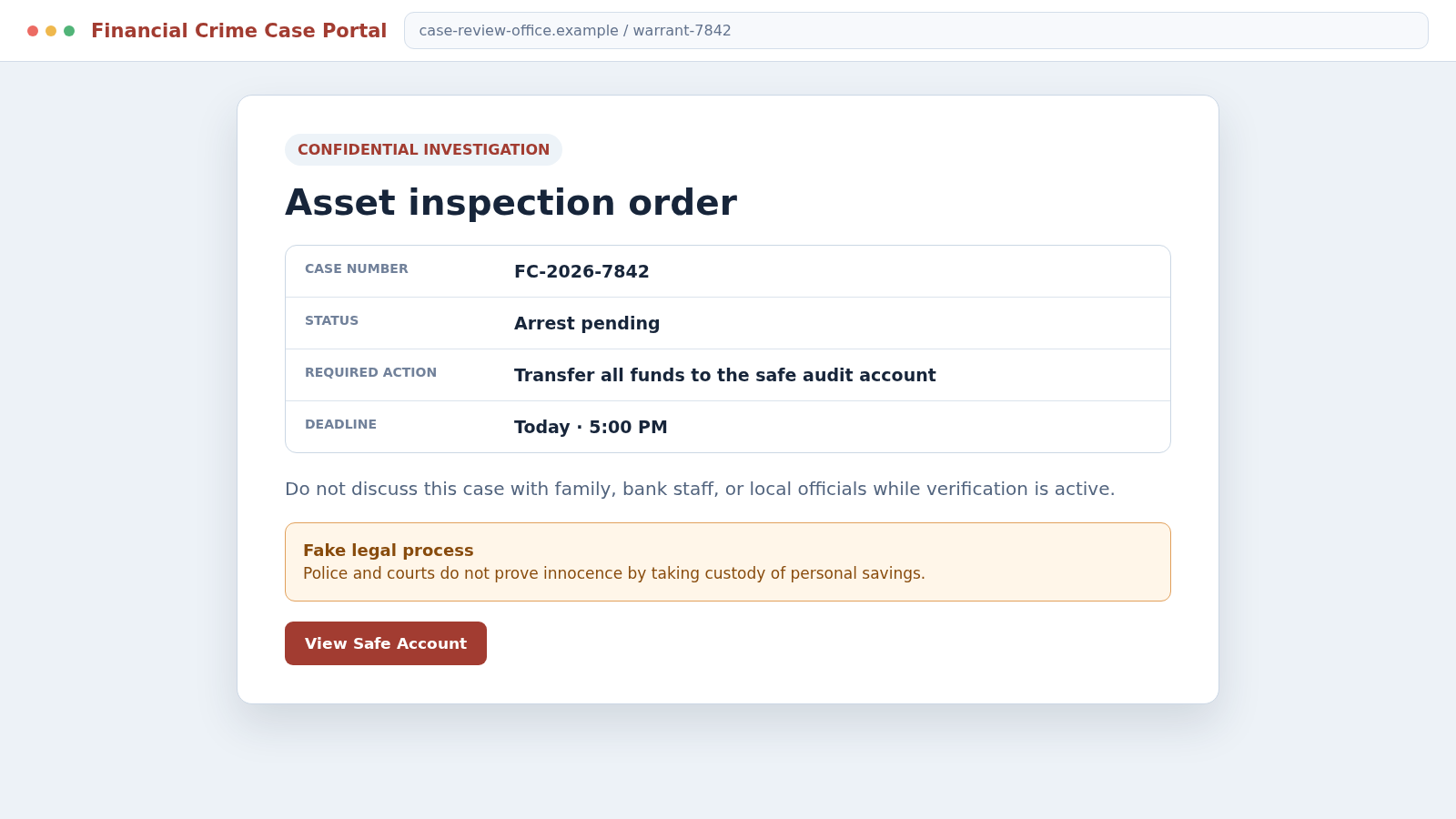
Bank Negara Malaysia describes the scam as calls from people impersonating banks or public officials to obtain banking details or transfers. Real authorities do not investigate innocence by taking custody of a citizen’s savings.
The Stories Used in Macau Scam Calls
One version begins with a supposed bank employee reporting a credit card or loan opened in the victim’s name. The victim denies it, and the call is transferred to police to report identity theft.
Another caller claims a parcel contains illegal drugs, passports, bank cards, or prohibited goods. A fake customs or courier representative says only law enforcement can clear the recipient’s name.
Telecom impersonators may allege that a mobile number registered to the victim distributed scam messages. Tax and court versions claim unpaid penalties or a missed summons.
The accusation is chosen to be frightening and difficult to disprove during a call. Most people cannot instantly check another city, agency, card issuer, or parcel system.
Once the target protests, the first caller sounds helpful and offers to transfer the case. That apparent assistance is how the victim is delivered to the next stage.
How Macau Scam Calls Work
Step 1: A cold call introduces a believable problem
The operation contacts large numbers of people through ordinary calls, internet calling, messaging apps, or spoofed numbers. Leaked personal data may help the opening sound targeted.
The caller names a bank, courier, telecom provider, or government body that many people recognize. They ask whether the victim authorized an account, shipment, or transaction.
Step 2: Denial is turned into evidence of identity theft
When the victim says the activity is unfamiliar, the caller does not end the case. They say criminals must have stolen the victim’s identity and that an urgent police report is required.
This move changes the fake caller from accuser to helper. The target may feel relieved that someone believes them and accept the offered transfer.
Step 3: An accomplice becomes the investigating officer
A second person answers with a formal title, station name, and case number. They may already know the facts discussed with the first caller because the criminals share notes or remain on the same system.
Call transfers between unrelated agencies are not proof. In a real investigation, a person can end the call and contact the relevant office through an independently verified number.
Step 4: Forged evidence makes the threat feel official
The fake officer may send photographs of an arrest warrant, freezing order, badge, non-disclosure form, or evidence file. Video calls can show a staged office background or uniform.
Names and logos copied from real institutions do not make the document valid. Criminals can insert the victim’s information into a reusable template within minutes.
Step 5: Secrecy isolates the victim from reality checks
The target is warned that discussing the case could obstruct justice, alert other suspects, or trigger immediate arrest. Family members and bank employees are described as possible accomplices.
Isolation prevents the short conversation that might expose the scam. Real legal representation and independent advice are rights, not evidence of guilt.
Step 6: Financial details are collected for an audit
The officer asks for balances, account numbers, income, cards, and online-banking information. They claim the data is needed to distinguish lawful money from criminal proceeds.
A link or application may be supplied for submitting statements or joining the investigation. It can steal credentials, messages, contacts, or remote control of the device.
Step 7: Savings are moved to a safe account
The victim is told to transfer money for verification, asset inspection, or temporary protection from a freezing order. The recipient may be described as a central-bank, police, court, or government account.
In reality, it belongs to a money mule or criminal-controlled business. The label spoken by the caller does not change the recipient shown by the banking system.
Step 8: The fake case expands until the money is gone
After one payment, another issue appears: a failed audit, new suspect, tax, bond, or verification fee. The scammers maintain daily contact to prevent the victim from reconsidering.
When funds are exhausted or the bank intervenes, the callers disappear. Another group may later promise recovery while demanding an advance payment.
Why the Call Transfer Feels So Convincing
People expect organizations to transfer difficult cases to specialist departments. The scam copies that routine behavior but keeps every participant inside one controlled telephone environment.
The second caller can repeat the victim’s name and case details because the first caller collected them. Information passed between accomplices looks like access to an official database.
Background sounds, hold music, formal greetings, and case numbers add theater. None provides independent confirmation of the caller’s authority.
A genuine organization will allow a person to hang up, find its published number, consult family or counsel, and attend a real office. A scammer frames those safeguards as dangerous delay.
The safest response is to break the chain. Every claim must be restarted through a separate channel that the original caller did not provide.
Caller ID, Video Calls, and Fake Documents
Internet calling services can make the display show a local, private, or familiar number. An international location shown on screen does not establish where the caller is physically operating.
A video call can be staged with a background, uniform, nameplate, or copied emblem. The presence of a face or office is not the same as verification through an agency.
Forged warrants often use urgent language and threaten confidentiality. Real documents follow legal procedures and can be checked with the issuing court or agency outside the conversation.
Do not scan a QR code, install an app, or open a file merely to inspect supposed evidence. The material can lead to credential theft or device compromise.
Record the details only if it is safe, then end the call. Do not remain connected while attempting to contact police or the bank.
Warning Signs of a Macau Scam
- An unexpected caller accuses you of a serious crime or debt.
- The call moves directly between unrelated organizations.
- A stranger sends a warrant or freezing order through chat.
- You must keep the investigation secret from family.
- The caller asks about every bank balance you hold.
- An app or link is required for police verification.
- One-time codes must be read to an investigating officer.
- Money must move to a safe or audit account.
- The caller will not allow an independent callback.
- More payments appear after the first transfer.
Authority, fear, and secrecy are the core combination. The specific agency, accusation, and document can change while the financial objective remains the same.
How to Verify the Allegation Safely
Hang up without pressing a number for another department. Search for the organization’s official contact details through a government or bank website and start a new call.
Call the bank using the number printed on the card or inside its official app. Ask whether the claimed account, transaction, or security event exists.
Contact local police directly if the caller alleged a crime. Do not use a number, link, QR code, email address, or office location sent during the suspicious conversation.
Malaysia’s official Semak Mule service can help check telephone numbers, bank accounts, and company names associated with reported fraud. A clean result is not proof of safety because new mule accounts appear constantly.
If money has already moved, contact the sending bank and national anti-scam response channel immediately. The chance of interruption falls as funds pass through additional accounts.
Company, Address, and Fulfillment Checks
The agency name may be real while the caller is fake
Criminals impersonate genuine banks, courts, police forces, and government departments. Confirm the person through the institution, not the institution through the person.
The displayed number does not reveal the call center
Caller ID can be spoofed, and calls can be routed across borders. A local prefix or official-looking number is not proof of physical location or authority.
Official support permits independent verification
A real employee should not object when you hang up and call a published number. Refusal, secrecy, and threats show that the caller needs control of the channel.
The receiving account is not a government safe account
Check the actual beneficiary name and account. Police, courts, and central banks do not ask citizens to prove innocence by transferring their private savings to a third party.
What to Do if You Have Fallen Victim to This Scam
- End contact immediately. Stop calls, video sessions, chats, and payments. Do not send a final fee to close the investigation or release frozen funds.
- Call the sending bank now. Use a trusted number, state that the transfer was induced by impersonation, and request urgent recall, beneficiary-bank contact, and account protection.
- Contact the national anti-scam response service. In Malaysia, use the current official response channel and make a police report. Provide transaction times and recipient details without delay.
- Secure online banking and email. Change passwords from a clean device, remove unknown sessions and payees, review recovery details, and enable stronger authentication.
- Replace exposed cards and identity documents. Tell the issuing institutions what images or numbers were shared and follow their steps for monitoring or replacement.
- Remove suspicious applications. Disconnect a remotely controlled device, uninstall tools added during the call, and run a full scan with Malwarebytes.
- Reduce malicious follow-up traffic. AdGuard can help block known phishing pages and deceptive ads, but banking and identity recovery still require direct institutional action.
- Preserve every record. Save call logs, recordings, chats, warrants, links, app names, bank receipts, beneficiary details, and cryptocurrency addresses.
- Tell a trusted person. Secrecy was imposed to isolate you. A relative, lawyer, bank investigator, or real police officer can help organize the response calmly.
- Reject recovery agents. Do not pay anyone who guarantees a refund, arrest, account unlock, or asset release. Share new approaches with the investigating bank and police.
Frequently Asked Questions
Do Macau Scam Calls really come from Macau?
Not necessarily. The term describes a style of organized impersonation fraud. Internet routing and caller-ID spoofing can hide the operation’s actual location.
Can police transfer my call from a bank investigation?
Do not trust a transfer arranged by an unexpected caller. End the call and contact the bank and police separately through their published channels.
Will authorities ask me to use a safe account?
No legitimate criminal investigation requires you to transfer savings to prove innocence or protect funds. Treat that instruction as fraud.
What if the caller sent a warrant with my name?
Personalized documents can be generated from information collected during the call or a leak. Verify with the issuing court or agency independently.
Can a video call prove the officer is genuine?
No. Uniforms, offices, badges, and backgrounds can be staged or manipulated. Verification must come from a separate official channel.
Is it too late after I transferred money?
Do not assume so. Contact the bank and anti-scam authorities immediately. Rapid reporting may help stop funds before they move through additional accounts.
The Bottom Line
Macau Scam Calls create a closed world in which a bank, courier, police officer, and court all seem to confirm the same accusation. In reality, every voice may belong to one coordinated fraud network.
No authority needs your passwords or savings to establish innocence. Hang up, verify each claim independently, and contact the bank immediately if any money or account access has been exposed.








