

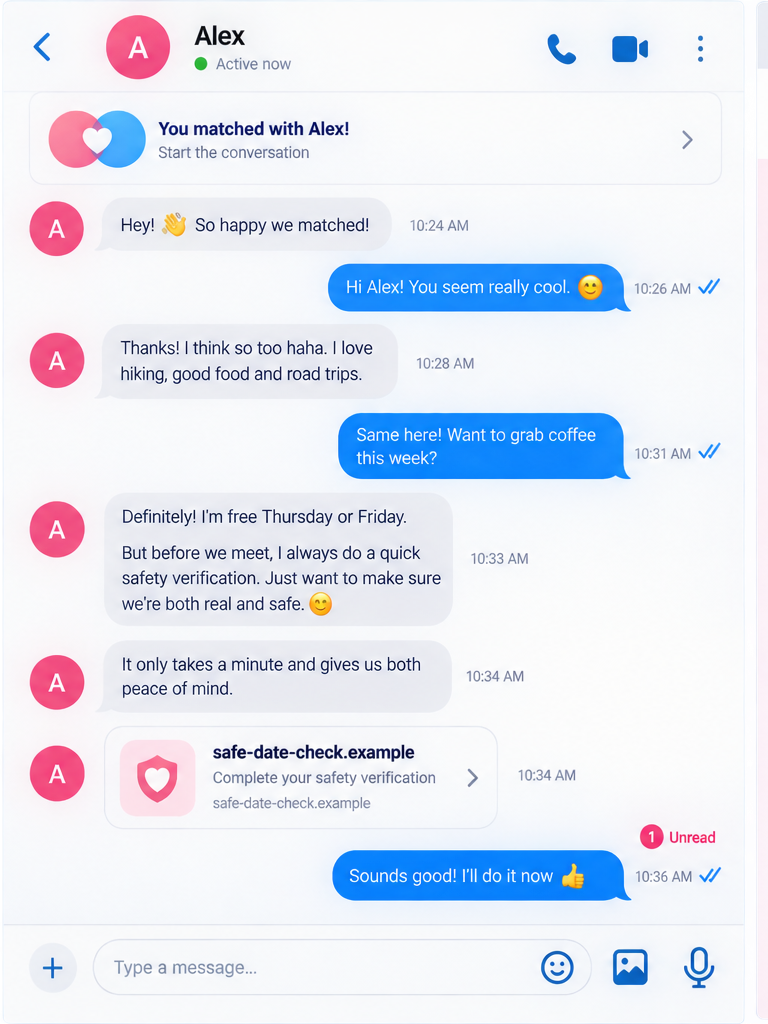
A new match seems thoughtful enough to put safety first. Before meeting, they ask you to complete a quick online check that supposedly proves you are not dangerous.
The dating verification scam turns that reasonable-sounding boundary into a link, a card form, and charges that were never part of the conversation.
The person in the chat is not trying to feel safer. They are steering you toward the checkout.
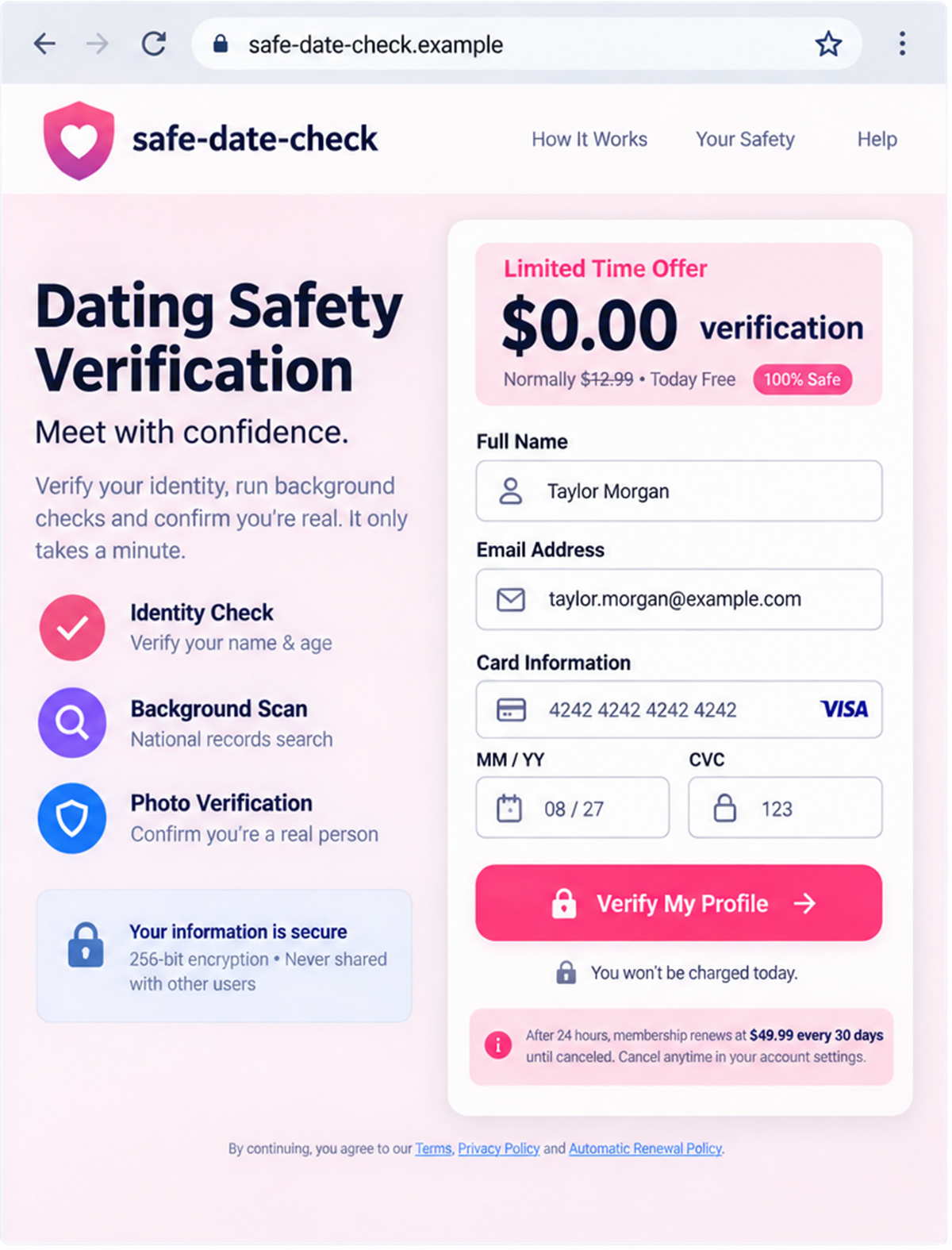
The verification page may say the check is free, costs only a small authorization amount, or exists to screen for sex offenders and violent criminals.
It asks for a name, phone number, email address, and credit card. Fine print may enroll the visitor in an unrelated, expensive dating membership that renews every month.
Other versions keep the card data for fraud or use the identity details in later phishing. The match disappears after the form is completed.
The FBI has warned about this exact pattern on dating websites and apps. It is a confirmed recurring-payment and data-theft scheme, not merely an awkward request from one suspicious profile.
Overview
A safety request lowers normal suspicion
People expect online matches to be cautious. A request for identity or background verification can sound responsible, especially before an in-person meeting.
The scammer reverses the usual risk. Refusing the link is framed as proof that the victim has something to hide, while compliance is presented as respect.
The free check is a paid enrollment
The page highlights $0 verification or a tiny authorization. The recurring price appears in lighter text, below the button, inside linked terms, or under the name of a different company.
After submission, the card may be billed monthly for a low-quality dating site or membership the user never intended to join.
The form creates several kinds of exposure
The card charge is only one danger. Contact details and credentials can support identity theft, account takeovers, targeted phishing, or the sale of victim information.
- A new match builds rapport quickly.
- The conversation moves off the dating platform.
- Safety becomes a condition for meeting.
- A stranger supplies the only acceptable verification link.
- The page calls the process free.
- Card details are required to prove identity.
- Fine print creates a recurring subscription.
- The match vanishes or sends more payment requests.
The FBI Confirmed the Verification Subscription Scheme
In April 2024, the FBI warned users of dating platforms about free verification schemes designed to produce costly recurring payments.
The advisory describes fraudsters who meet people on a dating site or app, show romantic interest, and quickly move the conversation to an encrypted messaging platform.
Under the guise of personal safety, the fraudster sends a website claiming to protect users from predators such as sex offenders or serial killers.
Fake articles and borrowed media logos are used to make the verification service look legitimate. The victim is asked for contact information and credit card details.
Submitting the form can redirect the victim to a private, low-quality dating service with expensive monthly charges. The statement later shows a business name the victim does not recognize.
The FBI also warns that information collected during registration can be used for identity theft or sold to other criminals.
This report addresses the criminal verification funnel. It does not suggest that every identity-checking service or safety feature offered by a legitimate dating platform is fraudulent.
Why the Safety Story Is So Persuasive
The request arrives at a moment when both people are deciding whether an online conversation should become a real meeting. Caution is expected, so the scam does not need an unbelievable promise.
The match may describe a frightening past experience or say every serious date completes the same check. That personal explanation makes the link feel like a boundary rather than a sales pitch.
Social pressure does the rest. Asking questions can be treated as disrespectful. The victim may worry that refusing a free check will end a promising connection.
The website reinforces the pressure with safety badges, fake news coverage, background-check language, and claims that thousands of daters trust the service.
None of those visual elements prove access to criminal records or a relationship with the dating app. A logo can be copied, and a counter can be invented.
The card requirement is explained as age confirmation or a way to prevent bots. Real identity checks may have costs, but a stranger should not control which provider receives your payment details.
The phrase free verification keeps attention on today’s price. The real charge may begin after a short trial and repeat until the user finds the correct billing company and cancellation route.
How the Hidden Subscription Appears
The checkout may show $0.00 in large type while placing the renewal terms beneath the submit button. On a small screen, the disclosure can sit below the visible area.
A preselected checkbox can authorize membership. Another design puts the recurring price inside a long paragraph beside phrases such as terms, privacy, or partner offers.
The verification brand shown on the landing page may not match the descriptor that appears on the card statement. That difference delays recognition and makes cancellation harder.
Some sites route users through several domains. The first page promises safety, the second collects data, and the final page enrolls the card with a separate entertainment or dating service.
A small test authorization can later become a full monthly fee. Multiple affiliated memberships may be created from one submission.
Cancellation links can be difficult to find, reject the email address, or demand more identity information. The scammer in the chat has no reason to help once the enrollment is complete.
Even when the terms technically appear somewhere, the surrounding deception matters. A romantic profile recruited the user for a supposed safety check, not a voluntary entertainment subscription.
How the Dating Verification Scam Works
Step 1: A polished dating profile starts a conversation
The account uses appealing photos, a believable biography, and messages tailored to the victim’s interests. Images may be stolen from another person’s public profile.
The scammer avoids obvious requests for money. Early conversation is friendly because the link works better after a little trust has formed.
Step 2: The chat moves to a private messaging app
The match asks to continue by text or through an encrypted messenger. Moving away from the dating platform reduces moderation and makes the original account easier to abandon.
The victim also loses some reporting context because the decisive messages occur outside the service where the pair met.
Step 3: Meeting depends on a safety verification
The scammer suggests coffee, dinner, or another believable plan, then introduces a firm rule. Both people must be verified before the meeting can happen.
A story about stalking, assault, fake profiles, or a friend’s bad experience makes the condition feel personal and responsible.
Step 4: The supplied link opens a convincing portal
The site claims to check identity, age, criminal records, or dating safety. Fake testimonials and trust badges imply a relationship with police, databases, or popular dating platforms.
The domain may contain words such as safe, secure, meet, verified, check, protection, or registry. Those words are branding, not evidence.
Step 5: The form collects identity and card details
The visitor enters a name, phone number, email address, location, and payment card. A password may also be requested for a new account.
The page says the card proves the user is an adult or prevents duplicate profiles. In reality, it provides a billable payment method.
Step 6: Recurring memberships begin
The checkout enrolls the card in one or more subscriptions. The amount, trial period, renewal schedule, and merchant name may be buried or different from the front-page offer.
Charges can continue monthly until the cardholder notices and reaches the actual billing entity or issuer.
Step 7: The victim is recycled for further fraud
The match stops responding, sends another verification link, or claims the first check failed. Collected contact and identity information may support new phishing messages.
A fake refund agent may later ask for a second payment or one-time code to reverse the charges.
Identity, Address, Support, and Traceability Checks
The dating profile is not proof of identity
Photos, verification badges, shared interests, and a long conversation can all exist on a stolen or compromised account. Ask for a live conversation, but remember that video alone is not absolute proof.
Report any profile that makes an external payment a condition for meeting.
The verification company must be independently identifiable
Look for a consistent legal name, physical address, billing descriptor, support contact, and clear explanation of the records being checked.
Search the company from a separate browser tab. Do not rely on reviews or news logos displayed by the seller itself.
The web address must match a known service
A professional design and HTTPS certificate do not establish ownership. Check the registered domain carefully and avoid links delivered by a person you just met.
If a dating platform offers verification, open that feature inside its official app rather than through an external message.
Support must explain the full price before payment
A legitimate service should state today’s charge, trial length, renewal amount, billing interval, cancellation process, and merchant descriptor before the card is submitted.
If those answers are absent or contradictory, do not test the checkout with a real card.
Warning Signs in the Chat and Checkout
- The match becomes interested unusually quickly.
- Conversation moves off-platform before identity is established.
- A meeting is promised immediately after verification.
- Only one unfamiliar verification service is accepted.
- The page uses fear about predators to force compliance.
- A free background check requires full card details.
- Large trust logos are not linked to verifiable organizations.
- The renewal price is smaller than the free offer.
- The billing name differs from the website name.
- The match refuses alternatives provided by the dating platform.
The clearest signal is control. A stranger who benefits from one specific checkout should not choose the service that handles your identity and card.
Safer Ways to Verify Before Meeting
Keep early conversation inside the dating platform. Its reporting and moderation tools cannot eliminate risk, but they provide more protection than an unknown external messenger.
Use identity or photo-verification features built into the official app when available. Open them from the app menu rather than from a link supplied in chat.
Arrange a live video call and compare details across the conversation. Reverse-search profile images, while remembering that no single search result proves a person is safe.
Choose a public meeting place, tell someone where you are going, arrange independent transportation, and keep control of food, drinks, money, and devices.
No background-check badge replaces real-world precautions. Criminal records can be incomplete, identities can be stolen, and a genuine identity does not guarantee good intentions.
If both people truly want a third-party service, select it together from independent research and read the complete price before paying. One person should never pressure the other to use a secret link.
What to Do if You Have Fallen Victim to This Scam
- Stop using the link. Do not submit another form, pay a second verification fee, or follow cancellation instructions sent by the dating profile.
- Contact the card issuer. Report deceptive enrollment and any unauthorized charges. Ask about blocking the merchant, replacing the card, and disputing eligible transactions.
- Identify every subscription. Review statements for small test charges, unfamiliar descriptors, and multiple renewals. Ask the issuer which merchant and contact details sit behind each charge.
- Cancel through verified channels. Use contact information confirmed by the issuer or legitimate company records. Keep cancellation numbers, emails, screenshots, and dates.
- Secure exposed accounts. Change reused passwords, protect the email account first, enable multifactor authentication, and sign out unfamiliar sessions.
- Protect identity data. If you supplied a Social Security number, ID image, or extensive personal details, visit IdentityTheft.gov and consider credit freezes.
- Check the device. If the site installed an app, profile, or extension, remove it and run a full Malwarebytes scan before changing sensitive credentials.
- Reduce repeat links. AdGuard can block some known phishing and malicious advertising domains, but it cannot cancel a subscription or recover card information already submitted.
- Preserve and report. Save the profile, messages, URL, terms, receipts, and statement descriptors. Report the account to the dating platform and file with the FBI IC3.
- Reject recovery offers. No investigator needs a gift card, cryptocurrency payment, remote access, or one-time code to help dispute a dating-site charge.
Frequently Asked Questions
Are all online dating verification services scams?
No. Some platforms provide legitimate verification. The scam involves a stranger steering a match to an outside service that hides subscriptions or steals information.
Why does a free verification ask for a credit card?
The page may claim the card proves age or identity. In this scheme, it supplies the payment method for recurring charges.
Can a dating app verification badge guarantee safety?
No. It may confirm part of an identity or photo process, but it cannot guarantee intentions, history, or control of the account.
What if the monthly charge uses a different company name?
Call the card issuer and ask for merchant details. Document the deceptive checkout and dispute or block charges according to the issuer’s process.
Should I click the link again to cancel?
Not through the match’s message. Obtain the merchant’s verified contact information from the card issuer or independent company records.
Will a new card stop every recurring charge?
Not necessarily. Ask the issuer about recurring-payment updates and merchant blocks, then monitor future statements for migrated or renamed charges.
The Bottom Line
The dating verification scam borrows the language of consent and safety to create a deceptive payment funnel. The stranger chooses the site, the site takes the card, and the promised meeting usually disappears.
Use verification tools reached inside the official app, read every renewal term, and never let a new match pressure you into one specific checkout. A genuine safety boundary does not require hidden subscriptions.

Join the discussion
0 commentsShare your experience or ask a question about this article.
Discussion
Start the conversation
Have a question or something useful to share? Add the first comment.