

A supplement says one capsule a day can improve testosterone, sperm count, mobility, stamina, and blood flow. For someone worried about fertility, the promise lands at a deeply personal moment.
The One Capsule Fertility Fix Scam turns that vulnerability into large bundles, automatic monthly charges, and return rules that make testing the product almost impossible.
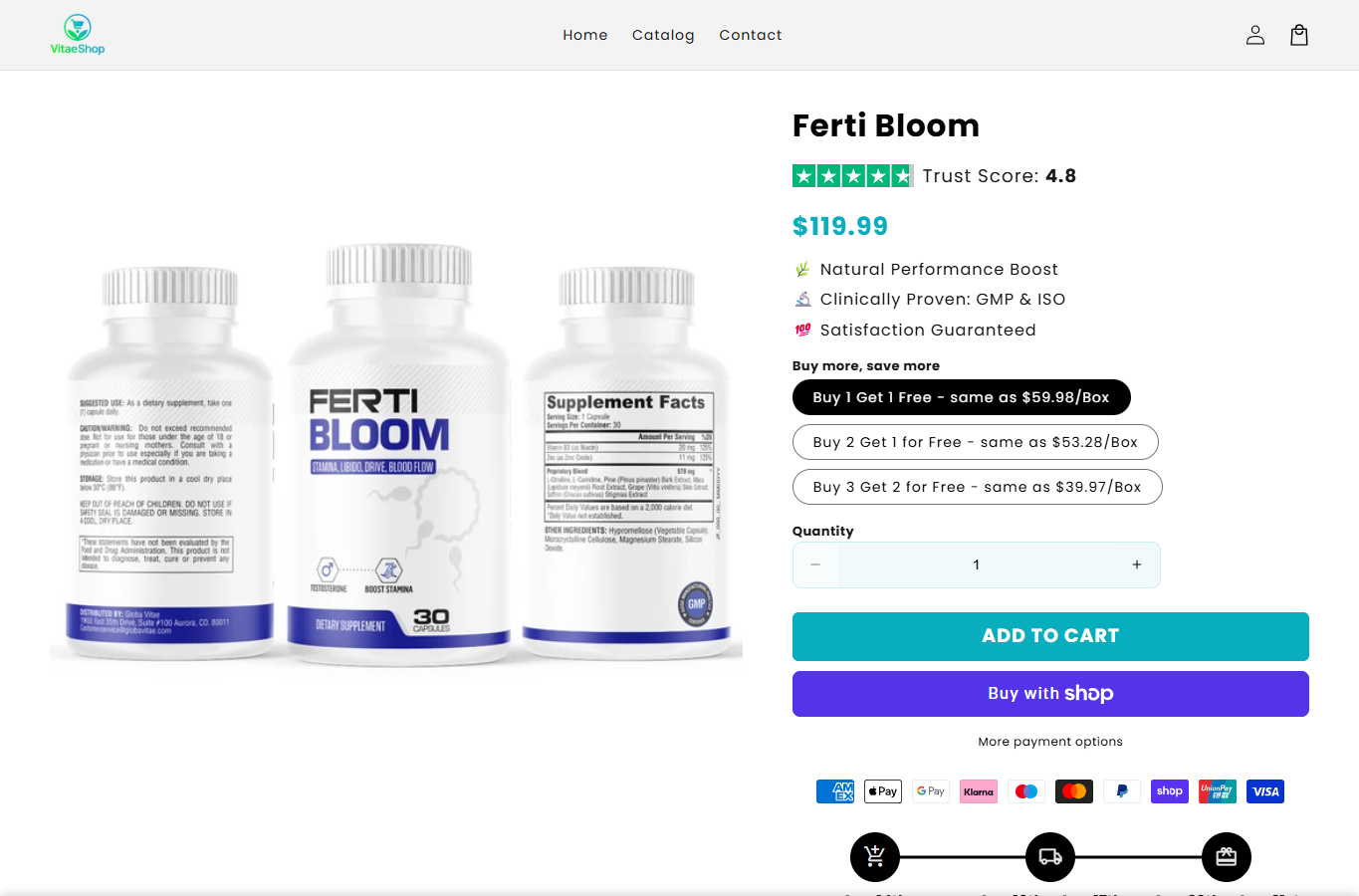
Ferti Bloom is presented by My Vitae Shop as a male wellness and performance formula. The site assigns a 4.8 trust score, uses clinically proven wording beside GMP and ISO references, and prices the first bundle at $119.99.
The product page offers two, three, or five boxes and marks the item as a deferred, subscription, or recurring purchase.
By continuing, the buyer authorizes charges at the frequency and dates shown until the order is fulfilled or canceled.
A separate checkout says the selected package is charged and delivered again every 30 days. Depending on the starting bundle, the monthly installment is listed as $119.85, $159.85, or $199.85.
Overview
The health promise is broader than the label disclaimer
My Vitae Shop has promoted Ferti Bloom with claims about testosterone, sperm count, mobility, stamina, libido, drive, and blood flow. Those messages can make the supplement sound like a treatment for infertility or sexual dysfunction.
The product page later says the statements were not evaluated by the FDA or EFSA and that the supplement is not intended to diagnose, treat, cure, or prevent disease.
Zinc contributes to normal testosterone levels when nutritional conditions make that statement relevant. That fact does not prove the finished proprietary blend improves fertility in men who take one capsule daily.
The bundle is an automatic monthly program
The storefront labels the purchase as recurring. The checkout terms state that the same package price and product will be charged and delivered again every 30 days until canceled.
This means a five-box order does not necessarily end after five boxes. The buyer can be charged another $199.85 the next month for the same package.
The prominent buy-one-get-one and buy-three-get-two language describes the quantity in each shipment, not the lifetime number of shipments. That distinction must be visible before payment.
The refund promises conflict across pages
The product page says satisfaction guaranteed, and the separate checkout promotes a 90-day money-back guarantee. Those statements encourage buyers to open and test the capsules.
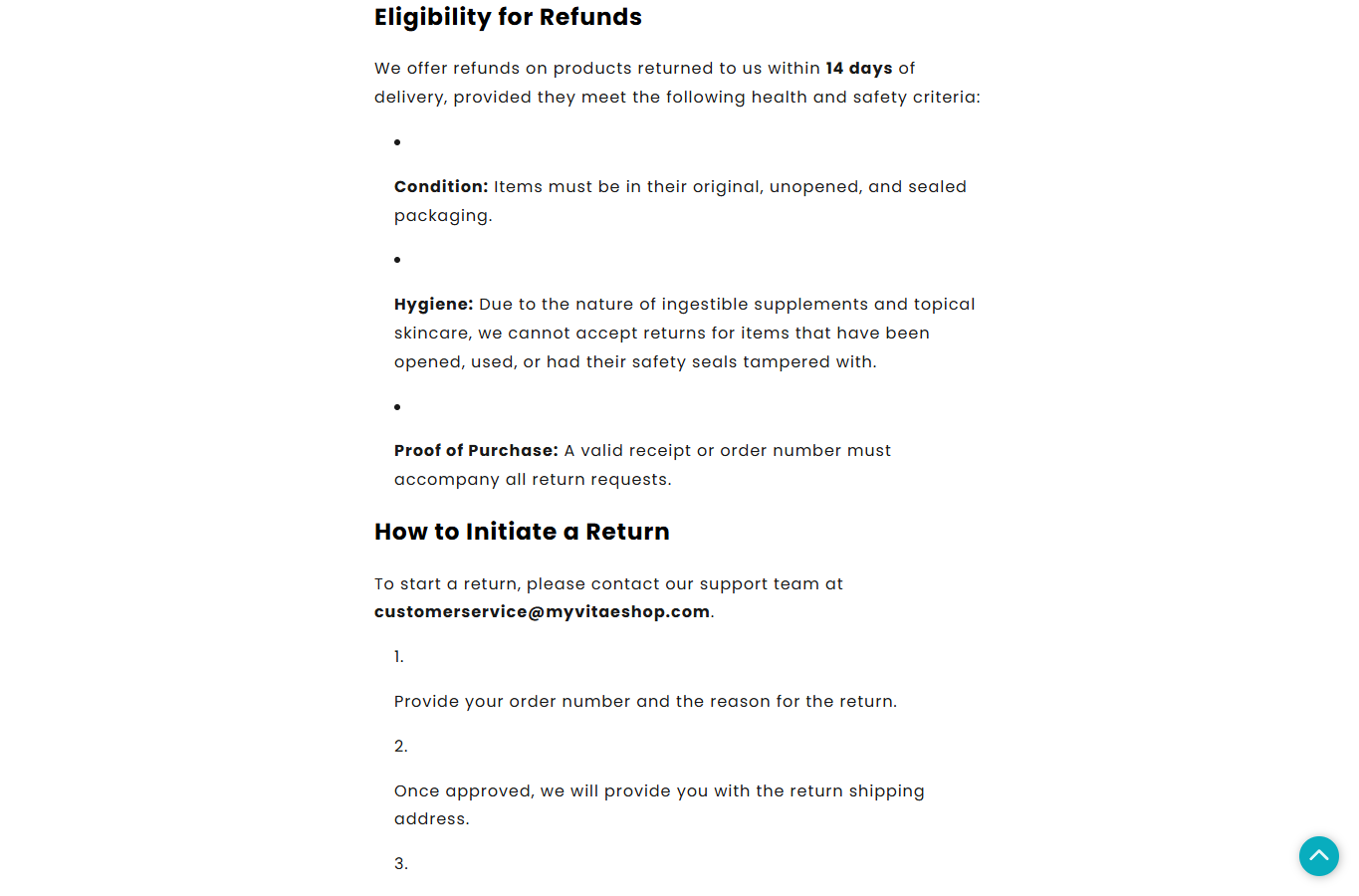
My Vitae Shop's refund policy allows returns within 14 days of delivery only when products remain original, unopened, and sealed. Its terms also describe a strict no-refund, no-cancellation policy.
A guarantee that requires unopened supplements cannot meaningfully cover whether the product works. Buyers need written clarification before ordering, not after the first recurring charge.
- Sensitive fertility and performance claims create emotional pressure.
- The formula uses a 570 mg proprietary blend without individual botanical amounts.
- The product page marks the order as recurring.
- The selected bundle is charged and shipped every 30 days.
- Monthly costs can reach $199.85 for the five-box package.
- Return pages conflict about 90 days, 14 days, cancellations, and opened products.
What Ferti Bloom Claims to Provide
Ferti Bloom contains niacin, zinc, L-citrulline, L-carnitine, pine bark extract, maca root, grape skin extract, and saffron stigmas in a 570 mg proprietary blend.
The product page says one capsule supports vitality, drive, stamina, circulation, and normal testosterone levels. Earlier promotional copy also connected the product with sperm count and mobility.
Those outcomes are not interchangeable. A supplement might contain nutrients involved in normal biological functions without improving fertility, treating low testosterone, or resolving a medical cause of reduced sperm count.
The proprietary blend hides the amount of each botanical. A buyer can see the combined weight but cannot determine whether any ingredient is present near a dose used in published research.
The packages are structured as buy one get one, buy two get one, and buy three get two. The largest order costs about $199.99 on the storefront and is described as $39.97 per box.
The recurring term changes the practical cost. If the selected five-box package renews every 30 days, three billing cycles can approach $599.55 before optional shipping or other charges.
Why the Fertility and Trust Claims Need More Proof
The site uses clinically proven beside GMP and ISO wording, but manufacturing standards do not prove that the finished supplement improves fertility or sexual performance.
The FDA does not preapprove dietary supplements sold through a fertility claim for safety or effectiveness before sale. A facility registration or good-manufacturing claim is not product approval.
Male fertility concerns can involve hormones, medication, infection, heat exposure, varicocele, genetics, lifestyle, or other factors. A broad proprietary blend cannot diagnose which factor applies.
The store claims natural, side-effect-free solutions on its homepage. No responsible supplement can promise zero side effects for every user, especially when ingredients can interact with blood pressure, anticoagulant, diabetes, or sexual-health medication.
The sales funnel's most verifiable feature is not the health result. It is the 30-day billing term, which is written into both the product notice and checkout agreement.
How the One Capsule Fertility Fix Scam Works
Step 1: A private health concern becomes a simple deficiency story
The ad suggests low stamina, reduced libido, weak performance, or fertility worries come from missing nutrients that one capsule can restore.
That framing avoids a medical examination and gives the viewer an immediate action that can be taken privately.
Shame and urgency reduce comparison shopping. Buyers may avoid asking a clinician because the product promises a discreet answer.
Step 2: Scientific words create an impression of proof
The page refers to high-potency nutrients, blood-flow support, GMP, ISO, a proprietary blend, and normal testosterone. Each phrase can be accurate in a narrow sense while the overall fertility promise remains unproven.
A trust score of 4.8 appears beside the price, but the page does not clearly identify the independent platform or transparent calculation behind that score.
Look for finished-product trials, not a list of ingredients that have each been studied in unrelated settings.
Step 3: Bundle math makes the largest order look cheapest
The first visible price is $119.99, while the largest package is described as $39.97 per box. The buyer focuses on value per unit rather than today's total.
Buy three get two free sounds like a one-time promotion. The recurring notice means the five-box shipment can repeat every month.
The checkout also uses limited-stock language and a reservation timer, making it harder to pause and calculate annual cost.
Step 4: The recurring authorization appears near the purchase controls
The product page states that the item is deferred, recurring, or subscription-based. Continuing authorizes future charges at the listed dates and frequency.
Checkout terms say the program repeats every 30 days and continues indefinitely until canceled. The amount depends on the package chosen initially.
A buyer should not rely on the word free inside the bundle. The relevant question is how many boxes arrive in every paid monthly installment.
Step 5: The guarantee encourages use while the refund policy forbids it
A 90-day guarantee suggests the buyer can take the capsules long enough to judge results. The storefront also says satisfaction guaranteed.
The refund policy limits ordinary returns to 14 days after delivery and requires original, unopened, sealed packaging. An opened bottle can make the order ineligible.
The general terms go further and describe a strict no-refund, no-cancellation policy. These contradictions should be resolved in writing before any card is charged.
Step 6: A foreign seller and U.S. fulfillment address split responsibility
The site names GLOBA VITAE S.M. P.C. and gives an address at Semilis 14-16 in Athens, Greece. The bottle shown online lists 19655 E 35th Drive, Suite 100, Aurora, Colorado.
That Aurora address also appears as the Optivell return location. It may be a shared fulfillment center rather than either brand's laboratory or headquarters.
The buyer must know whether the Greek company, payment processor, or U.S. warehouse handles cancellation and refunds. A package address alone does not answer that.
Step 7: Cancellation becomes a race against the next shipment
The website lists only an email and contact form prominently, with no equally visible product-specific telephone support. Delayed replies can allow another 30-day charge to process.
Send cancellation immediately and state that it covers every future installment. Ask the card issuer to block merchant-initiated recurring charges.
Do not assume returning one package ends the program. A refund request and subscription cancellation are separate instructions.
Company, Address, and Fulfillment Checks
Globa Vitae is the legal name behind My Vitae Shop
The terms identify GLOBA VITAE S.M. P.C., while the storefront uses My Vitae Shop and the bottle uses Globa Vitae. These names should all be preserved when disputing a charge.
The company gives Semilis 14-16, Athens as its address and applies Greek law in the terms. U.S. buyers may therefore face a cross-border seller even when the package ships domestically.
Ask which legal entity is the merchant of record and whether the card descriptor uses Globa Vitae, My Vitae Shop, or another processor.
The Aurora address connects Ferti Bloom and Optivell logistics
Ferti Bloom packaging shows 19655 E 35th Drive, Suite 100, Aurora, Colorado 80011. Optivell publishes the same suite as a return address.
A shared address can indicate a fulfillment company that stores and returns products for several marketers. It does not prove common ownership, formula, or manufacturing.
This is exactly why a fulfillment center should not be described as company headquarters or a research facility without additional evidence.
Email-only support is weak protection against monthly billing
My Vitae Shop prominently lists customerservice@myvitaeshop.com and says support is available 24/7, but it does not provide an equally prominent telephone number on the pages reviewed.
Email the exact cancellation before the next 30-day date and request a human confirmation. Save full message headers and delivery status.
If support does not respond quickly, contact the card issuer. Do not wait until a second $119.85, $159.85, or $199.85 installment appears.
The supplement origin and individual ingredient doses are unclear
The product page names a proprietary blend but does not reveal the amount of each botanical. It also does not clearly establish the factory or country where the capsules were manufactured.
Many private-label supplements are mass-produced in China, Europe, the United States, or other locations and shipped through third-party fulfillment centers. Hidden origin and missing batch testing make quality claims difficult to verify.
A fertility supplement can be risky when it delays diagnosis or interacts with medication. Natural, GMP, ISO, and FDA-registered language does not guarantee effectiveness or zero side effects.
Why Fertility Marketing Requires Extra Caution
Fertility is emotional, time-sensitive, and private. A seller can turn those pressures into urgency while avoiding the careful questions that would be asked in a clinical setting.
One capsule sounds easier than testing hormones, semen parameters, medication effects, and physical causes. Convenience is valuable, but it cannot replace diagnosis.
The recurring bundle exploits the same desire for a complete course. A five-box shipment feels like commitment to a plan, then the identical shipment repeats after 30 days.
A responsible decision starts with a clinician, a transparent formula, clear individual doses, and billing that is plainly one-time unless the buyer deliberately chooses otherwise.
Warning Signs to Watch For
- One capsule is connected with several fertility and performance outcomes.
- A proprietary blend hides individual botanical doses.
- A 4.8 trust score appears without a clear independent source.
- The product page marks the purchase as recurring.
- The same bundle repeats every 30 days.
- A 90-day guarantee conflicts with a 14-day unopened return rule.
- General terms describe no refunds and no cancellations.
- The U.S. address is shared with an unrelated vision supplement funnel.
The billing language is clearer than the fertility evidence. A seller that can specify a $199.85 monthly installment should be equally precise about clinical results, cancellation, and refunds.
What to Do if You Have Fallen Victim to This Scam
- Save the entire sales path before it changes. Capture the ad, video, landing page, claims, package choice, checkout total, recurring terms, receipt, shipping label, and card descriptor connected with the Ferti Bloom subscription. Save the Ferti Bloom subscription files outside the browser because this campaign can replace domains and pages quickly.
- Cancel the order and every recurring feature in writing. Contact My Vitae Shop and the payment processor and state that you cancel the original order, add-ons, memberships, automatic shipments, and future charges. The cancellation for that one-capsule sales funnel should identify the refund amount and recurring features removed. Keep the merchant's written confirmation.
- Call the card issuer without waiting for support. For the Ferti Bloom subscription transaction, explain what the advertisement promised, what you believed you were authorizing, and what was actually charged. Ask about blocking that merchant, replacing the card, disputing the Ferti Bloom subscription merchandise, and the deadline for challenging a later refill.
- Check statements for several months. When reviewing the Ferti Bloom subscription billing, look for the brand, a fulfillment company, a generic wellness descriptor, and unfamiliar small test charges. Another Ferti Bloom subscription refill may use a different descriptor from the bottle, so compare amounts and dates rather than searching for only one word.
- Keep unopened products and all packaging. Photograph every Ferti Bloom subscription label, seal, lot code, return address, tracking label, ingredient panel, and item in the box. Keep the Ferti Bloom subscription packaging until the refund or dispute is complete, and use tracked shipping only if the seller truly requires a return.
- Protect your health first. Stop using the supplement and contact a clinician if you experience flushing, dizziness, palpitations, stomach symptoms, rash, or another reaction. Bring the exact bottle and disclose all fertility, blood pressure, anticoagulant, diabetes, and sexual-health medicines.
- Secure any account or device exposed during the purchase. Change any password reused during the Ferti Bloom subscription checkout and enable multifactor authentication if an account was created. If the Ferti Bloom subscription page forced a download, browser extension, unofficial tracking app, or remote-support tool, remove it and run a full Malwarebytes scan.
- Reduce contact with the same advertising network. AdGuard can block many aggressive ad networks, pop-ups, and redirect chains that feed the Ferti Bloom subscription funnel. Use AdGuard as a filter around this one-capsule promotion, not as a product endorsement. Independently examine the seller, claims, and checkout terms.
- Report the campaign with useful evidence. Report the ad to the social or advertising platform where the fertility claim appeared, the transaction to the FTC at ReportFraud.ftc.gov, and any serious reaction to the appropriate health regulator. The report for this one-capsule product case should connect the ad to the charge. Include page addresses, support details, statement text, and screenshots.
Frequently Asked Questions
Is Ferti Bloom a one-time purchase?
The live product page marks it as recurring, and separate checkout terms state that the selected bundle is charged and delivered every 30 days until canceled.
How much can the monthly refill cost?
The published terms list $119.85 for the two-box installment, $159.85 for three boxes, and $199.85 for five boxes, depending on the starting package.
Does Ferti Bloom prove it improves sperm count?
The site does not present a transparent finished-product clinical trial proving that result. Ingredient associations and normal nutrient functions are not the same as a fertility treatment.
Can I test the capsules and still get a refund?
The refund page says ordinary returns must be requested within 14 days and remain unopened and sealed, despite separate 90-day and satisfaction language. Get clarification in writing.
Is the Aurora address the manufacturer?
The evidence supports it as a distributor or return point. The same suite appears with Optivell, which suggests shared logistics, not necessarily shared manufacturing.
How do I stop the next shipment?
Email cancellation immediately, name every order and subscription, request confirmation, and contact the card issuer about blocking future recurring transactions.
The Bottom Line
The One Capsule Fertility Fix Scam combines deeply personal health claims with a recurring bundle that can cost as much as $199.85 every 30 days.
The 90-day promise, 14-day unopened return policy, and no-refund language do not form a clear or consumer-friendly guarantee. The shared Aurora address also shows why fulfillment should not be confused with research or manufacturing.
Do not use a subscription checkout as a substitute for fertility care. Verify the formula and company, obtain medical advice, and reject automatic refills unless you knowingly want the full ongoing cost.

Reviews & discussion
0 commentsShare a firsthand experience, or ask a question.
Community reviews
One Capsule Fertility Fix
Moderated reader experiences, not an editorial verdict.
Start the conversation
Have a question or something useful to share? Add the first comment.