

Wild Harvest Gut Cleanse is promoted as a 2-step herbal cleanse designed to support digestion, bloating, gut comfort, and a “cleaner gut environment.”
The product page looks polished and reassuring, but the sales tactics, subscription setup, refund limitations, and similarity to cheap wholesale herbal drops raise serious concerns.
This review breaks down what Wild Harvest Gut Cleanse claims, what buyers may actually receive, and why the offer looks like a high-risk dropshipping supplement funnel.
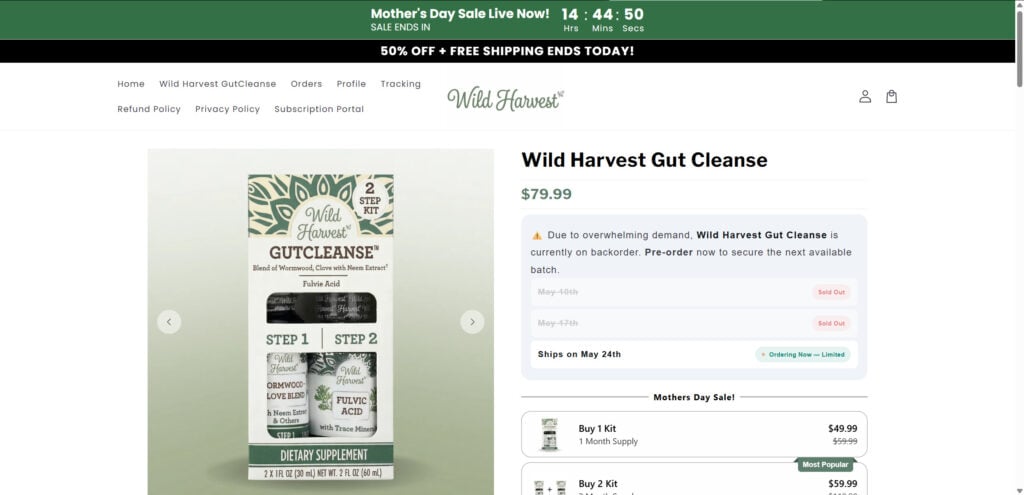
Scam Overview
Wild Harvest sells Wild Harvest GutCleanse as a 2-step liquid supplement kit. According to the product page, Step 1 contains a wormwood, clove, black walnut hull, neem, garlic, soursop, pau d’arco, and pumpkin seed blend, while Step 2 contains fulvic acid with trace minerals. The site says the product supports digestive comfort, reduced bloating, gut defense mechanisms, daily energy, mental clarity, and gut lining integrity.
The product is priced at $54.99, while the same page uses urgency language such as “50% off + free shipping ends today,” “low stock notice,” “sold out 12 times last year,” and “subscribing protects you against future stockouts.”
That combination is the first warning sign.
The product may exist. Customers may receive herbal drops. But the operation appears to rely on classic supplement-funnel tactics:
- Strong cleanse-style claims
- Backorder and scarcity pressure
- Subscription portal and auto-renew structure
- Seller-controlled testimonials
- Refund terms that are stricter than the front-end guarantee suggests
- Similar herbal drop formulas available from wholesale suppliers for a fraction of the retail price
What Wild Harvest Claims
The site says the product can support:
- A cleaner gut environment
- Digestive comfort
- Reduced bloating
- Natural gut defense mechanisms
- Daily energy and mental clarity
- Gut lining integrity
- A 4-week herbal protocol
- Multiple repeat cycles for best results
The page recommends a full 4-week cycle and says most customers choose to complete 2 to 3 full cycles with rest periods between them.
That wording matters because it encourages repeat purchases, which connects directly to the subscription risk.
Major Red Flags
1. The “gut cleanse” angle is exaggerated
“Gut cleanse” products often imply that your body needs a special protocol to clear toxins, parasites, waste, or buildup. Wild Harvest uses softer language than some parasite-cleanse ads, but it still frames the product around a cleaner gut environment and a multi-week cleanse-style routine.
The National Center for Complementary and Integrative Health notes that there is no compelling research supporting detox programs for eliminating toxins from the body, and long-term evidence is lacking.
That does not mean every herb is useless. It means “cleanse” marketing should be treated carefully, especially when the product is sold through urgency, testimonials, and repeat-use recommendations.
2. The formula is not unique
Wild Harvest’s Step 1 formula uses familiar cleanse ingredients such as black walnut hull, wormwood, clove, garlic, neem, soursop, pau d’arco, and pumpkin seed. Step 2 uses fulvic acid and trace minerals.
Similar wormwood, black walnut, clove, neem, and fulvic-acid liquid drops are available from wholesale suppliers. Alibaba listings show comparable products such as wormwood, clove, neem extract, and fulvic acid drops for around $1.50–$1.90, and other wormwood/black walnut/clove formulas for roughly $2–$2.90 depending on supplier and quantity.
That does not prove Wild Harvest uses one specific supplier. But it does show this product category is heavily commoditized and easy to private-label.
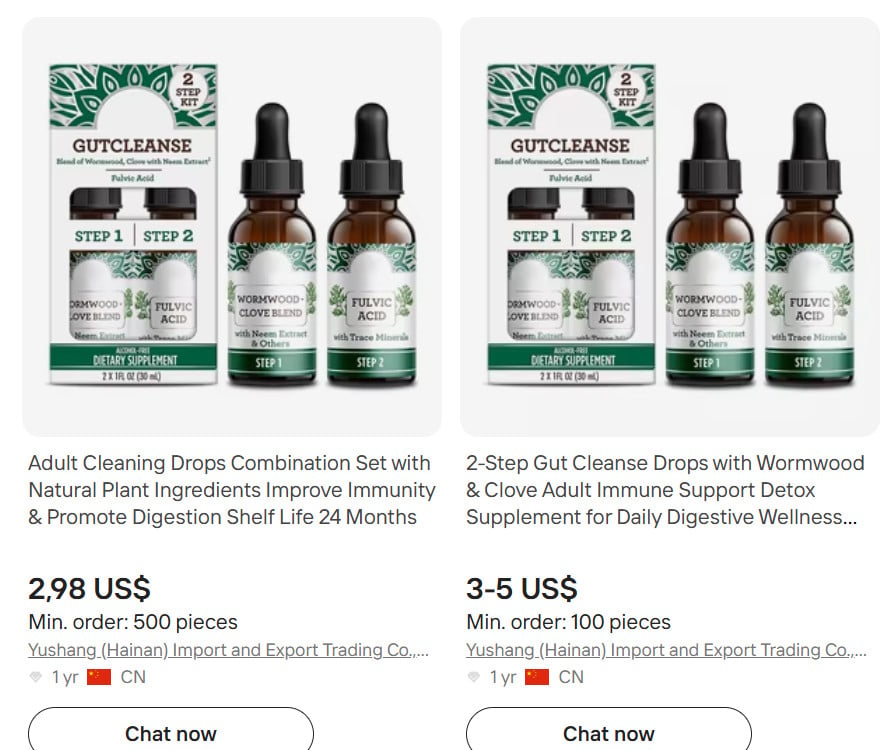
3. The dropshipping concern is real
A likely dropshipping or private-label pattern looks like this:
- Source generic herbal cleanse drops from a supplier
- Rebrand them as a premium “gut cleanse”
- Add a 2-step protocol
- Use backorder and “sold out” messaging
- Push subscriptions to “protect against stockouts”
- Sell at a much higher retail price
Wild Harvest sells its kit for $54.99, while similar liquid cleanse formulas can be found in wholesale listings at only a few dollars per unit.
The issue is not only price. The issue is that buyers may think they are purchasing a unique wellness system, when the underlying product type appears widely available.
4. Subscription risk is built into the site
The site has a visible Subscription Portal in its navigation, and the cancellation policy states that subscriptions involve repeat deliveries, stored payment details, and potential auto-renewal. It says customers can manage subscriptions through order confirmation links or by emailing the company.
That means recurring billing is part of the store’s structure.
The product page also explicitly says that subscribing protects customers against future stockouts.
That is a red flag for buyers who thought they were making a one-time purchase.
5. Subscription refunds are much stricter
The front-end product page says there is a 30-day money-back guarantee and says customers can contact support for a full refund. (WildHarvest)
But the refund policy says subscription autoship orders are not eligible for the 30-day money-back guarantee. It also says subscription refunds require unopened and unused items, customer-paid return shipping, non-refundable shipping costs, and a $4 restocking fee.
That is a major gap between the sales pitch and the practical refund terms.
6. The refund policy contains messy template errors
The refund policy includes duplicated sections and even tells customers to contact info@tryveyorahealth.com if more than 15 business days have passed after refund approval. That is not a Wild Harvest email address.
This kind of leftover template text is a trust problem.
A professional supplement company should not have another brand’s email address inside its refund policy.
7. “No questions asked” does not match the return conditions
The product page says refunds are “no questions asked.”
But the refund policy says returns must be in the same condition as received, unworn or unused, with tags, in original packaging, and must be inspected before refund approval. It also says items sent back without first requesting a return will not be accepted.
For an ingestible supplement, that is important.
If a buyer opens and tries the product, refund eligibility may become much more limited than the front-end guarantee suggests.
8. The site uses heavy scarcity marketing
The page claims the product is on backorder, lists multiple sold-out batch dates, and says the product sold out 12 times last year. It also warns buyers not to buy “fakes” on Amazon or eBay.
This is a classic pressure tactic.
It encourages buyers to act quickly, subscribe, and avoid comparison shopping.
9. The testimonials are seller-controlled
The page includes multiple 5-star testimonials claiming improved digestion, lighter bloating, steadier energy, and a gradual feeling of clarity. These reviews are presented directly on the seller’s own page, with “individual results may vary” disclaimers.
Seller-controlled testimonials are not the same as independent proof.
The FTC says health-related advertising claims must be truthful, not misleading, and supported by science, and the same principles apply to dietary supplements and other health products.
10. FDA disclaimer confirms it is not a treatment
Wild Harvest includes the standard disclaimer that the statements have not been evaluated by the FDA and that the product is not intended to diagnose, treat, cure, or prevent disease.
The FDA explains that dietary supplement claims must include this type of disclaimer because only drugs can legally make disease-treatment claims.
That matters because many buyers searching for gut cleanses are often looking for help with symptoms, parasites, bloating, digestive issues, or “detox.” Wild Harvest is not a medical treatment.
What You Are Probably Buying
If the product arrives, you are likely getting:
- A 2-step herbal liquid supplement kit
- A wormwood, clove, black walnut, neem, garlic, and botanical blend
- A fulvic acid and trace mineral formula
- A supplement protocol guide
- A product marketed as a gut cleanse routine
You are probably not buying:
- A proven parasite treatment
- A medical gut detox
- A guaranteed bloating cure
- A clinically proven digestive reset
- A unique formula unavailable elsewhere
- A risk-free purchase if you are placed on autoship
Why Buyers Report Problems With Products Like This
Unwanted subscriptions
The site has subscription infrastructure, repeat-delivery terms, stored payment language, and auto-renew policy wording.
That means buyers should be extremely careful at checkout.
Look for:
- Subscribe and save
- Autoship
- Auto-refill
- Recurring delivery
- Monthly delivery
- Next charge date
- Subscription portal
- Stored payment authorization
Difficult cancellation
The cancellation policy says subscriptions can be managed through order confirmation links or by email.
That may sound simple, but in practice, subscription issues often become difficult when support is slow, the buyer cannot find the portal, the next billing date is close, or the seller has already processed the next order.
Refund restrictions
Subscription orders are not covered by the same 30-day money-back guarantee and must be unopened and unused to qualify for refund consideration.
That is exactly where customers can get stuck.
Is Wild Harvest Gut Cleanse a Scam?
Not necessarily a fake-product scam
The product may exist, and buyers may receive herbal drops.
But it is high-risk
The main concerns are:
- Dropshipping/private-label indicators
- Similar formulas available cheaply from Chinese wholesale suppliers
- Strong cleanse-style marketing
- Scarcity and backorder pressure
- Subscription and auto-renew infrastructure
- Reports of unwanted subscriptions
- Refund exclusions for autoship orders
- Template errors in the refund policy
- Seller-controlled testimonials
- No visible product-specific clinical proof
The most accurate verdict is:
Wild Harvest Gut Cleanse appears to be a high-risk private-label supplement funnel promoted with cleanse claims, scarcity tactics, and subscription mechanics that may create refund and cancellation problems for buyers.
Should You Buy It?
For most buyers, caution is warranted.
Reasons to avoid it
- Similar products are available under other names.
- The formula does not appear unique.
- The cleanse claims are stronger than the proof shown.
- Subscription billing is part of the store setup.
- Subscription orders are excluded from the main guarantee.
- Refunds may require unused, unopened products.
- The policy page contains messy copied-template details.
If you still consider buying it
Treat it as a basic herbal supplement, not as a medical cleanse.
Do not use it as a substitute for care if you have:
- persistent abdominal pain
- unexplained weight loss
- blood in stool
- chronic diarrhea
- severe constipation
- suspected parasites
- fever
- vomiting
- liver, kidney, or digestive disease
- pregnancy or breastfeeding
- medication use
Consult a medical professional before using herbal cleanse products, especially formulas with multiple botanicals.
What To Do If You Already Ordered
1. Check for subscription enrollment immediately
Look for:
- subscription confirmation
- autoship terms
- recurring billing
- next billing date
- subscription portal access
- “manage subscription” link
If you did not intend to subscribe, cancel immediately and save proof.
2. Email support in writing
Contact support at the email listed on the policy page and request cancellation confirmation. The site lists info@trywildharvest.com as the contact email for subscription changes and returns.
Use a clear message:
I am requesting immediate cancellation of any subscription or autoship linked to order #[number]. Please confirm in writing that no further charges or shipments will occur.
3. Save screenshots
Save:
- product page claims
- backorder and stock messages
- subscription language
- refund policy
- subscription policy
- order confirmation
- checkout total
- emails with support
- payment statement
4. Do not open the product if you may return it
The refund policy requires items to be unused, in original packaging, and inspected before approval. Subscription refunds require unopened and unused products.
Opening the bottles may reduce your refund options.
5. Watch your bank account
Monitor for:
- repeat charges
- second shipments
- subscription renewals
- different merchant names
- unexpected shipping fees
If you see another charge, contact your bank immediately.
6. Dispute if cancellation fails
If you cancel and still get charged, or if the seller refuses to cancel a subscription you did not knowingly agree to, contact your payment provider.
Use reasons such as:
- unauthorized recurring charge
- subscription not clearly disclosed
- item not as described
- refund terms not honored
7. Be careful using the product
Herbal blends can still cause side effects or interact with medication.
Stop using it and seek medical advice if you experience:
- severe stomach cramps
- diarrhea
- vomiting
- rash
- dizziness
- allergic reaction
- worsening digestive symptoms
- unusual fatigue
- liver-related symptoms
- blood in stool
The Bottom Line
Wild Harvest Gut Cleanse is not clearly a “nothing ships” scam. The product may arrive.
The concern is the business model.
It appears to be a high-risk gut-cleanse supplement funnel using generic herbal ingredients, scarcity messaging, seller-controlled testimonials, subscription infrastructure, and refund rules that are much stricter for recurring orders.
The safest conclusion is simple:
Wild Harvest Gut Cleanse looks like a dropshipping-style herbal supplement sold with cleanse marketing and subscription mechanics that buyers should treat with caution, especially if they expect easy cancellation or a simple refund after opening the product.









Arnaque totale ! En plus, les flacons ne contiennent que de l’eau sucrée ! Commandés des boîtes de PURALIX via le site SUNURIS.COM en Angleterre, mais les boîtes sans marque mentionnent WILD HARVEST NUTRITION LABS basé à Austin TX USA ! Le paquet venait manifestement de Chine avec une étiquette mal recouverte.
Merci pour ce témoignage détaillé, Bénédicte. Le décalage entre le site vendeur, l’absence de marque claire, le fabricant indiqué au Texas et l’expédition apparemment effectuée depuis la Chine constitue un signal d’alerte important. Conservez les photos, l’emballage et la confirmation de commande, demandez le remboursement par écrit et, si le vendeur refuse, contactez votre moyen de paiement avec ces preuves.
Do not buy! Product doesn’t work and there doesn’t seem to be a return policy.
I used a Visa gift card to buy this product, so I have no chance of being caught up in a subscription.
My issue is, it took over two weeks to arrive and came directly from China. I then took it for two weeks and noticed nothing. I don’t think it did anything.
I then emailed for my “30 Day Money Back Guarantee”. I was told the guarantee only applied in the first 30 Days since your order date and to users who used it for at least 14 days. I replied “how is that even possible when it didn’t arrive for over two weeks?” The answer I got was they try to ship within 7-10 days and I had missed my return window. They refused to return my money.
Thank you for laying the timeline out so clearly, because that is the part other readers need to see. The guarantee is written so that it expires while the parcel is still in transit: counting the 30 days from the order date rather than delivery, and then demanding 14 days of use, is a deliberate design rather than an oversight, and shipping from China quietly eats most of the window. Using a Visa gift card was a smart move and has spared you the recurring-billing trap that catches most buyers here. If the card still has any dispute route available, it is worth one call, and either way please keep the emails where they refused you – they show the guarantee was never meant to be honoured, which is exactly what other readers need to know before they order.
Thank you for laying out the timeline so clearly, Kate. That refund window is designed to expire while the parcel is still in transit, which is precisely why they ship slowly from overseas and then count the 30 days from your order date. Using a Visa gift card was smart, as it kept you out of any rebill. Since the guarantee they advertised was not honoured, it is still worth reporting the merchant to your card provider and to the FTC, even if the money itself is hard to recover. Your comment will save other readers the same two weeks of waiting.
I was scammed. I listed to the videos and ordered right away due to limited stock. This article is correct. Everything is urgent, scarce, and (although I don’t remember signing up for a subscription) they say I have one. I’m currently in CONSTANT emails to their company to STOP the continuous billing (just got my first order last month before a move and now they are billing another $79.99 for another 3 months that I don’t want and can’t receive at the old address). I told them I wanted to cancel right away. No refund. I told them I wasn’t satisfied. I told them I didn’t have a subscription. Doesn’t matter. AI answers emails and then a person signs the next email that they have pushed it up to the next level for looking into and then that they “can’t find my subscription” and YET they are billing me $79.99 AGAIN after 1 month. I’ve used a Wormwood and Black Walnut organic product that is much better (Plnt brand at my local vitamin shoppe…does not have a pleasant taste but works). I wasn’t surprised to see Florida as the company address when I went in to dispute the latest transaction. Scammers galore in FL. (By-the-way Walmart sells 3 months of this same product for $60 instead of $79.99). RUN!
The subscription you do not remember agreeing to is the heart of it, and you almost certainly did not agree in any meaningful sense. On these checkouts the recurring order is a pre-ticked box below the fold, or a line in grey text under the buy button, and the urgency and the “limited stock” countdown exist precisely to stop anyone reading that far. The countdown, incidentally, resets when you reload the page – the stock was never limited.
Stop the emails. You will not win that correspondence, because the person answering is paid to delay you until the dispute window closes; the constant replies are the strategy. Ring the number on the back of your card instead and ask for three things in one call: revoke the merchant’s recurring authorisation, block that merchant, and issue a new card number. Then dispute the charges as not as described and as an unauthorised recurring charge, noting that you were enrolled in a subscription you did not knowingly accept. You generally have up to 120 days per charge.
Keep the emails, though – a paper trail of you asking to cancel and being fobbed off is excellent evidence for the bank. Then file at reportfraud.ftc.gov and with your state Attorney General. Negative-option billing without clear consent is illegal under the FTC’s rules, and it is one of the things they actually act on.
I got scammed by them. DO NOT buy!
Sorry you got caught by it, and thanks for the warning – short comments like this do get read.
If it is still recent, two things are worth doing. Ring your card issuer, dispute the charge as not as described, and ask them to revoke the merchant’s recurring authorisation and issue a new card number, because this particular seller enrols most buyers in a monthly charge that shows up four to six weeks later. And put it on the record at reportfraud.ftc.gov – it takes a few minutes and it is what puts you in line for money if regulators win a case against them.
Very good info, I will not be buying.
That is the best possible outcome – thank you for saying so. If you can still see the advert, reporting it on the platform where it appeared genuinely helps, since these operations are shut down by complaint volume rather than by articles.
Detailed analysis, coupled with straightforward, easy-to-understand solutions. Great resource. Thanks very much for this.
Thank you for the kind feedback. We appreciate you taking the time to comment, and we’re glad the information was helpful.