

Naturva Lung Cleansing Spray is marketed as a botanical respiratory spray designed to calm airway irritation, loosen mucus, and support easier breathing.
The product page presents it as a gentle, plant-based lung wellness solution. But the claims, policies, company transparency, and template inconsistencies on the site raise several concerns buyers should understand before ordering.
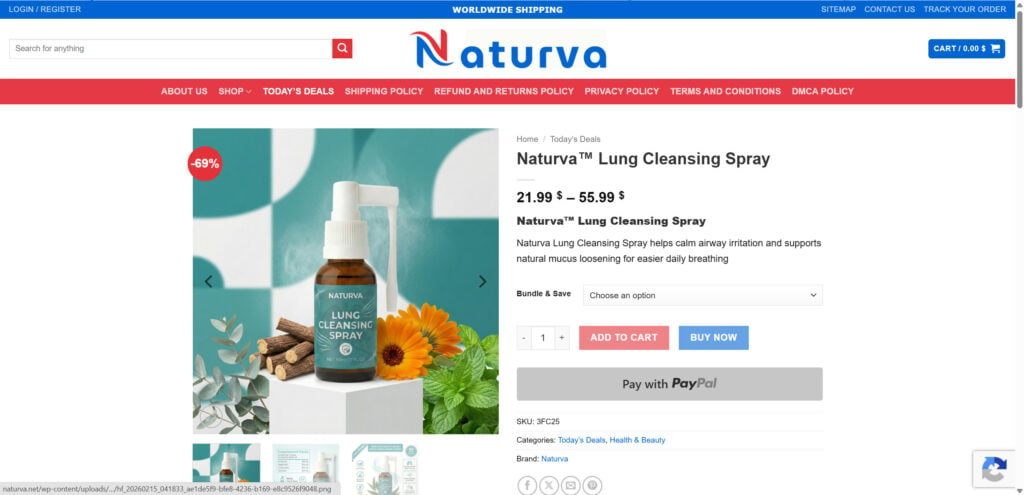
Overview
Naturva sells its Lung Cleansing Spray for $21.99–$55.99, with bundle options for Buy 1, Buy 2, and Buy 3. The page claims the spray helps calm airway irritation, support mucus loosening, reduce a tight chest feeling, and support clearer daily breathing. It also says the product is one of Naturva’s most popular wellness essentials and warns that stock is limited and demand is high.
The product is built around a four-herb formula:
- Eucalyptus
- Peppermint
- Licorice root
- Calendula
Those ingredients are common in herbal respiratory products. The issue is not that herbal sprays cannot exist. The concern is how the product is positioned as a “lung cleansing” solution without showing serious product-specific proof.
What Naturva Claims
The site says the spray can help with:
- airway irritation
- trapped mucus buildup
- tight chest feeling
- coughing discomfort
- constricted passages
- restless nights
- daily breathing comfort
- “calmer, deeper breathing”
The page also says the botanical blend helps the body clear mucus, relax constricted passages, and soothe respiratory discomfort over time.
That is strong health-style language for a spray sold through an online store.
Major Red Flags
1. “Lung Cleansing” is a misleading product angle
The phrase “lung cleansing” is already a warning sign.
The American Lung Association says the lungs are self-cleaning organs and that the best way to support lung health is avoiding smoke, vaping, air pollution, exercising regularly, and eating well — not relying on pills or concoctions.
So when a product uses “lung cleansing” branding, buyers should be skeptical.
A spray may create a cooling sensation. It may contain herbs traditionally associated with respiratory comfort. But that is not the same as cleansing the lungs, repairing lung tissue, removing tar, or reversing respiratory damage.
2. The claims are broad but proof is thin
Naturva claims the product can calm irritation, loosen mucus, relax restricted passages, and support deeper breathing.
Those are not simple cosmetic claims. They relate to respiratory function.
A serious respiratory product should provide:
- full ingredient amounts
- dosage instructions
- safety warnings
- clinical studies on the exact product
- batch testing
- manufacturer details
- medical disclaimers placed clearly near claims
- information about who should not use it
The product page does not provide enough of that.
It uses wellness language and herb descriptions, but it does not show evidence that this specific spray produces the claimed results.
3. The site itself admits it is not a treatment
Naturva includes a disclaimer saying the product is not intended to diagnose, treat, cure, or prevent disease, and that it is designed for general wellness and personal care use only.
That matters because the sales page still talks about chest tightness, coughing, airways, mucus, irritation, and breathing discomfort.
The FDA explains that dietary supplement-type claims must make clear that the product is not intended to diagnose, treat, cure, or prevent disease because only drugs can legally make those claims
This creates the usual problem with these products:
The marketing creates a strong health-improvement impression, while the legal disclaimer pulls back from medical responsibility.
4. “Natural” does not mean safe for everyone
Naturva emphasizes botanical ingredients and says the spray is gentle enough for daily use. It also recommends consulting a healthcare professional if someone has a pre-existing respiratory condition or takes medication.
That warning is important.
Eucalyptus, peppermint, licorice root, and herbal sprays may not be suitable for everyone. People with asthma, COPD, allergies, pregnancy, medication use, or chronic respiratory symptoms should be careful.
A product being plant-based does not automatically make it safe, effective, or appropriate for daily use.
5. The return policy is weaker than “easy returns” suggests
Naturva’s site repeatedly promotes “EASY RETURNS” in the header.
But the refund policy says products must be returned unused and in original condition, and it specifically lists opened or used consumable goods as non-refundable. Refund requests must be submitted within 30 days after delivery confirmation, and return shipping costs are the customer’s responsibility unless the item is defective or incorrect.
That is a major practical issue.
If someone buys the spray, opens it, tries it, and finds it does not help, the product may no longer qualify for a refund.
So the real policy is not “try it risk-free.”
It is closer to: return it unused, pay return shipping, and wait for inspection.
6. The shipping policy mentions a different brand name
Naturva’s shipping policy begins by saying: “At Divinvera, every order is processed with care…” and later directs tracking and support through divinvera.net links
That is a serious trust issue.
The site is branded as Naturva, but the shipping policy appears copied from or connected to another store called Divinvera.
This kind of template mismatch is common on quickly built ecommerce stores and dropshipping-style operations.
A serious wellness brand should not have another brand name inside its shipping policy.
7. Company transparency is weak
The Contact Us page shows only a form asking for name, email, and message. It does not clearly display a company address, phone number, legal business name, manufacturing details, or direct support email in the visible page text.
For a basic gadget, that would already be a concern.
For a product sprayed into or around the mouth and marketed for breathing comfort, it matters more.
Consumers should know who is responsible for the product, where it is made, how it is tested, and how to reach the company if something goes wrong.
8. The About page is generic
Naturva’s About page uses broad language about effortless navigation, protected checkout, smooth functionality, customer support, and curated wellness products. It does not provide meaningful founder details, formulation background, manufacturing standards, lab testing, or respiratory-health expertise.
That makes the brand look more like a general ecommerce store than a specialized respiratory wellness company.
9. The product is listed inside a broad dropshipping-style catalog
Naturva’s navigation includes many unrelated categories, including Health & Beauty, Home & Garden, Fashion, Accessories, Electronics, Kids, Vehicles, Pet, Sports, and Adult Stuff.
That does not prove the product is fake.
But it does suggest Naturva is not a focused respiratory brand. It appears to be a general online store selling many different product categories.
That is common in dropshipping operations.
10. The claims may encourage people to delay real care
This is the most important health risk.
If someone has chest tightness, persistent coughing, mucus buildup, wheezing, shortness of breath, or breathing discomfort, they should not rely on an online spray as the solution.
Those symptoms can be caused by asthma, COPD, bronchitis, allergies, infection, reflux, smoking damage, heart issues, or other medical conditions.
A spray marketed as “lung cleansing” may make people feel they are treating the problem when they may need real medical evaluation.
What Naturva Lung Cleansing Spray May Actually Do
If the product arrives and contains the listed herbal ingredients, it may provide:
- a cooling sensation
- a minty or eucalyptus-like feel
- temporary throat freshness
- subjective comfort
- a sense of easier breathing due to menthol-like effects
But buyers should not assume it can:
- cleanse the lungs
- remove tar
- treat asthma or COPD
- cure chronic cough
- clear infections
- reverse smoking or vaping damage
- reduce lung inflammation in a clinically proven way
- replace prescribed inhalers or medications
How This Operation Appears to Work
Step 1: Use a health fear
The page focuses on chest tightness, mucus, coughing, poor breathing, and restless nights.
Those are distressing symptoms, so the product immediately feels emotionally relevant.
Step 2: Use natural-language positioning
The formula is framed as botanical, gentle, plant-based, and free from harsh synthetic ingredients.
That makes it feel safer and more trustworthy.
Step 3: Use vague but powerful claims
Instead of clearly saying it treats disease, the page says it “supports” mucus loosening, “helps” calm irritation, and “restores a sense” of easier breathing.
This wording is common in supplement-style marketing because it creates a medical impression while staying legally cautious.
Step 4: Push bundles
The page offers Buy 1, Buy 2, and Buy 3 bundles.
This encourages buyers to purchase more before they know whether the product works for them.
Step 5: Make refunds difficult after use
Because opened or used consumable goods are non-refundable, a buyer may be stuck once they actually test the product.
Is Naturva Lung Cleansing Spray a Scam?
Not necessarily a fake-product scam
The product may exist. Buyers may receive a bottle of herbal spray.
But it is high-risk
The concerns are:
- “lung cleansing” branding
- broad respiratory claims
- no visible product-specific clinical proof
- generic ecommerce-store structure
- weak company transparency
- another brand name appearing in the shipping policy
- refunds limited to unused products
- risk of delaying real medical care
The most accurate classification is:
Naturva Lung Cleansing Spray appears to be a high-risk wellness product sold with respiratory claims that may go beyond what the evidence on the site proves.
Should You Buy It?
For most people, caution is warranted.
Reasons to avoid it
- The product is marketed around breathing symptoms.
- The “lung cleansing” concept is questionable.
- The site does not show strong clinical evidence.
- The refund policy does not appear useful once the bottle is opened.
- The shipping policy contains another brand name.
- Company transparency is limited.
If you still consider buying it
Treat it only as a general herbal comfort spray, not as a lung treatment.
Do not use it as a substitute for:
- inhalers
- antibiotics
- asthma medication
- COPD treatment
- allergy medication
- medical evaluation
- smoking cessation care
What To Do If You Already Ordered
1. Save the product page
Take screenshots of:
- “Lung Cleansing Spray”
- mucus-loosening claims
- airway irritation claims
- tight chest claims
- breathing comfort claims
- bundle offers
- refund policy
- shipping policy
- checkout total
This may help if you need to dispute the charge.
2. Check the merchant name
Because the shipping policy mentions Divinvera while the site is Naturva, check your payment statement and order confirmation carefully.
Look for:
- Naturva
- Divinvera
- another merchant name
- unfamiliar payment processor
- international charge
3. Do not open it if you plan to return it
The refund policy says opened or used consumable goods are non-refundable.
If you already doubt the purchase, keep it sealed and contact support immediately.
4. Inspect the label before using
Check for:
- full ingredient list
- dosage directions
- warnings
- lot number
- expiration date
- manufacturer details
- country of origin
- safety instructions
If any of this is missing or unclear, do not use it.
5. Do not use it for serious symptoms
Seek medical advice if you have:
- shortness of breath
- chest pain
- wheezing
- coughing blood
- fever
- persistent cough
- worsening mucus
- symptoms after smoking or vaping
- known asthma, COPD, or heart disease
Do not rely on an online spray for those symptoms.
6. Watch for side effects
Stop using it and seek advice if you notice:
- throat burning
- rash
- swelling
- breathing difficulty
- dizziness
- nausea
- allergic reaction
- worsening cough
- asthma-like symptoms
7. Request a refund quickly
Send a clear message:
I am requesting a refund for order #[number]. The product does not match the expectations created by the sales page. Please provide return instructions, return address, and refund timeline in writing.
Keep all replies.
8. Dispute the charge if necessary
If support does not respond, the product never arrives, the merchant name is unclear, or the item is materially different from the page, contact your bank or payment provider.
Use documentation showing:
- what was advertised
- what you ordered
- what you received
- the refund policy
- your support messages
The Bottom Line
Naturva Lung Cleansing Spray is not a proven lung-cleansing treatment.
It appears to be a botanical wellness spray sold through a general ecommerce store using respiratory-support claims, bundle offers, limited-stock messaging, weak transparency, and a refund policy that excludes opened or used consumable goods.
The product may arrive.
That does not mean the claims are reliable.
The safest conclusion is simple:
Naturva Lung Cleansing Spray looks like a high-risk herbal respiratory product marketed with “lung cleansing” claims that buyers should treat with skepticism, especially if they have real breathing symptoms or expect an easy refund after trying it.









So funny watching big pharma and all the corrupt 3 letter agency squirm when a real product comes around to disrupt their $$$$ flow. Big tobacco would go broke from lawsuits and big pharma would lose all that money they make on inhalers and all the other meds they sell for COPD. Screw all of them, there’s a special place in hell for all of them..
These people are a ripoff! Didn’t help my husband and I can’t get them to stop charging my account and shipping the worthless product to us. I stopped the subscription and they still sent out the order, and charged my bank so I went and took off the payment source. I have tried and tried to return the product I get some AI generated response email telling me they would give me different types of refund amounts or I can send in for full refund but never got a response on either no refund amount or any instructions on where to return it…I have threatened to get ahold of the trade commission no response so that is my next resort.
I am sorry you have been put through this, Jennifer. Save the cancellation request, every refund offer, the continued charges, and the unopened products; then ask your bank or card issuer to stop future recurring payments and open a dispute for charges made after cancellation. Reporting the pattern to the appropriate consumer-protection agency is also worthwhile, but do not wait for the seller to cooperate before protecting the payment method.
No instructions in the box on how to use the product! Where is it? Where is not even online. This is crazy. Where do I spray this product for the best results? I just received 4 bottles today and I am lost without instructions. Please send instructions soonest for Proper uses of this product Please!!!!
Please send instructions by text phone # 760-267-4449 and email jones.james54@yahoo.com
Hi James – to be clear, MalwareTips is an independent review site with no connection to the seller of this spray, so we can’t send you instructions or usage directions. The fact that nothing came in the box and there is nothing online either is exactly the pattern we found when we investigated this product. Since you’ve just received four bottles, the practical step now is to call your card issuer, dispute the charge and ask them to block any further billing from that merchant. One more thing for your own protection: we’d suggest not leaving your phone number and email in a public comment – scammers harvest contact details from comment sections and follow up with fake refund or support offers.
need to cancel auto delivery. card no long words
Hi Barbara – we’re an independent review site, so we can’t cancel the auto-delivery for you, and these sellers rarely answer their own cancellation lines. Call the bank or company that issued the card the payments come from, tell them you want the recurring charges from that merchant stopped, and ask them to reissue the card if the charges keep coming through. That stops the shipments at the source. If they’ve already billed you for something you didn’t want, ask to dispute those charges at the same time.
I wish I would have seen this sooner. I just got taken by Naturva. I made the first order & it said it the next order would be sent unless you notified them BEFORE the next order was due to ship which was the 24th of the following month. Today is the 25th & I got an email from them that my next order was shipped. This email is dated 5/15/26, kind of weird considering today is the 25th.
I had followed their rules, I notified them 3 times, twice the first week of the initial order. The third time was the following week. I plan on refusing the order & calling the fraud department of my credit card.
They eventually gave me credit for last month. Monday I received an email that my order is shipping soon. I go to my credit card co. & there they have another pending charge for THIS MONTH. They had my old card number & it automatically rolled over to the new card. In talking to my credit card we fixed that. I am about to notify them that my card is pulled & that’s that! I don’t know if they will learn their lesson or not.
That rollover is the detail almost nobody expects, and you have described it exactly right. Visa and Mastercard operate an account-updater service that automatically passes your new card number to merchants holding a recurring authorisation, so simply being issued a new card does not always break the subscription – the merchant is handed the new number.
So the wording matters when you ring the bank. Ask them to revoke the merchant’s recurring authorisation and add a block on that merchant, not just to reissue the card, and say explicitly that you do not consent to the updated details being shared with them. If a charge still appears after that, it is billed against a revoked authorisation and the bank has to take it back. Well spotted, and thanks for posting it – it will save other people a second month of charges.
That structure has a name – negative-option billing – and the reason it caught you is that it is designed to. The obligation to cancel before an unspecified date, disclosed after payment, is what makes it work, and in the US it is illegal to enrol someone this way without clear, informed consent. So you are not in a weak position here, whatever their terms say.
Ring the number on the back of your card and ask for four things in one call: dispute the charge, revoke that merchant’s recurring authorisation, block the merchant, and issue a new card number. Ask for the new number specifically – card networks automatically pass updated details to merchants holding a subscription, so a reissued card alone does not always break it. Say plainly that you were enrolled in a recurring order without clear consent; that is the wording that gets these approved, and you generally have up to 120 days per charge.
Do not ring their cancellation line first. It is a sales line, it will offer you a discount to stay, and the hold time exists to run down your patience. Anything that arrives afterwards is legally yours to keep under the FTC’s unordered-merchandise rules, so ignore any restocking fee. Then file at reportfraud.ftc.gov and with your state Attorney General – this is precisely the practice they act on.
Well what would you recommend instead?
Honestly, I am not going to name a replacement product, and I would be wary of anyone who does – “the scam is bad, buy this instead” is itself one of the commonest affiliate tactics, and we do not sell or recommend supplements.
What I would suggest instead is the boring route, which actually works. Take whatever you were hoping the product would do to a pharmacist or your doctor – pharmacists are free to talk to, and they will tell you in a couple of minutes whether anything in that category has evidence behind it and whether it interacts with what you already take. For most of the things these ads target, the honest answer is that the effective options are unglamorous: sleep, movement, a change in diet, or an actual prescription that costs less than the supplement did.
If you do decide to buy something in this category, the safer way to do it: buy a named brand from a normal pharmacy or supermarket rather than from an advertisement, look for a USP Verified or NSF mark, which means the contents have been independently checked against the label, and never buy from a checkout that carries a recurring order. Paying with a virtual card number with a spending limit, if your bank offers one, means a hidden subscription simply fails.
And be sceptical of anything sold with a discovery story, a doctor in a video, or a countdown timer – the delivery mechanism tells you more than the ingredient list does.
Drug companies drity practices to try to scare people from buying something that could very well make copd people a little better way of life
I understand the suspicion – the pharmaceutical industry has earned plenty of it, and I would not try to talk you out of that. But it does not apply here, and it is worth saying why plainly.
We are an independent site that reviews online scams. No drug company funds us, and we have no interest in what anyone takes for COPD. Our objection to these sellers is not the ingredients at all – it is the advertising and the billing. The videos use cloned voices of people who have never endorsed the product, they cite studies that do not exist, and the checkout enrols buyers in a recurring charge they did not knowingly agree to. Most of the comments on these pages are not from people saying the capsules did nothing; they are from people billed three or four times for one order who cannot reach anyone to stop it. That would be just as wrong if the product worked perfectly.
The part that does worry me medically is different: someone with COPD who delays or reduces an inhaler or a prescribed treatment because a supplement promised to fix the underlying cause can end up considerably worse. If something in this category looks worth trying, take the ingredient list to your doctor or pharmacist – they will tell you whether there is anything to it and whether it interacts with what you already take, and it costs nothing to ask. Do not stop anything you have been prescribed on the strength of an advertisement.