

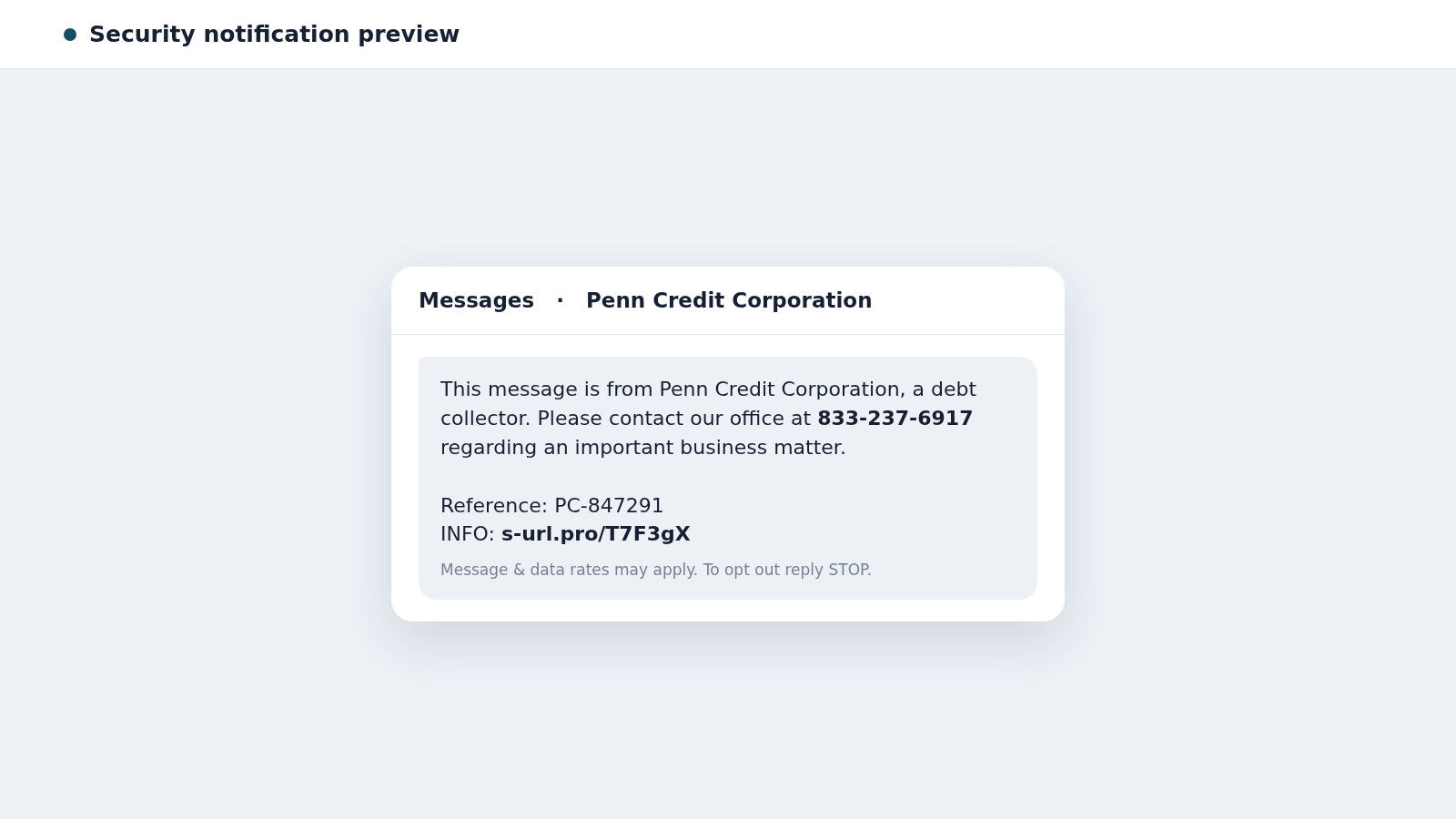
A text from “Penn Credit Corporation” says a debt collector needs to discuss an important business matter. It includes a reference, a callback number, and a short link that seems deliberately vague.
The Penn Credit text scam is difficult because the company name is real while the sender may not be. The safest response is neither instant payment nor blind dismissal, but independent debt verification.
Overview
A real collector’s name can be used by an impostor
Penn Credit Corporation is a legitimate debt-collection company. Its existence does not authenticate every text, call, email, or payment page displaying the Penn Credit name.
Criminals often borrow real business identities because a quick search then produces an established company. The victim may confuse proof that the company exists with proof that the specific sender works there.
The first text may reveal very little
A collection message can avoid naming a debt before the recipient’s identity is confirmed. That privacy practice can make a genuine communication feel vague, and it also gives scammers an easy format to imitate.
A reported suspicious message directs the recipient to 833-237-6917 and a shortened s-url.pro address. A number, reference, STOP option, and disclosure about message rates do not prove who controls the contact.
The target may be money, identity data, or both
A fake collector can threaten lawsuits, arrest, wage garnishment, license suspension, or workplace embarrassment. The pressure is designed to produce payment before the debt is validated.
The impostor may seek:
- Credit or debit card numbers and bank account details
- Social Security numbers, birth dates, and addresses
- Online-account credentials entered on a fake portal
- Gift cards, wire transfers, crypto, or payment-app transfers
- A small token payment that confirms the victim will cooperate
- Information about employers, relatives, and other creditors
- Documents later reused for identity theft
A real debt should survive a written verification request. An impostor depends on urgency, secrecy, and a payment channel that disappears once the money is sent.
What a Penn Credit Text May Look Like
The initial message may identify Penn Credit Corporation as a debt collector and ask the recipient to call about an important matter. It can include a reference number and a link labeled INFO, ACCOUNT, or PAYMENT.
Some versions mention tolls, parking notices, medical bills, utilities, taxes, or an unnamed account. The message may threaten escalation if the recipient fails to respond that day.
A genuine collection text and a copied one can look similar. Both may contain a STOP instruction, message-rate language, office hours, or a case reference.
The meaningful difference is not visual polish. It is whether the contact details match independently verified company records and whether the collector provides legally required information about the debt.
A text sent to the wrong number is another possibility. Recycled telephone numbers and inaccurate records can bring a legitimate collection attempt to someone who does not owe the account.
How the Penn Credit Text Scam Works
Step 1: The sender obtains a list of active telephone numbers
Numbers can come from leaked databases, marketing records, public listings, or previous phishing activity. Partial names and addresses may be added to make the message appear targeted.
The scammer does not need accurate debt information. A large campaign will reach people who have old bills, collection accounts, or recent credit concerns.
Step 2: A real collection company becomes the costume
The message uses Penn Credit Corporation because the name can be found online. That search result reassures a worried recipient even though it says nothing about the supplied number or link.
The text may copy legal disclosure language from real communications. Standard phrases are easy to reproduce and should not be treated as authentication.
Step 3: Vague wording encourages a reply or click
“Important business matter” creates curiosity without giving the recipient enough information to check the claim. A reference number suggests that a complete file waits behind the next step.
The victim may call simply to learn what the message concerns. That puts the scammer in control of the explanation and pace.
Step 4: The caller or portal starts identity confirmation
A fake agent asks for a name, address, birth date, or last four Social Security digits before revealing the creditor. The questions are described as privacy safeguards.
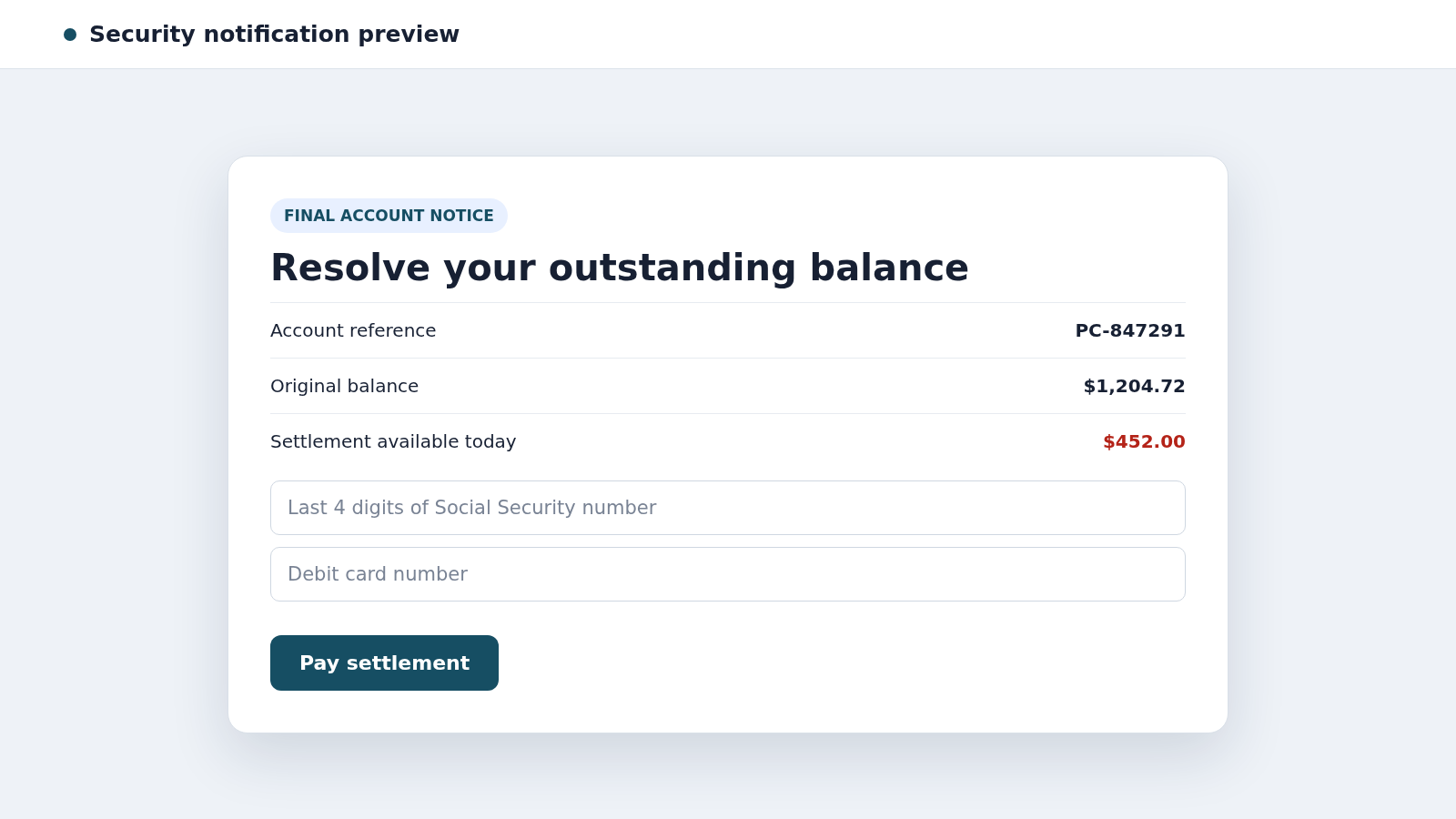
A fraudulent website can gather the same details in a form. The data remains valuable even if the visitor decides not to make a payment.
Step 5: An unfamiliar debt is made to sound urgent
The impostor names a plausible creditor or type of bill and claims the account is at its final stage. Interest, court costs, wage action, or service at the workplace may be threatened.
The victim is discouraged from calling the original creditor. Any delay is presented as surrendering a special settlement or triggering legal action.
Step 6: A discounted payment is offered for immediate compliance
The caller may reduce the claimed balance if payment is made while the call remains active. A $1,200 debt might supposedly disappear for $450 today.
The discount turns fear into a perceived opportunity. No written validation or settlement agreement is provided before money changes hands.
Step 7: Payment goes through a weak-recovery channel
Gift cards, crypto, wires, and transfers to personal accounts are common warning signs. A fake portal may instead capture a card number while displaying a failed-payment error.
Another attempt can follow immediately. The scammer claims the first charge failed even though it was received or the card details were stolen.
Step 8: Information and payment behavior fuel later attacks
A responsive victim may receive new calls from supposed lawyers, courts, creditors, or recovery agents. Details learned during the first contact make each story more convincing.
Identity data can support account openings, password resets, and tax fraud. A person who paid once may be targeted repeatedly with different invented balances.
Three Possible Explanations for the Message
The text may be a legitimate Penn Credit communication about an account assigned for collection. That possibility should be tested through official contact details and written validation.
It may be a genuine message sent to the previous owner of the number or another person with similar information. Receiving it does not make the current phone owner responsible for the debt.
It may be a complete impersonation. The Penn Credit name is copied while the link, number, collector, and payment destination belong to criminals.
A fourth situation is possible: the collector is genuine, but the debt, amount, ownership, age, or identity is disputed. Verification and a written dispute are appropriate responses.
Do not decide which explanation applies from the sender name alone. Contact the company through details you located separately and compare the account with your records.
Warning Signs of a Fake Debt Collector
- The caller refuses to provide a legal company name and mailing address.
- The original creditor, account, and itemized amount are not identified.
- Immediate arrest, deportation, or police action is threatened.
- You must pay before receiving written validation information.
- The link uses an unrelated or shortened internet address.
- Payment is demanded through gift cards, crypto, or a personal account.
- The caller insists you cannot speak with the original creditor.
- A full Social Security number is requested at the beginning.
- The balance or settlement changes whenever you hesitate.
- The caller claims that disputing the debt is illegal.
Do not ignore actual court papers. Verify them directly with the court using contact information from an official government source, never the number printed in a suspicious text.
How to Verify a Penn Credit Message Safely
Preserve the text without tapping its link. Visit Penn Credit’s official website by typing the address yourself and compare published texting disclosures and contact information.
Penn Credit’s disclosure page identifies 59304 as a number used for texts in its program. A different sender is not automatically fraudulent, but it requires careful independent confirmation.
Ask for validation information in writing. It should identify the collector, current creditor, relevant account, itemized amount, and procedures for disputing the debt or requesting the original creditor.
Compare the information with statements, prior correspondence, and credit reports obtained through AnnualCreditReport.com. The absence of an item from a report is not conclusive, but inconsistencies deserve investigation.
Contact the original creditor through a known statement or official website. Ask whether the account was placed with Penn Credit and confirm the balance without using any contact detail supplied by the text.
What Debt Validation Should Give You
Validation information helps separate a real account from a frightening story. It should identify the collector and current creditor, provide an account reference, and state the amount as of a specific date.
The amount should be itemized so interest, fees, payments, and credits can be understood. A caller who cannot explain how the balance was calculated has not earned a payment.
The notice should explain how to dispute the debt or request information about the original creditor. Keep the envelope, message, and a copy of anything you send.
Receiving a validation notice is not the same as admitting the debt. Compare it with your own records and get qualified legal advice if the account is old, disputed, or connected to identity theft.
Do not make a token payment simply to stop calls. In some places, acknowledging or paying an older debt can affect legal time limits, so understand the consequences first.
Company, Address, and Fulfillment Checks
The legal company must match the person contacting you
Finding Penn Credit online verifies the business, not an unknown texter. Confirm the agent and account through the company’s independently located channels.
The mailing address should remain consistent
A legitimate collector can provide a physical mailing address for disputes and correspondence. An agent who offers only a mobile number or chat account cannot be properly verified.
The debt details must be documented before payment
A real obligation has a creditor, account history, reference date, and itemized amount. A vague threat in a text is not a substitute for validation information.
The payment route should belong to the verified collector
Do not send money to an individual, unrelated company, gift card, crypto wallet, or unfamiliar payment app. Get a settlement agreement in writing before paying a confirmed debt.
What to Do if You Have Fallen Victim to This Scam
- Stop all contact and further payments. Do not pay an additional processing fee, court hold, refund charge, or verification amount, even if the caller knows details from the first transfer.
- Contact the payment provider immediately. Tell the bank, card issuer, app, exchange, or wire service that the transaction was induced by impersonation and ask about a reversal or dispute.
- Reach Penn Credit independently. Report the copied name and ask whether the reference, sender, number, and account are connected to the company.
- Secure exposed financial information. Replace compromised cards, change online-banking passwords, remove unfamiliar sessions, and monitor for small test transactions.
- Protect identity records. If Social Security or ID data was submitted, use the recovery plan at IdentityTheft.gov and consider credit freezes with all three bureaus.
- Scan any device used on the site. Remove unknown downloads and run Malwarebytes if the link installed an app, extension, document, or remote-access tool.
- Block dangerous destinations. AdGuard can help stop visits to known phishing and malicious advertising pages, but it cannot reverse a completed payment.
- Preserve the evidence. Save the text, short link, expanded destination, telephone numbers, reference, receipts, collector names, and threats. Do not publish private debt details.
- Report the impersonation. File with the FTC and CFPB, notify the state attorney general where appropriate, and forward the fraudulent text to 7726.
- Dispute any inaccurate real debt separately. A scam contact does not erase a genuine obligation. Use written validation and qualified legal help rather than negotiating with the impostor.
Frequently Asked Questions
Is Penn Credit Corporation a real company?
Yes. The real company’s existence does not authenticate a particular text, link, caller, or payment request. Verify the communication independently.
Why does the text avoid naming the debt?
Privacy rules can limit what a genuine first message reveals. Scammers copy that ambiguity because it encourages a curious recipient to call.
Should I reply STOP to an unfamiliar collection text?
Use caution when the sender is unverified because a reply can confirm an active number. Preserve the message and contact the verified company through a separate route.
Can a debt collector have me arrested?
Ordinary consumer debt is not resolved through an immediate arrest demanded by telephone. Threats of instant police action are a major impostor warning.
What if the debt is mine but the link looks suspicious?
Do not use the link. Confirm the collector and debt independently, request written validation, and arrange any payment through a verified channel.
Can I recover money sent to a fake collector?
Recovery is not guaranteed, but fast reporting improves the chance. Contact the payment provider immediately and give investigators exact destination and transaction details.
The Bottom Line
The Penn Credit text scam succeeds by placing a real collector’s name above an unverified number, link, and debt. A legitimate company search result cannot validate the person demanding payment.
Preserve the message, contact Penn Credit independently, and request written debt information. Pay only after the creditor, amount, collector, agreement, and destination have all been confirmed.

Join the discussion
0 commentsShare your experience or ask a question about this article.
Discussion
Start the conversation
Have a question or something useful to share? Add the first comment.