

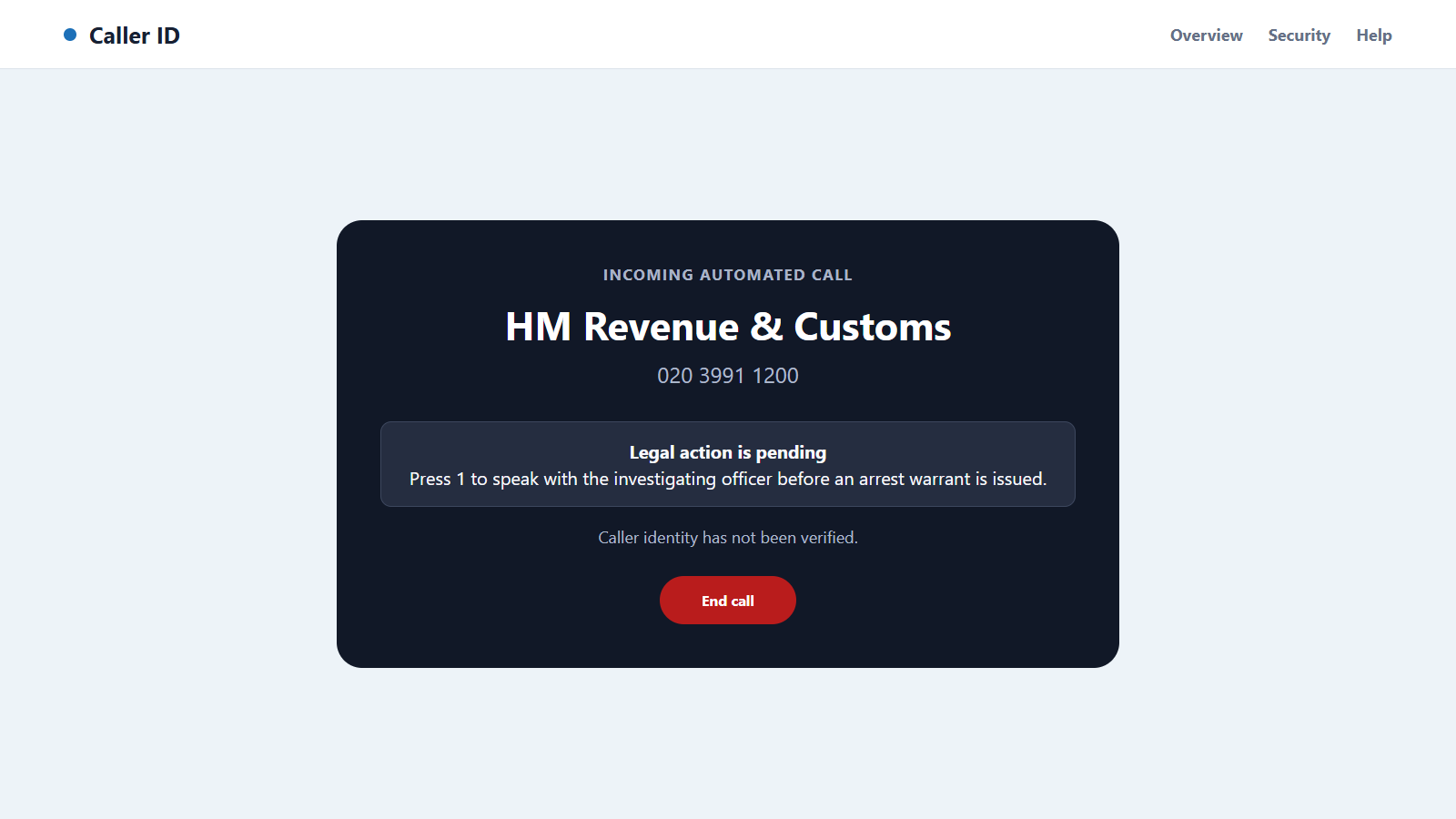
The recorded voice says a tax case has reached its final stage. Call back now, it warns, or legal action and an arrest warrant may follow.
An HMRC 02039911200 scam call uses fear before the recipient has time to check a tax account or speak with anyone they trust. The number looks ordinary; the script is anything but.
Overview
The call impersonates HM Revenue and Customs
The recipient hears an automated message or a caller claiming to represent HMRC, a tax investigation unit, a court, or the police. The story alleges unpaid tax, a compromised National Insurance number, or a serious filing error.
The voice may instruct the listener to press 1 or call 020 3991 1200 immediately. A live operator then treats the invented case as established fact.
Legal threats are used to force instant obedience
Scammers mention arrest, prosecution, asset seizure, licence suspension, or a warrant. The consequences sound so severe that checking the claim can feel like dangerous delay.
HMRC’s official scam warning says it will never leave a voicemail threatening legal action or arrest. That behavior is a decisive warning sign.
The displayed number cannot prove who is calling
Caller ID can be spoofed, and telephone numbers can be reassigned. Even if 02039911200 appears on screen, the identity must be judged by the request and verified through an official contact route.
Watch for these features:
- A recording says legal action begins unless you respond immediately.
- The caller asks you to remain on the line and not contact anyone else.
- Payment is demanded through gift cards, crypto, transfer, or a web link.
- The operator wants card details, an online-banking code, or HMRC credentials.
- A supposed case officer becomes hostile when you ask to call HMRC directly.
- The caller claims police are already traveling to your address.
- A court or solicitor is introduced to make the same demand sound verified.
- The amount must be paid before any written assessment can be reviewed.
What HMRC May Do and What This Caller Does Differently
HMRC can contact taxpayers by telephone in genuine circumstances. That fact is why a blanket rule such as HMRC never calls would be inaccurate and unhelpful.
The safer distinction is about method and verification. Genuine contact should allow you to stop, check the communication, and use official HMRC channels without being threatened for doing so.
HMRC publishes a current list of phone contacts that helps taxpayers compare recent campaigns. The guidance explains what those calls cover and what information they will not request.
A genuine debt does not require payment to a random individual, personal account, crypto wallet, or gift-card code. Tax obligations can be checked through the taxpayer’s official account and established payment routes.
An unexpected call may mention your name, address, employer, or part of a tax reference. Such details can come from public records, stolen data, earlier phishing, or an unrelated breach.
Correct personal information does not authenticate the caller. It only shows that someone had access to data, and the scammer may read it aloud precisely to discourage questions.
The number in this scam’s name is best treated as an historical indicator, not a permanent identity. Spoofing can make an unrelated number appear, and a formerly abused number may later belong to someone innocent.
For that reason, blocking 02039911200 can reduce repeat calls but cannot stop the campaign. Criminals rotate numbers and may display an official-looking one.
The reliable response is to end the call, open GOV.UK yourself, and contact HMRC through the number for the relevant tax matter. Do not ask the caller to transfer you to a safe department.
How the HMRC 02039911200 Scam Call Works
Step 1: Telephone numbers are targeted in bulk
Automated systems can place thousands of calls cheaply. The recipients do not need to be HMRC customers with a known problem because almost every adult has some connection to tax.
Voicemail messages let the campaign reach people who screen unknown calls. The threat remains waiting in the inbox until worry prompts a callback.
Step 2: A recorded legal warning creates panic
The recording announces that a case, investigation, or warrant is active. It may say repeated letters were ignored even when no such letters exist.
Formal vocabulary and a case reference give the statement an administrative tone. The message moves straight to consequences before presenting evidence.
Step 3: The recipient is connected to a fake officer
Pressing a key or calling back reaches someone trained to control the conversation. The operator may provide a name, badge number, department, and direct extension.
Those details are easy to invent. A real-sounding introduction has no value unless the department confirms it through a separately obtained contact route.
Step 4: Personal information is requested or confirmed
The caller asks for a National Insurance number, date of birth, address, employer, passport details, or HMRC account information. Questions are presented as security checks.
Sometimes the operator states stolen information and asks for confirmation. A frightened recipient can reveal the missing pieces simply by correcting a small error.
Step 5: The fake tax debt is calculated
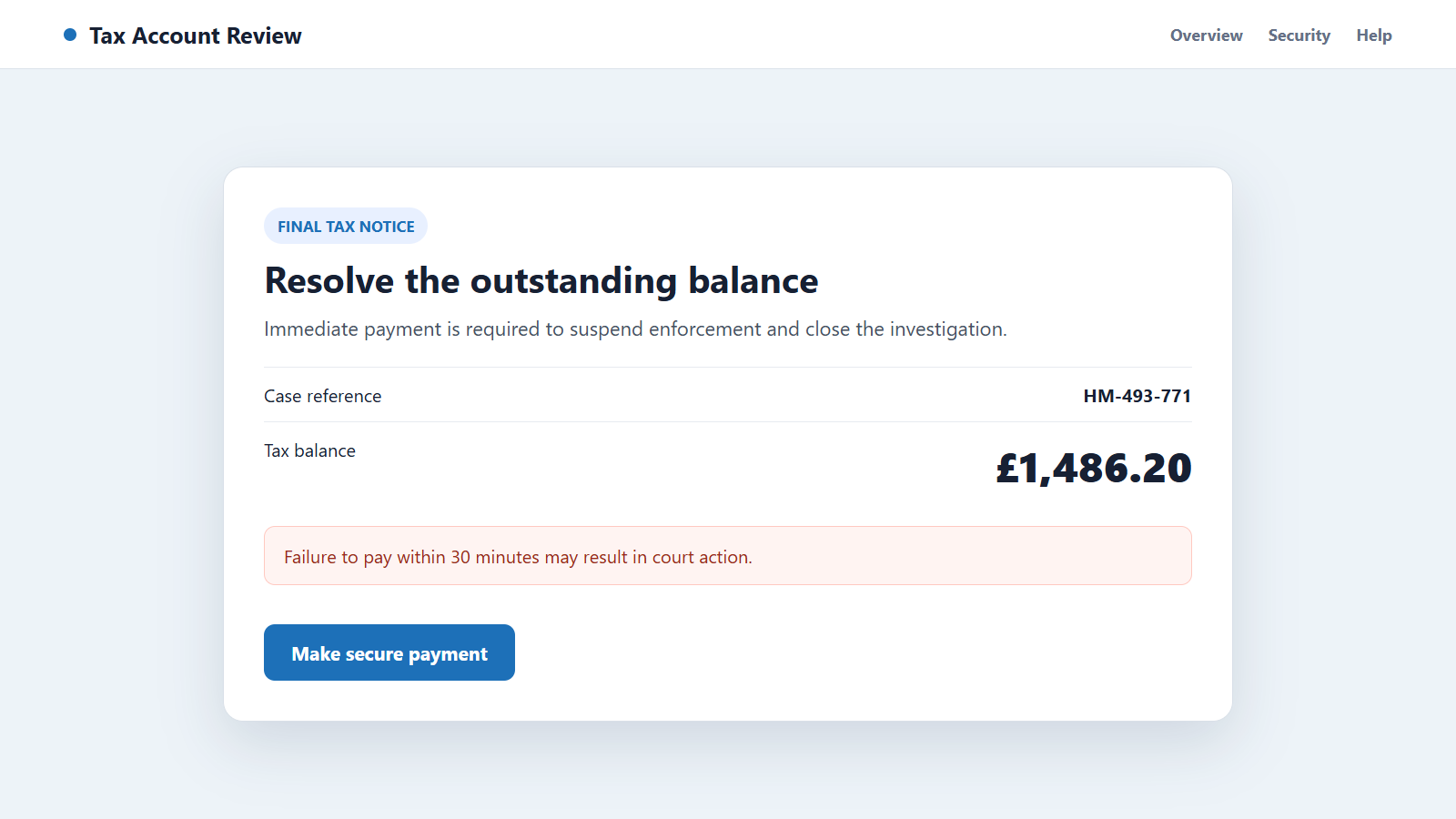
The supposed officer announces an amount that includes tax, penalties, court costs, or interest. The figure may be chosen to feel serious but still payable on the same day.
A second caller may pose as a supervisor, solicitor, or police officer. Multiple voices create the illusion that separate authorities reviewed the case.
Step 6: Isolation removes opportunities to verify
The victim is told not to hang up, contact family, visit a bank branch, or discuss the case. The caller may claim that disconnecting is evidence of refusal.
Keeping the line open prevents a calm search for HMRC guidance. It also lets the scammer react immediately when a bank or payment service raises questions.
Step 7: Payment or account access is demanded
The operator may request bank transfer, card payment, vouchers, crypto, cash collection, or remote access to online banking. A linked portal can imitate a government payment page.
Verification codes are described as receipt numbers or cancellation codes. In reality, sharing one can authorize a transfer, add a payee, or reset an account.
Step 8: Follow-up pressure extracts more
After one payment, the caller discovers another fee needed to close the warrant or release a refund. The victim is kept engaged until funds run out or the bank intervenes.
Personal data from the call can support later HMRC refund emails, bank-security calls, identity applications, and recovery scams.
How to Check a Tax Call Without Taking a Risk
End the conversation. A genuine organization can continue through official correspondence, while a scammer loses the ability to manage your emotions once the line is closed.
Do not immediately call a number from the message, caller ID, or a search advertisement. Type GOV.UK into the browser and find the contact page for the tax involved.
Check your Personal Tax Account or HMRC app through its normal sign-in route. Look for a corresponding balance, message, or communication instead of using a link supplied by the caller.
If you call HMRC, explain the exact allegation and ask whether the department, reference, and amount exist. Do not merely ask whether the displayed number looks familiar.
Open any real paper correspondence you already hold and compare the account reference. A scammer’s claim that letters were sent does not create a debt.
If the person says a court or police force is involved, contact that organization independently. HM Courts and Tribunals Service has warned that criminals spoof court numbers while alleging an HMRC debt.
Ask a trusted relative, accountant, or adviser to review the situation. Secrecy is a weapon in the scam, while a second calm reader often notices contradictions.
Never install remote-access software for a tax call. HMRC does not need control of your computer or a live view of online banking to verify an account.
Keep a simple record of genuine tax contacts, including the date, department, reference, and route you used to verify them. That history makes a later impersonation easier to separate from real account business.
Be cautious with search advertisements when looking for a helpline. A paid result or copied government design can lead to another intermediary, so confirm that the destination belongs to GOV.UK before dialing.
If anxiety makes it difficult to assess the call, wait until the next day unless an official account independently shows a deadline. A criminal demands speed; a real process provides documents, contact routes, and review rights.
Company, Address, and Fulfillment Checks
The claimed department must be listed officially
Search GOV.UK for the department and contact type. Scammers invent names that combine tax, legal, compliance, and enforcement language without matching a real HMRC team.
Use the published contact details to ask about the case. Do not allow the caller to supply a confirmation number for another member of the same operation.
The address must belong to the real authority
A payment page or email may display a government office copied from public records. Check whether replies, documents, and web domains actually lead to GOV.UK or HMRC.
An accurate office address in the footer proves very little because anyone can copy it. The communication route matters more than decorative contact information.
The payment destination must be an HMRC route
Review official instructions for the specific tax and payment method. A personal account, voucher, crypto address, or payment processor introduced during a threatening call is not a valid tax route.
Do not send a token amount to test the beneficiary. That confirms your willingness to pay and may make the next demand more aggressive.
The promised outcome must exist in your tax record
A caller may promise to cancel a warrant, remove a penalty, or unlock a refund. Verify the underlying issue in the official account before considering any action.
Ask HMRC to explain genuine balances through its established process. A verbal promise from an unknown operator creates no legal protection.
What to Do if You Have Fallen Victim to This Scam
- End contact with the caller. Hang up, block the number, and ignore callbacks from supposed supervisors, police officers, banks, or recovery teams connected to the same incident.
- Call your bank without delay. Use the number on the card or official banking app. Explain the payment method, ask whether funds can be stopped, and protect any exposed cards or online-banking access.
- Contact HMRC through GOV.UK. Check whether a real tax issue exists and tell HMRC which personal or account details the caller obtained.
- Report the fraudulent call. GOV.UK provides a dedicated HMRC scam-reporting route. A call involving threats or personal information can be reported online.
- Report financial loss. Use the official UK fraud-reporting service and provide the number, time, payment details, recordings, voicemails, and any fake case references.
- Change compromised credentials. Replace HMRC, email, banking, and reused passwords. Revoke unfamiliar sessions and enable multifactor authentication using the official service.
- Protect identity documents. If you revealed a National Insurance number, passport, date of birth, or address history, follow the fraud-monitoring advice given by the relevant authority.
- Remove remote-access software. Disconnect the affected computer from the internet and tell the bank if the caller saw your screen or controlled a payment session.
- Run a full security scan. After removing suspicious tools, use Malwarebytes to look for malware and unwanted software before restoring sensitive access.
- Limit further phishing exposure. AdGuard can help block known malicious pages, ads, and trackers, but it cannot authenticate a telephone caller.
- Tell trusted people what happened. A family member or adviser can help monitor follow-up calls and accounts without judgment. Scammers rely on embarrassment to keep victims isolated.
- Refuse refund guarantees. Someone who knows about the loss may pose as a regulator or recovery specialist. Do not pay an advance fee or share a fresh verification code.
Frequently Asked Questions
Is 02039911200 definitely controlled by HMRC scammers today?
Not necessarily. Numbers can be spoofed or reassigned. The documented scam script matters, but the current owner cannot be established from caller ID alone.
Does HMRC ever make telephone calls?
Yes. HMRC publishes information about genuine campaigns and what they may request. End an unexpected call and verify it through GOV.UK.
Will HMRC threaten arrest in a voicemail?
No. HMRC specifically warns that it will not leave voicemails threatening legal action or arrest. Do not follow the callback instruction.
Can a caller know my details and still be fake?
Yes. Personal data can come from breaches, public records, old forms, or prior phishing. Treat known details as information, not authentication.
Should I press 1 to ask for more information?
No. Engaging confirms an active number and exposes you to live pressure. Hang up and use a separately found official HMRC contact.
What if I might genuinely owe tax?
Check the official tax account and speak with HMRC or a trusted adviser. A real balance can be resolved without obeying an unverified legal threat.
The Bottom Line
An HMRC 02039911200 scam call tries to make fear feel like proof. Neither a London number, a case reference, nor knowledge of your address establishes who is on the line.
Hang up before sharing information or money, then rebuild the conversation through GOV.UK. Genuine tax matters survive independent verification; a threatening caller will fight it.

Join the discussion
0 commentsShare your experience or ask a question about this article.
Discussion
Start the conversation
Have a question or something useful to share? Add the first comment.