

The job description sounds almost boring: receive a parcel, check the contents, upload a few photos, print a prepaid label, and send it on. The portal tracks every task, including the salary supposedly building in your account.
The package inspector job scam hides the crime inside that routine. The worker sees boxes and shipping labels, not the stolen cards, compromised accounts, and false identities used to buy what is inside them.
By the time payday arrives, the packages are gone and so is the employer.
Overview
The offer turns a home address into a shipping depot
The package inspector job scam advertises remote work under titles such as parcel inspector, shipping coordinator, quality-control agent, logistics assistant, or package processing specialist. The duties involve receiving merchandise at home, photographing or inspecting it, replacing the label, and forwarding it to another destination.
The recruiter presents the arrangement as the last mile of international e-commerce. Workers may be told the company helps overseas customers buy from U.S. stores, checks merchandise for damage, or consolidates shipments before export.
Real logistics jobs exist, but legitimate companies do not normally route anonymously purchased consumer goods through a new employee’s home. The residential address is useful to criminals because retailers and fraud systems are more likely to trust it than a known reshipping warehouse.
The parcels are usually connected to another crime
Merchandise can be purchased with stolen cards, taken over shopping accounts, fraudulent financing, or identities created from stolen personal data. The reshipper receives the goods, removes documents, applies a new label, and breaks the direct trail between the fraudulent order and the criminal.
The Federal Trade Commission describes this exact work-from-home setup as a reshipping scam. The FTC warns that the promised paycheck does not arrive and that participants may be helping send stolen goods.
The U.S. Postal Inspection Service also warns that reshipping schemes recruit people to receive and forward merchandise obtained through fraud. Calling the work “quality inspection” does not change the source of the packages.
The salary is a number on a dashboard, not real pay
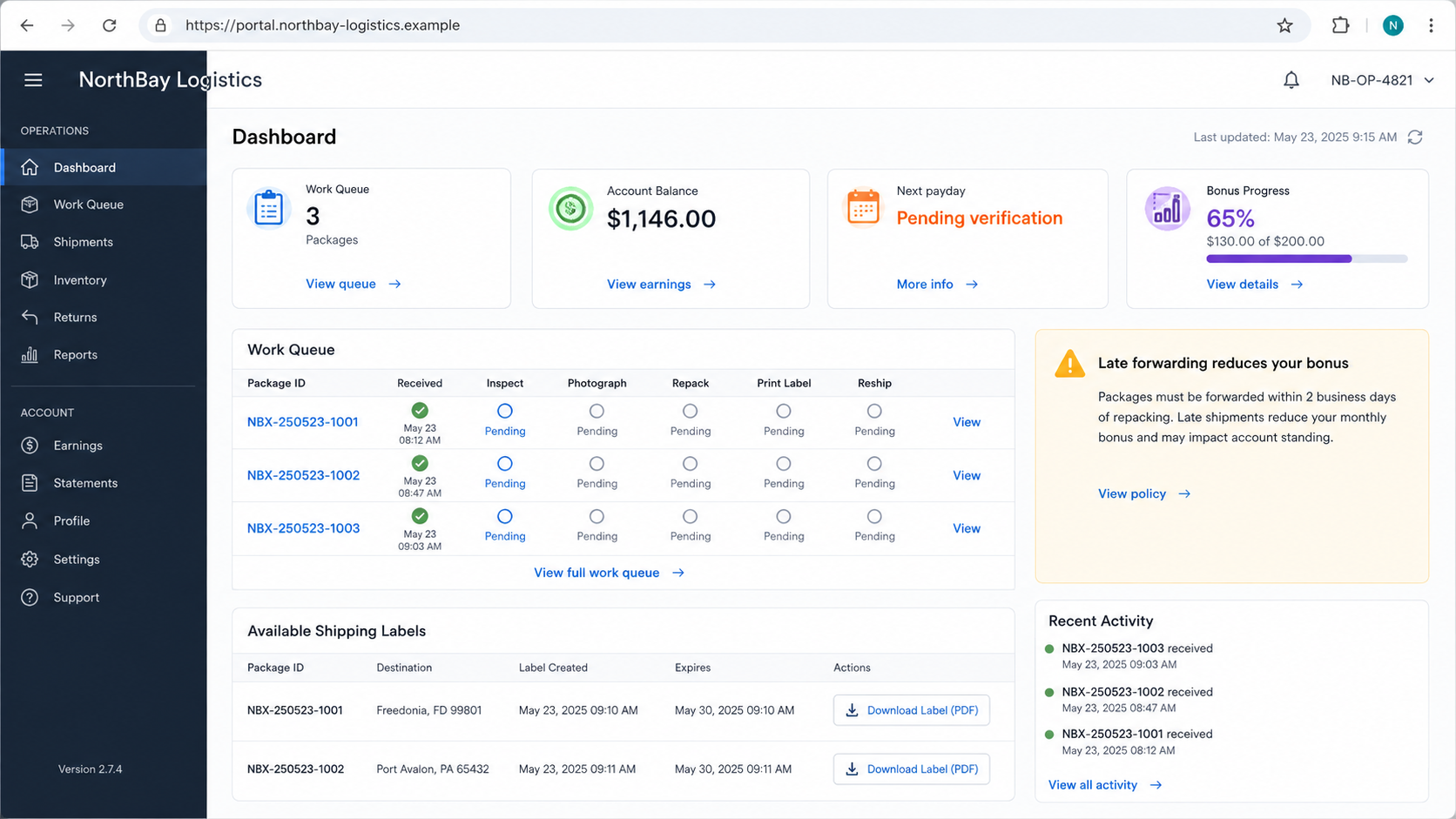
A professional-looking portal assigns packages, shows deadlines, provides labels, and calculates a monthly salary plus bonuses. That interface is powerful because it makes each shipment feel like ordinary employment.
Payday is often set several weeks after the start date. The delay gives the operation time to move many packages through the victim’s address before suspicion grows. When the date arrives, the account may require verification, a paid fee, or one final assignment.
Warning signs include:
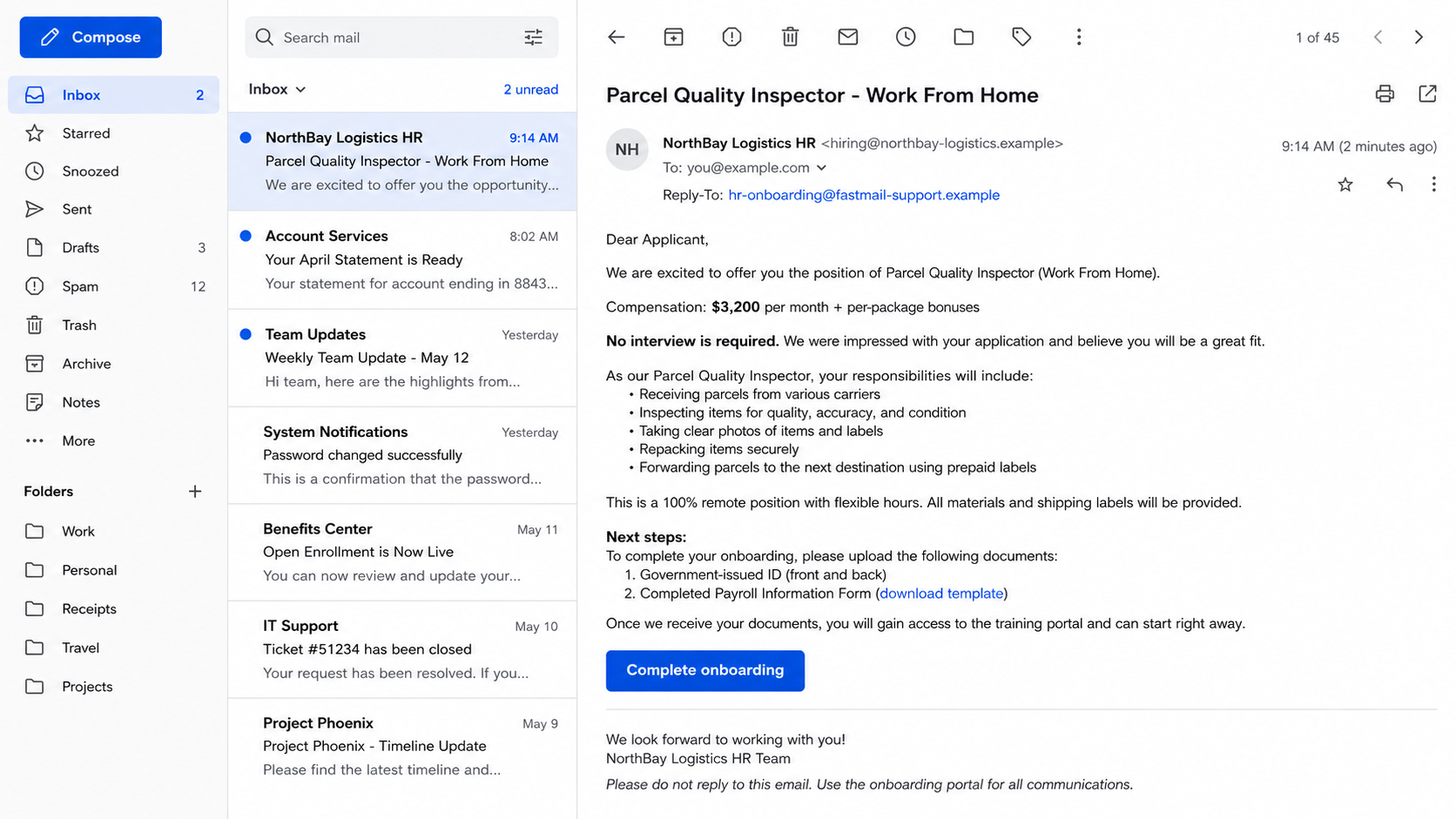
- The company offers a remote job without a real interview.
- Your home address is the primary receiving location for consumer goods.
- The job consists mainly of opening, photographing, relabeling, and forwarding parcels.
- The recruiter uses a recently created domain or unrelated reply-to address.
- The employment paperwork requests identity and bank details before verification.
- Package labels name different buyers, stores, or return addresses.
- Destinations change frequently or include freight forwarders and private individuals.
- The portal shows earnings but the first payday is weeks away.
- You are asked to pay postage or buy equipment with a check.
- Questions about a physical office, supervisor, or payroll provider receive vague answers.
How the Package Inspector Job Scam Works
Step 1: A fake recruiter advertises easy remote logistics work
The opening may arrive through email, text, a job board, social media, or a messaging app. The pay is attractive for simple duties, experience is optional, and the schedule fits around other work. Those features widen the pool of people willing to respond.
Some recruiters copy the name and address of a real company. Others create a polished site for a fictional logistics firm. A corporate-looking domain is helpful, but it is not proof that the legal business, recruiter, and job actually exist.
Step 2: Onboarding collects identity and payroll information
The applicant receives an employment agreement, tax form, direct-deposit form, and a portal login. This paperwork makes the offer feel formal while collecting a Social Security number, driver’s license, signature, bank details, and home address.
The information can be used for identity theft even if no package ever arrives. A scam does not become legitimate because it provides a contract with a logo and electronic signature box.
Step 3: Fraudulent purchases are sent to the worker
The operation orders electronics, clothing, gift cards, tools, cosmetics, or other resalable goods using compromised payment methods. The newly recruited worker’s residential address acts as a buffer between the merchant and the final recipient.
Packages may arrive under several names. The recruiter explains that they belong to international clients or uses a suite number built from the worker’s account ID. That explanation normalizes a pattern that should instead trigger questions.
Step 4: The portal turns forwarding into a checklist
The worker logs the parcel, opens it, checks for damage, photographs the product and invoice, removes old paperwork, and downloads a new shipping label. Points and bonuses reward fast turnaround.
Each small task feels harmless on its own. Together, they help conceal the original buyer, remove evidence, and move the merchandise beyond easy recovery.
Step 5: Prepaid labels lead to criminal-controlled destinations
The replacement label may send the parcel to another U.S. intermediary, an export company, a storage unit, or a person using a false identity. Several hops can be used before the goods leave the country or reach a reseller.
The worker is told never to contact the store or carrier because the “client relationship” is confidential. That rule protects the operation from the verification most likely to reveal the fraud.
Step 6: The employer delays payment while volume grows
The first paycheck may be scheduled thirty days after probation. During that period, the dashboard balance grows and the recruiter praises good performance. A victim who sees $1,000 or more marked as pending has a reason to keep forwarding packages.
If the worker threatens to stop, the recruiter may say unfinished assignments forfeit all earnings. The fake balance becomes leverage even though the operation never intended to pay it.
Step 7: A fake check or fee may create another loss
Some schemes send a check for supplies, then instruct the worker to buy equipment or forward the remainder. The bank may initially show the deposit, but a fraudulent check can be reversed later, leaving the victim responsible for money already sent.
Other portals demand a background-check fee, payroll activation payment, or postage reimbursement before releasing wages. Real pay does not require an employee to pay an anonymous employer first.
Step 8: The portal and recruiter disappear
When stolen cards are reported or the first payday arrives, messages stop, the phone number fails, and the portal goes offline. The worker is left with no wages and a home address tied to disputed orders.
Merchants, cardholders, carriers, or investigators may contact the address later. Keeping records and reporting quickly helps show how the victim was recruited and where the packages were sent.
Why Criminals Need a Reshipper
Retailers use delivery addresses as one signal when evaluating an order. A purchase made with a stolen card and shipped directly to a known fraud address may be blocked. Sending it to an ordinary residence creates distance and makes the order appear less obviously connected to the final operator.
The reshipper also performs evidence-removal work. Invoices can identify the stolen account, original order, or payment source. Repacking strips away those documents and gives the next carrier a label unrelated to the merchant’s shipment.
Finally, the victim absorbs visibility. Doorbell footage, carrier scans, delivery photographs, and merchant records all point to the residential address. The people directing the operation remain behind messaging accounts, false names, and a web portal.
This is why the label “parcel mule” is useful. Like a money mule who moves stolen funds, a parcel mule moves value between the original fraud and the criminal beneficiary. The person may have been deceived, but the movement still helps the crime succeed.
Can Any Work-From-Home Shipping Job Be Legitimate?
Some people legitimately ship products from home for their own business or an established employer. The crucial distinction is whether the company can be independently verified and whether the goods, buyers, inventory, accounting, and fulfillment chain make commercial sense.
A real employer should have a checkable legal entity, established contact details, normal interviews, transparent payroll, and a physical operating model. It should be able to explain why merchandise goes to a residence and prove that it owns or is authorized to handle the goods.
Search the job description in quotation marks. Fraud networks reuse titles and scripts. Also search the company’s name with terms such as reshipping, parcel mule, complaints, and scam, but remember that a newly created name may have no history.
Contact the company through a phone number found in an official registry or long-established website. If the recruiter copied a real business, that independent call protects both you and the company being impersonated.
Most importantly, do not forward the first package while you are still verifying the job. Once the merchandise leaves your control, recovery and explanation become harder.
Company, Address, and Fulfillment Checks
Verify the legal employer
Search state business records, the claimed office address, and the official phone number. Compare the recruiter domain with the established company domain. A recently created lookalike is not the same business.
Confirm the recruiter independently
Call the company’s published human-resources department and ask whether the person, vacancy, and portal are genuine. Do not use the number or reference supplied in the offer.
Examine the residential-address request
Ask why a logistics company needs unknown consumer purchases sent to an employee’s home instead of an insured warehouse. Vague claims about overseas clients do not establish ownership of the goods.
Trace the fulfillment chain
Compare purchaser names, invoices, original shipping labels, and new destinations. Do not remove paperwork or send anything onward if the names conflict or the recruiter cannot prove authorization.
What to Do if You Have Fallen Victim to This Scam
- Stop forwarding packages. Tell the recruiter nothing more until you have spoken with authorities or the merchant. Do not send a final parcel to unlock wages.
- Keep unopened merchandise secure. Do not use, sell, or discard it. Record tracking numbers and ask the carrier, merchant, or postal inspector how it should be handled.
- Preserve the operation’s records. Save emails, contracts, portal pages, chat messages, labels, invoices, package photos, phone numbers, domains, and every destination.
- Contact the merchants. Use independently verified support channels. Explain that products may have been purchased fraudulently and sent to your address through a fake job.
- Report mail-related activity. Contact the U.S. Postal Inspection Service when the mail is involved and file a report with the FTC at ReportFraud.ftc.gov.
- Protect your identity. If onboarding included a Social Security number or ID image, place fraud alerts or credit freezes, review credit reports, and watch for new accounts.
- Protect your bank account. Tell the bank if you supplied direct-deposit details, deposited a company check, or sent money. A displayed check balance can still be reversed.
- Change reused passwords. Secure the email account first, then any account that shared the portal password. Remove unfamiliar sessions and recovery methods.
- Scan the device. If onboarding required software, an extension, or document viewer, disconnect from sensitive accounts and run a full Malwarebytes scan.
- Limit malicious follow-up links. AdGuard can block many known phishing and malvertising destinations after cleanup, but it cannot validate a recruiter or prove ownership of a parcel.
- Tell investigators you were recruited. A clear timeline of the offer, instructions, packages, and destinations helps distinguish a deceived worker from the organizers.
- Ignore payroll-recovery offers. The dashboard balance was controlled by the scammer. Do not pay anyone who claims a fee will release it.
Frequently Asked Questions
Is a package inspector a real job title?
Warehouses employ quality and shipping staff, but an unsolicited remote role that sends consumer goods to your home for relabeling matches a known reshipping-scam pattern.
What if every shipping label is prepaid?
Prepaid postage does not prove the goods were purchased legally. Labels can be bought through compromised accounts or supplied to move fraudulently obtained merchandise.
Can I keep a package if the employer disappears?
Do not treat it as wages. The merchandise may belong to a merchant or fraud victim. Keep it secure and get instructions from the merchant, carrier, postal inspectors, or police.
Why does the portal show a real salary balance?
The operator controls the number on the screen. It costs nothing to display growing earnings, and the fake balance motivates workers to complete more shipments before payday.
Am I in legal trouble if I did not know?
Only a qualified lawyer can assess a specific case. Stop participating, preserve evidence, and report promptly. Continuing after recognizing the warning signs can make the situation worse.
Should I confront the recruiter?
No. Preserve the evidence and stop following instructions. Confrontation can make the accounts and portal disappear before authorities or merchants receive the information.
The Bottom Line
The package inspector job scam does not pay people to check merchandise. It recruits a clean address and a pair of hands to move goods obtained through fraud, while a fake dashboard postpones questions until the valuable parcels are gone.
A real employer should not need your living room to hide the path from retailer to recipient. Stop before forwarding anything, verify the company independently, and report every package already handled.

Join the discussion
0 commentsShare your experience or ask a question about this article.
Discussion
Start the conversation
Have a question or something useful to share? Add the first comment.