

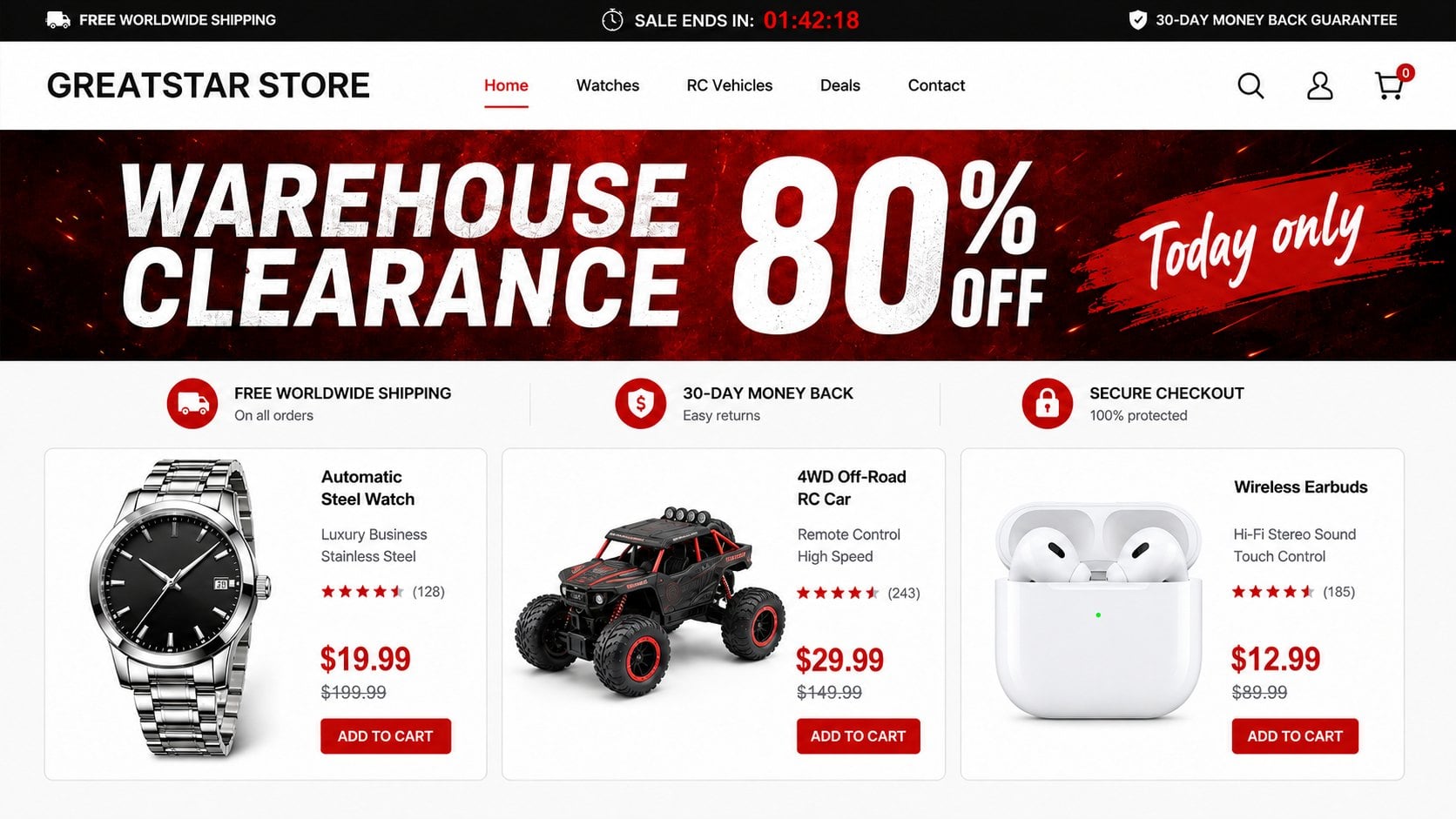
A hard-to-find watch or remote-control car at 80% off can make an unfamiliar store feel like a lucky discovery. The lower the price falls, however, the more important it becomes to verify who runs the shop and whether an order can actually be fulfilled.
Greatstar Store attracted concern because its storefront combined broad product claims with steep discounts and limited business details. The evidence buyers should examine is found beyond the sale banner, in the domain history, contact trail, payment flow, and delivery promises.
Overview
What Greatstar Store appeared to offer
Reports about Greatstar Store described an online shop at greatstar.store selling unrelated goods such as watches, off-road remote-control vehicles, electronics, and gift items. The catalog used dramatic markdowns to turn products that normally require comparison into quick impulse purchases.
A mixed catalog is not automatically fraudulent. It becomes concerning when expensive or scarce items appear at implausibly low prices while the seller provides little verifiable information about inventory, authorized distribution, or fulfillment.
- Large discounts across unrelated product categories
- Limited-time clearance language and countdowns
- Product photos that may appear on many other shops
- A checkout that requests payment before confirming stock
- Contact details that are difficult to connect to the store
Why shoppers have reason to be cautious
Historical reports associated the shop with an Outlook email address, an unusual international phone number, a company name written as Shu dong technology Co., Ltd, and a loosely formatted address in Shenzhen. Those details should not be accepted at face value without independent records connecting them to the domain and merchant.
At the time of this review, the greatstar.store domain was not loading reliably enough for us to confirm a functioning retail operation. That does not prove what happened to every past order, but it removes the ability to verify current policies, support, inventory, or ownership through the site.
What can happen after an order
Risky discount stores follow several outcomes. The buyer may receive nothing, a low-value substitute, a counterfeit item, or a tracking number that never shows meaningful movement. A payment form may also expose card and personal data.
Some operators provide a cheap trinket so delivery appears in the carrier system. That record can complicate a dispute even though the advertised product never arrived. Others delay responses until the payment provider’s claim window is close to expiring.
How the Greatstar Store Scam Works
Step 1: An advertisement presents an exceptional bargain
A shopper sees a social media advertisement, search result, marketplace link, or shared post promoting a desirable product at a fraction of its ordinary price. The image may have been copied from a manufacturer, established retailer, or crowdfunding campaign.
The advertisement focuses on the product and discount, not the seller. By the time the visitor notices the unfamiliar store name, they are already thinking about securing the deal.
Step 2: The storefront manufactures urgency
The landing page displays a countdown, low-stock counter, flash-sale notice, or claim that many people are viewing the item. These messages can be generated by a template and may not reflect real inventory or shopper activity.
A timer that restarts after refreshing the page is a clear sign that the deadline is not genuine. Even when a timer does not reset, the seller’s identity and product rights still require verification.
Step 3: Borrowed content creates credibility
Product photos, specifications, customer quotes, and badges can be copied in minutes. A detailed product page therefore does not prove that the store owns the goods or has a supply relationship.
Reverse image searches often show where a product photograph appeared earlier. Identical text, including the same unusual typo, can reveal a network of cloned stores using different domains and logos.
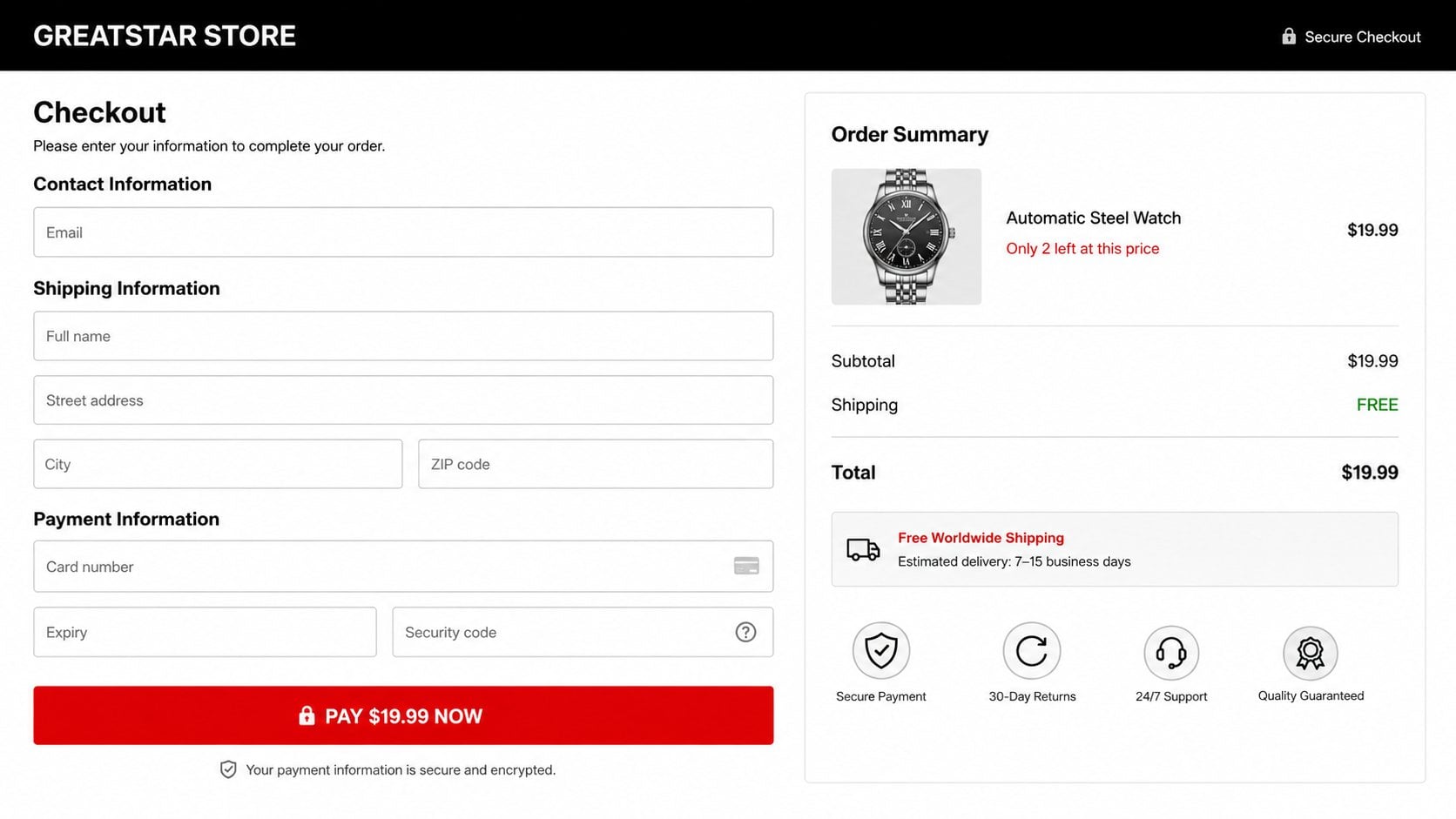
Step 4: The checkout captures money and customer data
The buyer provides a name, delivery address, phone number, email, and payment information. If the checkout is controlled directly by a dishonest operator, all of this data can be retained even when an error appears.
The merchant name on the payment statement may not match Greatstar Store. An unrelated descriptor makes the transaction harder to recognize and can delay a dispute if the buyer assumes it belongs to another purchase.
Step 5: Shipping excuses consume the dispute window
After payment, the customer may receive an automated confirmation but no useful tracking. Support responds with generic messages about high demand, customs delays, warehouse relocation, or a carrier backlog.
A tracking number may show only that a label was created. In more deceptive cases, it refers to a shipment delivered in the same postcode but not to the customer’s address. The operator uses that status as supposed proof of fulfillment.
Step 6: Refund requests lead nowhere
When the buyer asks for a refund, the seller may demand more waiting, offer a tiny partial refund, or require expensive return shipping to an address different from the one on the site. Messages can stop completely once the buyer rejects the offer.
The domain may later disappear while a similar storefront opens under another name. Customer data can then be used for additional shopping scams, delivery messages, or card-testing attempts.
Greatstar Store Red Flags to Examine
A store should be evaluated as a whole. One weak signal can have an innocent explanation, but a cluster of mismatched details creates substantial risk.
- Prices far below every established retailer
- A broad catalog with no clear retail specialty
- A free email account used as the main support channel
- A phone number that is incomplete, oddly formatted, or unreachable
- A company name that cannot be tied to the domain
- An address that is vague or not formatted as a deliverable location
- Policies copied from another business or naming another website
- No reliable explanation of where goods ship from
- A demand for bank transfer, gift card, or cryptocurrency
- Pressure to withdraw a dispute in exchange for a promised refund
Customer reviews should also be checked outside the store. A perfect rating displayed only on the product page is controlled by the seller. Look for older, detailed reports that describe ordering, tracking, the received item, support, and refund outcome.
Company, Address, and Fulfillment Checks
Verify the legal company behind the store
A genuine shop should identify the business that accepts the order, not just a brand name in the header. Search the legal company name in the relevant corporate registry and compare its status, registration date, business activity, and officers.
Historical Greatstar Store reports cited Shu dong technology Co., Ltd. A company name written on a policy page is not proof of a relationship. The registry, domain records, invoices, and payment descriptor should form a consistent chain.
Confirm the physical and return addresses
Paste the address into a mapping service and postal lookup. Check whether it identifies a deliverable commercial location, a residential building, a virtual office, or an incomplete area description.
The address historically connected with Greatstar Store was described only in broad terms around Bantian, Longgang, Shenzhen. Before ordering internationally, buyers need a complete return destination and a clear explanation of who pays return postage.
Test the support channels before paying
Send a specific question about stock location, model number, warranty, and return procedure. A useful answer should address the question instead of repeating a generic sales message.
Historical reports listed givegivetoo@outlook.com and the phone number +1-34-18550496. Free mailboxes and unusual number formatting do not prove fraud, but they are weak support infrastructure for a store selling costly products internationally.
Verify stock, shipping, and payment protection
Ask where the item is physically stored, which carrier will handle it, how long dispatch takes, and when valid tracking becomes available. Compare product identifiers with an authorized manufacturer’s listings.
Use a credit card or another method with a clear dispute process. The FTC’s online shopping guidance recommends checking sellers and paying by credit card when possible because it provides protections when an order does not arrive as promised.
How to Research an Unfamiliar Online Store
- Compare the price. Check several established retailers. A store offering the only huge markdown needs a credible explanation.
- Search the exact domain. Add terms such as review, complaint, refund, counterfeit, and non-delivery. Separate the domain from similarly named businesses.
- Check domain age and changes. A very recent registration conflicts with claims of years in business. Privacy protection alone is not proof of fraud.
- Reverse-search product images. Determine whether the same photos belong to another retailer or manufacturer.
- Read every policy. Look for another company name, inconsistent country references, impossible deadlines, and an undisclosed return address.
- Confirm independent contact details. Do not rely only on the phone number or email printed by the shop.
- Inspect checkout identity. Note who processes the payment, what merchant name will appear, and whether the final amount and currency match.
- Keep evidence before ordering. Save the product page, price, delivery promise, policies, and order confirmation because the site can change later.
No checklist can make an unverified seller risk-free. If basic ownership and fulfillment questions remain unanswered, the safest decision is to buy from a retailer with a traceable history, even when the price is higher.
For branded goods, check whether the manufacturer lists authorized retailers and whether the warranty applies to purchases from the seller’s country. A copied warranty logo cannot create coverage.
If the store will not provide a model number, stock photograph of the actual item, or written warranty terms, the bargain may carry costs that appear only after delivery.
Also compare the language at the product page, cart, and checkout. Changes in company name, currency, return country, or delivery estimate can show that separate templates and payment services have been stitched together without a consistent retail operation behind them.
What to Do if You Have Fallen Victim to This Scam
- Contact the payment provider promptly. Explain whether the issue is non-delivery, counterfeit goods, an unauthorized charge, or a product materially different from the description. Ask about the dispute deadline and required evidence.
- Lock or replace an exposed card. If card details were entered directly into a suspicious checkout, tell the issuer that the number may be compromised. Review both pending and posted transactions.
- Send one clear written demand. State the order number, promised item, delivery deadline, problem, and requested resolution. Do not let endless scripted replies cause you to miss the payment dispute window.
- Preserve the full purchase record. Save screenshots of the listing, checkout, policies, confirmation, tracking, support messages, package label, and received product. Photograph the parcel before discarding it.
- Do not return goods blindly. Confirm the address and obtain tracked instructions through the dispute provider. International return postage can exceed the item’s value, and an unverified address may reject the parcel.
- Change reused passwords. If the store account password was used elsewhere, replace it everywhere. Enable two-factor authentication on email and payment accounts.
- Scan suspicious downloads. If the store supplied an app, invoice file, or tracking attachment, run a full Malwarebytes scan and remove detected threats. Do not open additional files sent by supposed support.
- Reduce follow-up exposure. AdGuard can block many known advertising, tracking, and phishing domains. Remain cautious of delivery texts and refund emails that quote details from the order.
- Report the store. Notify the advertising platform, search engine, hosting or domain provider, payment company, and your national consumer-protection or fraud authority. Include the exact domain and evidence.
If a package arrived, its presence does not automatically resolve the dispute. Compare the actual item with the advertised brand, model, specifications, dimensions, and value. The FTC also provides guidance on what to do when online orders go wrong.
Frequently Asked Questions
Is Greatstar Store operating now?
The greatstar.store domain was not loading reliably when checked for this review, so a current functioning shop, policies, and ownership could not be confirmed. Avoid relying on old screenshots as proof that a current seller is legitimate.
Does an 80% discount prove an online store is fake?
No, but an extreme discount raises the verification standard. The seller should still have traceable ownership, plausible inventory, protected payment, clear shipping, and a workable return process.
What if Greatstar Store sent a tracking number?
Check the carrier directly and confirm the package weight, destination, acceptance scan, and delivery details where available. A label-created status or delivery somewhere in the same postcode may not prove your order was fulfilled.
Can I get a refund for a product that never arrived?
Contact the card issuer or payment provider quickly and follow its dispute process. Deadlines vary, so do not wait indefinitely for the seller’s next shipping excuse.
Should I accept a small partial refund?
Consider whether the offer fairly resolves the problem and whether accepting it closes the payment dispute. Do not withdraw an active claim merely because the seller promises a larger refund later.
What if a different cheap item arrived?
Photograph the packaging, label, contents, and size or weight. Tell the payment provider that the goods were materially different from the description rather than describing the case only as a delivery.
The Bottom Line
The concern surrounding Greatstar Store is not one isolated design flaw. It is the combination of extreme discounts, a difficult-to-verify business trail, uncertain fulfillment, and a domain that was not reliably accessible during this review.
Do not let a countdown or rare bargain replace ordinary seller checks. Verify the company, address, product source, return route, and payment protection before ordering. If you already paid, preserve the listing and communications, contact the payment provider before its deadline, secure exposed data, and report the exact domain.

Join the discussion
0 commentsShare your experience or ask a question about this article.
Discussion
Start the conversation
Have a question or something useful to share? Add the first comment.