

The balance on the Fun Coffee app could make an ordinary deposit look like the beginning of a second income. Every day brought another number, another profit entry, and another reason to believe the platform was working.
The illusion lasted until investors tried to withdraw. What looked like a coffee and technology opportunity then became a costly lesson about crypto, recruitment commissions, and numbers that existed only on a screen.
Overview
Fun Coffee combined a business story with crypto deposits
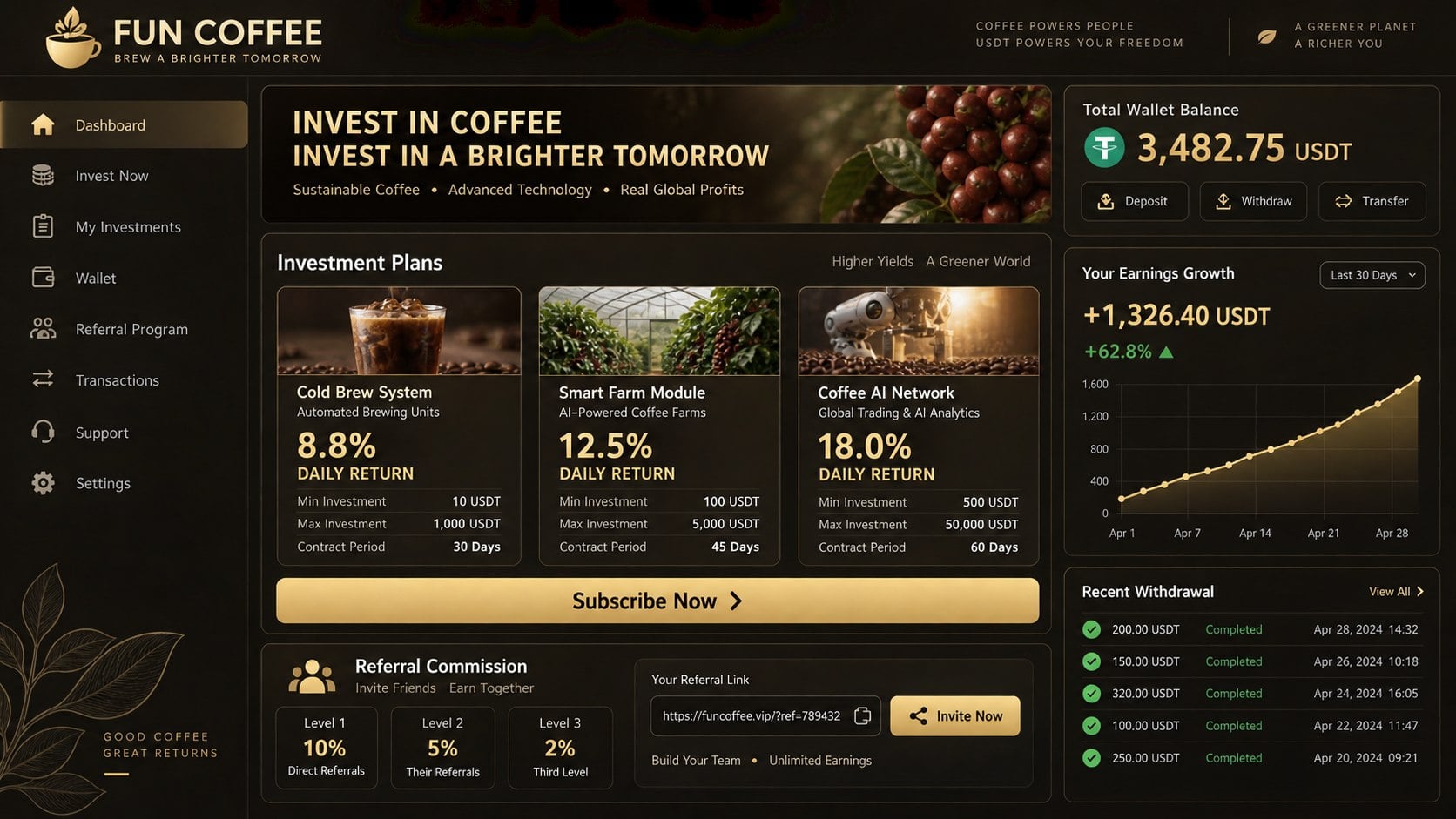
The Fun Coffee platform was promoted as an investment connected to coffee technology, agriculture equipment, cold-brew systems, food tracing, or artificial intelligence. Participants used an app and transferred Tether, commonly called USDT, to wallet addresses supplied by the platform.
The story gave the investment a physical-sounding purpose. Instead of simply promising profit from crypto trading, promoters could talk about coffee projects, equipment, and international expansion.
That business narrative did not make the promised returns reliable. Singapore Police said users subscribed to plans in the app, were offered unrealistically high returns, and could earn additional commissions by recruiting other people.
Authorities linked the model to pyramid-style promotion
On August 8, 2026, the Singapore Police Force announced an investigation and the arrest of a 49-year-old woman who allegedly promoted the scheme and recruited participants.
Police warned the public not to make further payments, including payments requested by people claiming to represent Fun Coffee. They also noted that participants in Singapore later became unable to withdraw funds through the application.
Hong Kong’s Securities and Futures Commission separately listed Fun Coffee GCM projects as suspicious investment products. That listing described marketing around technology and agricultural equipment projects.
The app balance was not the same as recoverable money
An investment dashboard can display any number its operator chooses. A rising balance, daily profit, or completed transaction does not prove that customer assets exist, are invested as described, or can be withdrawn.
Crypto transfers are especially risky because they usually cannot be reversed by a bank. Once USDT moves to a wallet controlled by the scheme, the sender may have no practical chargeback route.
The main warning signs included:
- Returns that were unusually high, steady, or presented as nearly guaranteed.
- Deposits requested in USDT to wallet addresses supplied inside an app.
- Extra rewards for recruiting friends, relatives, or colleagues.
- A business explanation that was difficult to verify independently.
- Small early withdrawals used to build confidence.
- Pressure to upgrade to a larger plan before an offer ended.
- New fees or deposits demanded when a large withdrawal was requested.
- No clear regulated entity holding the investor’s money.
What Investors Were Told They Were Funding
Fun Coffee marketing reportedly tied investment plans to coffee-related technologies and equipment. These descriptions made each plan sound like participation in an operating business rather than a transfer to an anonymous crypto wallet.
A promoter could describe cold-brew extraction, smart farming, supply-chain tracking, or artificial intelligence as the source of returns. Technical language can make an offer feel sophisticated while leaving the central financial question unanswered.
Investors needed to know which legal company owned the assets, where revenue came from, whether audited financial statements existed, and how the advertised profit could be sustained. A presentation, event, or app screen is not a substitute for those records.
The referral component created another concern. When rewards depend heavily on bringing in new participants, incoming money can appear to support earlier withdrawals even if the claimed underlying business is not generating comparable profit.
How the Fun Coffee Crypto Scam Works
Step 1: A trusted contact introduces the opportunity
Many investment schemes spread through personal relationships. A friend, colleague, community member, or online contact shares their dashboard and says they have already received returns.
The invitation feels safer because it comes from someone known to the recipient. That person may genuinely believe the platform is legitimate and may also be receiving a commission for the referral.
Step 2: Coffee and technology give the pitch a business story
The prospect hears that money supports real equipment, agriculture projects, extraction systems, or technology development. Events, videos, and polished presentations can reinforce the impression of a growing enterprise.
However, the investor may never receive audited accounts, ownership rights, independently verified contracts, or a clear explanation of how the advertised return is produced.
Step 3: The investor installs the app and buys USDT
The participant is instructed to acquire USDT through an exchange or crypto kiosk. The token is then sent to an address shown by the Fun Coffee app or provided by a promoter.
This step moves the transaction outside normal card and bank protections. A blockchain record confirms that crypto moved, but it does not confirm why it moved or who ultimately controls the destination.
Step 4: The dashboard shows daily profit
Once a plan is activated, the app displays a growing balance. Earnings may appear on a fixed schedule, creating the comforting impression that a machine, farm, or project is producing predictable revenue.
The operator controls that display. Until funds arrive in a wallet controlled by the investor, the balance is only a claim made by the platform.
Step 5: Small withdrawals and referral rewards build confidence
Some schemes allow early withdrawals because successful payouts are powerful advertising. Participants share screenshots, reinvest profits, and persuade others to join.
Recruitment commissions can turn victims into unknowing promoters. Family and friends may deposit because they trust the person, not because they verified the investment.
Step 6: Larger deposits are encouraged
As confidence grows, the app offers higher tiers, time-limited plans, or bonuses for increasing the deposit. A participant who has withdrawn $100 may feel comfortable risking thousands.
Displayed profit also creates a fear of missing out. Leaving money in the app appears more rewarding than withdrawing it.
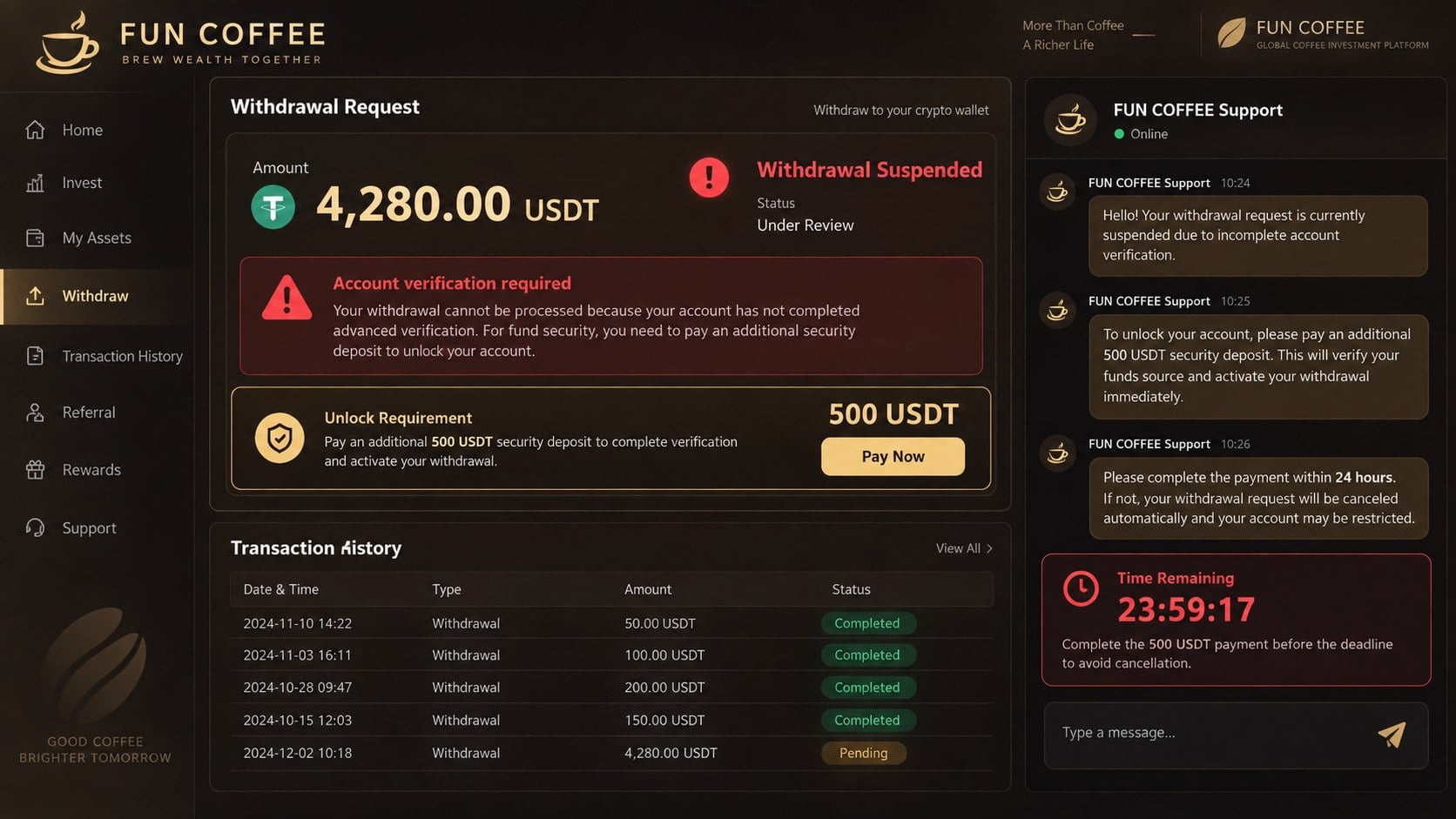
Step 7: Withdrawals are delayed, rejected, or tied to new payments
When users request meaningful withdrawals, the platform may cite verification, taxes, liquidity, compliance, or an account upgrade. The supposed solution is another deposit.
Paying an unlock fee rarely releases the balance. It shows the operator that the victim is still willing to send money, which can trigger another invented charge.
Step 8: The app or support channel disappears
A collapse may begin with slow withdrawals and changing excuses. Eventually, the app stops working, support accounts vanish, or promoters say they also cannot reach management.
The dashboard balance remains useless if the operator no longer honors withdrawals. Victims are then targeted by recovery scammers who claim they can trace or unlock the crypto for another fee.
Operator, Returns, Wallet, and Recruitment Checks
The legal operator should match the investment contract
A brand name and an app are not legal accountability. Investors should identify the incorporated entity, jurisdiction, directors, registered address, and regulator that authorizes it to offer investments.
The name on a marketing event should match the name on the contract and the recipient of funds. Unexplained changes between entities, countries, and wallet owners are serious warning signs.
The promised return must have a believable source
Ask how much genuine operating revenue would be required to pay every participant. A steady daily return is especially difficult to reconcile with normal business activity, where costs, sales, and profit fluctuate.
Documents should be independently audited and specific. A slide about market size or technology potential does not show that the platform owns profitable assets.
The destination wallet reveals limited accountability
A wallet address does not provide the protections of a regulated client account. It may be controlled by an individual, routed through other wallets, or moved across services quickly.
Never assume USDT is safe merely because its value aims to track $1. Price stability does not protect a transfer sent to a scammer.
Recruitment should never replace due diligence
A commission for bringing in other participants creates a conflict. The promoter benefits from a deposit even when they cannot verify the underlying investment.
If returns depend primarily on new members and their money, the model can fail as soon as recruitment slows. Personal trust cannot repair an unsustainable structure.
Why Intelligent People Still Get Pulled In
The scheme does not need every claim to be credible. It needs a sequence of reassuring moments: a familiar introduction, a professional event, an app, a visible balance, and perhaps one successful withdrawal.
Each moment answers a different doubt. The app makes the project seem operational. The small withdrawal suggests liquidity. The referrer supplies social proof. The coffee story gives the money an understandable destination.
Sunk cost then takes over. After depositing money, participants want the next plan or fee to solve the problem. Admitting that the balance may be fictional feels more painful than sending one more payment.
Shame also delays reporting. Victims may have recruited people they care about and fear being blamed. Fast reporting is still important because exchanges and investigators need wallet addresses, transaction hashes, and communication records while they are fresh.
Warning Signs of a Crypto Investment App
- The investment is presented through private chats or referral groups.
- The app is downloaded from a link rather than an official store.
- The company promises a fixed daily return unrelated to market conditions.
- USDT must be sent to a wallet instead of a regulated client account.
- The displayed balance grows with no independently verifiable statements.
- Recruiting new participants produces extra levels of commission.
- Promoters focus on lifestyle and screenshots instead of audited results.
- The operator’s regulatory status cannot be confirmed in an official register.
- A withdrawal requires tax, security, activation, or verification money first.
- Support uses countdowns and threats to force another transfer.
- The project changes domains, apps, or legal names without a clear reason.
- Recovery agents contact victims before a report has even been filed.
What to Do if You Have Fallen Victim to This Scam
- Stop every new transfer. Do not pay verification, tax, insurance, liquidity, or release fees. A genuine withdrawal is not unlocked by sending more crypto to the same operator.
- Preserve blockchain evidence. Save wallet addresses, transaction hashes, exchange receipts, QR codes, network names, amounts, dates, and screenshots of the app balance.
- Export all communications. Keep promoter chats, group messages, usernames, telephone numbers, event materials, voice notes, and support replies. Do not edit the originals.
- Contact the sending exchange immediately. Report the destination as connected to suspected fraud. Ask the exchange to preserve account records and cooperate with law enforcement. A transfer may not be reversible, but reporting still matters.
- Notify local police and financial authorities. In Singapore, use the Police or ScamShield channels. In Hong Kong, contact Police and the Securities and Futures Commission. Elsewhere, report to the equivalent cybercrime and securities agencies.
- Warn people you recruited. Give them the official police notice and tell them to stop paying. A direct warning can prevent a friend from increasing the loss.
- Secure the accounts used during onboarding. Change reused passwords, enable multifactor authentication, revoke unknown wallet approvals, and review email forwarding rules.
- Scan devices used for the app. Run a full Malwarebytes scan, especially if the application came from a private download link. Remove unknown apps and review device-administrator or accessibility permissions.
- Block malicious follow-up pages. AdGuard can stop many known phishing domains and deceptive ads. It cannot reverse crypto transfers, but it may reduce exposure to cloned recovery sites.
- Get specialist advice before moving remaining crypto. If a wallet seed phrase was shared, create a safe replacement through a trusted process. Never send the phrase to someone who claims to be tracing funds.
- Reject guaranteed recovery claims. No private agent can promise recovery from only a transaction hash. Upfront fees, wallet-connection requests, and secret recovery software are common secondary scams.
Frequently Asked Questions
Was Fun Coffee a real investment platform?
It operated an app and marketing network, but authorities raised serious concerns about the investment arrangement. Singapore Police said participants were unable to withdraw and warned the public not to make more payments.
Why did the app show profits every day?
The platform controlled the dashboard. Displayed earnings were not independently verified assets and did not prove that operating revenue existed.
Is USDT safer than other cryptocurrency?
USDT aims to track $1, but a stable token can still be sent to a fraudulent wallet. The main risk here is the recipient and the investment claim, not only price volatility.
Why were some early withdrawals successful?
Early payouts can build trust, encourage reinvestment, and generate referrals. A small completed withdrawal does not prove that the platform can honor all balances.
Should I pay a fee to release my withdrawal?
No. Stop sending money and report the request. Scam platforms often invent a sequence of fees, and paying one commonly leads to another.
Can a crypto recovery company get the money back?
Recovery is uncertain and normally depends on exchanges and law enforcement identifying and freezing funds. Anyone guaranteeing success or asking for wallet secrets should be treated as another scammer.
The Bottom Line
Fun Coffee wrapped a crypto investment in the language of coffee, technology, and community. The app’s rising balance and referral payments made the story feel real until withdrawals stopped.
The essential test is not what a dashboard says. It is whether a regulated operator can prove how returns are generated and return the investor’s money without demanding another deposit.
If you participated, stop paying, preserve every wallet and transaction record, report quickly, and warn the people who entered through your referral.








