

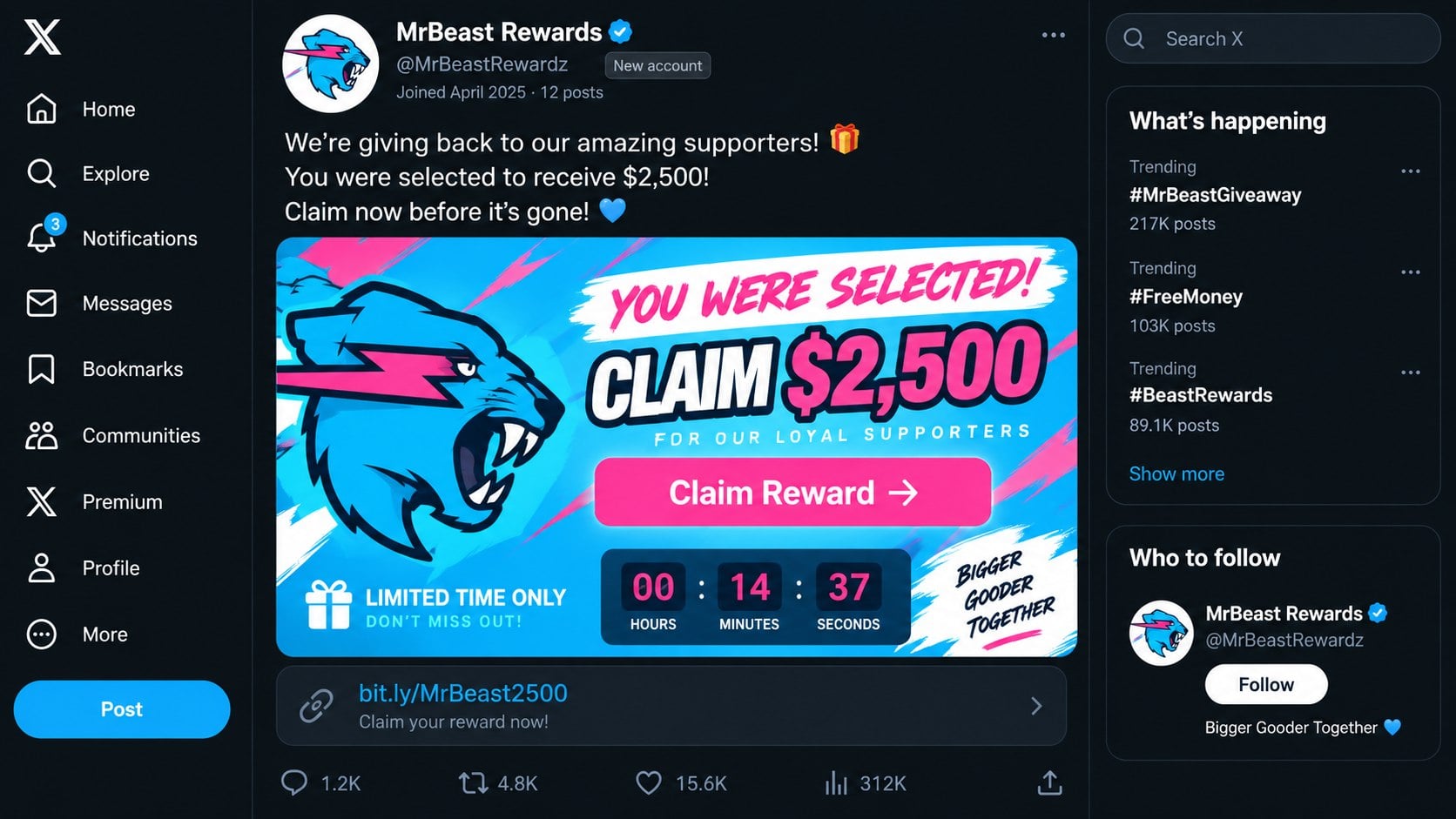
The picture is designed to stop a scroll: bright colors, a verified badge, a huge prize, and the name of one of the internet’s best-known creators. It may say that only a few people were selected or that a reward disappears in minutes.
The image looks like the proof. In reality, it is only the bait for a chain of fake accounts, copied websites, crypto deposits, surveys, and credential theft.
Overview
Scammers package the entire lie inside one shareable image
Fake MrBeast giveaway images appear in social posts, direct messages, Discord chats, video thumbnails, search ads, comments, and short-form videos. A single graphic can carry the impersonated name, prize, deadline, and destination.
The design may promise $500, $2,500, an expensive phone, cryptocurrency, or access to a creator-backed casino. Bright colors and familiar branding make the promotion recognizable before the viewer reads the account name.
The image is often reposted by compromised accounts or sent by someone the recipient knows. That delivery adds social trust to a graphic that can be created in minutes.
The same image can lead to several different scams
One link opens a fake giveaway survey that collects personal information and pushes paid offers. Another leads to a casino-style site that displays an instant bonus but demands a crypto deposit before withdrawal.
Some pages steal Google, YouTube, Discord, or email credentials. Others install an infostealer, malicious browser extension, or fake app.
The visible prize changes, but the basic trade is the same: the victim is asked to give money, data, an account password, or device access before receiving something supposedly free.
Verification badges and creator photos can be copied
A blue badge printed inside an image is not a platform verification. Even a real badge on the posting account can belong to an account that was hacked or renamed.
The FTC warns about social media giveaway scams that imitate real promotions and request financial information from supposed winners. The existence of a polished video or image does not mean the creator approved it.
Common warning signs include:
- A reward that requires a deposit, fee, or purchase before release.
- A misspelled handle hidden beneath a familiar display name.
- A new account with copied branding and a verification symbol.
- A shortened link or unrelated domain printed inside the image.
- A countdown claiming the prize will vanish within minutes.
- A crypto casino balance that appears before any real activity.
- A request to connect a wallet or reveal a seed phrase.
- A direct message claiming every recipient was specially selected.
The Main Types of Fake MrBeast Images
Giveaway cards are the simplest format. They announce that the viewer is one of a limited number of winners and direct them to a link, QR code, or profile biography.
Discord screenshots often promote a fake casino or crypto platform. The message may appear to come from a friend’s real account because an infostealer or phishing page compromised it.
Video thumbnails use a creator image, piles of cash, arrows, and a “Claim Reward” button. The actual video or comment then sends viewers to an off-platform site.
AI-generated video ads add a cloned voice or altered face to old footage. Awkward mouth movement, strange cadence, and vague instructions can expose the manipulation, but improving tools make visual judgment alone unreliable.
Search and display ads can be just as deceptive. Paid placement does not mean a promotion has been endorsed by the person shown in it.
How the MrBeast Scam Images Work
Step 1: A graphic promises an unusually large reward
The image announces a cash prize, phone, gift card, or account balance. It uses a familiar creator name to make an otherwise implausible giveaway feel possible.
The viewer is told that the selection is random, exclusive, or a reward for being a loyal subscriber.
Step 2: A deadline prevents normal checking
A timer, limited quantity, or “today only” message creates fear of missing out. The victim is encouraged to click before comparing the post with the creator’s verified channels.
On many pages, refreshing the screen simply restarts the deadline.
Step 3: A copied or compromised account supplies credibility
The post may come from a newly created impersonation profile with a nearly identical handle. In other cases, criminals use a genuine account stolen from another user.
Fake comments and engagement numbers create the impression that thousands of people have already claimed the reward.
Step 4: The link moves the victim off the trusted platform
A shortened address, QR code, link-in-bio page, or direct-message button opens an external domain. The site copies the colors and language of the original image.
Once the victim leaves the platform, its reporting tools and warnings are easier for the scammer to avoid.
Step 5: A fake task creates commitment
The visitor completes a survey, creates an account, watches a video, shares the promotion, or enters a referral code. These small actions make the reward feel closer.
Survey pages may collect name, address, telephone number, birth date, and marketing consent before showing more paid offers.
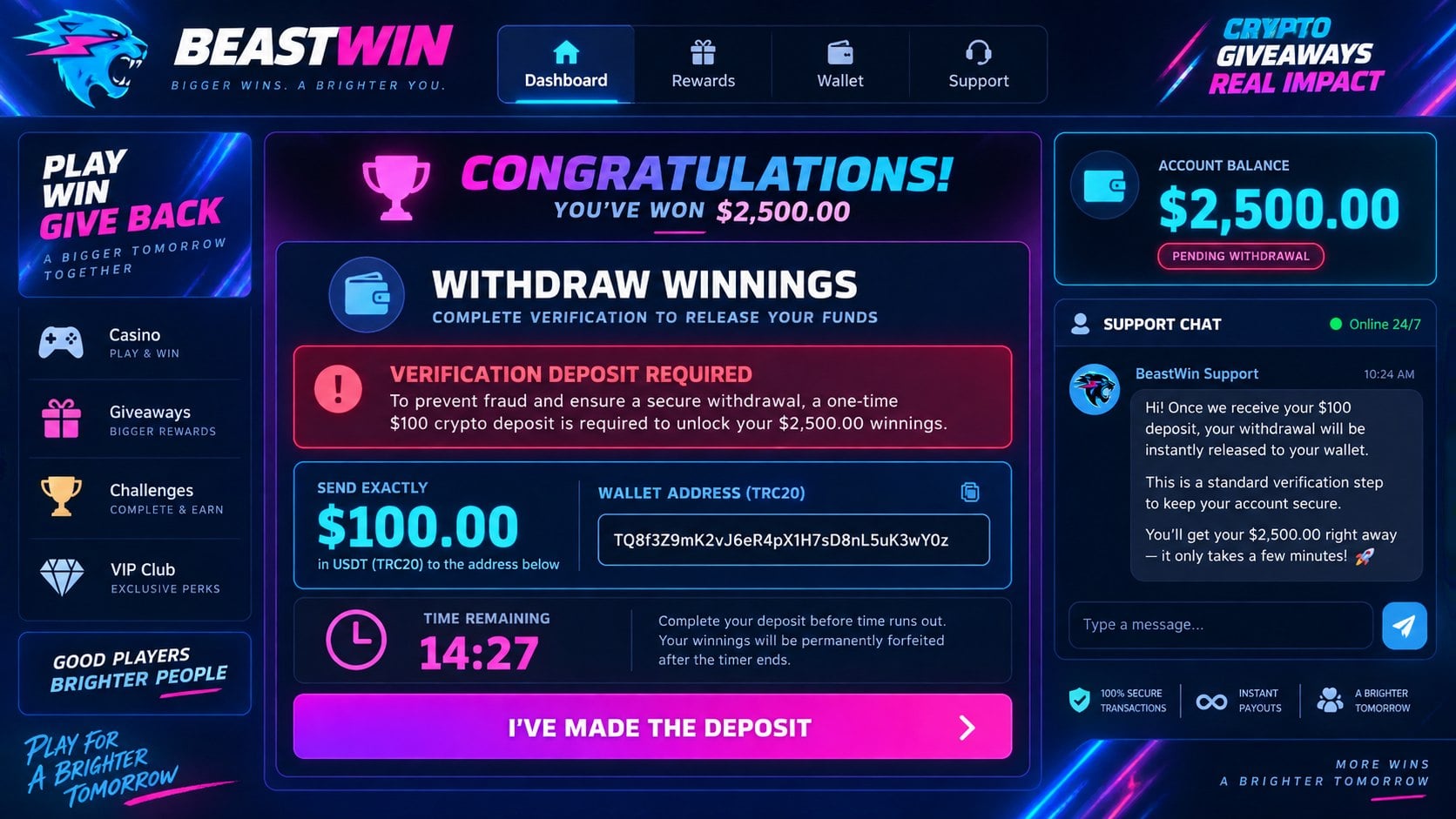
Step 6: The prize becomes a displayed account balance
Casino and crypto versions place $2,500 or another amount in a dashboard immediately. The number looks withdrawable even though no genuine prize funds exist.
A large balance makes the next request feel small by comparison.
Step 7: A verification payment or credential request appears
The site asks for a crypto deposit, card verification, processing fee, wallet connection, or sign-in. The explanation may refer to anti-fraud rules, age verification, taxes, or account activation.
Real giveaways do not require winners to send money to unlock a free prize. A wallet seed phrase should never be entered into any giveaway site.
Step 8: The criminal repeats the demand or takes the account
After one deposit, another fee appears. If credentials were entered, the attacker may change the password, steal stored payment methods, or use the account to send the same image to contacts.
The victim may then be approached by a fake recovery service that claims the money can be returned for an upfront charge.
Account, Image, Domain, and Payment Checks
The account handle matters more than the display name
Open the full profile and read the exact handle, creation date, follower history, and previous posts. Look for extra letters, underscores, unusual punctuation, and recent name changes.
A verification icon printed inside the promotional artwork has no meaning. A platform badge must belong to the actual posting account, and even that account can be compromised.
The image should be treated as an advertisement, not evidence
Logos, prize amounts, screenshots, and testimonials can all be fabricated. Reverse-image search may reveal the same graphic reused with different domains or offer names.
AI-generated likeness and voice also remove the old comfort of seeing a celebrity apparently speak. Verification must come from official channels, not appearance alone.
The destination domain must have a credible connection
Do not judge a link by words such as beast, rewards, official, bonus, or secure. Check who operates the domain and whether the creator’s verified profile links to it.
New domains, anonymous ownership, copied terms, and a support address on a free email service add risk. A padlock does not establish endorsement.
A free prize should not require a payment
Deposit-to-withdraw is the clearest warning sign in fake casino promotions. The dashboard balance is controlled by the site and can be changed to any amount.
Card checks, shipping payments, taxes, and crypto activation fees can serve the same purpose. Stop when money is requested to release something advertised as free.
Why These Images Spread So Quickly
A picture survives where a long explanation would be ignored. It can be copied across platforms, embedded in a private message, or reposted without the destination appearing in searchable text.
Compromised accounts create a chain reaction. One stolen Discord or social account sends the graphic to trusted contacts, and a few of those contacts enter credentials on the same page.
Scammers also use many domains. When one address is blocked, the same artwork can point to a replacement with only a small text change.
Celebrity familiarity lowers skepticism. MrBeast is publicly associated with large giveaways, so an offer that would sound impossible under another name can feel consistent with his public image.
The graphic can also cross language boundaries with almost no editing. Scammers change the currency, prize, short link, or countdown while keeping the same layout. That makes one successful template useful in dozens of countries and across many platforms.
Moderation may remove an account or domain, but copies can remain in old messages and saved images. A recipient should evaluate the promotion at the time of use, not assume that an image is safe because it was originally shared days earlier.
How to Check a MrBeast Giveaway Safely
Do not use the image’s link. Open the creator’s verified channel or profile through a separate search and look for the promotion there. Check multiple official platforms when the alleged giveaway is large.
Read the official rules. A genuine contest should identify eligibility, dates, sponsor, selection process, and privacy terms. YouTube states that contests on its service must be free to enter and must include official rules.
Search the exact domain and offer name, but do not assume positive reviews are genuine. Scam networks often publish promotional articles or comments that repeat the same claim.
Never install a file, browser extension, wallet app, or remote-access tool to claim a prize. Never connect a wallet holding valuable assets to an unknown giveaway page.
What to Do if You Have Fallen Victim to This Scam
- Stop the payment and close the page. Do not send an additional deposit, tax, gas fee, or verification payment. The displayed winnings are not evidence that money is waiting.
- Contact the card issuer or payment service. Report unauthorized or deceptive charges and ask what dispute and replacement steps apply. Be precise about what you entered and approved.
- Notify the crypto exchange. Provide wallet addresses and transaction hashes. Ask the exchange to flag the destination and preserve account information for investigators.
- Move exposed crypto safely. If a seed phrase was entered, create a new wallet through trusted software and transfer remaining assets. Do not accept help from a stranger in direct messages.
- Change stolen credentials. Start with email, Google, YouTube, Discord, and any account whose password was reused. Sign out other sessions and enable multifactor authentication.
- Warn contacts from a compromised account. Tell them not to open the giveaway image or link. Delete malicious posts and messages after preserving evidence.
- Remove suspicious software. Uninstall apps, extensions, or remote-access tools obtained through the giveaway. Review permissions and browser notification settings.
- Run a full Malwarebytes scan. An infostealer can capture saved passwords, cookies, and crypto data even after the visible page closes. Scan before trusting the device with new credentials.
- Use AdGuard to reduce repeat exposure. It can block many known phishing domains, malicious redirects, and deceptive ads. New clone sites can still appear, so verification remains necessary.
- Report the impersonation. Report the account, post, ad, video, or message to the platform. File fraud reports with the FTC, IC3, or the appropriate authority in your country.
- Save the evidence. Keep screenshots, profile handles, URLs, wallet addresses, receipts, transaction hashes, and chat logs. Do not publish unredacted account or wallet recovery information.
- Reject recovery guarantees. Anyone promising to recover crypto or restore an account for an upfront fee may be targeting victims a second time.
Frequently Asked Questions
Does MrBeast give away money online?
Real promotions may exist, which is why impersonation works. Verify any offer through his established, verified channels and published rules rather than a reposted image or private message.
Can a verified account post a scam image?
Yes. Accounts can be compromised, sold, or renamed. Check account history and confirm the promotion across other official channels.
Is a $100 verification deposit normal?
No. A demand to pay money or crypto before withdrawing a free prize is a classic advance-fee scam. Sending the first payment usually leads to another demand.
What if the image uses a real MrBeast photo or voice?
Photos can be copied and video or audio can be generated or altered with AI. Familiar appearance is not proof of authorization.
Can clicking the image infect my device?
The image itself is often only bait, but its link may open a malicious download, extension, or phishing page. Close it, inspect downloads, and scan the device if anything was installed.
Should I connect my crypto wallet to check the reward?
No. A malicious connection can request dangerous approvals, and a seed phrase should never be entered. Use a block explorer to inspect public transactions without connecting the wallet.
The Bottom Line
Fake MrBeast scam images work because the creator’s public reputation makes an extraordinary prize feel possible. Bright graphics, badges, comments, and countdowns turn that familiarity into rushed action.
Do not judge the offer by the image. Verify it through established official channels, read the rules, and walk away the moment a free prize requires money, wallet access, credentials, or software.
If you already interacted, protect payment methods, crypto, email, and social accounts together. The same stolen access that caused one loss can be used to spread the image to the next victim.








