

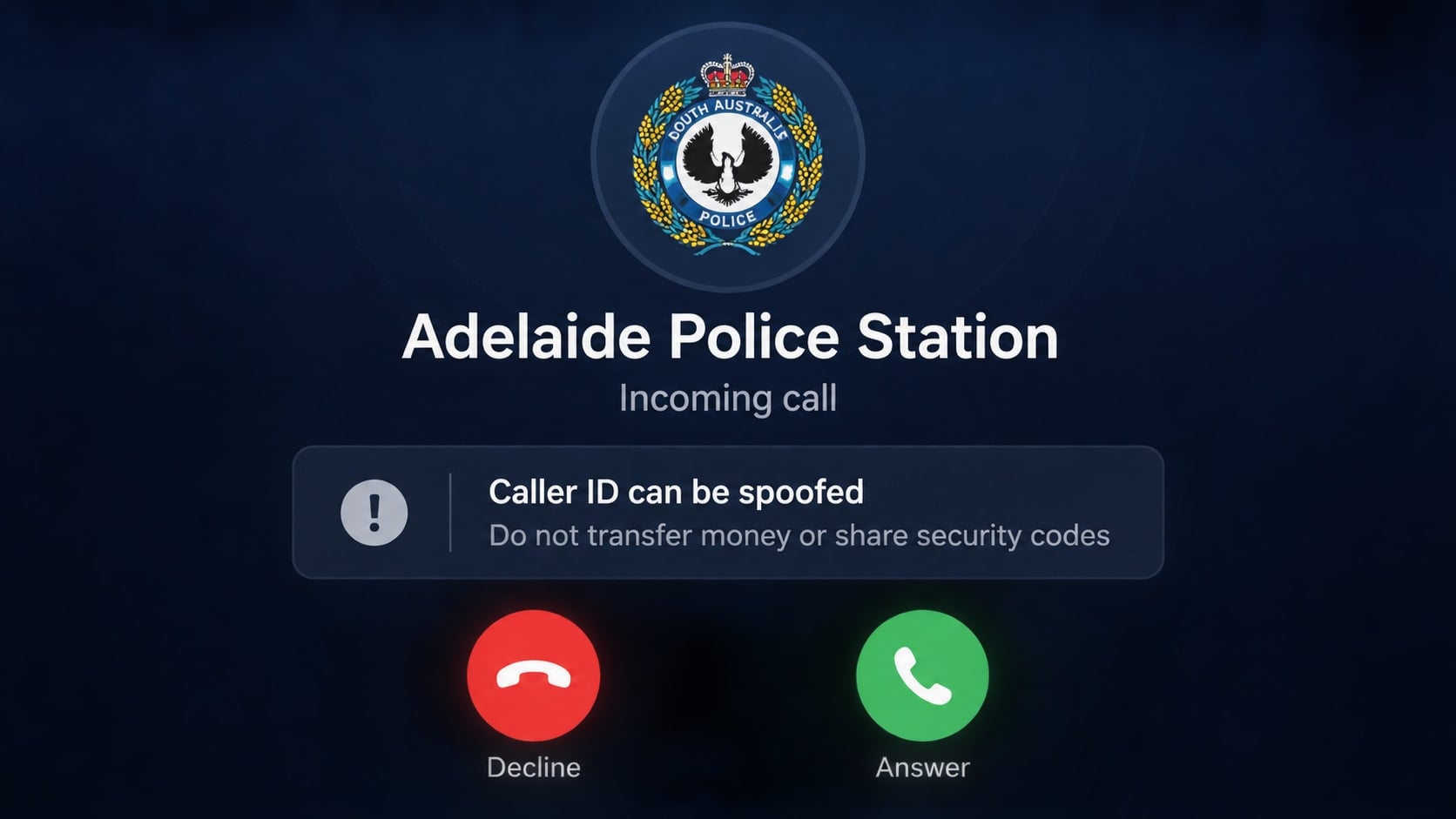
Your screen says Adelaide Police Station is calling. The person on the line knows your name, speaks about an investigation, and warns that hanging up could make the situation worse.
The display can be forged. In the South Australia Police phone scam, criminals manipulate caller ID and use the authority of law enforcement to pressure people into disclosing information, installing software, or moving money before they can verify the call.
Overview
The caller ID can display a genuine police station name or number
Caller ID spoofing lets criminals replace the number shown to the recipient. The incoming call may therefore appear to come from Adelaide Police Station or another legitimate South Australia Police location even though the fraudster is calling from somewhere else.
If the recipient later calls the genuine station, staff may have no record of the first call. That is because the station’s number appeared on the screen but did not originate the conversation.
The caller invents an investigation that demands immediate cooperation
The fraudster may allege identity theft, money laundering, an unpaid fine, a compromised bank account, or a warrant. Personal details from a data breach can make the accusation sound specific.
Threats of arrest and instructions to remain on the line are used to prevent the recipient from contacting family, a bank, or police through an independent number.
The supposed safety procedure is designed to steal
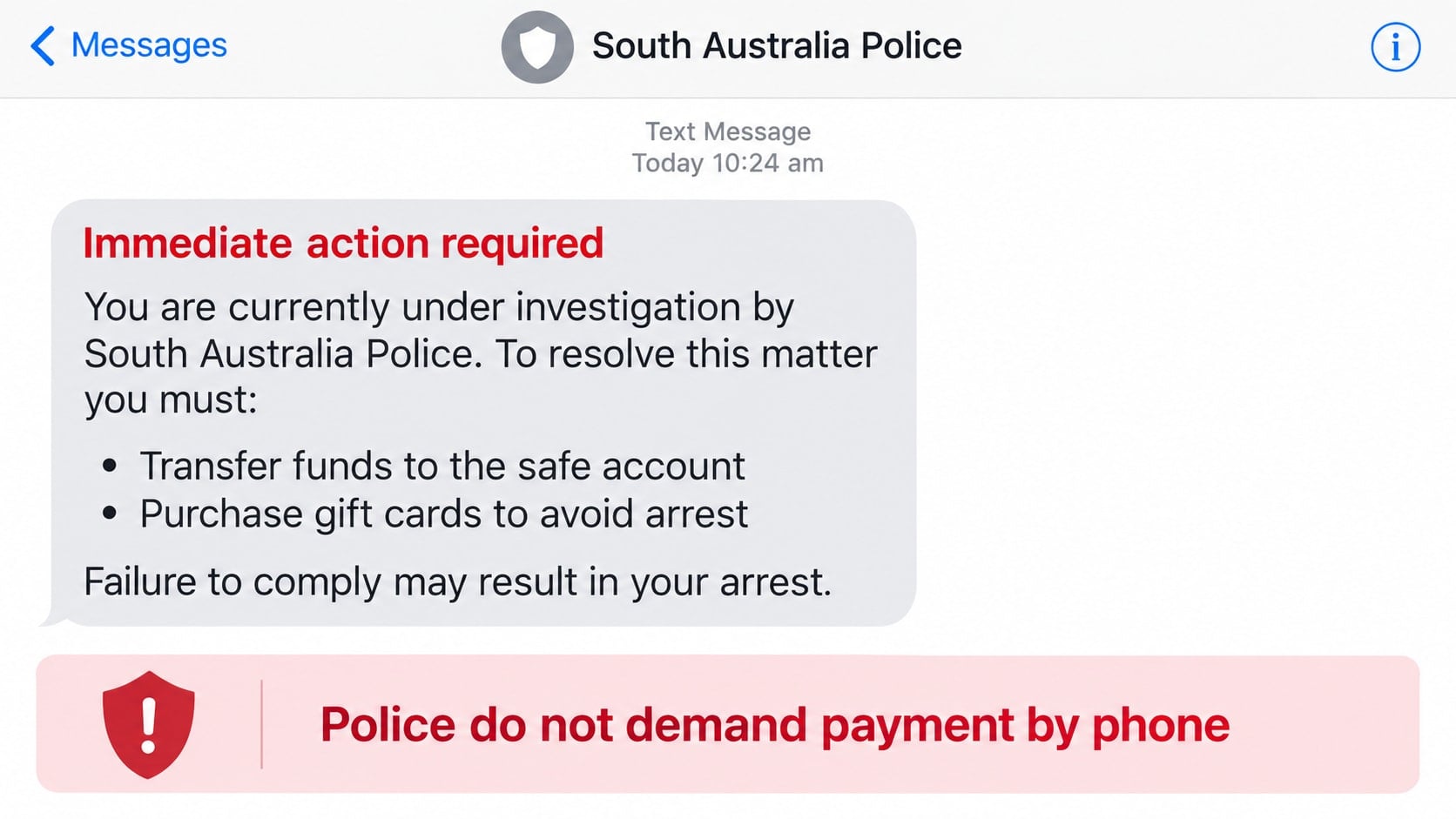
The caller can request a transfer to a safe account, cryptocurrency purchase, gift cards, remote-access download, or one-time banking code. None of those actions belongs in a legitimate police investigation initiated by an unexpected call.
The scheme may expose:
- Bank balances and login details viewed during a remote-access session.
- Money transferred to accounts controlled by the scam network.
- Government ID, address, and date of birth used for identity fraud.
- Security codes that approve new devices or high-risk payments.
- Friends and relatives contacted from a compromised phone or email account.
Why a Spoofed Police Call Feels Real
People are conditioned to take police contact seriously. A caller who uses legal terminology, an officer name, badge number, and case reference can create fear before the recipient has time to examine the story.
The number on the screen appears to answer the most obvious verification question. Seeing a local station name can feel stronger than hearing a stranger claim to be an officer. Spoofing exploits that trust in the display.
Criminals may know a full name, address, or recent financial event. Those facts can come from data breaches, stolen mail, public records, social media, or earlier scam responses. They do not prove police access.
The caller can create a background that sounds like a busy office. Another fraudster may join as a supervisor, bank investigator, or cybercrime specialist. Multiple voices are used to simulate an organization.
The story also changes when challenged. If the victim says they have not committed a crime, the caller may switch to claiming their identity was stolen. That softer explanation keeps the person engaged while preserving the need to secure funds.
How the South Australia Police Phone Scam Works
Step 1: The criminal spoofs a trusted caller ID
The fraudster configures internet-based calling tools so the recipient’s screen displays a police station number or name. The visible information is chosen by the caller and is not reliable proof of origin.
A local display increases the chance that the call is answered. The scammer may target South Australian area codes or use information from a leaked customer list to make the timing feel less random.
Step 2: A serious allegation removes the victim’s sense of control
The caller says a bank account, mobile number, tax identity, or parcel is connected to criminal activity. The recipient is told that immediate cooperation can prevent arrest or clear their name.
The accusation is intentionally confusing. A frightened person may focus on proving innocence and start answering questions that would normally feel intrusive.
Step 3: The caller performs a fake verification interview
The supposed officer requests a date of birth, address, passport or license number, bank name, and account balance. Each answer is framed as necessary to separate the victim from the real suspect.
The criminal may already know some details and ask the victim to confirm them. This technique encourages the person to supply missing information while believing the caller is reading from an official file.
Step 4: Isolation keeps the invented investigation intact
The victim is told not to disconnect, contact the bank, or discuss the case because the operation is confidential. Some callers threaten that outside contact will be treated as obstruction.
Continuous telephone contact stops the person from checking the station number independently. It also lets the fraudster react when a bank employee or family member questions the transfer.
Step 5: Money is moved under the label of protection or compliance
The scammer says funds must be placed in a safe account while police investigate. Other versions demand a bond, fine, verification transaction, crypto purchase, or gift cards to prevent an arrest.
A legitimate officer does not secure private money this way. The account belongs to the criminals or a money mule, and the transfer may be moved again within minutes.
Step 6: The group seeks more money or control
After one transfer, the fake officer may claim another account is compromised. The victim can be told to withdraw cash, hand it to a courier, or move retirement savings for a broader audit.
If credentials or remote access were obtained, the attackers may continue without the victim’s participation. They can attempt password resets, new payees, card transactions, or impersonation calls to contacts.
Identity, Contact, and Payment Checks
Hang up and call the station from an independently found number
Do not press a key, accept a transfer, or redial through the call history. Find the station on the official South Australia Police website and place a new call.
Tell staff the name, badge number, unit, and case reference provided by the caller. A genuine matter can be checked without keeping the original caller connected.
Do not trust the caller ID display
South Australia Police warns that scammers can alter caller ID so a call appears to come from Adelaide Police Station. The displayed number is a clue, not authentication.
Calling the same number back later may reach the real station because the criminal borrowed its identity only for the incoming call. That does not validate anything said earlier.
Challenge requests for money, codes, and remote access
Police do not ask someone to protect funds by transferring them to another account. They do not require gift cards or cryptocurrency to avoid arrest, and they do not need a banking one-time code.
A request to install screen-sharing software should end the conversation. An investigation does not require an unexpected caller to control a private device.
Confirm financial concerns with the bank
Use the number on the bank card or the secure app. Ask whether suspicious transactions, new payees, password changes, or unusual logins appear. Do not call a bank officer introduced by the supposed police caller.
If the bank says the account is safe, do not let the criminal reinterpret that answer. End the call and report the attempted impersonation.
Common Stories Used by Fake Police Callers
One script says the victim’s identity was found during a money-laundering investigation. A bank account or mobile number has supposedly been opened in their name, and every account must be reviewed.
Another alleges unpaid taxes, court fines, or a missed summons. The caller threatens a warrant but offers a same-day payment route that will supposedly suspend enforcement.
Crypto owners may hear that their exchange account is linked to a data breach or cybercrime report. The fake officer asks for wallet balances, seed phrases, or transfers to a protected wallet.
A parcel version claims customs or police intercepted a package containing drugs, cash, or illegal documents. The victim is pressured to verify identity and finances to show they were not involved.
A bank-collaboration story transfers the call to a supposed fraud department. Both callers are criminals, and the second role exists to make the safe-account instruction feel financially authorized.
Some impostors claim a relative has been arrested or injured and needs urgent help. They may use details from social media to make the family emergency sound personal, then demand bail, legal costs, or transport fees.
Others say the victim has been selected to assist a confidential police operation. Secrecy becomes part of the script, giving the criminal a reason to forbid calls to family, the bank, or a local station.
Red Flags During the Call
Even a polished caller cannot make these behaviors legitimate:
- The call is unexpected and begins with a threat or alarming investigation.
- The caller ID is treated as the only proof of police identity.
- You must stay on the line and keep the matter secret.
- Personal information is demanded before the case can be verified.
- The caller asks for account balances or online banking access.
- Money must be transferred to a safe or evidence account.
- Gift cards, cryptocurrency, cash, or PayID are requested.
- A remote-access application is required for protection.
- Hanging up is said to trigger arrest or cancel your chance to cooperate.
- The caller discourages contact with the bank, family, or a local station.
An officer may contact a member of the public for legitimate reasons. The difference is that a real officer can be reached again through the agency’s official switchboard and will not demand secret payment over the phone.
What to Do if You Have Fallen Victim to This Scam
- End the call and preserve evidence. Write down the time, displayed number, names, badge numbers, case references, payment details, and instructions. Save messages and voicemails, but do not call the number back from the scam conversation.
- Contact the bank immediately. Use its official app or a verified telephone number. Ask the fraud team to stop or recall transfers, freeze cards, secure online banking, remove unauthorized payees, and note that remote access may have occurred.
- Report the impersonation to genuine police. Use the South Australia Police Assistance Line for non-urgent matters or attend a station. If there is an immediate threat to safety, use the official emergency channel.
- Secure affected accounts. From a trusted device, change email and banking passwords, enable multi-factor authentication, inspect recovery methods, and sign out unfamiliar sessions. Tell providers if one-time codes were disclosed.
- Remove remote-access software. Disconnect the affected device, uninstall programs added during the call, and run a full Malwarebytes scan. Check browser extensions and startup items before returning to sensitive accounts.
- Block malicious web destinations. AdGuard can help prevent connections to known phishing pages and malicious advertising used in follow-up contact. Continue to reject unexpected calls because telephone persuasion can bypass browser protection.
- Protect exposed identity records. If passport, license, Medicare, or tax information was shared, contact the appropriate Australian issuing body and IDCARE for tailored support. Monitor credit and financial statements closely.
- Report the scam nationally. Submit the incident to Scamwatch and use ReportCyber when online accounts, devices, or money were affected. Detailed reports help connect related calls.
- Watch for follow-up impersonators. Criminals may return as detectives, bank investigators, or fund-recovery agents. Verify every new caller from scratch and never pay someone who promises guaranteed recovery.
Frequently Asked Questions
Can a scam call really display Adelaide Police Station?
Yes. Caller ID information can be spoofed. South Australia Police specifically warns that scammers may make a call appear to come from Adelaide Police Station. The display is not proof of origin.
What happens if I hang up on a real police officer?
You can call the station through its official published number and explain that you wanted to verify the contact. A genuine officer can reconnect through an accountable channel. A scammer relies on preventing that independent step.
Will police ask me to transfer money to a safe account?
No. A safe-account transfer is a scam mechanism. Police do not protect private funds by directing them into another account, crypto wallet, gift card, or cash handover.
Why did the caller know my name and address?
Personal details can come from data breaches, stolen mail, public records, social media, or earlier scam lists. Accurate information can make a caller sound official without giving them any police authority.
Can reading back a one-time code cause harm?
Yes. The code may approve a login, password reset, new payee, or payment. Contact the provider immediately, change credentials, and review recent account activity if any code was shared.
Should I trust a second caller who says the first was a scam?
Not automatically. Fraud groups use multiple roles, and victim information can be shared. End the call and contact police or the bank through independently verified details before accepting help.
The Bottom Line
The South Australia Police phone scam makes a forged caller ID look like official proof. The badge number, case reference, and urgent investigation are tools for isolating the recipient and directing money or information into criminal hands.
Hang up, find the station’s number yourself, and verify the story away from the caller. Police authority does not depend on secrecy, gift cards, remote access, or a transfer to a so-called safe account.








