

A call from 856 looks local if you live around Camden, Cherry Hill, or Vineland. That familiarity can make an unfamiliar voice feel one step safer than an overseas or toll-free number.
856 Area Code scams exploit that assumption. The prefix is legitimate, but the number on the screen can be spoofed, rented, or abandoned long before the victim realizes the caller’s story was false.
Overview
856 is a real southwestern New Jersey area code
The prefix serves communities in southwestern New Jersey. A call or text beginning with 856 can genuinely come from a resident, business, medical office, school, or public agency in that region.
The area code itself is not a warning and not a certificate. It identifies the telephone numbering plan presented to the device, not the person controlling the communication.
Scammers use local familiarity to earn an answer
Caller ID spoofing allows criminals to display a number they do not own. Other operators obtain local virtual numbers, send thousands of texts, then replace them when complaints accumulate.
A recipient is more likely to answer a nearby prefix because the call might concern a neighbor, appointment, school, delivery, or local service. That first answer gives the scammer a chance to create urgency.
Several different scams can wear the same prefix
There is no single 856 script. The number can front a police impersonation, family emergency, fake debt, utility threat, job offer, home-service lead, or wrong-number conversation.
Common objectives include:
- Gift cards or crypto for a fake fine or emergency
- Bank transfers to a supposed government or utility account
- Card details entered on a fraudulent payment page
- Social Security numbers and identity documents
- Online-banking passwords and one-time passcodes
- Remote access under a technical-support pretext
- Confirmation that the telephone number is active
Treat the story and requested action as the evidence. A local prefix, a familiar town name, and even a copied government number can all be part of the presentation.
Common 856 Area Code Scam Calls and Texts
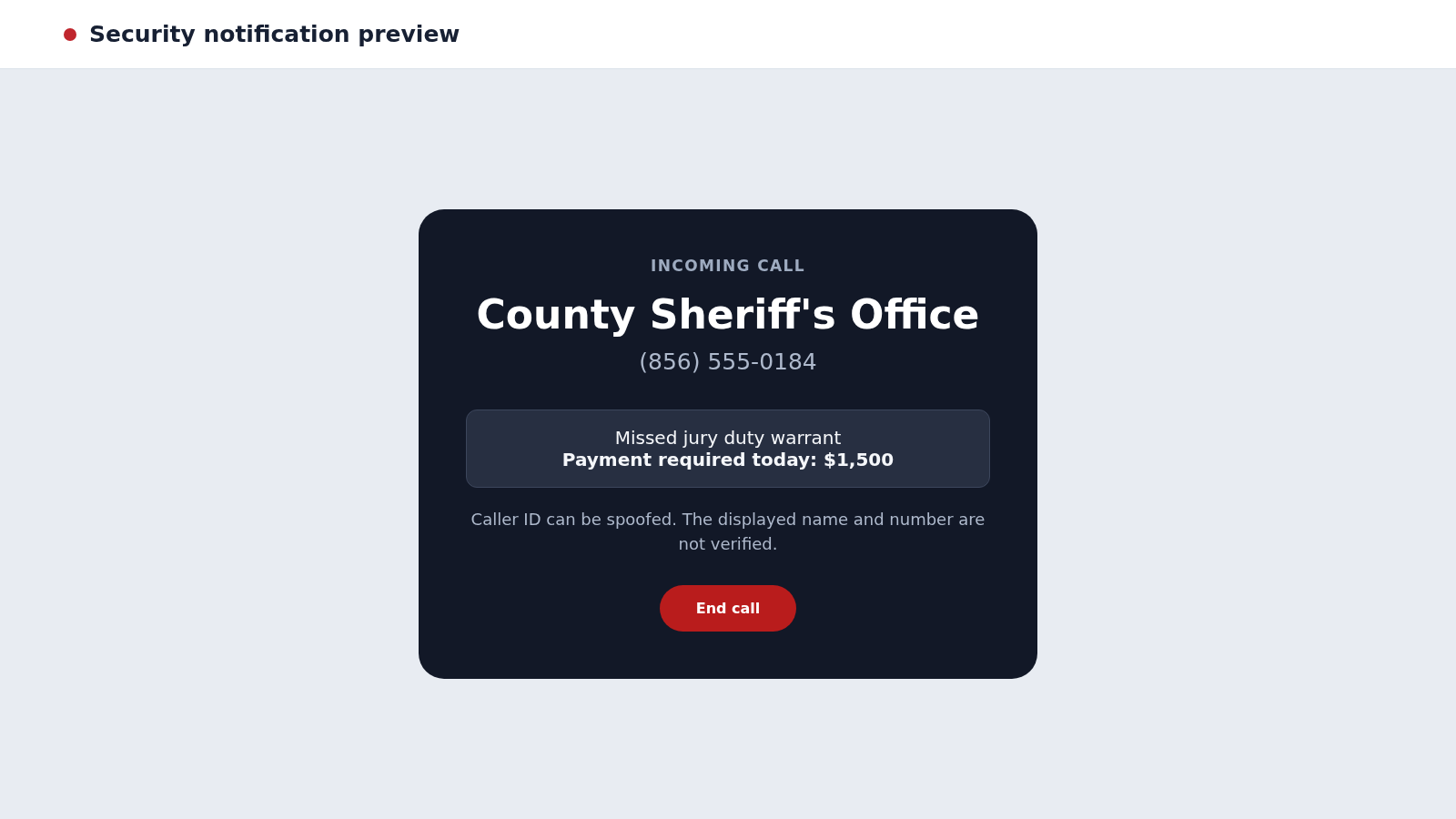
A fake sheriff or court officer may say the recipient missed jury duty, ignored a subpoena, or has an outstanding warrant. Immediate payment is offered as the only way to avoid arrest.
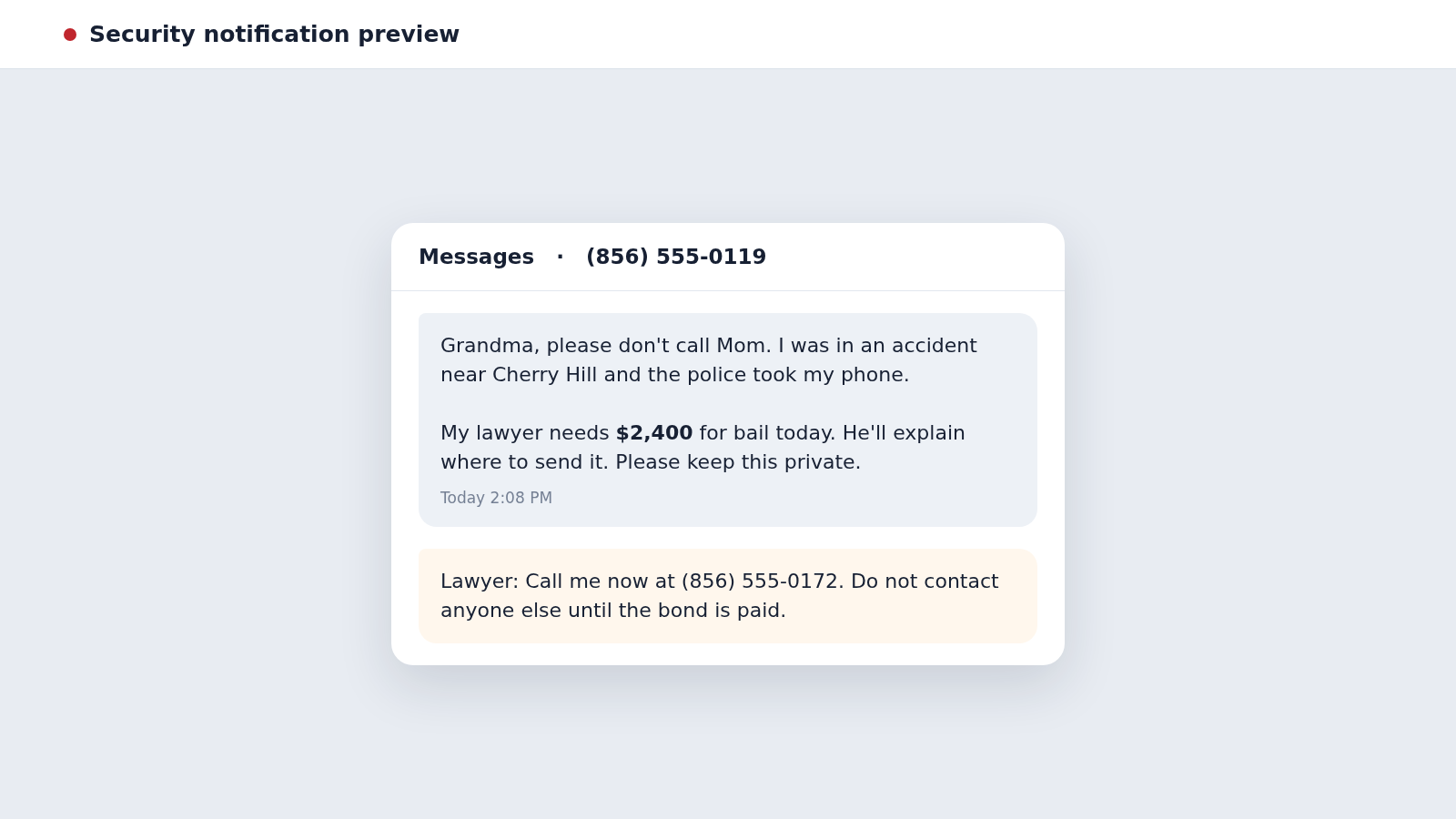
A family-emergency caller claims a child or grandchild caused a crash, was arrested, or needs medical care. A second person may pose as a lawyer, police officer, or hospital employee.
Fake collectors mention utilities, tolls, solar financing, medical bills, or old loans. They use local details to suggest the account is connected to a nearby provider.
Home-service robocalls advertise roofing, solar panels, insurance, or storm repairs. The operator may be collecting leads rather than providing the service represented in the call.
Text versions can begin with a wrong name, package problem, bank warning, job invitation, or friendly “Are you free?” message. The first reply is used to move the conversation toward money or personal data.
How 856 Area Code Scams Work
Step 1: A local-looking caller ID is selected
The criminal spoofs an 856 number or uses an internet-based line registered with that prefix. Some systems choose a number sharing the first six digits of the recipient’s own telephone number.
This neighbor-spoofing effect makes the contact look geographically relevant. It does not require the caller to be in New Jersey.
Step 2: The first sentence creates a reason not to hang up
The caller mentions a warrant, relative, bank transaction, utility disconnection, unpaid bill, or urgent job. Each script suggests that ignoring the call could have an immediate cost.
A text may be deliberately incomplete. Curiosity about the missing package, unnamed relative, or wrong name encourages a reply.
Step 3: Public details make the story feel specific
Names, addresses, relatives, employers, and property information can be found in public records, social media, leaked databases, and people-search services.
Knowing a fact about the victim does not prove authority. It shows only that the caller had access to information that may not be as private as expected.
Step 4: The victim is kept emotionally occupied
The operator uses fear, urgency, sympathy, or excitement to narrow attention. A police threat prevents calm checking, while a family emergency makes verification feel cruel.
The caller may insist that the line remain open. This keeps the victim away from relatives and official agencies that could expose the lie.
Step 5: A second character confirms the same story
A supposed supervisor, lawyer, bank officer, dispatcher, or bail clerk joins. The new voice sounds independent but may sit beside the first caller or be played by the same person.
Confirmation is meaningful only when the second contact is found independently. A character introduced by the original caller is part of the same unverified claim.
Step 6: Payment is made deliberately difficult to recover
Gift cards, cryptocurrency, wires, cash pickups, and payment apps are favored because speed and limited reversal protect the thief. Codes may be requested before the call ends.
A fake portal can collect card data and display an error. The victim tries again while the first submission has already reached the criminals.
Step 7: The caller manufactures reasons for another payment
A fee, tax, insurance amount, bond adjustment, or verification charge appears after the first transfer. Each payment is described as the final requirement.
Resistance may trigger harsher threats or a more sympathetic agent. The objective is to keep the victim inside the story while money remains available.
Step 8: The active number and personal details are reused
Answering or replying can mark the telephone number as responsive. The victim may receive more bank alerts, debt threats, wrong-number messages, and recovery offers.
Information disclosed during the call helps later impostors sound informed. A different 856 number can present the same criminal operation under a new identity.
Why Searching the Number Is Not Enough
A search can reveal complaints, but an empty result does not prove safety. Spoofed numbers may belong to innocent residents or real businesses that had no involvement in the call.
Criminals rotate virtual numbers quickly. A newly activated line can begin calling before complaint databases or search engines have indexed any reports.
Positive directory information is also weak evidence. If caller ID displays a sheriff’s office or bank number, the actual call may still have originated elsewhere.
Verify the organization, not the inbound number. End the conversation, locate an official site or statement, and start a new call using contact details you found separately.
Never call back merely to confront the sender. The return call can confirm that the number is active, expose your voice, or connect to an expensive service.
Warning Signs Behind a Local 856 Number
- The caller demands payment before you can verify the claim.
- Arrest, disconnection, or account closure is threatened within hours.
- Gift cards, crypto, wires, or cash pickup are required.
- A family member supposedly cannot be contacted directly.
- The caller insists that the situation remain secret.
- A one-time banking code or password is requested.
- The organization will not provide written documentation.
- A text link uses a shortened or unrelated domain.
- The caller becomes aggressive when you decide to hang up.
- The requested recipient does not match the named agency or company.
One of these signs can be enough to stop. A genuine organization will allow independent verification and use payment methods tied to a documented obligation.
How to Verify an 856 Call Safely
Let unfamiliar calls go to voicemail. A legitimate caller can leave a name, organization, reason, and callback route without demanding that you act before the message ends.
For a family emergency, hang up and call the relative through a saved number. Ask a question whose answer was not published online and contact another family member.
For police, court, or government claims, locate the agency’s official website and call its published number. Courts do not resolve warrants through gift card codes.
For a bank or utility, use the app, a statement, or the number printed on the card. Inspect the real account before discussing any transaction.
For contractors, verify licensing, insurance, address, written estimates, and complaint history. Never let a storm or local prefix replace ordinary due diligence.
Different Stories Often Lead to the Same Payment
The sheriff script, family emergency, utility threat, and debt call sound unrelated. Their endings are remarkably similar: act now, keep the matter private, and use a payment method with weak recovery.
Gift cards turn money into codes that can be redeemed from anywhere. Cryptocurrency moves to an address without providing the consumer protections associated with a card purchase.
A cash courier gives the scheme a local appearance, but the person collecting the package may be a money mule following instructions. Their presence does not verify the emergency.
Bank transfers and payment apps can display a recipient name. Read it carefully. If the beneficiary is an individual or unrelated company, the screen is showing a contradiction the caller hopes you will ignore.
Scammers may let the victim send a small amount first, then invent a reason for more. A successful test is not proof of legitimacy; it proves only that the criminal’s payment route works.
When any urgent story reaches this stage, stop immediately. A real relative, utility, court, bank, or licensed contractor can be reached separately and can provide reliable records before payment. Ten quiet minutes of verification can prevent a transfer that may be impossible to reverse.
Company, Address, and Fulfillment Checks
The displayed number may not belong to the caller
Caller ID is a label supplied by telephone systems and can be spoofed. Do not use it as proof of location, identity, or authority.
The claimed address must be found independently
A real agency or business should have a consistent public address. Compare it with official government, licensing, or company records rather than details dictated on the call.
The obligation should exist outside the conversation
Real court cases, utility accounts, debts, and purchases produce records. An inbound voice cannot create a valid fine or bill merely by describing it.
The payment recipient must match the verified organization
A personal payment app, crypto wallet, gift card, or unrelated bank beneficiary is not an official fulfillment route. Stop when the recipient and claimed organization differ.
What to Do if You Have Fallen Victim to This Scam
- Stop contact and additional payments. Block the number after preserving it. Do not pay a final fee, tax, bond adjustment, or recovery charge.
- Call the payment provider immediately. Give the bank, card issuer, wire service, app, or exchange the recipient, amount, time, and reference. Ask whether the transfer can be frozen or disputed.
- Contact the impersonated organization. Use a verified number to confirm the claim and report the copied identity, telephone number, link, and payment instructions.
- Secure exposed accounts. Change passwords from a trusted device, remove unknown sessions, replace disclosed cards, and update authentication if codes were shared.
- Protect personal identity. If a Social Security number or ID document was exposed, follow IdentityTheft.gov and consider placing credit freezes.
- Check devices used during the call. Remove remote tools or downloads and run a full Malwarebytes scan before returning to sensitive accounts.
- Reduce malicious follow-up links. AdGuard can help block known phishing pages and deceptive advertising, though it cannot recover an earlier transfer.
- Preserve the entire trail. Save voicemail, texts, URLs, caller ID, call times, gift card receipts, crypto transaction hashes, and beneficiary details.
- Report the fraud. File at ReportFraud.ftc.gov, notify local police when money or threats are involved, and forward fraudulent texts to 7726.
- Warn close contacts when appropriate. If the scammer used family information or a copied account, tell relatives how the story worked without publicly posting private evidence.
Frequently Asked Questions
Is every call from the 856 area code a scam?
No. 856 is a legitimate New Jersey prefix. Judge the caller by independent verification and requested action, not the area code alone.
Can scammers copy a real local telephone number?
Yes. Caller ID spoofing can display a number that belongs to an uninvolved person, business, or agency. Calling it back may reach the innocent owner.
Why do local numbers receive more answers?
Recipients assume a nearby call could concern an appointment, school, neighbor, or service. Scammers exploit that familiarity to begin the conversation.
Should I answer and ask to be removed?
Let unknown calls reach voicemail. Engaging can confirm an active number, and an illegal operator is unlikely to honor a removal request.
What if the caller knew my address or relative’s name?
Those details can come from public records, social media, or breaches. Verify the claimed emergency directly with the person or organization involved.
Can money sent to a spoofed caller be recovered?
It depends on the payment route and speed. Contact the provider immediately, preserve destination details, and do not pay anyone who guarantees recovery.
The Bottom Line
856 Area Code scams use a real New Jersey prefix to make false police, family, debt, utility, and service stories feel close to home. The number displayed on the phone may have no connection to the caller.
Let the call go to voicemail, hang up on urgent payment demands, and verify every claim through a separately located channel. Local-looking is not the same as locally verified.

Join the discussion
0 commentsShare your experience or ask a question about this article.
Discussion
Start the conversation
Have a question or something useful to share? Add the first comment.