

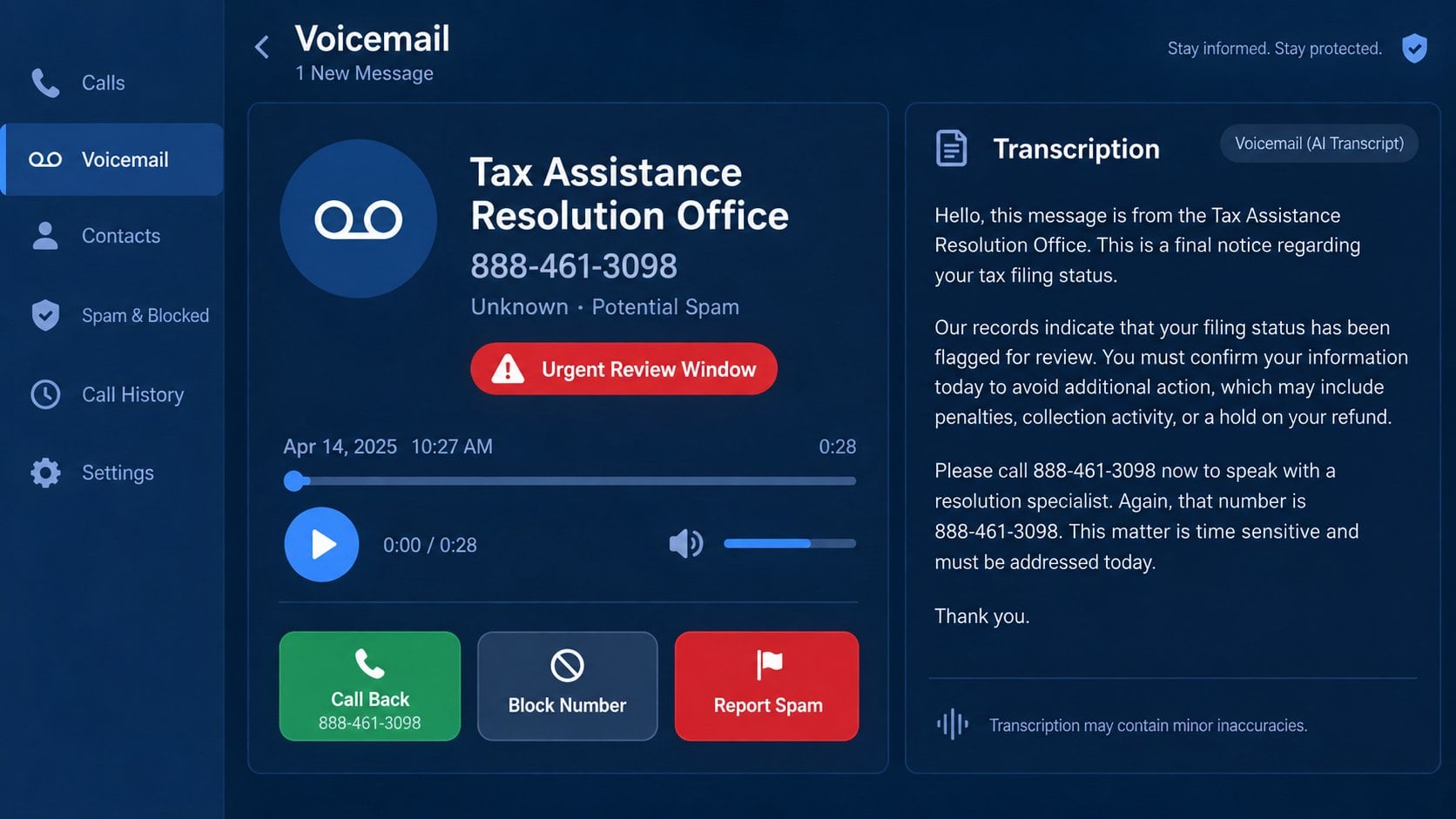
The voicemail sounds as if a government file has already moved into a dangerous stage. It says a tax issue was flagged, a review window is closing, and the recipient should call 888-461-3098 before penalties or enforcement begin.
Nothing in the message proves that a tax debt exists. The urgency is designed to make the callback happen before the recipient checks an IRS account, a mailed notice, or the identity of the supposed office.
Overview
The call uses an official-sounding office name
Reports connect 888-461-3098 with messages that mention a Tax Assistance Resolution Office, filing resolution office, tax review unit, or similarly formal name. These labels are chosen to sound like part of the IRS without giving the listener a familiar agency to verify.
The recording may refer to unresolved filings, a balance, a flagged review, or a deadline to confirm the taxpayer’s status. It offers a direct line to a specialist who can supposedly prevent the matter from becoming more restrictive.
An official tone and a toll-free number are not evidence of government authority. Virtual phone systems let scammers operate professional call queues from almost anywhere.
The first goal is usually a callback
The voicemail may not demand money immediately. It first asks the recipient to call 888-461-3098, which gives a live agent time to learn the victim’s fears, income, identity, and tax situation.
Once the conversation begins, the agent can switch between two stories. One threatens collection or enforcement, while the other promises a special hardship, forgiveness, or tax-reduction program.
Both paths create a reason to collect a Social Security number, date of birth, bank information, credit details, and an upfront payment.
The number can change while the script stays the same
Phone numbers used in mass campaigns are disposable. A voicemail may arrive from one local number and tell the recipient to call 888-461-3098, while a later campaign uses a different callback number with nearly identical wording.
Blocking the number is useful, but recognizing the script provides better protection. The Federal Trade Commission warns that fake tax-resolution callers invent official-sounding agencies, claim a filing problem was found, and offer a false path to avoid action.
Core warning signs include:
- An unexpected voicemail claiming a tax file was flagged.
- A callback number presented as a direct or priority line.
- A threat that the case will worsen if the call is not returned today.
- A promise of an undisclosed IRS reduction or forgiveness program.
- A request for a Social Security number before the caller is verified.
- A demand for upfront tax-relief fees.
- Payment requested by gift card, wire, crypto, or payment app.
- Pressure not to contact the IRS independently.
What the 888-461-3098 Message May Say
The script often begins with a first name and a date to sound current. It says the recipient’s filing status was flagged during a recent review and that unresolved balance or filing items require confirmation.
The message can claim that the office maintains a proprietary verification line with no wait. That phrase makes the callback feel like a privileged government route rather than a sales or fraud operation.
Some versions avoid a direct arrest threat. Instead, they say the account could enter a more restrictive state or trigger additional action. The vague language lets the listener imagine the worst.
Other versions promise a tax hardship program, fresh-start review, settlement, abatement, or liability reduction. Real IRS options do exist, but an unsolicited caller does not gain legitimacy by naming concepts that resemble them.
A person who has no tax debt may still worry that a return was filed incorrectly or an identity thief used their name. The script is broad enough to create doubt in almost anyone.
How the 888-461-3098 Tax Scam Works
Step 1: An automated voicemail creates a case
The recipient hears that a tax file, balance, or filing issue has been flagged. The message uses no verifiable notice number or provides a generic case reference that only the callback agent can supposedly explain.
A short deadline discourages the person from signing into an IRS account or finding an official phone number.
Step 2: The callback enters a controlled sales script
An agent answers with an official-sounding department name and asks why the person is calling. The victim repeats the voicemail, revealing which part of the story caused concern.
The agent then adapts. Someone worried about debt hears about enforcement; someone seeking help hears about special relief.
Step 3: Personal information is framed as verification
The caller asks for a full name, address, date of birth, Social Security number, filing status, income, and employer. The questions resemble a tax intake, which makes the data collection feel routine.
In a scam, those details can be used for identity theft, fraudulent returns, new accounts, or more convincing follow-up calls.
Step 4: A fake tax problem or savings estimate appears
The agent claims to locate a balance, penalty, compliance hold, or unresolved return. Alternatively, the agent says the victim qualifies for a major reduction that must be secured immediately.
The calculation is not based on an authenticated IRS record. It is a pressure tool controlled by the person on the call.
Step 5: Money is requested before real help exists
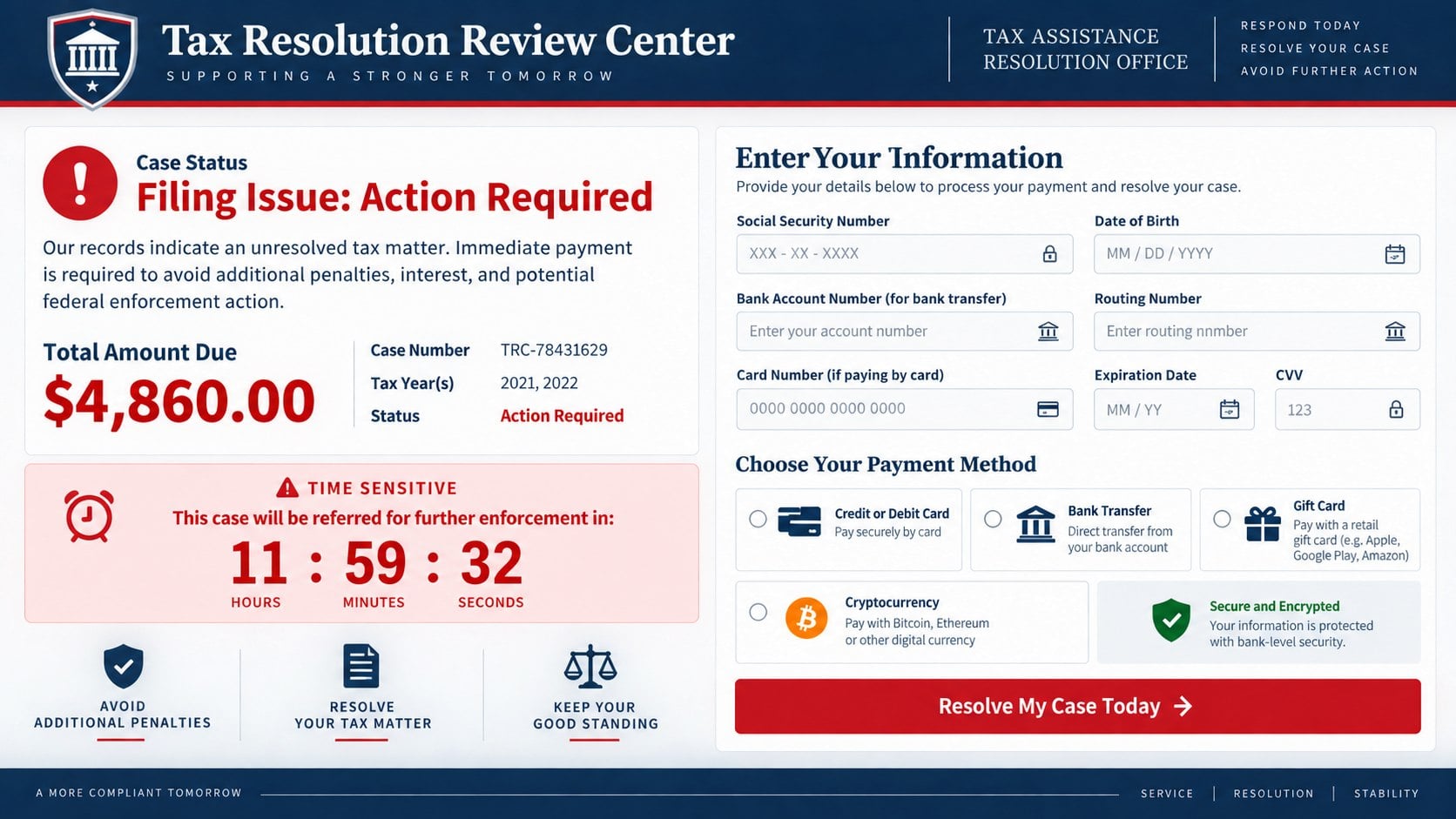
The victim may be charged an enrollment, investigation, retainer, compliance, or processing fee. A criminal impersonator may demand immediate payment toward the invented tax debt.
Gift cards, crypto, wire transfer, and payment apps are favored because they are difficult to reverse. A questionable tax-relief seller may instead take a card or bank debit for services that are vague or never delivered.
Step 6: Remote access or online forms expand the theft
A link may open a copied tax portal that requests identity and payment information. The agent can also ask the victim to install remote-access software so a “specialist” can review documents.
Remote control exposes tax returns, saved passwords, bank sessions, and files far beyond the original call.
Step 7: New fees or repeat impersonation follow
After a payment, the supposed case may develop another problem. The victim is asked for insurance, court, filing, or release money before the resolution can be completed.
Stolen information can also be passed to another caller who pretends to be the IRS, a bank investigator, or a recovery service.
Caller, Agency, Payment, and Tax Record Checks
The callback number should be checked independently
Do not use the number supplied by the voicemail to verify the voicemail. Search IRS.gov from a browser or use contact details from a genuine notice already in your records.
A reverse-phone search can reveal complaints, but an empty result does not make a new number safe. Scammers change numbers frequently.
The agency name should exist on an official government site
Names such as Tax Assistance Resolution Office or Tax Resolution Oversight Department sound governmental without identifying a recognized agency. Ask for the exact department, mailing address, and notice number.
Then end the call and verify those details through IRS.gov. Do not let the caller transfer you to another supposed authority.
The payment method exposes many impersonators
The IRS does not demand immediate payment by gift card, crypto, or wire and does not threaten arrest to force payment. A taxpayer has rights to review and appeal a claimed balance.
Even a card payment should be made only through an official IRS payment method or a tax professional the taxpayer independently selected and verified.
The real tax account is the final check
Sign in to the IRS Online Account by typing IRS.gov yourself. Review balances, notices, payment history, and tax records without using a link from the caller.
The IRS says its first contact generally comes by mail. It does not call to demand payment now, threaten arrest, or unexpectedly announce a refund.
Tax Impersonation and Tax Relief Are Related but Different
A direct impersonator claims to be the IRS, Treasury, or a government office and demands payment or identity information. The claim is fabricated, and the money goes to the criminal.
A deceptive tax-relief seller may present itself as a private company. It can use aggressive calls, misleading savings estimates, illegal upfront fees, and vague promises even when the company does not explicitly claim to be the IRS.
Some calls blur the line. The agent uses a government-like office name at first, then says a private specialist can enroll the taxpayer in a program. That transition should not be accepted without independent research and a written agreement.
Tax debt does not disappear because a caller knows a filing year or partial Social Security number. Those details can come from data theft and do not prove access to an IRS account.
How to Verify a Tax Problem Safely
Start at IRS.gov, not with the voicemail. Sign in to the official account or call the published taxpayer line. A genuine balance, notice, or filing issue can be checked without disclosing information to the incoming caller.
If a letter exists, search its CP or LTR number on the official site. Compare the tax year, amount, and response instructions with the account.
People who need help can look for an enrolled agent, certified public accountant, attorney, or Low Income Taxpayer Clinic. Verify licenses and disciplinary history through the relevant state or professional authority.
Ask any private tax-relief firm for its legal name, physical address, fee schedule, refund policy, the professional assigned to the case, and a written explanation of what work begins before payment.
What to Do if You Have Fallen Victim to This Scam
- Break contact before another charge is made. Hang up, block the number, and refuse any new filing, release, insurance, or verification fee. There is no benefit in calling the supposed agent back to argue.
- Contact the bank or card issuer. Report the transaction as soon as possible, ask about stopping or disputing it, and replace exposed cards or account numbers.
- Report gift cards immediately. Contact the card issuer using the official number on the card or website. Keep the card, receipt, and packaging. Never send another image of the code.
- Secure your IRS account. Go directly to IRS.gov, review activity, and create an Online Account if appropriate. Consider obtaining an IRS Identity Protection PIN when personal data was exposed.
- Protect your identity. Visit IdentityTheft.gov for a recovery plan. Place fraud alerts or credit freezes when a Social Security number and other identifying details were shared.
- Change affected passwords. Start with email, banking, tax software, and cloud storage. Sign out unknown sessions and turn on multifactor authentication.
- Remove remote-access software. Disconnect the device if a caller still has control. Uninstall the tool, review permissions, and change financial passwords from another trusted device.
- Run a full Malwarebytes scan. Scan for remote-control tools, credential stealers, and other malware installed during the supposed tax review.
- Block malicious links and ads. AdGuard can stop many known scam domains and deceptive redirects. It cannot identify every fraudulent caller, so keep verifying through IRS.gov.
- Report the call. Record the incoming and callback numbers, then report IRS-related impersonation to TIGTA at 800-366-4484 and fraud to the FTC at ReportFraud.ftc.gov.
- Send tax-related phishing evidence to the IRS. The IRS reporting guidance explains how to submit suspicious numbers, texts, emails, and sites to phishing@irs.gov.
- Reject recovery callers. Anyone promising to retrieve the payment for another upfront fee, remote session, or gift card is likely continuing the fraud.
Frequently Asked Questions
Is 888-461-3098 an official IRS number?
It is not listed as the IRS’s main taxpayer assistance number. Reports associate it with Tax Assistance Resolution Office messages. Verify tax matters only through contact information published on IRS.gov.
Does the IRS call taxpayers?
Calls can occur in limited circumstances, but the IRS generally begins with mail. It does not call to demand immediate payment, threaten arrest, or unexpectedly announce a refund.
What if the caller knows my Social Security number?
That knowledge can come from a data breach or previous fraud. End the call, protect your identity, and verify any tax issue directly with the IRS.
Can a tax resolution company really reduce tax debt?
Legitimate professionals can help taxpayers understand official options, but no company can guarantee a settlement before reviewing the facts. Verify credentials, fees, and the written scope of work.
Should I press a number to be removed from the call list?
Do not interact with a suspicious robocall. Pressing a key or calling back can confirm that the number reaches a responsive person. Hang up, block, and report it.
What if I called but shared no information?
End contact and block the number. Be alert for follow-up calls that use the fact that you responded. No financial recovery steps are needed unless information or payment was provided.
The Bottom Line
The 888-461-3098 tax scam uses a formal office name, a vague filing problem, and a short deadline to pull recipients into a controlled callback. The number and language may change, but the pressure pattern remains recognizable.
Do not resolve a tax issue through the contact that announced it. Check IRS.gov, review the official account or mailed notice, and choose any tax professional independently.
If money or personal information was shared, act quickly across banking, IRS records, identity protection, email, and the affected device. One fast report can prevent the first loss from becoming a longer campaign.








