

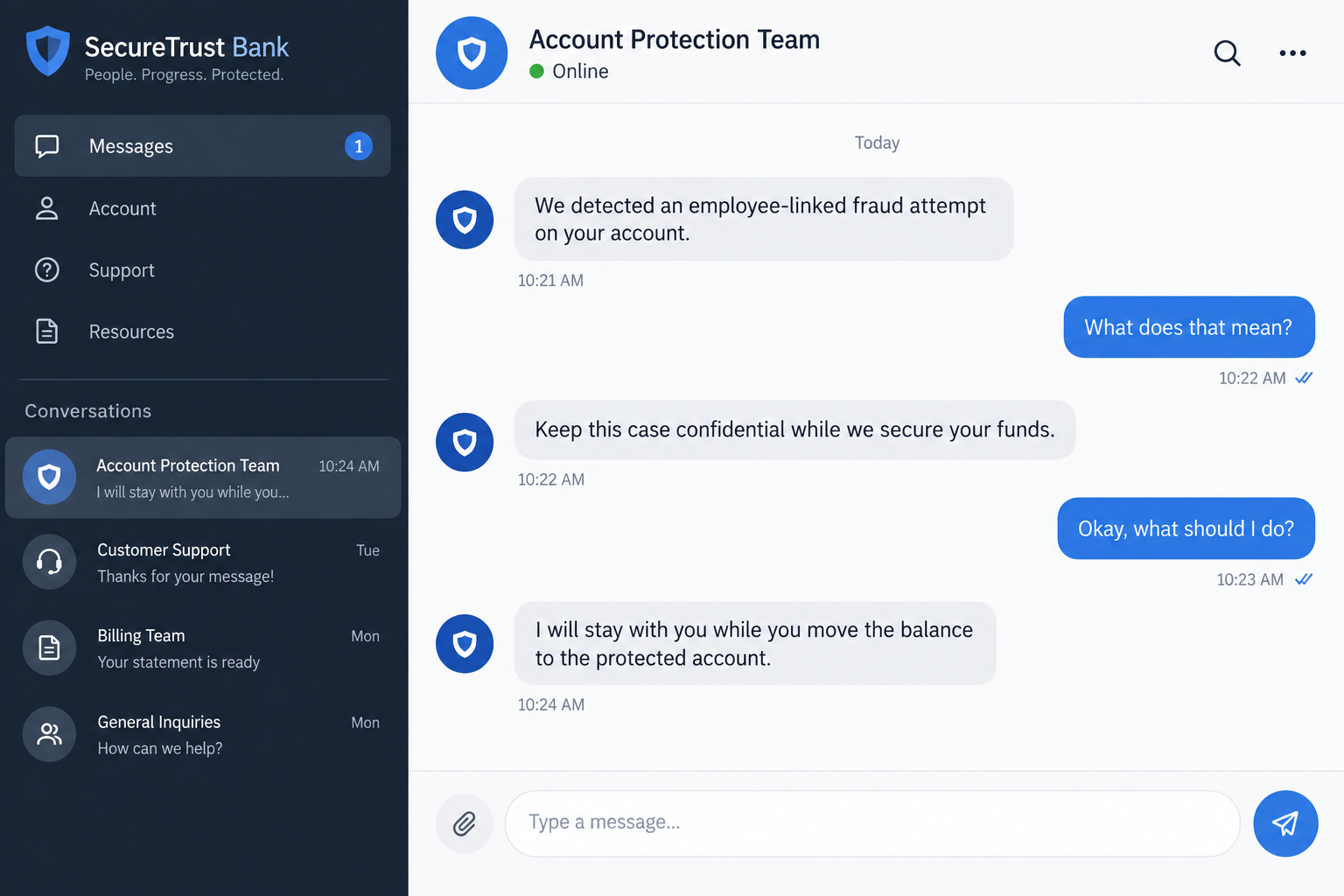
A caller knows something about your bank account and says an insider is stealing from you. They sound calm, introduce another official, and offer to stay on the line while you move the balance somewhere safe.
The move your money scam makes the victim perform the transaction while the impersonator directs every step. The most convincing detail may be the very thing that should make you hang up.
Overview
A supposed helper says your own bank cannot be trusted
On September 14, 2026, the Social Security Administration Office of the Inspector General published an alert titled “Don’t Let Anyone Help You Move Your Own Money.”
The alert describes scammers telling Social Security beneficiaries that a bank employee is committing fraud. The caller claims that transferring money out is the only way to protect it.
This is not ordinary investment advice or a disagreement about a bank’s service. It is a confirmed impersonation and payment scam in which the criminal invents an emergency, isolates the victim, and directs the movement of real funds.
The conversation may include a genuine bank call
SSA OIG warns that the scammer may keep a victim on the phone for hours and coach them through a three-way call with their real bank. The purpose can be to unlock an account or clear a transaction the bank would otherwise question.
That creates a dangerous mixture of real and fake. Hearing your bank’s actual representative on one part of the call does not authenticate the person who arranged the conference or the destination account.
The criminal may already know details about you or your account. The alert says this information can appear to be something only a bank or Social Security employee would know. Knowledge is used as persuasion, not proof of authority.
Secrecy and continuous contact protect the scam
The caller may tell you that a bank employee is involved, so you cannot trust ordinary staff. They may demand secrecy and insist that you remain connected while visiting a branch, unlocking an account, or making a transfer.
SSA OIG says no legitimate government agency will help you transfer money to protect it, and no legitimate bank employee needs you to stay on a call for hours or keep it secret.
- An unsolicited caller claims there is insider fraud.
- The caller already knows personal or account details.
- You are transferred among supposed departments or agencies.
- You are told not to discuss the case with bank staff or family.
- You are coached to move money, load a barcode, or share access.
Why the Three-Way Call Does Not Prove the Story
A conference call can contain a legitimate participant without making every participant legitimate. The scammer may call the bank through a public support number while keeping you connected.
The bank employee may hear a customer asking to release funds and may not know that another person is supplying the answers or threatening the customer in the background.
The scammer can also prepare explanations for fraud warnings. They may tell you that bank staff will resist because the insider has flagged your account or because the transfer must remain confidential during an investigation.
This turns normal safeguards into apparent confirmation of the conspiracy. A declined transfer, a security question, or an employee’s concern is presented as evidence that the criminal’s story is true.
Break that loop. End the call and contact the bank from a different line or after restarting the device. Tell the bank explicitly that someone may have been coaching you.
A genuine fraud department can place holds, replace cards, block online access, and investigate suspicious activity inside the bank’s own systems. It does not need you to transfer your balance to a stranger’s account so the money can be protected.
If the caller says ending the call will cancel the investigation or expose your funds, end it anyway. A legitimate case can be recovered through an independently verified number. A scam depends on preventing that independent contact.
What “Protecting” the Money Can Really Mean
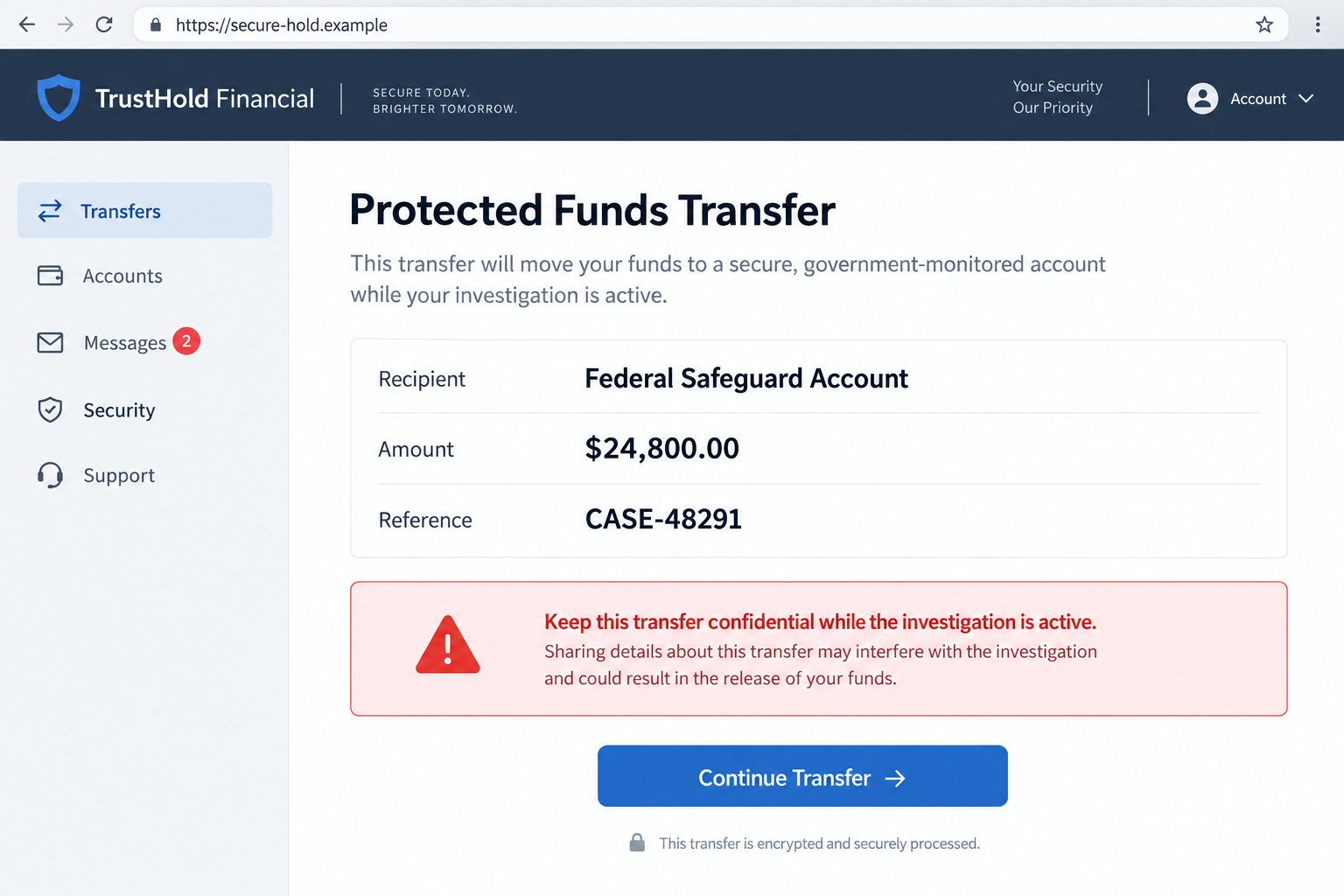
A destination described as a safe account, federal wallet, protected holding account, or secure replacement account is not yours merely because the caller says it is.
The SSA alert warns against moving money, loading a barcode, or sharing account access on an unsolicited caller’s instructions. Different versions can use different methods, so do not wait for one exact phrase.
A transfer can be routed to an account controlled by a criminal or money mule. A barcode may facilitate a cash or cryptocurrency purchase. Shared access may let someone initiate transactions directly.
The illustration below shows a fictional secure-transfer instruction. Its bank name, amount, reference, and domain are invented; it is not a victim receipt or a genuine protective banking feature.
How the Move Your Money Scam Works
Step 1: The caller invents a serious account breach
The opening story may involve identity theft, a dishonest bank employee, a compromised Social Security number, or criminal activity linked to your account. The caller presents the situation as already investigated.
Real details can be mixed with false conclusions. A correct balance, address, or bank name does not prove that the caller works for that institution.
Do not confirm additional details. End the call and compare the claim with activity visible through your own banking app or independently contacted bank.
Step 2: Authority is built through transfers and titles
The first speaker may introduce a bank investigator, government agent, supervisor, or law enforcement officer. Each role appears to confirm the previous one.
A caller can change voices, pass the phone, or conference another criminal. They can also spoof official numbers or quote names found on public websites.
The number of apparent departments does not make the investigation real. Every participant must be verified outside the call.
Step 3: The victim is kept connected and isolated
The long call leaves little room to think. The scammer may discourage breaks, tell you not to contact family, and ask you to narrate what appears on the screen.
Secrecy is framed as protecting an investigation or catching the corrupt employee. In reality, it prevents a trusted person or alert bank employee from interrupting the transfer.
Hang up even if the caller knows you are at the bank. A legitimate investigation will not collapse because you independently verify it.
Step 4: The real bank is used to overcome its own safeguards
During a branch visit or three-way call, the criminal may coach you to describe the transfer as a personal decision. They may provide an answer for questions about the recipient or purpose.
Tell the bank the truth: an unsolicited caller directed you to move funds and told you to keep the reason secret. That context can change how the bank assesses the request.
Do not be embarrassed about changing course. Stopping a transaction after reaching the bank is a success, not a failure to follow through.
Step 5: The funds leave under the victim’s authorization
The victim may press the transfer button, withdraw cash, scan a barcode, or give access while believing the money is being protected. The visible authorization can make recovery more complicated.
That does not mean the deception was your fault or that reporting is pointless. Tell the provider exactly how the transaction was induced and ask for immediate escalation.
Do not make a second transfer to reverse the first. A supposed recovery department that contacts you without being asked may be the same operation.
Company and Caller Checks Before Moving Any Money
The real agency is being impersonated
SSA and its Office of the Inspector General are legitimate government bodies. Their alert warns that scammers claim to be government or bank employees.
Do not accuse a real employee based only on the caller’s story. Verify the claim with the bank’s fraud team after disconnecting.
A displayed phone number is not a verified identity
Caller identification can be spoofed. A government or bank number on the screen does not prove the call originated there or that the person speaking has authority.
Use the number on your physical card, bank statement, or official website. Place a new call yourself rather than accepting a transfer from the suspect caller.
Support will not require secrecy from your bank
A legitimate fraud team may ask security questions and discuss account protection. It will not need you to lie about the recipient, hide the purpose from branch staff, or stay on an hours-long secret call.
Ask the independently reached bank to review recent account access, payees, transfer attempts, and contact notes.
The receiving account must be independently traceable
An account number and case reference supplied by the caller trace back only to the caller’s instructions. They do not prove the recipient belongs to a government protection program.
Your bank can explain its real procedures for compromised accounts. Protecting money normally means restricting access, replacing credentials, or opening a verified account through the bank, not sending funds to a stranger’s destination.
Warning Signs During a Bank Visit
If someone is listening through an earbud, telling you what to say, or insisting you keep the phone hidden, tell a bank employee privately that you may be under scammer control.
A criminal may anticipate that staff will ask questions and give you a cover story. The need for a cover story is itself a warning.
Do not leave the branch to complete a cryptocurrency purchase or cash handoff because the transfer was blocked. A failed transaction is not a reason to use a less protected route.
Ask for time. A legitimate security issue can be documented and handled after a second opinion. The scammer’s need for immediate movement is not your deadline.
What to Do if You Have Fallen Victim to This Scam
-
End the call and contact the bank independently. Use the number on your card or statement. State clearly that an impersonator coached you to move money, possibly during a conference call.
Ask the bank to stop pending transfers, restrict compromised access, and alert the receiving institution. Do not minimize the role of the caller because you pressed the final button.
-
Disconnect any shared access. If you installed remote-control software or shared a screen, disconnect the device from the internet. Remove unauthorized access only after preserving the information your bank or investigator needs.
From a separate trusted device, change banking, email, and other exposed passwords. Review new payees, recovery settings, and active sessions.
-
Document the complete chain. Save phone numbers, call times, names used, transfer instructions, recipient details, barcodes, receipts, emails, and chat messages. Write down what happened while it is fresh.
Do not contact the recipient or money mule yourself. Give those details to the financial institution and law enforcement.
-
Report the government impersonation. Use the reporting route at ssa.gov/scam for a Social Security-related approach and report the financial fraud to the appropriate police or national fraud service.
If another agency was impersonated, contact that agency through its official website. A report helps establish the pattern even when recovery is uncertain.
-
Warn a trusted person and expect follow-up scams. Secrecy is part of the control. Tell someone who can help monitor calls, messages, and account activity.
Reject anyone who promises guaranteed recovery for an advance fee. Information from the first incident may be used to make the recovery pitch sound official.
-
Check devices when the caller gained technical access. Malwarebytes can scan supported personal devices for malicious remote tools or other malware. AdGuard can block some known scam pages and malicious advertising.
Security software does not recall a transfer. Keep working with the bank and investigators, and consider a professional device review when remote access or sensitive business information was exposed.
Frequently Asked Questions
Has SSA confirmed the move your money scam?
Yes. SSA OIG warned on September 14, 2026 that scammers tell beneficiaries a bank employee is committing fraud and coach them to transfer money to protect it.
Can a real agency transfer my call directly to SSA or OIG?
SSA warns that legitimate companies and other agencies cannot transfer a call directly to SSA or OIG. End the call and contact the agency independently.
What if the caller knows my balance or bank details?
That knowledge can make the story convincing, but it does not prove employment or authority. Treat the information as a possible exposure and contact the bank through a trusted route.
Does a three-way call with my real bank make it safe?
No. The official alert specifically describes scammers coaching victims through three-way calls with their real banks. Tell the bank about the coaching after disconnecting.
Is there a government protected account for my money?
Do not send funds to an account introduced by an unsolicited caller. SSA says government agencies will never help you transfer or move money to protect it.
What should I do if the transfer is still pending?
Call the bank immediately, disclose the scam, and ask it to stop or recall the transfer. Preserve the recipient details and follow the bank’s fraud-reporting instructions.
The Bottom Line
The move your money scam uses insider-fraud stories, real account details, and even genuine bank calls to make the victim feel protected while funds are being stolen.
No legitimate bank or government agent needs hours of secrecy to safeguard your balance. Hang up, call your bank yourself, and never send money to a protection account chosen by an unsolicited caller.








