

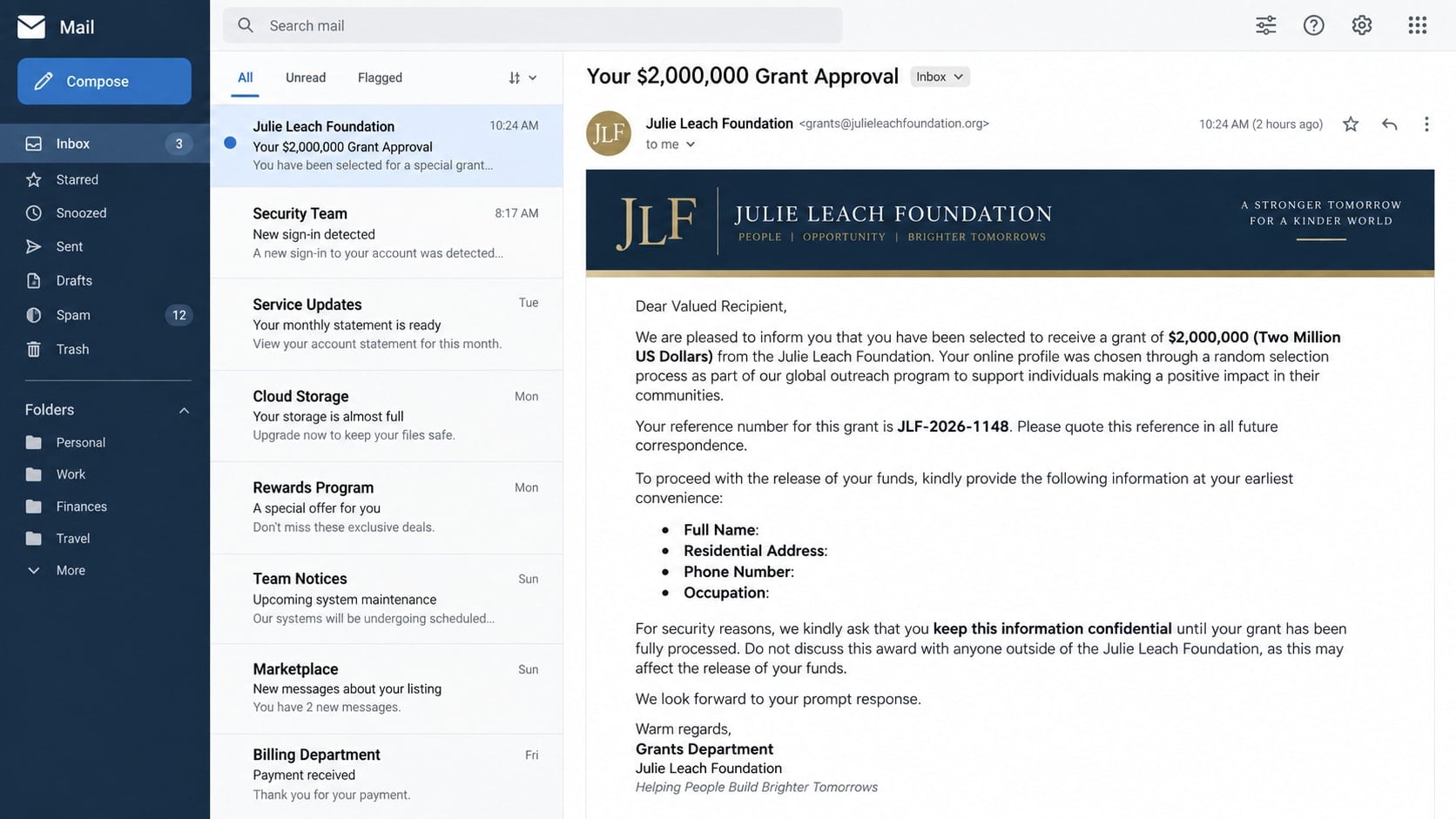
The email does not begin with a sale or a threat. It begins with generosity. A foundation has supposedly noticed you, approved a grant worth millions, and needs only a few details before the money can be released.
That gentle opening is what makes the Julie Leach grant scam dangerous. Behind the charitable language is a familiar advance-fee operation that uses a real lottery story, an invented foundation, and a growing list of charges to separate victims from their money.
Overview
Scammers misuse a real lottery winner’s name
Julie Leach won a large Powerball jackpot in Michigan in 2015. Criminals have used that public event as the foundation for emails, texts, and social media messages claiming that she or a private foundation is distributing money to strangers.
The real lottery win does not make the private message genuine. The scammers are not connected to Julie Leach, and the “Julie Leach Foundation” presented in these messages is part of the fraud story.
The grant is awarded before the recipient applies
A fake message may claim that LinkedIn, Microsoft, Google, or a random online selection produced the recipient’s profile. It can promise $500,000, $2,000,000, or another enormous amount without an application, eligibility review, or previous relationship.
Legitimate grants do not begin with a surprise approval sent to a random personal inbox. They have published programs, requirements, deadlines, and accountable administrators.
Personal data and advance fees are the real prize
The sender first asks the recipient to confirm a reference number and provide contact information. Later, a supposed bank, attorney, or transfer officer claims that the grant is on hold until a fee is paid.
Victims can lose far more than the first charge:
- Gift cards, wire transfers, crypto, or payment-app transfers are taken as “fees.”
- Passports, licenses, and Social Security numbers are collected for identity theft.
- Bank details are harvested through fake beneficiary and transfer forms.
- Counterfeit checks are used to make victims send real money elsewhere.
- Email accounts can be stolen through fake document-sharing pages.
- People who pay are targeted with more charges and recovery scams.
How a Real Lottery Story Becomes Fake Proof
The campaign works because one part of it is true: a person with that name did win a major lottery prize. The scammer may link to a genuine interview, news article, or public photograph and invite the recipient to “verify” the donor.
That research confirms only a historical event. It does not authenticate the email address, foundation, assistant, or grant. A criminal can link to the same public article just as easily as anyone else.
The messages often imitate foundation language. They talk about lifting communities, supporting the less privileged, and helping recipients build a better future. A logo, motto, and electronic signature can make the message feel like a structured philanthropic program.
What is missing matters more. There is no application that you completed, no independent program announcement, no verified administrator, and no reason this particular inbox qualified. The sender controls every piece of evidence presented inside the conversation.
Secrecy completes the illusion. Victims may be told that sharing the award will trigger duplicate claims and cancel the grant. That warning has no legitimate purpose. It keeps the recipient from asking someone else to examine the offer.
How the Julie Leach Grant Scam Works
Step 1: The recipient receives an approval, not an invitation
The first message often says the grant has already been awarded. A reference number and a precise amount create the impression that an evaluation happened before contact.
Some versions mention a random selection of online profiles. Others say the recipient’s email was chosen as part of a worldwide charity project. Neither explanation describes a credible grant process.
Step 2: The “foundation” collects beneficiary information
The recipient is asked for a full name, residential address, phone number, age, occupation, marital status, nationality, and sometimes a scan of an identity document. The request is framed as basic verification.
In reality, the information allows the scammer to produce personalized forms and exposes the victim to identity fraud. A stranger does not need a passport or Social Security number to send a gift.
The criminal may also ask which bank the recipient uses. That can guide later phishing, while questions about income or occupation help estimate how much money the victim might be able to send.
Step 3: A banker or transfer officer takes over
Once details are supplied, the donor introduces a second contact. This person may claim to represent an international bank, a legal department, a courier, or a grant disbursement office.
Multiple roles make the scheme look independently supervised. In practice, the same person may control every mailbox. Free email accounts, mismatched domains, and similar writing styles often reveal the connection.
Step 4: A polished dashboard shows the money on hold
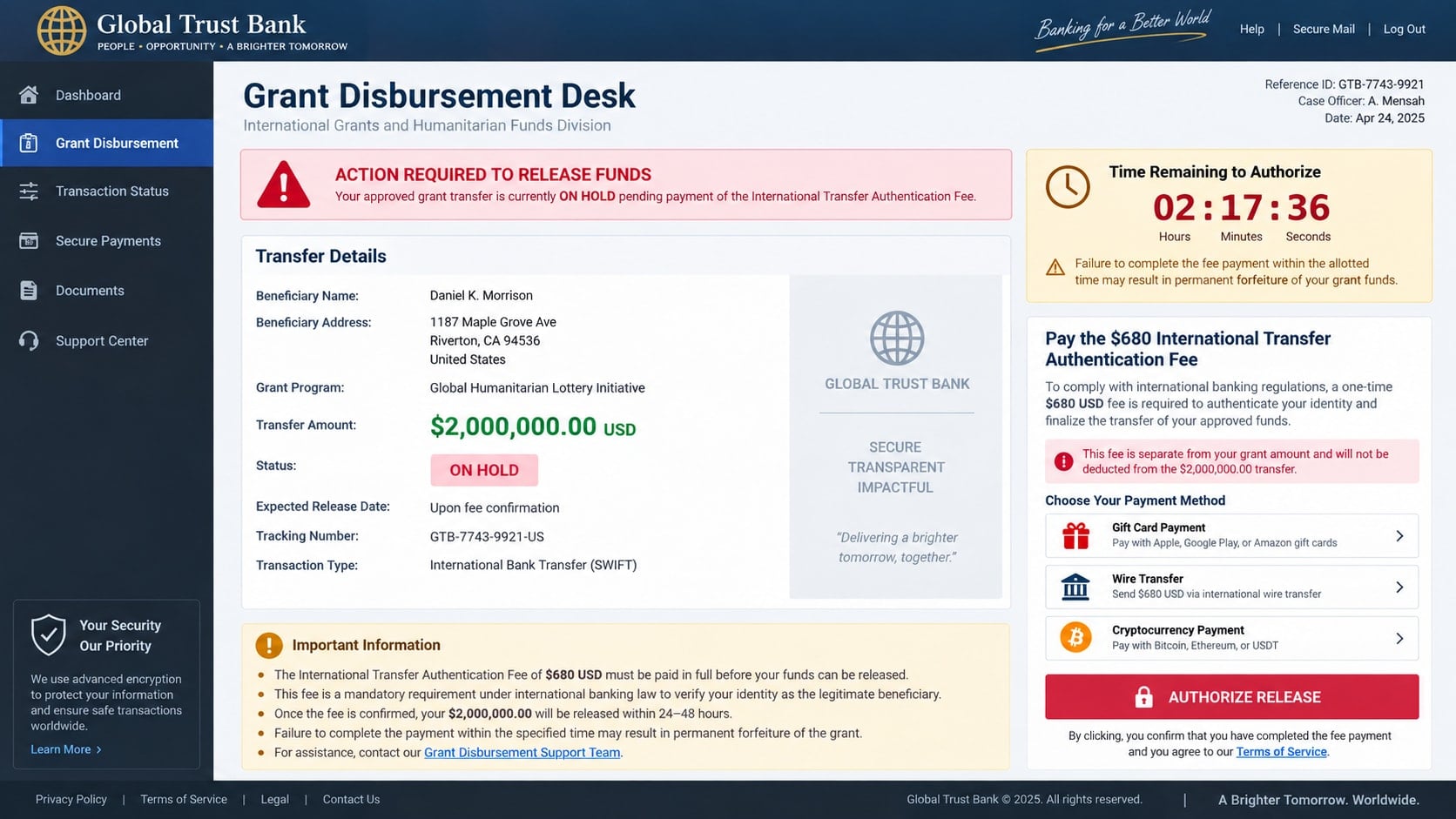
The victim may receive a login for a fabricated banking site. It displays the promised grant beside the victim’s name, with a status such as “approved,” “on hold,” or “awaiting authentication.”
The page exists to make fictional money feel tangible. Balances, progress bars, encryption badges, and transfer references are easy to create. A website can display any number its operator chooses.
Step 5: The first fee is presented as mandatory
The supposed bank claims that the money cannot be deducted from the grant. The recipient must separately pay an international transfer fee, tax clearance, account activation charge, courier insurance, or anti-money-laundering certificate.
The amount is intentionally small compared with the promised millions. A $680 fee can feel acceptable when it is framed as the only barrier to $2,000,000. That comparison is the psychological engine of the fraud.
Step 6: New charges continue until the victim stops
After payment, another authority suddenly needs money. A tax office, customs official, attorney, or courier may demand an additional certificate or penalty.
There is no completed transfer waiting in the background. The process ends only when the victim refuses or runs out of funds. The scammers may then switch to threats or return later as recovery specialists.
Identity, Contact, and Payment Checks
Search for the program outside the message
Do not use links in the email to research the offer. Search the exact program name, amount, reference wording, and sender address independently. A real grant of this scale would have a visible application and public administration process.
Look for reliable coverage that connects the named donor to this exact initiative, not simply to a lottery win. If the only evidence comes from the people offering the money, nothing has been independently verified.
Compare the sender and reply-to addresses
Open the full message details. The visible sender may show a foundation name while replies are routed to a free mailbox or unrelated domain. The message can also be sent from one account and direct claims to another.
A domain that contains a person’s name is not automatically official. Anyone can register a plausible address. Its ownership and connection to the claimed organization must be independently established.
Refuse unnecessary identity requests
Do not provide a passport, license, Social Security number, bank statement, or selfie to an unsolicited donor. Those items can enable account fraud long after the grant story disappears.
Even ordinary details have value. A name, address, age, occupation, and phone number can support password recovery attacks, targeted phishing, fake account applications, and convincing messages to relatives.
Stop when money is required to receive money
The FTC explains that real prizes are free. The same practical rule applies to unsolicited donations. A demand for taxes, shipping, handling, processing, customs, insurance, or authentication is not a normal step toward a windfall.
No legitimate bank needs Apple, Google Play, or Amazon gift cards to release a transfer. Crypto payments and wires to individuals are equally incompatible with a genuine charitable grant.
Warning Signs in the Julie Leach Foundation Email
Some messages are poorly written; others are polished. Focus on the structure rather than the grammar:
- The grant arrives without an application or any prior contact.
- A random internet profile or email selection supposedly determines eligibility.
- The amount is extraordinarily large and no conditions are publicly documented.
- A real lottery article is offered as proof of the sender’s identity.
- The recipient must reply to a free or unrelated email account.
- The message requests personal data that a real administrator would not need at this stage.
- Confidentiality is used to discourage outside advice.
- A bank or courier introduced by the sender controls all verification.
- A fee is described as impossible to deduct from the grant.
- Payment must be fast, irreversible, or sent to a person rather than an institution.
A scammer may remove one obvious warning sign after victims question it. For example, the first email can promise “no fee.” That statement has little value when the same sender later invents a separate bank or courier charge.
A legitimate program should survive a basic pause. You should be able to find public eligibility rules, application dates, administrators, and contact information without using anything supplied in the award email. If every path back to the grant begins inside the same message, the sender has built a closed loop that only appears independent.
Also watch how the story changes when you ask for proof. A scammer may avoid direct answers, resend the same certificate, or introduce a new “officer” instead. Repetition is not verification. Real evidence can be checked outside the conversation and does not disappear because you refuse to pay immediately.
What to Do if You Have Fallen Victim to This Scam
- Stop replying and preserve the complete record. Save emails with headers, chats, phone numbers, documents, websites, payment instructions, receipts, and wallet addresses. Do not delete the evidence until reports and disputes are filed.
- Call the financial provider now. Contact the fraud department for your bank, card issuer, wire service, gift card company, payment app, or crypto exchange. Ask whether the transaction can be stopped, recalled, disputed, or flagged before the recipient moves the funds.
- Secure your email account. Change the password if you entered it on any linked page, turn on multi-factor authentication, sign out unknown sessions, and review forwarding rules, recovery details, app passwords, and connected applications.
- Act on exposed identity documents. Use IdentityTheft.gov to build a recovery plan if you sent a Social Security number, license, passport, or banking document. Consider freezing credit and contacting the document issuer.
- Check the devices you used. If you opened an attachment, installed a program, or granted remote access, run a full scan with reputable software such as Malwarebytes. Remove unknown remote-control tools and browser extensions.
- Block known phishing and advertising routes. AdGuard can help stop access to many malicious domains and deceptive ads used in follow-up campaigns. It cannot verify a donor, so continue checking unexpected offers independently.
- Report the impersonation and payment account. File a report at ReportFraud.ftc.gov, report the sending account to the email or social platform, and give the receiving account details to the payment provider.
- Prepare for recovery scammers. Victims are often contacted by people claiming to be investigators, hackers, lawyers, or fund-recovery agents. Do not pay anyone who promises a guaranteed refund or asks for an upfront tracing fee.
Frequently Asked Questions
Is the Julie Leach Foundation grant real?
Unsolicited messages claiming random people were approved for large grants under this name are scams. The genuine lottery winner is being impersonated. Do not confuse a real historical jackpot with a real foundation or grant offer.
Why does the scam use LinkedIn or Microsoft in the selection story?
Well-known platform names make mass spam sound like an organized draw. Those companies do not secretly nominate users for private lottery-winner grants. Contact the platform through its official support channel if a message claims otherwise.
Can taxes be required before I receive a donation?
Scammers frequently use tax language because it sounds unavoidable. Do not pay taxes through gift cards, crypto, wires to individuals, or a bank chosen by an unknown sender. Consult a qualified local tax professional about any genuine gift.
What if the online bank page shows the grant in my name?
The scammer can place any name and balance on a page they control. A displayed balance is not a bank deposit. Verify the institution through regulators and contact it through independently sourced information before trusting any portal.
Is it safe to send my ID if I have not paid anything?
No. Identity theft can be as damaging as the fee scam. A passport or license can support account creation, impersonation, and fraud aimed at other people. Do not send documents to an unsolicited grant contact.
Can I keep money from a check while the bank verifies it?
Do not spend or forward any part of an unexpected check. Funds can appear available before the check is identified as counterfeit. When it is reversed, the account holder is responsible for money already withdrawn or sent onward.
The Bottom Line
The Julie Leach grant scam borrows a true lottery story to support a completely false donation. The impressive amount, foundation letter, and bank screen all exist to make a later fee feel small and necessary.
A genuine grant is not secretly awarded to a random inbox and unlocked with gift cards or cryptocurrency. Keep your money and identity documents, verify claims outside the conversation, and report the accounts carrying the impersonation.








